Lese-Ansicht

Playing with Cellulose Fiber

Uh oh, did I list these in increasing order of goodness? YES. YES I DID. FOR I AM THE DECIDER OF GAMES, AND ALL SHALL KNOW MY LOGIC.

Paper! Despite the meddling of the internet, it’s still everywhere. There’s a good chance you have some in your very own home. In fact, it’s probably within arm’s reach right now. Coming for you. Fluttering closer. Ready to give you a stingy cut on the fingertip.

But for all its sins, paper is good for a few things. Making board games happens to be one of them. And today, I’m going to talk about three paper games I’ve been playing this week.
they're called colts, but that's super weird

A crane chick.

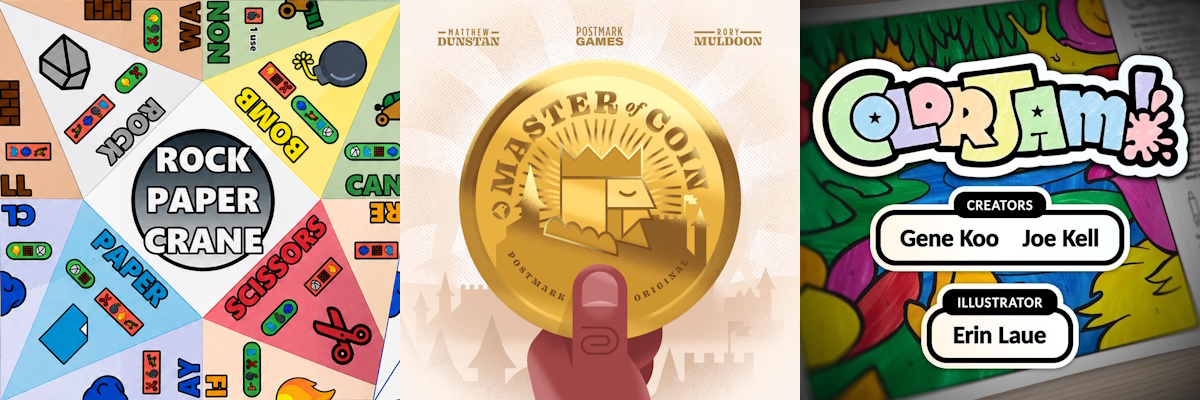
Rock Paper Crane

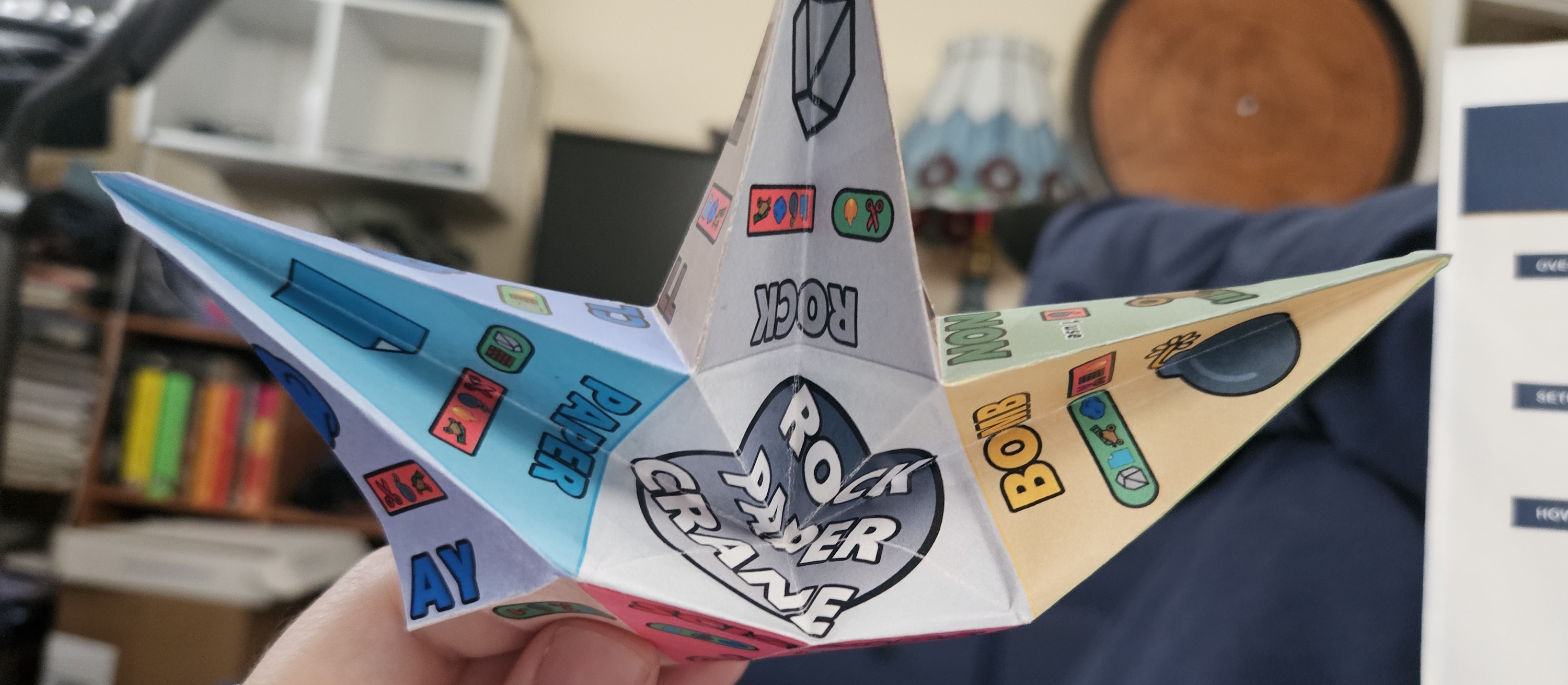
Rock Paper Crane bills itself as the world’s first-ever origami card game. True to its word, its construction requires you to craft the first couple of steps for making an origami crane.

Okay, so that’s the first problem. I dabbled in origami once. But I also happened to be six years old. Also, my little sister ruined my collection of nice origami papers, so I decided to spite her by never going back to the hobby or informing her or really imposing even the slightest imposition on her in any way. Which is to say, I finally fumbled together those first few steps. But the magic is in the fingers, not the voice, so as I labored to instruct my wife in how to shape her crane, I may have uttered the phrase, “You need to tuck in that piece, you’ve got it all popped out and flabby,” to which she replied, with a rather elevated voice, “You’re all popped out and flabby!”

So. Um. Be careful who you play Rock Paper Crane with.
I don't remember the next step. Nor will I ever.

Crane, interrupted.

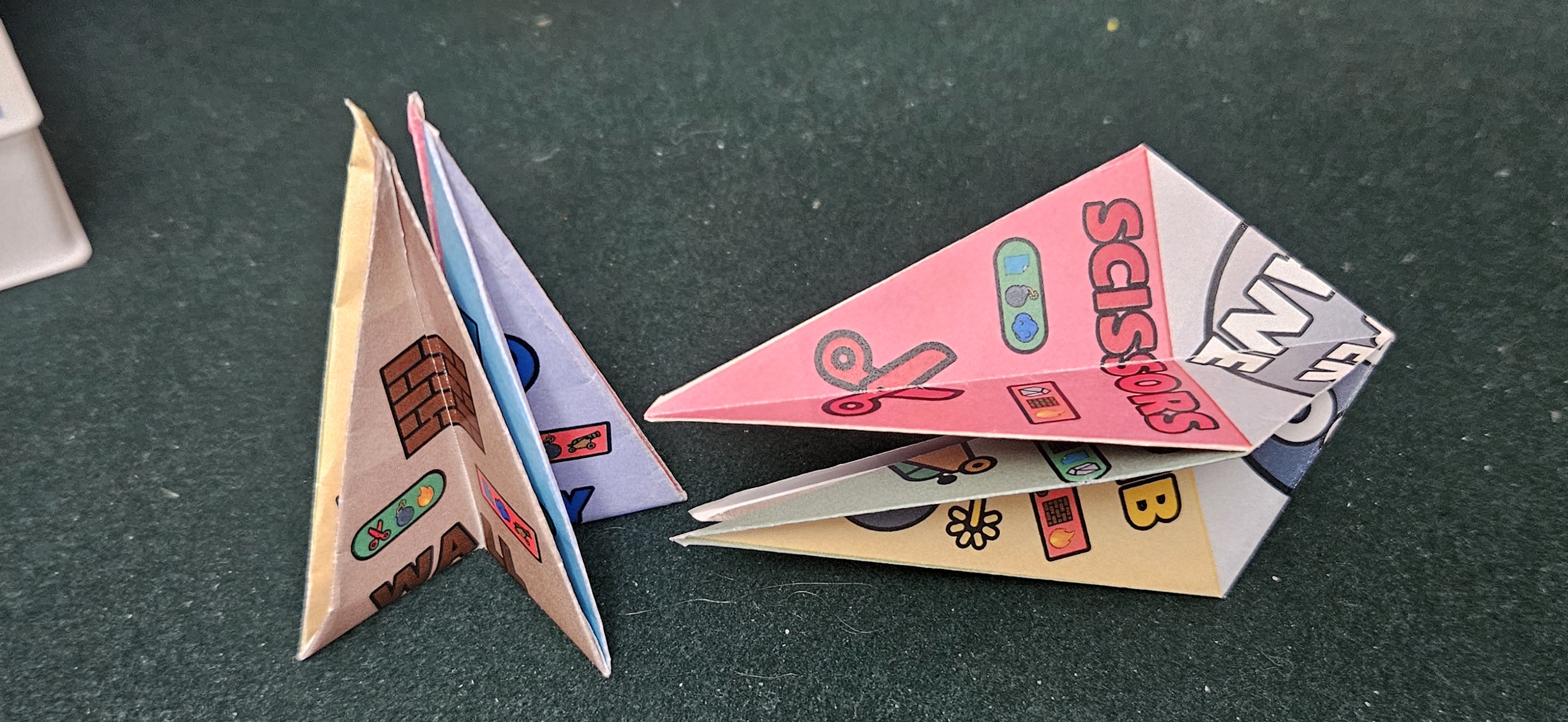
Once assembled, Rock Paper Crane is Rock Paper Scissors with extra steps. For one thing, there’s an extra piece, the bomb. For another, winning a throw means you upgrade one of your sides. (Pause for origami.) Rock becomes wall. Paper becomes clay. Scissors become fire. That sort of thing.

Your objective, ultimately, is to win four throws, which will bring you one step closer to a finished crane. More importantly, you will have won the game. Or lost it, which is just as good, because, like I said, Rock Paper Crane is Rock Paper Scissors with extra steps.

Did I finish my crane? Nope. I couldn’t remember past those first two steps. Honestly, it’s pretty amazing that I got this far at all. Maybe I could have looked up the next instructions. But I swore an oath to never finish an origami ever again, and I’m true to my word. Take that, Mary.
Hm. Can I use this game to teach my children how to operate my kingdom long after I have departed this mortal realm?

Putting coins on paper.

Master of Coin

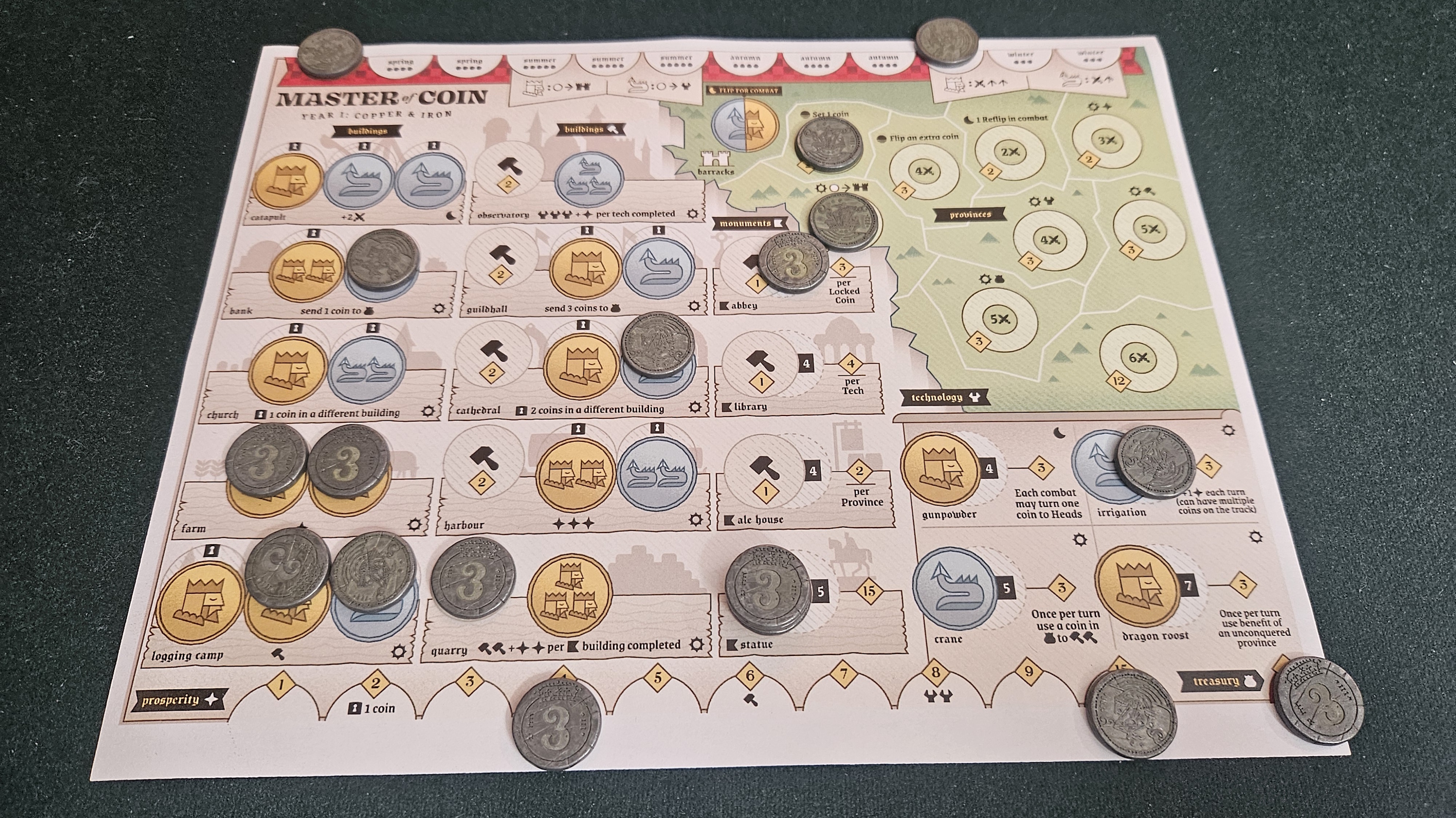
Master of Coin is the eighth title from Postmark Games that I’ve played, and this time Rory Muldoon and Matthew Dunstan are ditching the dice and the cards. Their replacement? Coins, of course. It’s right there the title.

As you might expect, Master of Coin makes good on its conceit by requiring you to flip so many coins that your fingers will start to smell rather pockety indeed. Covering a single year in the history of a small kingdom, you begin each month by picking up some number of coins — the exact quantity varies by season — and flipping them to determine how many heads and tails you have to work with.

Early on, your options are finite. A few basic buildings, some technologies, and any leftover orphans packed off to the army. But it isn’t long before the gameplay begins to accelerate. Once completed, you can clear a building of its coins to activate its ability, whether to unlock better structures, develop your nation’s economic infrastructure, obtain perks in war and peace, or maybe construct monuments that unlock better scoring benefits. Crucially, some abilities let you “lock” coins, sliding them a few millimeters upward on your sheet. From that point on, when you clear the corresponding structure, any locked coins stay in place.

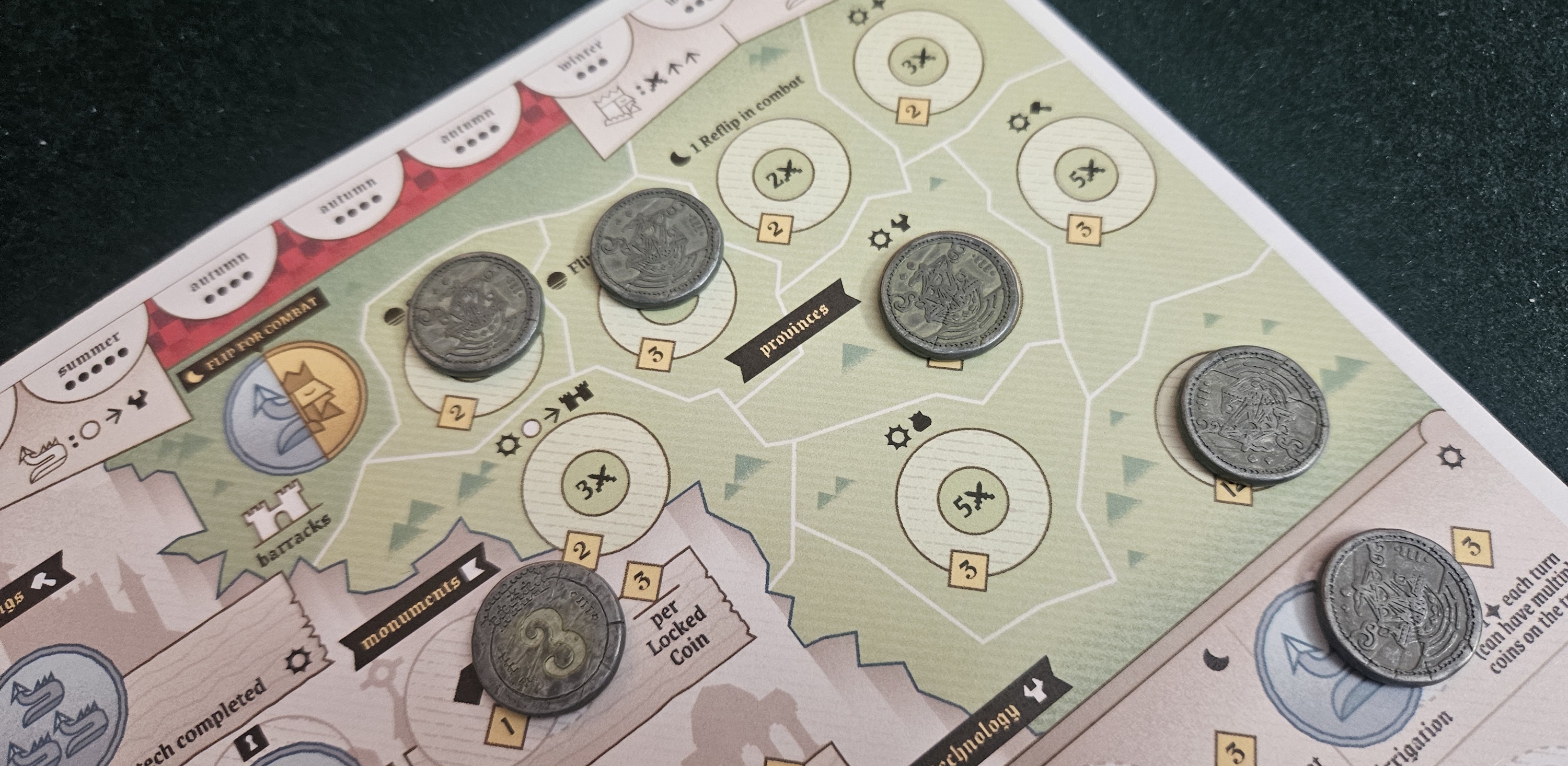
As a concept, Master of Coin is solid. Consider the army. When it’s time to march on neighboring provinces, you pick up all the coins in your army and give them a flip. Heads become indicators of conquest, while tails are failures. But there are so many ways to massage the odds. Certain buildings, like the catapult, can be cleared to produce guaranteed successes in battle. Or there are techs, like gunpowder, that let you shift a coin from tails to heads, saving you in the nick of time. All this is to say that there are ample ways to get ahead. Even if you, as happened to our group, happen to play a session with novelty coins that always flip heads.
aitg

Money is great for conquering distant nations.

Of course, there’s more to be seen. As with previous Postmark titles, Master of Coin isn’t limited to a single map. The game is on Kickstarter right now, and according to the campaign there will be five scenarios in all, each adding a year to the story of this wealthy kingdom and its unfortunate neighbors.

Unlike those previous Postmark titles, however, I’ve only tried the first scenario, so I’m unable to furnish a full review at this time. The good news is that what I’ve played has been exemplary. Very quickly, I was surprised that my kingdom’s main limitation didn’t lie with having too little money, but rather in keeping too many coins tied up in other projects. The kingdom only has access to twenty coins, you see, and two of those are reserved for tracking the month and any possible events. It isn’t long before you’ll need to make some tough decisions, forsaking certain appendages of your financial project altogether to double down on whatever has become most important.

Anyway. After not being all that enthralled with Postmark’s playing card games, Master of Coin feels like a return to form, capturing some of the tight but expressive playspace of titles like Voyages and Waypoints. I’m excited to see how this one develops.
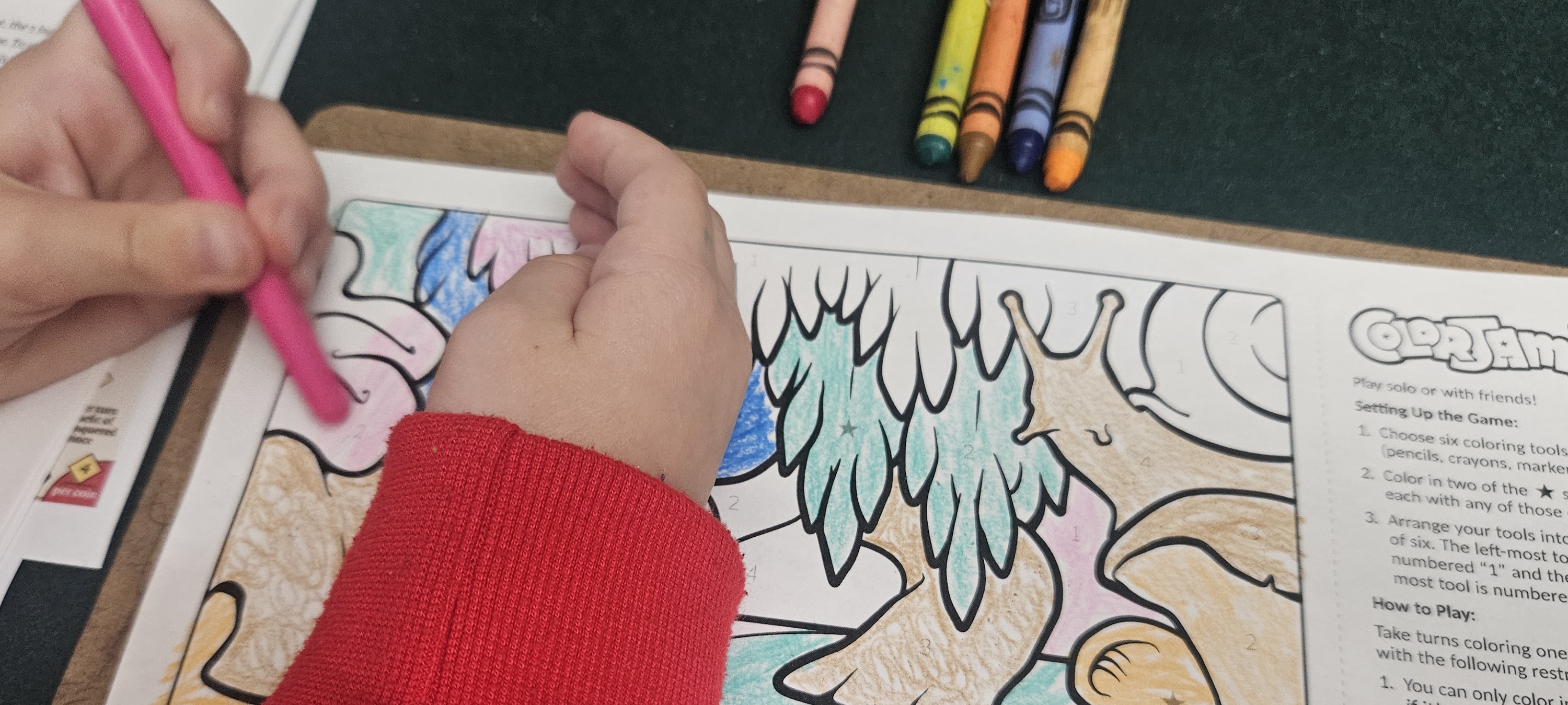
With rice. Maybe butter. Kidding! I don't like rice.

I love little fingers.

Color Jam

When’s the last time you colored by numbers? Being a parent to a recent kindergartner means it hasn’t been as long as it might have been otherwise, but this still isn’t a regular occurrence of my daily life.

Until Color Jam. Designed by Gene Koo and Joe Kell, and illustrated by Erin Laue, Color Jam is about coloring by numbers. And contrary to my expectations going in, it’s wonderful.

But first, a note. Color Jam is being published by Lunarpunk Games, the indie imprint operated by Xoe Allred and Matthew Hocker. If you’re elbows-deep in the indie scene, this might already tell you something about the game. Foremost, Color Jam doesn’t have the usual victory conditions. Nor does it really have goals, at least not goals of the foreordained variety. You’re here to make your own fun, set your own benchmarks, and, hopefully, come away charmed.
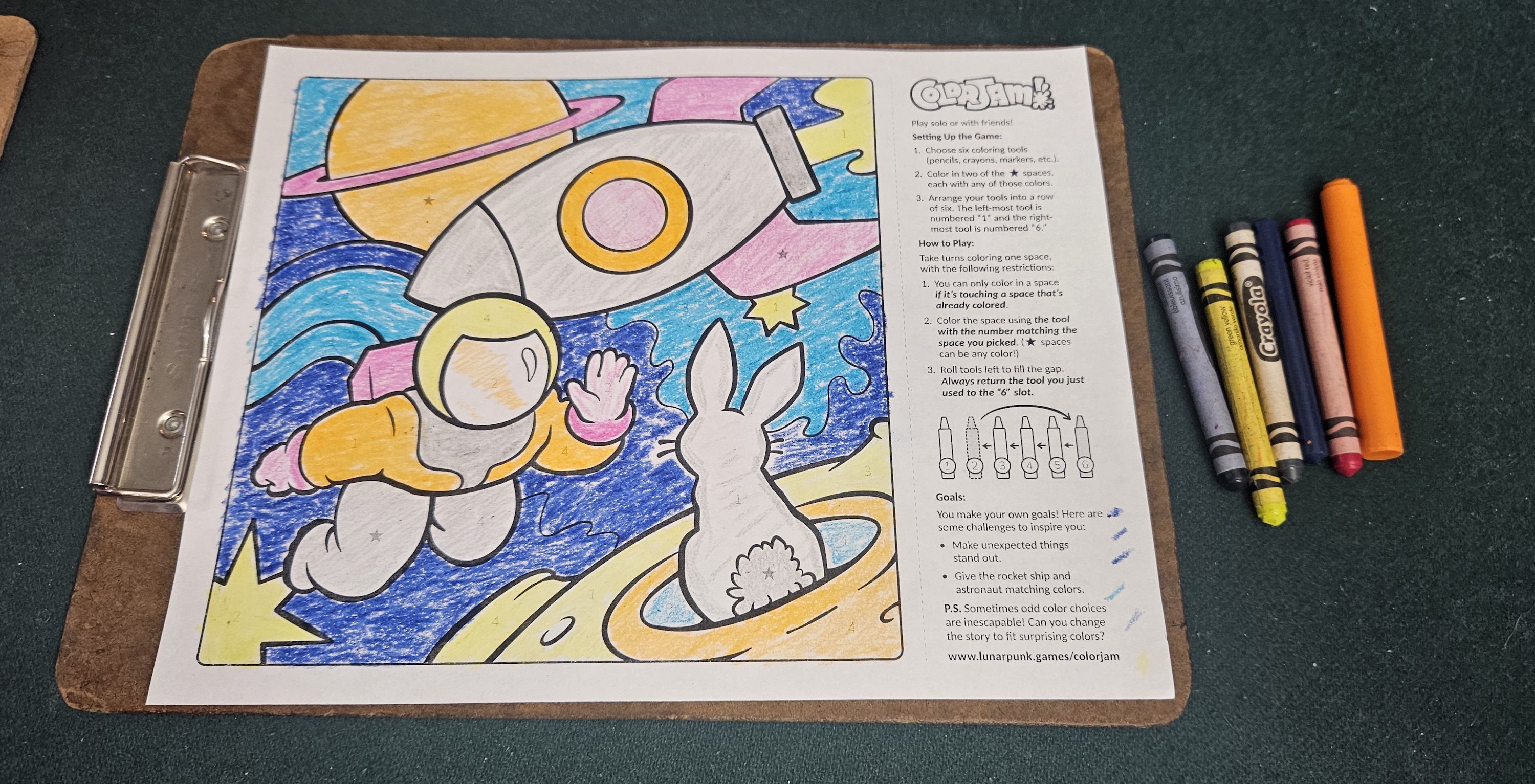
This is the future liberals want.

I am inordinately proud of my art.

The basic idea is as simple as it gets. You take a picture and six crayons. Then you color in two of the spaces with stars in them. There are always four options, giving you some range to where you begin on the page.

From that humble beginning, you start to color in the entire thing. But there are limitations. Beautiful, expansive limitations. For one thing, you can only color a cell next to something you’ve already filled in. More importantly, those six crayons? You put them in order, numbered one to six. When you color a space, you use the corresponding crayon. Then — and this is where the game starts to breathe — you take that crayon and shift it to the last place.

Now, this might not sound like much. But it transforms Color Jam from an elementary school project into something unexpected. You might want consistency. The wings of a butterfly to align, perhaps. But the right crayon might not be available. Or, when the right crayon comes up again, maybe you’ll want it for something else.

What do you do? Well, you get creative. Maybe this butterfly is prismatic, like a jeweled brooch, its colors vibrant but mismatched. The colors can become revelatory, streaks of the unexpected in what might have otherwise been an ordinary picture. Or maybe you start to plan ahead, counting the crayons down until the right one is ready for another scribble, transforming the page into a low-stakes logic puzzle. Or perhaps you get artistic. You can do a lot with shading, with the strokes of a crayon, with the application of a smudge or a smear. Two spaces that both use orange don’t need to look the same. This isn’t the paint bucket in an image editor. You can do whatever you like.
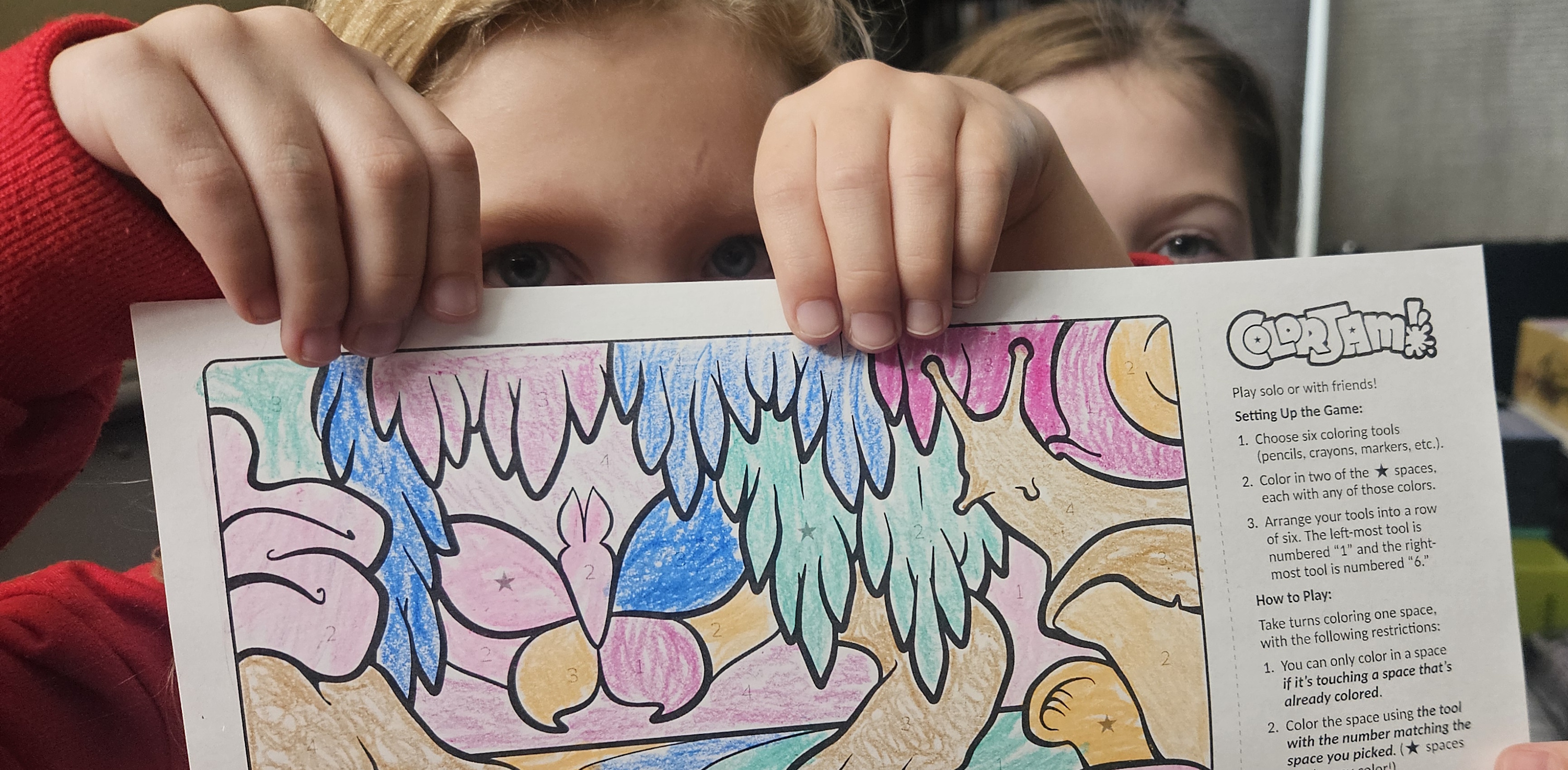
One day this picture will be worth no cents, because a robot will have ripped it off to make slop.

The artists.

More than that, Color Jam is flexible. It’s possible to play solitaire, one person making every decision. But it’s also possible to play as a group. I played with both of my daughters, and everybody got a say in the creation of our picture. Over which crayons we pulled from the bucket. Over the turn order. Eventually, over how to account for colors that wouldn’t quite fit where we wanted them.

The most unsurprising thing about Color Jam, but which bears repeating, is that it’s simply delightful. It’s soothing to play, but thinkier than one might expect from a distance. We played together, and then we all played apart. And then Summer came home and wanted to play as well, so we did that, too. In each case, we came away having crafted something wonderful, whether in collaboration or on our own, whether according to strict logic and long-term thinking or creative storytelling, and felt all the richer for it.

Color Jam will be on Kickstarter sometime in the next month or so.


Access to the files and/or complimentary copies of Rock Paper Crane, Master of Coin, and Paper Jam were provided by the designers.

(If what I’m doing at Space-Biff! is valuable to you in some way, please consider dropping by my Patreon campaign or Ko-fi. Right now, supporters can read the next installment in my series Talking About Games, this time tackling the topic of what makes a good list! Naturally, the piece includes a list.)

  •  

Yawpz

I'm the little kaiser-kisser on the right, sipping tea with my peers across the lines, oblivious to the carnage around me.

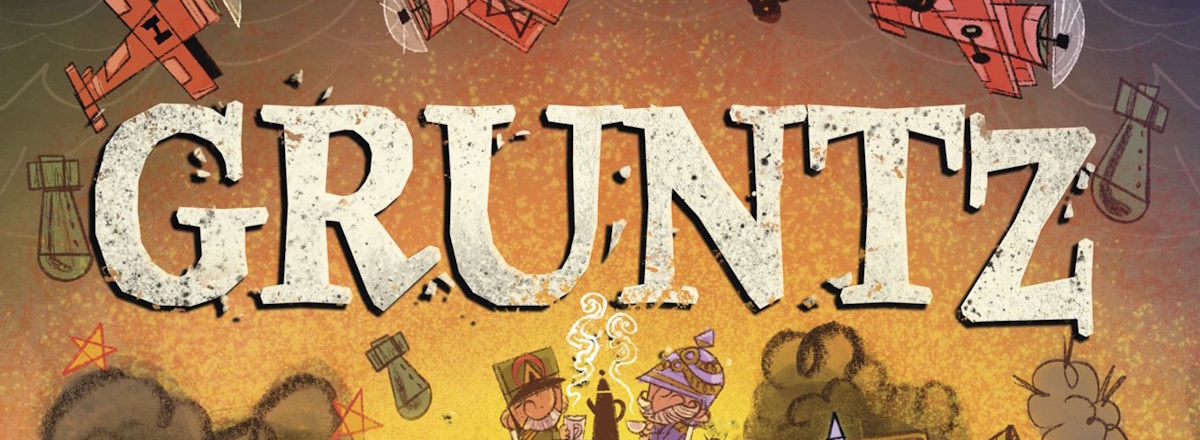
This might sound funny, but the game that kept springing to mind while playing Gruntz, the tiny-as-it-gets wargame by Carter Scott, was none other than Kurt Vonnegut’s GHQ. Like that ancient (but now resuscitated) title, Gruntz is about a pair of World War-era armies bashing it out on the field. They’re both highly attritional, encouraging a tit-for-tat gameplay that’s either enthralling or exhausting depending on your tolerance for swapping one piece for another.

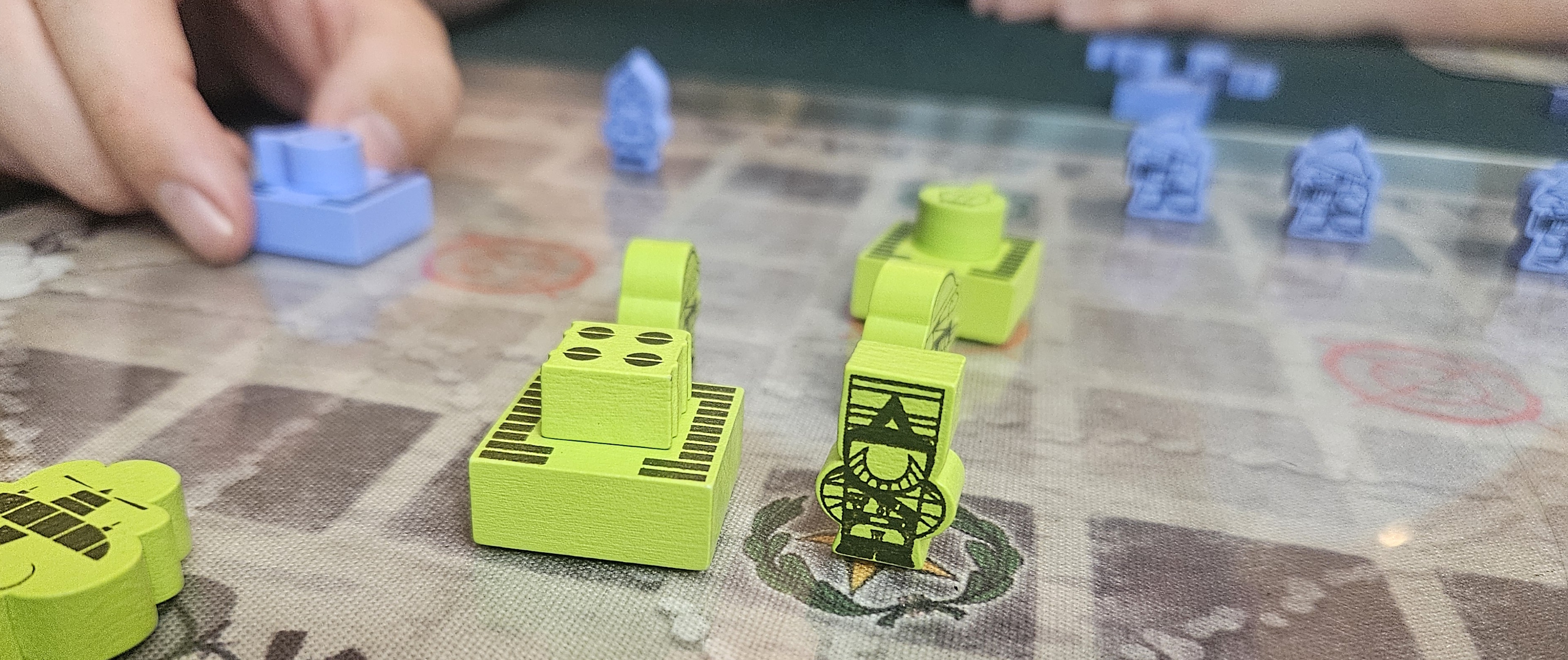
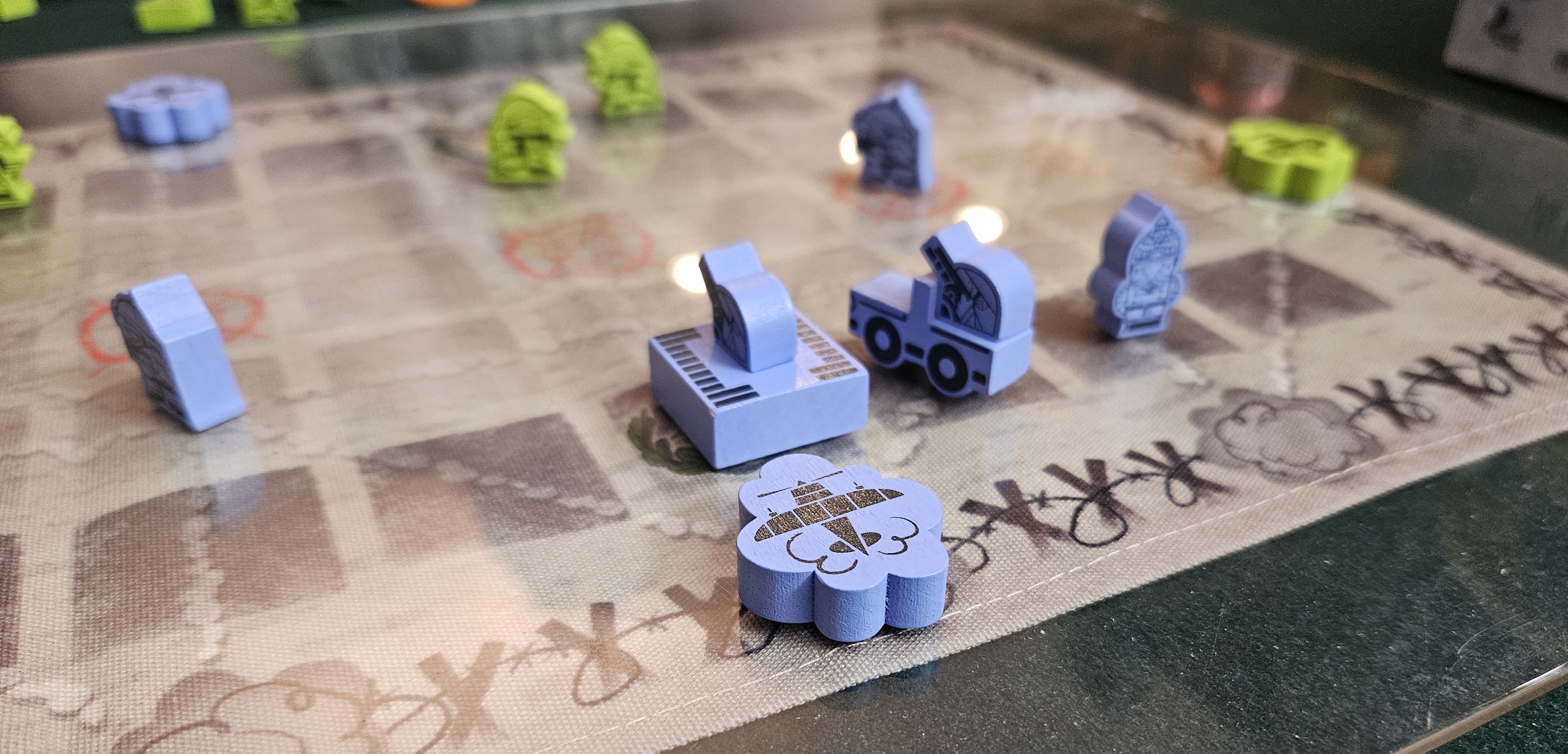
More than that, they’re both games about both movement and reinforcement. It isn’t enough to position your troops smartly. You also need to know when — and what — to call up from the rear. In the case of Gruntz, that sometimes means snapping a range of equipment onto a chassis to create a custom-built war machine.

This is never not cool. Because magnets, baby. I’m always in a mood for magnets.

This game would benefit from a soundboard of growly but cute tank, truck, and biplane noises.

Screening my fighter with plentiful anti-air.

The parallels don’t stop there, although I’m hell-bent on preventing this from becoming a comparison piece between two board games that are similarly under-known and probably wouldn’t appreciate the association anyway. Still, there’s something to be said about the way these titles portray their miniature battlefields. Where GHQ was a pale representation of Vonnegut’s WWII battlefields, dominated by artillery and armor, with infantry more or less serving as a screen for the good stuff, Gruntz is more timeless. Which is a polite way of saying that it isn’t quite as distinctive, history-wise, despite the visuals and hardware looking a little more Great War.

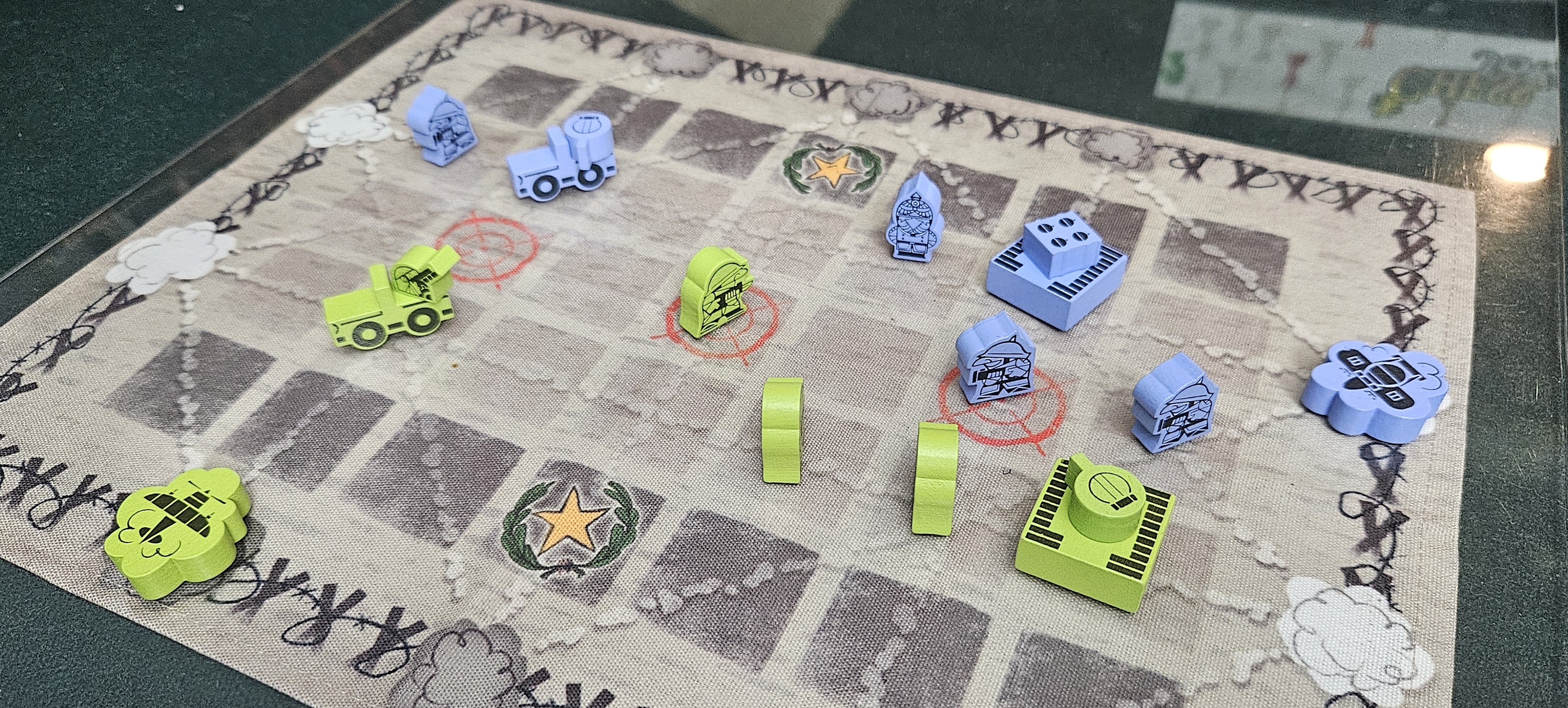
Perhaps the best place to start would be with the units. Infantry — the titular gruntz — represent a never-ending supply of bodies. Really, that’s their main trait: when killed, they bounce back into their general’s reserve rather than disappearing permanently from the table. They’re also useful for capturing control points, and can be moved en masse thanks to a captain who’s the spitting image of a gentleman officer in the midst of a war that’s very quickly eliminating the aristocracy at a pace that leaves every revolution red-faced with envy.

Those control points are the game’s biggest advantage over something like GHQ. Controlling two of the map’s three points at the end of a turn will award a star; controlling all three is worth two stars. Reaching three stars means victory, so there’s a strong incentive to usher your boys forward, even if it means they’ll get chewed up on the following turn.

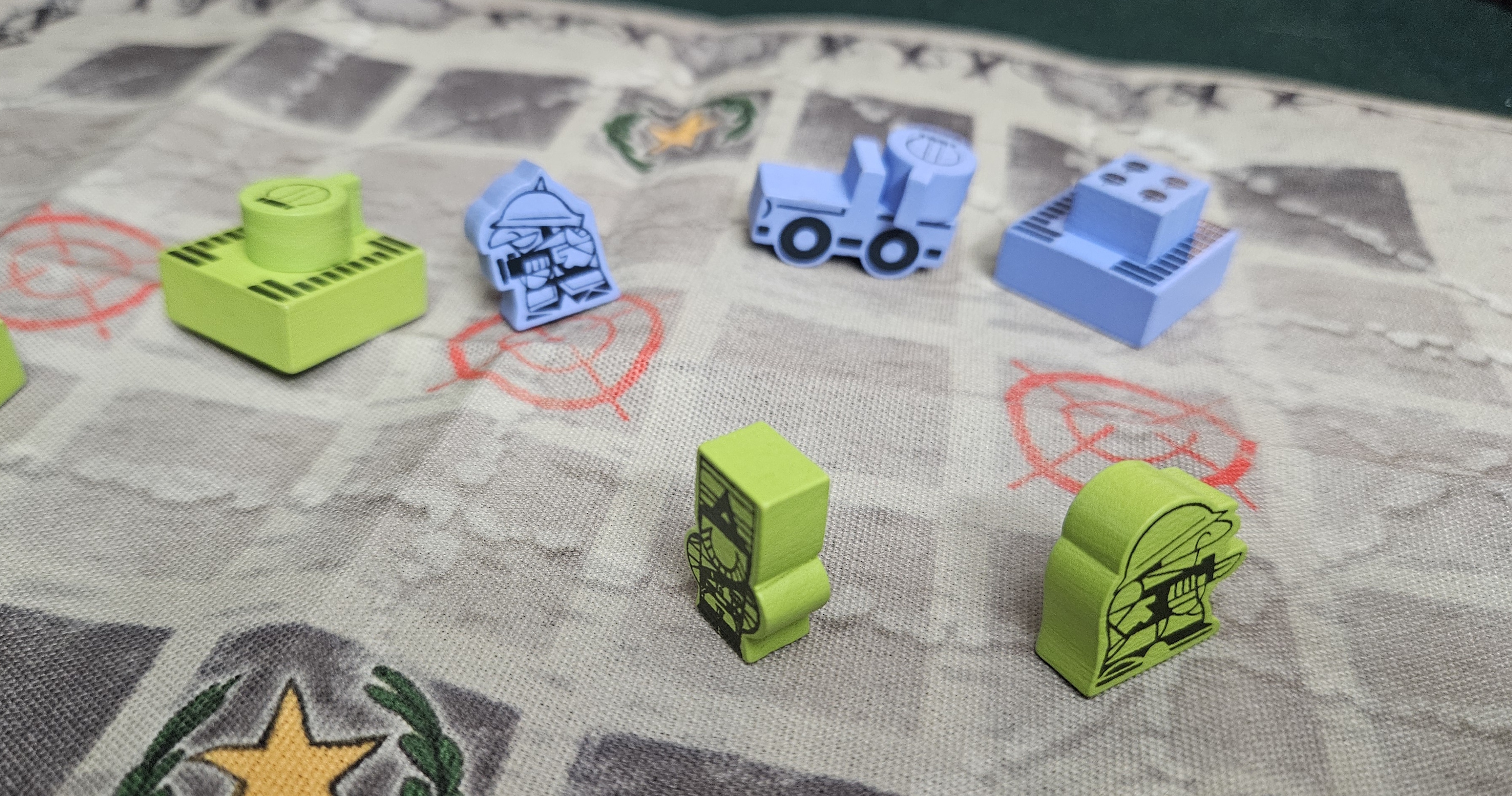
To oblige said chewing, there are ample instruments. Both sides have access to quite the range of hardware. There are planes, both fighters and bombers, which tootle along wisps of contrail over the main battlefield, and are especially keen to obliterate anyone foolish enough to position their manpower in a straight line. These are matched on the ground by vehicles, which are built of two components, chassis and attachment. The chassis, whether armor or truck, either trundles or sprints across the battlefield, while providing more or less protection. The attachments, meanwhile, offer anti-air capabilities — more of an area denial strategy than an actual threat, it should be noted — a cannon for defeating anything in range, or a transport for depositing infantry closer to enemy lines.

By mixing and matching the best attachments, you can assemble the right tools for the current crisis. That’s the idea, anyway. Most of the time, armor gets the cannons and trucks become speedy transports. It’s a case of play mirroring life, a bit like how evolution tends to produce crabs because armor and pincers present obvious competitive benefits.

The ability to move a unit twice in a row is deadly. Maybe broken? Although I also feel that not being able to do it would make the game a little too considerate of relative ranges to be playable.

Tanks checking their ranges.

Very much unlike GHQ, which allowed its generals to divvy up their moves and reinforcements as they saw fit, Gruntz employs a stricter formula. Either you move twice and deploy once or move once and deploy twice. This ensures a steady stream of troops will enter the battlefield, and also that many of those troops will be demolished before the last clouds of smoke have blown clear.

Its most conspicuous absence is artillery. This is its biggest departure from something like GHQ, not to mention easy historical placement. Put simply, this is not simulationist fare. Units capture their peers in the manner of chess, by moving onto them, rather than pelting their targets from a quarter-mile out. The effect, then, is approximate to playing with little green army men, all bayonets and glory rather than ignoble death from afar.

To be clear, this isn’t a complaint so much as an errant thought. For all its symmetry, Vonnegut’s attempt reflected the unfairness of the war he took part in, the absence of rules, the capriciousness of the howitzer and the carpet bomb. Writing about the former war, Hemingway described modern combat as dying like a dog for no good reason.

In Gruntz, your gruntz die for good reason. The stakes are crystal clear. To defeat someone, you move into range of the counter-attack. This imbues the process with a necessary attrition. Of course, you try to avoid losing troops. A well-positioned flak cannon can stave off a bomber; a tank in the right spot can discourage an infantry push. But this isn’t a game about decapitating the serpent so much as trading bites with it, fang for fang and venom for venom, until one side is too exhausted to continue.

Then again, it does a better job of evoking a broken no man's land. Any time your grunt tips over, it's a leg sprain. Back to the hospital.

The fabric mat is a pain to deal with.

There are always back-of-mind benchmarks for combinatorial titles like this, and these exchanges make Gruntz feel more like Checkers than Chess, more about constant trades than graceful maneuvers. The one exception would be the aircraft, which glide over entire lanes and columns. A bomber is one of the few things that can ruin a tank’s day, which makes its appearance rather potent indeed. This can lead to interesting bottlenecks, anti-aircraft guns strangling any viable avenues of approach, only to grow obsolete the moment the threat has subsided.

The entire thing is full of misdemeanors like that. Obsolete units. A playmat that’s too creased to allow the gruntz to stay upright. The ease with which reinforcements appear, all but necessitating a protracted first act to clear out the chaff and force both sides to prioritize a few units. These are shortcomings, not outright game-breakers, but that only makes them more galling.

And then there’s the expansion. Allplay does this thing where they sell premium pieces separately from the main game. In most cases, it’s a positive practice. Those who want the metal bits can pay a few dollars more, while those of us who are fine with cardboard punch-outs can settle for the more affordable core box. It’s a smart middle ground.

Here, though, there’s an entire expansion that’s omitted from the main box despite only requiring a pair of reminder sheets and five cardboard tokens. Supplies, it’s called, and it adds — you guessed it — little supply markers. These can be spent to activate special abilities, like charging all your gruntz forward at once, making a crucial extra move with a vehicle, or swapping a now-obsolete AA gun for a big stonking cannon.

On its own, the Supplies expansion improves my opinion of the game considerably. It’s exactly what Gruntz needs to shine, adding a crucial but rules-light layer of resource management atop the game’s straightforward rules. Using a bomber to drop a bunch of paratroopers is incredibly cool, not to mention game-swinging; the limitation, naturally, is that your opponent also has access to their own cache of supplies. Without the expansion, Gruntz is handsome and interesting, but deeply flawed. With it, the flaws are still present, but dulled sufficiently that it becomes one of the more formidable precious-scale battlefield games out there.

Yes, you caught me, this is not from actual gameplay. But look in the plexiglass: CHESS JOKER looks on, smirking. "I am not the only mixed review this week," it says.

The view from on high.

All told, Gruntz is a strange offering, especially for Allplay’s small box line. Its direct conflict and zero-chance combat make it more confrontational than one might expect. This is no feel-good trick-taker or Peter Hayward deduction game. There will be blood. Or at least scrapings of green and blue crayon across the pavement.

Despite its shortcomings, however, I feel kindly toward Gruntz. It doesn’t have the pedigree of GHQ, and its diminutive scale may preclude it from broader adoption. But there’s something here, a certain sangfroid, some marginal strategy, that makes me want to get better at maneuvering its dweeby little guys and chonky tanks and turbulent aircraft. I want to stroll my captain into the enemy base for a more elegant win. I want to figure out how to keep its gun-trucks alive long enough to swing a battle. Is the depth there? I have my doubts. But it feels like something is lurking there, beneath the fabric.

Also… it has magnets. How do they even work? We may never know. Like I said, put magnets in your game and I’ll give it higher marks than otherwise. That’s a Space-Biff! promise.


A complimentary copy of Gruntz was provided by the publisher.

(If what I’m doing at Space-Biff! is valuable to you in some way, please consider dropping by my Patreon campaign or Ko-fi. Right now, supporters can read the next installment in my series Talking About Games, this time tackling the topic of what makes a good list! Naturally, the piece includes a list.)
  •  
❌