Anmelden


Our must-have 2-player co-op games at Spiel 2026
By Kaysee and Max
September – the month where Advents Calendar and Spekulatius start to pop up in grocery stores all over Germany, including the city where we live and some other cities in Northrhein Westphalia. It’s also the time to start keeping ourselves warm, cozy up, and prepare our minds and budget for the biggest board game convention in the world – the SPIEL Essen (which also happens to be in Northrhein Westphalia).
There are 209 games listed as cooperative games on the SPIEL app as of this writing. It’s plenty, but we checked them one by one. There are many factors we considered in choosing the games that we want to have. Some of them are how difficult it would be to get the game in Germany outside SPIEL, how interesting the mechanics are, how interesting the theme is, whether we have played something like it, and how difficult it would be for us to carry them (we will only be taking the train to and from Essen).
Some of the games on our list will be or are already widely available in Germany and in some other countries, but we’d also like for some games from small/indie publishers to get some recognition. So while some of the games here might not be as widely available as games from bigger publishers (at least for now), giving them exposure may also help them get their games distributed and be more widely available and accessible.
So, without further ado, here’s our most anticipated, must-have games at SPIEL:
Kinsokuchi (禁足地)

Game designer: SHI-TEN-NŌ
Artist: Yoshihiro Arisawa
Publisher: Sugorokuya
Complexity: Light
Language: English and German
A horror game from Japan, where players are stuck in a forbidden land filled with curses. The game has a communication limit and has eight scenarios. What we find interesting is it has octagonal tiles, different from the typical hexagonal ones that are common in this hobby, and it seems to require a style of cooperation that we probably haven’t done before. It does require deduction and some “reading the room”. It also seems very thematic.
Mission Amazonia
Game Designer: Markus Lehmann
Artist: Victor Sales
Publisher: Humming Games
Complexity: Medium
Language: German
A deck-building game from Switzerland, players are sent on a mission to protect the Amazon rainforest. This became one of our must-haves as the game is not just educational, but also mechanically interesting. If uses a book as a map and we tend to like deck-building as well. They have an English version of the game but in very limited amount.
Potemkin Villages
Game Designer: Petr Čáslava
Artist: Ekaterina Bystroň
Publisher: Albi
Complexity: Light
Language: English
Potemkin Villages is a trick-taking game where players have to make sure that Catherine the Great would only see that the villages are prosperous. It is based on the historical Potemkin Village. The mechanisms for two players are similar to The Crew, but we expect it to be more thematic. It would also be our first game with some historical reference. The artstyle also caught our attention.
The Slasher
Game Designer: Katsunari Takahashi
Artist: Katsunari Takahashi
Publisher: Jelly Jelly Games
Complexity: Light
Language: English
Another horror game from Japan, this one is a 2-player only trick-taking game, where you have to work together to escape the killer. We like trick taking as a mechanic, but the cooperative trick-taking games we have tried were either not very thematic (The Fox in the Forest Duet), not primarily designed for two players (The LotR trick-taking games) or neither (The Crew: MDS). So, we’re very excited to try this one, as it should be perfect for us.
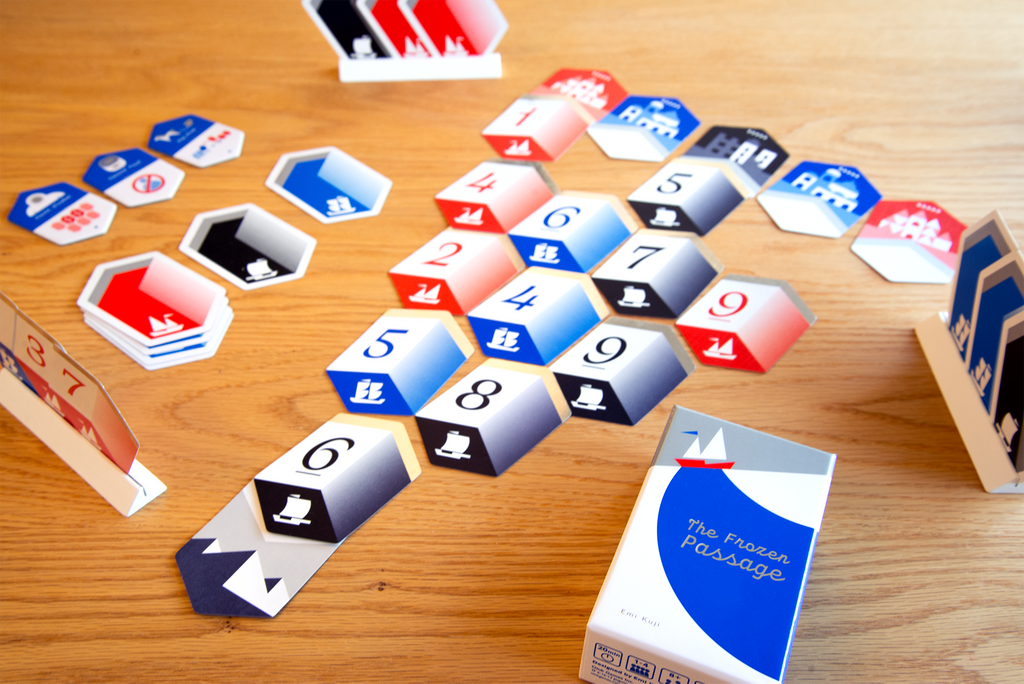
The Frozen Passage
Game Designer: Emi Kuji
Artists: Rie Komatsuzaki & Rie Takahashi
Publisher: Oink Games
Complexity: Light
Language: English, German
Oink Games are known for publishing very pretty, very small games. We really adore their style. While we’re not sure how closely the mechanics of The Frozen Passage are linked to it’s setting of navigating the Northwest Passage, we expect to have a lot of fun maneuvering around the communication limit.
Aridnyk
Game Designers: Yaroslav Kifor, Volodymyr Kuznietsov, Andrii Yanovskiy
Artist: Liudmyla Samus
Publisher: Koalla, boardova
Complexity: Medium
Language: German (also available in English but not at SPIEL)
The main thing that drew us to Aridnyk is the fact that the setting is inspired by the culture of the Hutsuls living in the Carpathians in Ukraine. We always appreciate board games that allow us to learn more about areas of the world we’re unfamiliar with. While we generally don’t play competitive games when it’s just us, for playing with friends and family we like games like this that can played either cooperatively or competitively.
Bandido Alcatraz (10th Anniversary Edition)
Game Designer: Martin Nedergaard Andersen
Artists: Martin Nedergaard Andersen, Lucas Guidetti Perez, Ajša Zdravković
Publisher: Helvetiq
Complexity: Light
Languages: English, Spanish, French, German, Italian, Dutch
We haven’t played the original Bandido in which the players have to stop a prisoner from escaping, but we’re looking forward to helping them escape from Alcatraz in this new 10th anniversary version. The art and the “tongue in cheek” theme are very charming. Given the short play time, this game seems perfect for those times where we don’t have the time for something heavier.
Flixo
Game Designer: Friedemann Friese
Artists: Ine Friese & Maren Rache
Publisher: 2F-Spiele
Complexity: Light
Languages: English, German
Just like prolific German designer Friedemann Friese, we’re both huge fans of the color green. The letter F isn’t as significant to us, but that isn’t going to stop us from trying one of his many games whose name begins with that letter. While Flixo is a more abstract game than most others that we play, it is interesting mechanically, because it reimplements a competitive game as a cooperative one.
Spirits of Valenor
Game Designer: Johannes Krenner, Alexander Pfister
Artist: George Doutsipoulos
Publisher: Pegasus Spiele
Complexity: Medium
Language: English (also available in German)
Thematically, Spirits of Valenor shares quite a bit of DNA with Spirit Island, which is one of our favorite games of all time. While much less heavy mechanically, it is a campaign game, which we also like. As with many of the games on this list, the art is an important factor and we definitely have a weakness for cute critters of any kind.
Yami
Game Designers: Hiroki Oba, Anthony Perone, Ryoji Suzuki, Hiraku Tezuka
Artist: Makoto Takami
Publisher: Musoka Studio
Complexity: Light
Language: English
Like the previous entry, Yami is a campaign game featuring spirits as the protagonists. We’re intrigued by the combination of trick taking and polyominos. We haven’t played any board game with polyominos, so it’s going to be a new experience. Although we should mention that we have of course played Tetris (and on the original Game Boy, no less).
There are some other must-have games for us that cannot make it to the list since they are either competitive or not suitable for two players. These are Mutter Natur and Cat Years. Games that could’ve made it to the list but we’re still considering are Neon Hope, Planet Pioneer Meteora, and Flame & Forge. We didn’t include Deckers – Duplicity, the new and first expansion for Deckers, even if we’re definitely gonna get it since the list is just for core games.
Not about SPIEL, but some updates regarding where we’re at now: we’re currently playing and trying out the highest difficulties of Forbidden Jungle and finishing all the scenarios of Voidfall. We will be posting a new review after a couple of days. Please keep your eyes peeled!
If there are some games at SPIEL that you would like us to try/consider more, leave a comment down below. The link to the list of games is right here.
Image Sources:
The Slasher
Kinsokuchi
Mission Amazonia
Potemkin Villages
The Frozen Passage
Aridnyk
Bandido Alcatraz (10th Anniversary Edition)
Flixo
Spirits of Valenor
Yami
The post Our must-have 2-player co-op games at Spiel 2026 appeared first on Schmeeples.