Anmelden
BGDL+ is live!
25. Mai 2021 um 19:46
The brand new BGDL community site is now live at www.bgdlplus.com!
The post BGDL+ is live! appeared first on Board Game Design Lab.

The brand new BGDL community site is now live at www.bgdlplus.com!
The post BGDL+ is live! appeared first on Board Game Design Lab.
Ami Baio, designer of You Think You Know Me and several other conversation-based games, talks about what all goes into designing and publishing them.
We talk about how to create gaming environments that encourage people to talk, listen, and enjoy chatting with each other.
The post Designing Conversation Games with Ami Baio appeared first on Board Game Design Lab.
Joe Klipfel, designer of Griphold Tower, discusses what it’s like to take a large, published game and turn it into a microgame. Joe has done this with Set a Watch and Gloomhaven and offers lots of insight on how to break a game down to its essence.
The post [Community Spotlight] Turning Big Games into Microgames with Joe Klipfel appeared first on Board Game Design Lab.


Marco Pecota, designer of Legions of Steel, discusses the ways he’s engaging with the fans of his game. We talk about building a community, releasing bonus content, reaching out to your fans for feedback, and more.
The post [Community Spotlight] Customer Engagement, Support, and Satisfaction with Marco Pecota appeared first on Board Game Design Lab.
About a month ago, I spent several hours doing a self-assessment of my life. I wasn’t sleeping well, which was a huge problem since I already wasn’t sleeping much. Usually, I can overcome a lack in quantity by an increase in quality, but when both of those things are bad, I find myself in a really tough spot.
It felt like I had thiiiiiiiiiiiiiiiiiiiiiiiiiiiiiiiiiis much to do and thiiiiiiiiis much time to do it. Something had to give. Experiencing that for a few days is one thing (the week leading up to a Kickstarter launch for example), but I had been in that situation for months. It wasn’t good for my family, my mind, or my health.
But as I assessed everything, what I realized is that it wasn’t actually a time problem. The time was there. It was an energy and attention problem.
My time wasn’t being well spent. It was like my watch had a hole in it.
The great algorithm gods in the sky must have known my struggle as YouTube started recommending lots of videos related to this issue. Writers, biologists, psychologists, professors, and former Facebook employees were all posting content with a central premise: The current state of social media is a problem.
Platforms that originally functioned to keep people connected have become much better at tearing us apart. Algorithms that used to show us what we cared about most were altered to show us what would keep our attention the longest.
Companies have spent billions of dollars figuring out how to get us to spend as much time scrolling through their news feeds as possible. The more time we spend scrolling, the more money they make, and the less time we spend on things of actual value.
As I took a good, hard look at my time, I realized I was spending a ridiculous amount of it scrolling. I’d sit down for a meal and scroll. I’d push my son on the swing-set and scroll. I’d wait on my wife to get ready for a date and scroll. I’d edit a podcast and scroll. I’d take a “two-minute” break from working on something worthwhile and thirty minutes later realize I had been scrolling the whole time. I’d sit on the toilet and scroll until my legs fell asleep.
This had to stop.
It’s not like scrolling was improving my life in any way, and a strong case could easily be made that it was making things worse.
And even though I wasn’t wasting my time getting caught up on useless political debates or hopping on board the latest outrage train, I was watching them unfold. And I think that’s a lot of us. Several studies have shown that the vast majority of posts on social media platforms come from a very small minority of users. It’s like a car crash on the side of the highway. Most of us have enough sense to drive around it, but we sure spend a lot of time staring at the carnage as we pass by.
And just like rubber-necking slows us down to a crawl on the highway, scrolling through a news feed slows down our productivity to a near standstill.
Upon realizing how much of my attention was being gobbled up in scrolling, I unlocked my phone and started to delete the social media apps from my phone. But as I started the process and watched as the app icons danced around the screen, I hesitated.
I wasn’t sure if I could do it. What were the consequences of deleting these things from my life? Did I actually want to? If I removed the scapegoat of what was wasting my time, was I prepared to place the blame on myself going forward?
I deleted the Twitter app first. It wasn’t a particularly hard decision because I hate Twitter, and I didn’t spend much time on it anyway. But as my finger hovered over Facebook, I paused for a while.
I thought about all the good things about Facebook and specifically about the BGDL Facebook community. It’s basically the only place I post and comment, and it’s full of nearly 9,000 people all trying to accomplish the same thing I am – to design great games people love.
I closed my phone. I needed a plan.
I didn’t need to delete Facebook from my life. I needed to control it and make it work for me.
I jotted down some notes:
-Delete the Facebook app from my phone.
-See what’s happening in the BGDL group 2-3 times a day, but only using my laptop.
-Avoid scrolling the news feed at all costs.
And about a month ago, that’s what I started doing, and life has definitely not gotten worse.
Instead of scrolling, I now spend more time talking to the people I care about most. My productivity has gone way up, and I’m getting more done in less time. My kids don’t have to pull on my shirt to get me to look up from my phone to pay attention to them. I’m more active in the BGDL group because my time is more focused and purposeful. I’m reading more. I’m writing more. I’m getting better sleep.
Will doing something similar work for you? Maybe. I’m not here proclaiming some “right” way to live, and your mileage may vary. But it’s definitely worked for me.
A little over a year ago, I started brainstorming and thinking through what it would look like to create a website where the BGDL community could live. The Facebook group was going strong, but even way back then I was very aware of the limitations and downsides of the platform.
I wanted a site with all the best parts of a Facebook community while getting rid of the worst.
I wanted a place for game designers to hang out that was made for us and by us.
I wanted a platform that was focused on helping designers create great games people love.
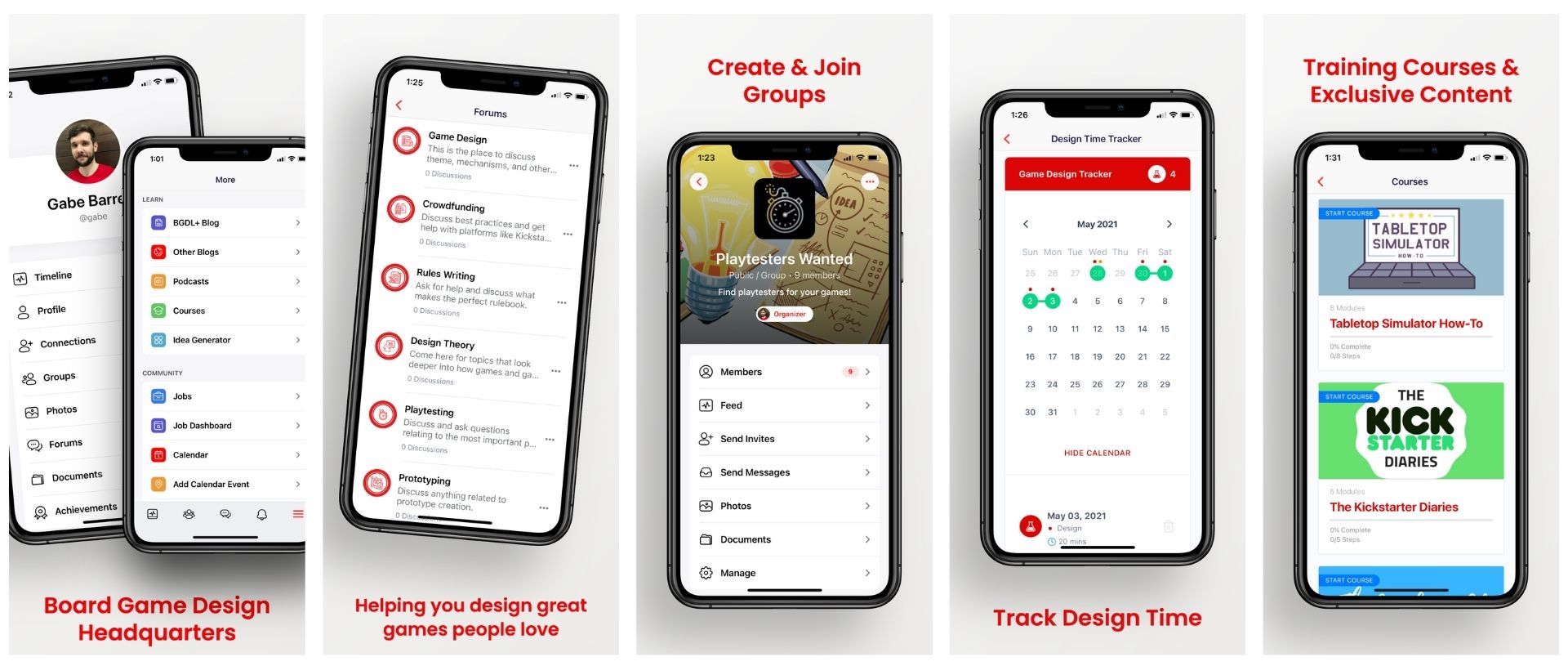
I wanted training courses to help people grow as designers.
I wanted forums to ask questions.
I wanted a calendar to organize Kickstarter launches, conventions, and playtest events.
I wanted a job board for freelancers to find opportunities and for publishers to find amazing people to work with.
I wanted a blog where people could post articles and design diaries.
I wanted a way for people to create groups and sub-groups around activities and their designs.
I wanted a way to track game design time.
I wanted a random game idea generator.
I wanted monthly design challenges.
I wanted an incredible mobile experience.
And I wanted a news feed that worked for us, not against us.
No algorithms. No data harvesting and selling it to the highest bidder. No drunk uncles.
And after a year of a tremendous amount of work, BGDL+ is almost here.
Is it the perfect solution? No. But I hope you’ll join me in the search for a platform that provides a better way.
Even with all those features, this is just the ground floor, and I’m super excited for what’s ahead.
Thanks for being an amazing community, and I can’t wait to share BGDL+ with you soon!

The post Why I Deleted Social Media from My Phone appeared first on Board Game Design Lab.
Martin Wallace, designer of Brass: Birmingham and about 100 other great games, talks about Euro games and his process for designing them.
Martin is one of the greatest designers of all time, and he offers tons of excellent advice based on his 30+ years in the industry.
The post How to Design Euro Games with Martin Wallace appeared first on Board Game Design Lab.
Joe Slack, designer Relics of Rajavihara, talks about the many different jobs in the board gaming industry and how people have found their way to those jobs.
Joe recently released a book devoted to this topic, so we talk a lot about what he found through his interviews and research.
And you can find Joe’s latest book about jobs in the gaming industry HERE.
The post Getting a Job in the Board Game Industry with Joe Slack appeared first on Board Game Design Lab.
Nick Metzler, game designer at Spin Master, talks about designing games that create excellent social experiences.
We also dive into chasing dreams, overcoming obstacles, and gamification.
The post How to Design Social Experiences with Nick Metzler appeared first on Board Game Design Lab.
BGDL community member Trevor Laforce discusses how to optimize your life to get more designing done in less time.
We talk about habits, time management, and self-management in the context of designing games while also having a job, family, and busy schedule.
And you can find Trevor’s daily planner and more time optimization content on his website here.
The post Optimizing Game Design Time with Trevor Laforce appeared first on Board Game Design Lab.
Dennis Furia talks about the board game identity pyramid.
The pyramid is an excellent tool and framework to help you break down a game into its main selling points and help you figure out the why, what, and how behind your game.
You can find more about the pyramid HERE.
The post The Board Game Identity Pyramid with Dennis Furia appeared first on Board Game Design Lab.
Laura Hoffman, COO of Game on Tabletop, discusses the ins and outs, pros and cons of crowdfunding your game.
Game on Tabletop is a crowdfunding platform specifically for board game campaigns, and Laura has a ton of experience working with creators and project managers.
The post Why You Should Crowdfund Your Game (or Not) with Laura Hoffman appeared first on Board Game Design Lab.
Wade Hayes designer of Poetic License, dives into everyone’s favorite topic…taxes. We talk about lots of the major accounting topics designers and publishers need to be aware of.
Wade is a tax pro, and this episode will be super helpful in making sure you stay in the government’s good graces (assuming you’re in the U.S.).
Here’s an excellent tax guide PDF Wade created.
And be sure to check out Wade’s game, Poetic License, on Kickstarter HERE.
The post Taxes for Designers and Publishers with Wade Hayes appeared first on Board Game Design Lab.
Joe Hout, designer of Dungeon Draft, talks about how to design a roll and write game.
Joe has designed quite a few roll and writes, and we get into dice vs cards, combos, player counts, and more.
And be sure to check out Joe’s game Dice in the Darkness and play along on Twitch HERE.
The post Designing Roll and Write Games with Joe Hout appeared first on Board Game Design Lab.
In this BGDL community spotlight episode, Alex Lu, designer of Dogs Bond, discusses how to implement interchangeable win conditions in a game.
The post BGDL Community Spotlight – Interchangeable Win Conditions with Alex Lu appeared first on Board Game Design Lab.
In this BGDL community spotlight episode, Wayne Koenig, designer of lots of games, discusses his experience and process of designing a brand new game every single week.
The post BGDL Community Spotlight – Designing a Game a Week with Wayne Koenig appeared first on Board Game Design Lab.
Isaac Childres designer of Gloomhaven, talks about how to design games that are massive in scope.
Gloomhaven is a 25-pound box of hours upon hours of gameplay, and we dive into design challenges, player progression, marketing, and more.
The post Designing Massive Games with Isaac Childres appeared first on Board Game Design Lab.
Sara Perry, designer of Gift of Tulips, talks about all the many angles of shipping and logistics.
Sara handles logistics for quite a few publishers (including me), and we talk about vetting fulfillment partners, shipping rates, what to think about if you’re just a game designer, and more.
And be sure to check out Sara’s game on Kickstarter HERE.
The post Board Game Logistics and Fulfillment with Sara Perry appeared first on Board Game Design Lab.
Today, it’s just me on the show, and I’m discussing different angles of designing and publishing solo games, and I’m talking through the design process for my latest solo game, Hunted: Wode Ridge.
I talk about pros, cons, design challenges, the business side of things, and more.
And you can check out Hunted: Wode Ridge on Kickstarter HERE.
The post Designing Solo Games and the Making of Hunted: Wode Ridge with Gabe Barrett appeared first on Board Game Design Lab.
James Fazio, founder of Pique Games, discusses how to overcome failure in game design and game publishing.
We talk about defining success, the danger of comparison, taking feedback gracefully, and more.
The post Overcoming Failure with James Fazio appeared first on Board Game Design Lab.
Azhelle Wade, the toy coach, discusses how to design board games for the mass market and toy industry.
We talk about “toyetic” games, patents, pitching to publishers, contraption based games, and more.
The post Designing Mass Market Games with Azhelle Wade appeared first on Board Game Design Lab.