Normale Ansicht

Vibin’

05. März 2026 um 02:03

my king

Ah, solipsism. It’s always appreciated when a board game demonstrates that we exist in shocking isolation, our comprehension of the universe siloed from every other human being, loved ones and enemies alike, by an unspannable gulf. Usually it’s Dixit or Mysterium that performs the winnowing, but there are no shortage of titles for transforming everyday people into miniature versions of René Descartes.

But then there’s The Vibe. Crafted by Jacob Jaskov nearly a full decade after he exploded onto the scene with Fog of Love, The Vibe is… how shall I put this… it contains some really great public-domain artwork. Joseph Ducreux, history’s finest self-portraitist, was a wonderful choice for the cover.

I considered trying to squeeze Ducreux into every image, but the gimmick fell flat rather quickly. A commentary on the game itself? Perhaps.

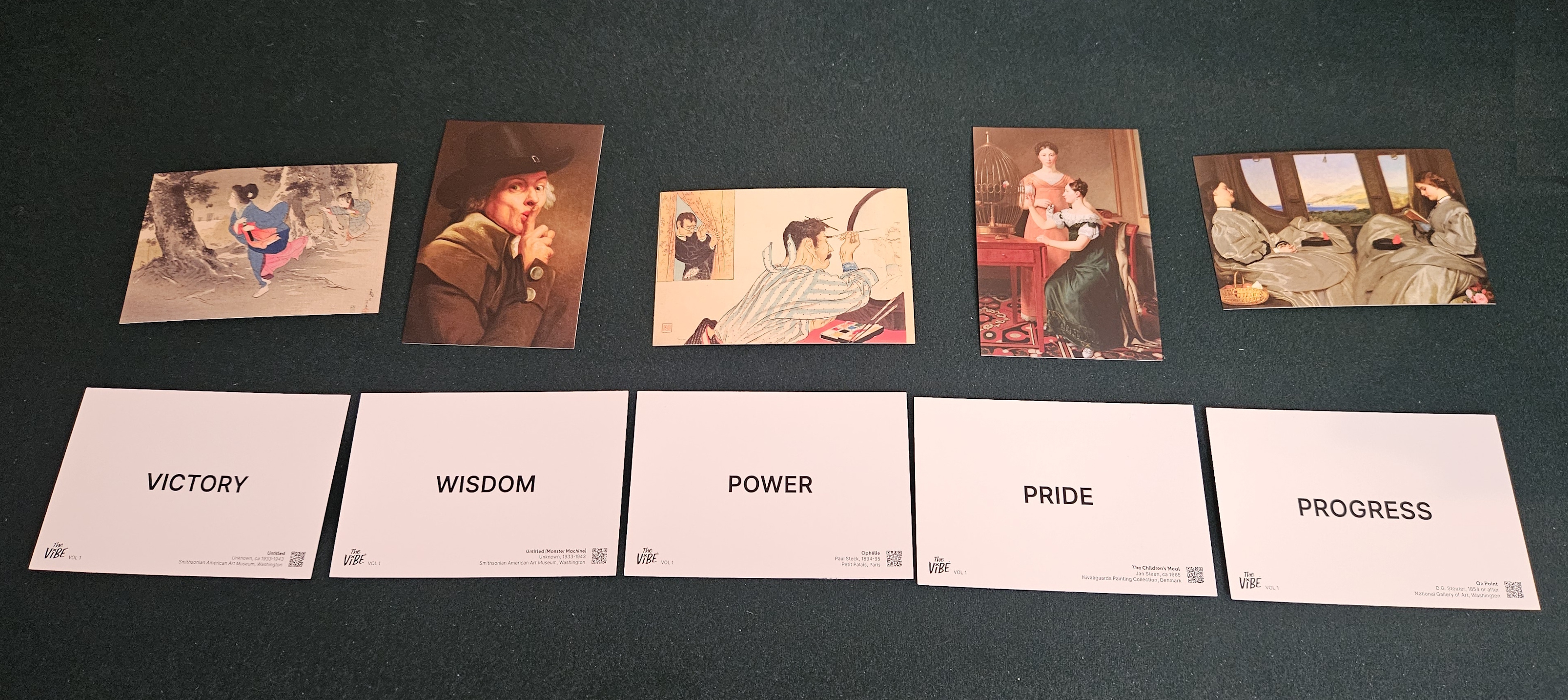
Which descriptor matches this sequence of images?

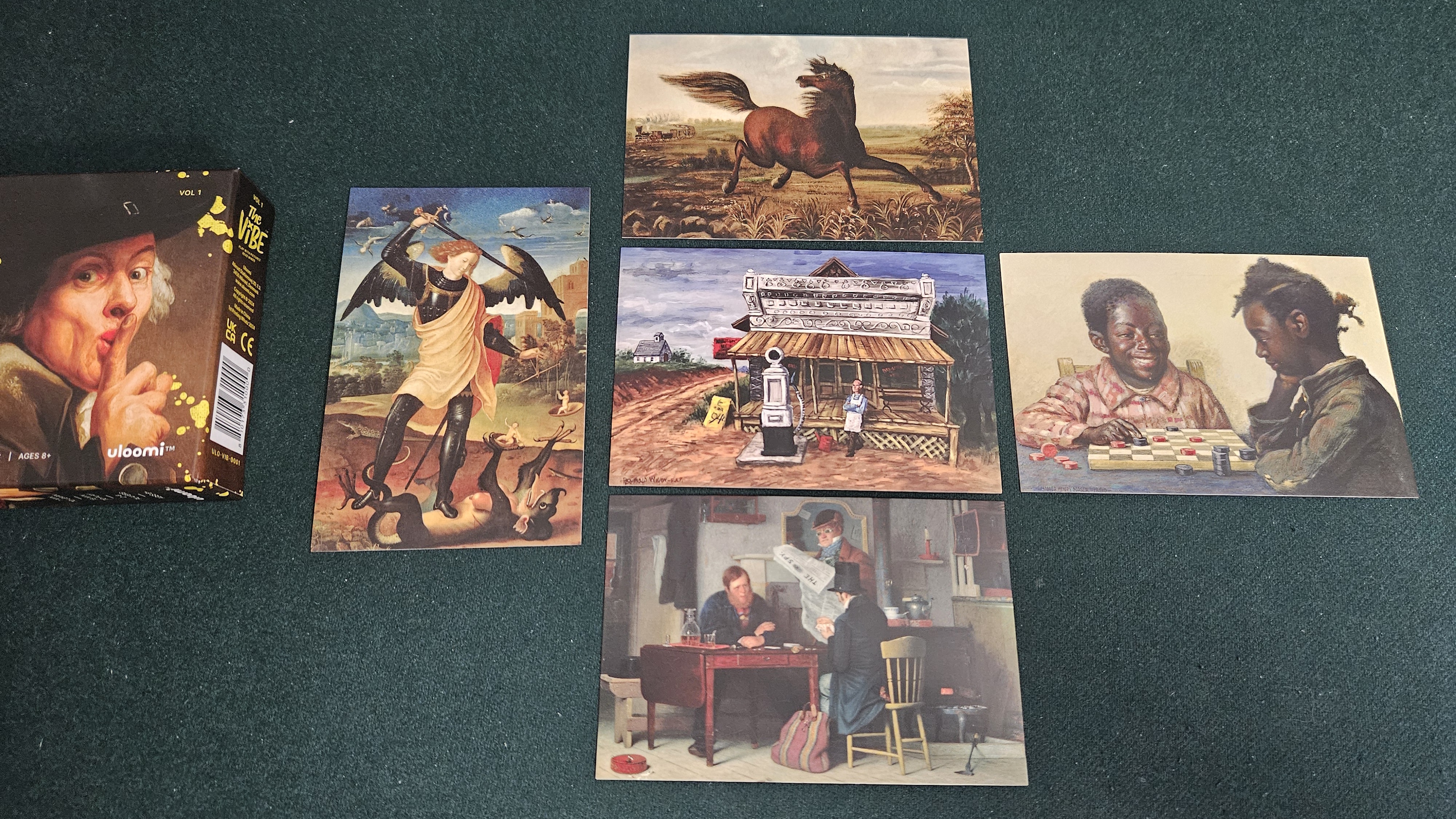
Really, I cannot applaud the art enough. The Vibe’s sixty-plus cards tour a virtual gallery, covering such works as Jacobus Doyer’s “Jan Van Speijk Debating Whether to Set Fire to the Gunpowder,” Eastman Johnson’s “The Pets,” and Unknown’s “Lover’s Eyes.” Actually, I think Unknown may be over-represented in this set. Give everyone else a chance, Unknown! Point is, opening the box presents the greatest hits from the postcard stands of a dozen art museum gift shops, drawing breathless exclamations of “Ooh, I think I remember this one!” from everyone at the table who took A.P. Art History twenty years ago.

On the back of each card, the art is titled, attributed, dated, and located in its modern museum or collection. There’s even a little barcode that promises to share more info, although at the time of writing they all lead to a generic page announcing that further details are forthcoming. Still, it’s a lovely collection. Poring over each image is a delight, and as a bonus it probably beats out any tourist shop in the world at per-postcard price. The last time I visited the Louvre, each one cost over a euro. What are the odds they’ve gotten cheaper?

But then I have to play the dang thing.

this is a board game picture about a picture about a board game

I’ve spent more time looking at the pictures than playing the game.

Picture this. In addition to the image title and author name and all that, the back of each card reveals a concept. Justice, perhaps. Loss. Passion. Surprise. On the table, you array five images, plus five more cards face-down to reveal a smattering of those concepts. Rebellion. Constipation. Transformation. Now somebody selects one of those ideas — in secret, mind you, in their brains, not aloud — and arranges the images in the order of how much they embody that idea. Left to right for all to see, from most to least. Grief. Relief. Justice. Oops, we’ve done that one. Shuffle it back into the deck. Betrayal. That’s better.

Now everybody else hems and haws and theorizes. Maybe Katsushika Hokusai’s “The Ghost of Kohada Koheiji” symbolizes anger? I mean, of course it does, but I mean right now, here, according to the five concepts on the table. But then we glance at the next image and it’s Brueghel’s “The Children of Planet Mercury.” Not very anger-y, y’know? Unless, perhaps, the arranger is struggling with their childhood faith, so any scene with a rooster-drawn chariots has certain connotations. Anger, then? Or maybe wisdom? The wisdom of the dead, the wisdom of rooster-drawn chariot-riders? Hmm. Humm.

It’s fine. Nothing incroyable, to pretend I know French. Too often it’s painfully obvious what the arranger intended to say; the rest of the time, it’s hopelessly obscure. Dixit was competitive, which ensured there were penalties for either extreme, the vague or the obvious. Mysterium was cooperative but muddied by the contrast between abstract images and concrete player actions. Here, the play is too straightforward to muster the necessary ambiguity.

Sure, there’s some of the usual apprehension that arises whenever we try to draw a box around things, to neatly cluster disparate ideas and images under shared headings. Is One Battle After Another just a social justice Star Wars? Is The Force Awakens just A New Hope for those who’ve misplaced their childlike sense of wonder? Is Star Wars just Vietnam? Are we just the Empire? Yes. I think so. Yes. I think I’m having more fun being discursive than actually talking about The Vibe. What I’m really trying to say is that the game wants to say something profound, only it doesn’t. It mostly prompts the occasional chuckle because somebody didn’t notice a detail when they examined the paintings.

There he is! My man.

The cross-four version is significantly more interesting.

There are sparks of brilliance in this game. Especially in the advanced mode. This sees the arranger making two rankings instead of just one, this time exhibited in cruciform. Now two of those five concepts are superimposed over the images, one of them situated so that it fulfills both criteria, but only as the middle spot in both rankings. This gives the enterprise a greater density, allowing for wider interpretations and broader misunderstandings. It isn’t enough to remake the game into something smarter, more like the artists it admires than the observers who flock to see their work, but it does nudge it a little closer to becoming an engaging plaything.

Sadly, The Vibe isn’t going to redefine the party game as we know it. I wish it would. I wish it had revolution in its bones. That way, we’d be guaranteed another few boxes of sixty postcards adorned with perfect examples of human creation. Instead, The Vibes is one of the finest packs of postcards ever assembled — and a weak imitation of better titles about the wiggly nature of perception and interpretation.


A complimentary copy of The Vibe was provided by the publisher.

(If what I’m doing at Space-Biff! is valuable to you in some way, please consider dropping by my Patreon campaign or Ko-fi. Right now, supporters can read about which films I watched in 2025, including some brief thoughts on each. That’s 44 movies! That’s a lot, unless you see, like, 45 or more movies in a year!)

The Old King’s Annulment

03. März 2026 um 20:10

Want to dump your bride but don't want to ask the Pope? Annulet!

No need to bury the lede: as of this morning, The Old King’s Crown is now in funding for its second printing. If you haven’t read my review, the short version is that Pablo Clark’s debut design was a stunning achievement on every level.

Except, ambush!, there’s a second game afoot, and that’s the real target of my interest today. Included as an option for the crowdfunding campaign, Annulet is a card game that ostensibly exists within the broken realm of The Old King’s Crown. What is an annulet, you might ask? Short of being a legal way to divorce one’s spouse without God getting frumpy about it, an annulet is a little ring one might stick on a coat of arms or a pinkie toe. Exactly the sort of paraphernalia you might expect from the well-garbed folk of Clark’s faraway kingdom.

But is Annulet the sort of card game those selfsame weary warmongers would actually splay atop a knife-scored tavern slab? That’s the pressing question.

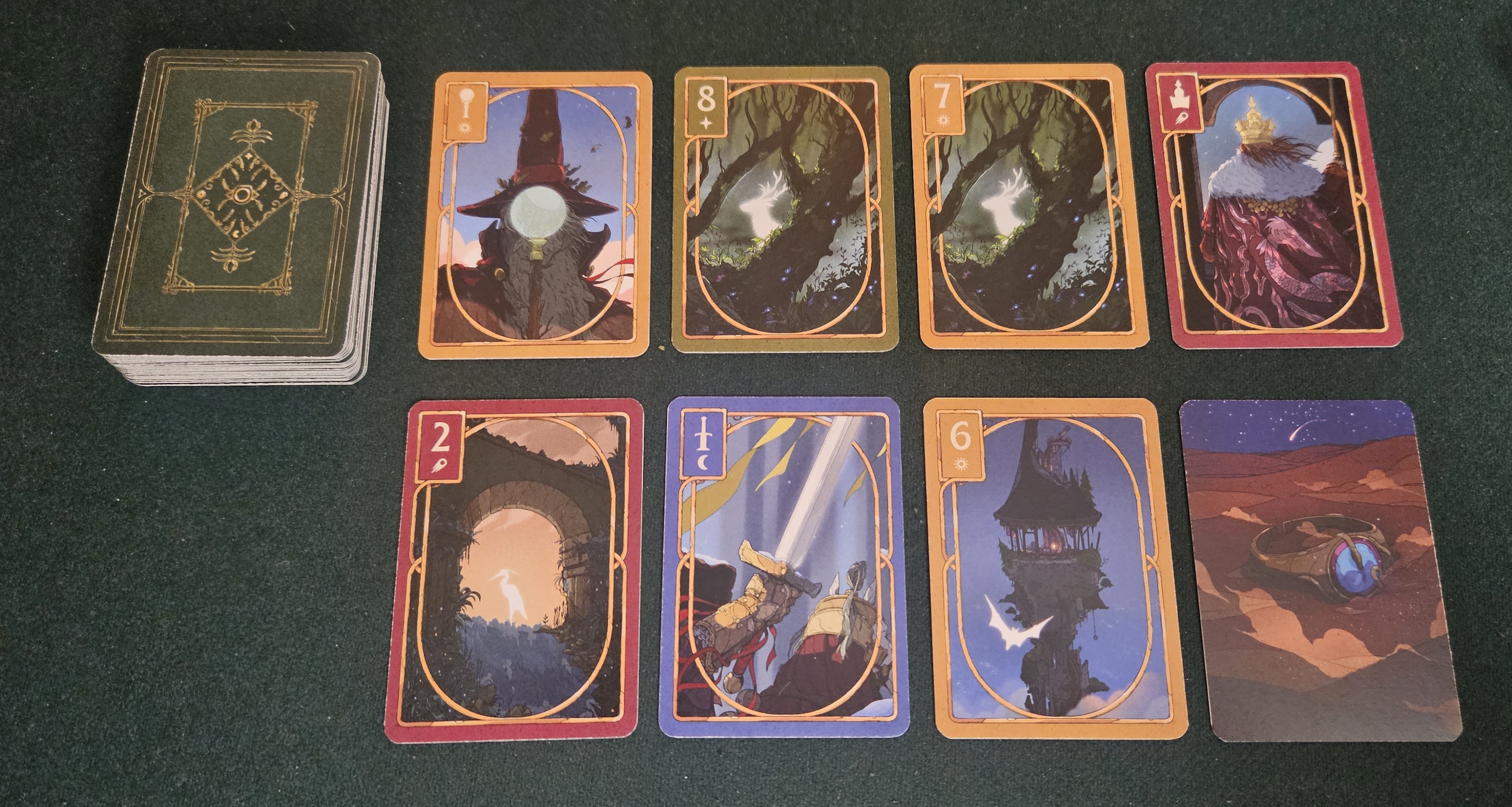
My kingdom is full of ghost animals.

Cards are arranged on a three-by-three grid; score whenever you like!

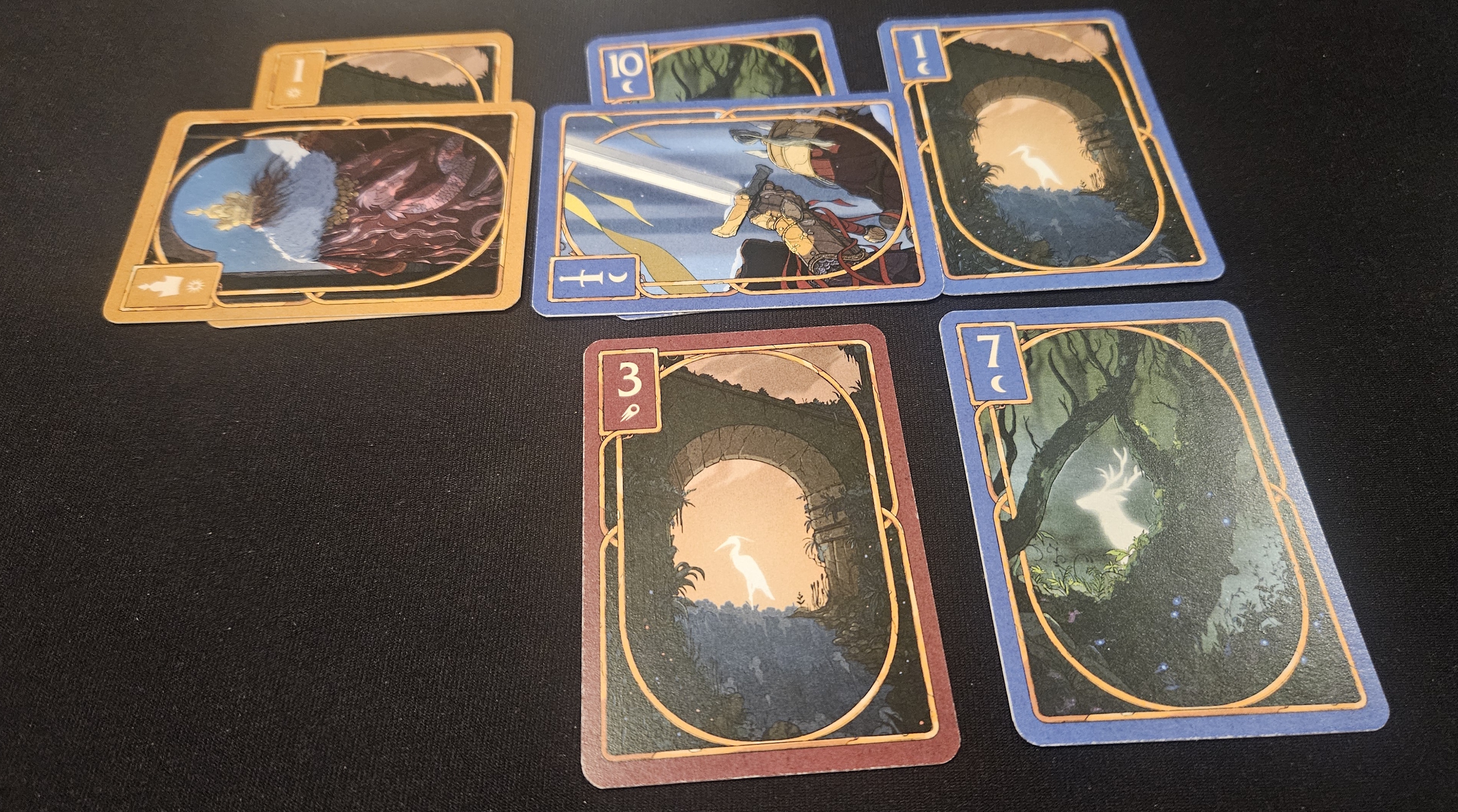
At a glance, Annulet, like everything else in the world of The Old King’s Crown, is downright gorgeous. Also illustrated by Pablo Clark, even the prototype calls to mind a plate from a favorite childhood book of myths and tall tales, all enigmatic figures and crumbling aqueducts and mossy forests. Sure, it takes all of ten seconds to realize the game must have been designed with a regular deck of playing cards, given its four suits and face cards. So what? I can buy the notion that everything in Clark’s universe is just like ours but better illustrated.

To Clark’s credit, Annulet doesn’t play quite like anything else out there. At core it’s a market selection game. Every round begins with a few cards on offer, from which the players will draft some number into their supply.

How many cards? That’s surprisingly hard to answer thanks to the way Annulet morphs according to player count. While the rules don’t undergo any substantive changes when swapping from two players to three or four, its underlying ethos is so transformed that it becomes something fundamentally different. We’ll circle back around to this question. For now, the answer is “two cards with two players, but only one with three or four players.”

All right. So you take either one or two cards. These are added to your supply. From there, cards can be installed in your kingdom, which swiftly shapes into a three-by-three grid of lands and characters. In the short-term, cards in your kingdom are secure. Unlike those still in your supply, they cannot be stolen by upstart rivals. Thinking ahead a bit, your kingdom is also the basis of your scoring. At some future moment of your choosing, every row, column, and diagonal may form points-earning sets. The rarer the better.

Secret Insider Info: originally the game was called Signet. I'm not sure if I'm allowed to say more than that.

The market shows which cards are available now and later.

As befits Annulet’s heritage, it manages to feel simultaneously old and new. Old because it doesn’t stray far from any number of card-gathering and set-forming games of yore. There’s a comforting familiarity to its percentages, that instinctual understanding that a straight flush is rarer and therefore deserves more coins than three-of-a-kind. Unlike The Old King’s Crown, which was sometimes burdened by keywords and concepts and special abilities, Annulet holds its cards closer to our shared cultural vest.

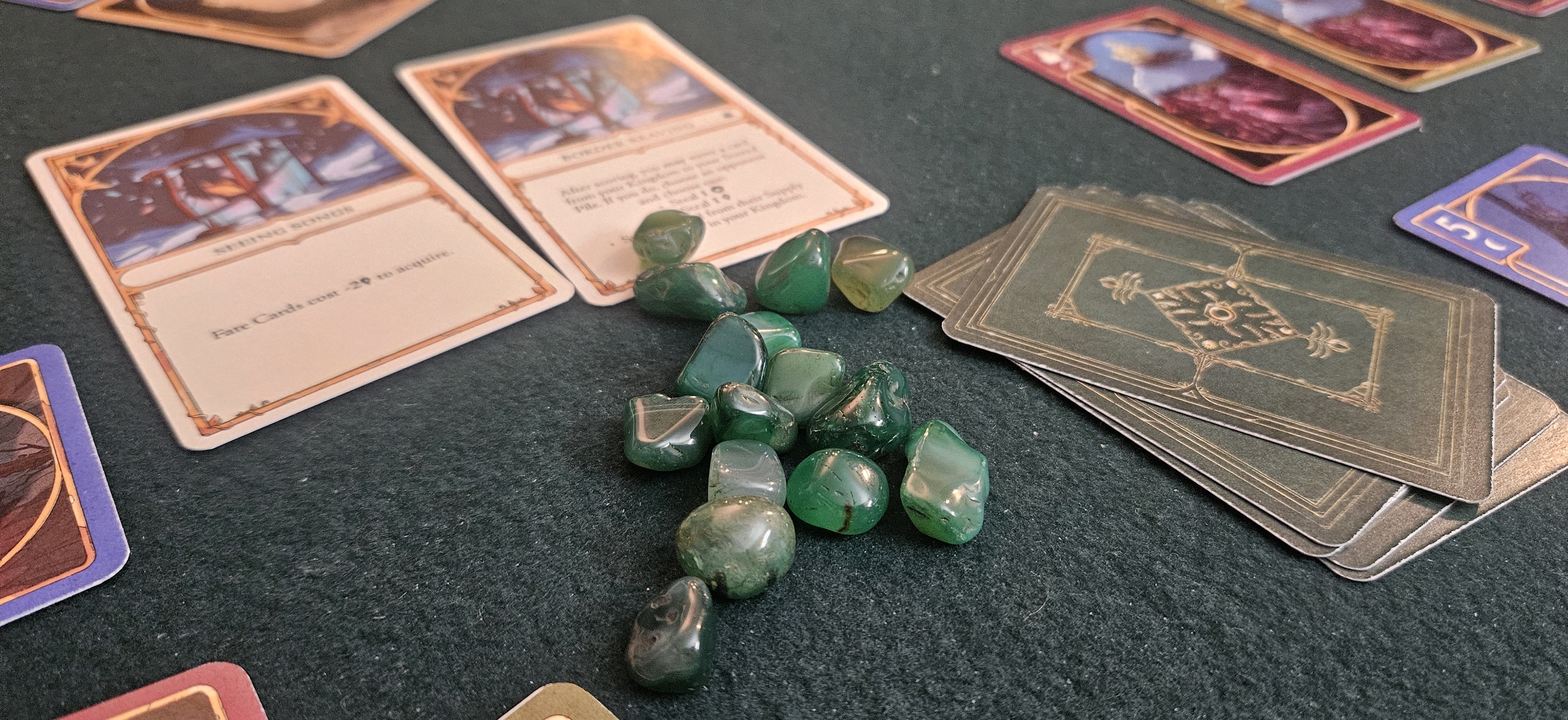
But it feels new, too, thanks to more modern flourishes that make its cardplay more dynamic and open-ended than most tavern games. There’s the game’s currency, river stones that must be spent and even exchanged between players in order to install additional cards into one’s kingdom or swipe juicy offerings from a rival’s supply. There’s the way face cards are arranged atop lands to alter their values. In the case of magicians and knights, this means adjusting their host land’s suit or rank. Monarchs are even more potent, increasing the scoring value of any set they’re part of, and all the better if you can score them in multiple directions at once. At absolute best, a single monarch in the middlemost space of a kingdom can score four times. That’s rare, but it’s hardly impossible.

Crucially, these flourishes tell something of a story, or at least they gesture at the outlines of Clark’s fantasy world. Just as different trick-takers might speak to the sensibilities of those who played them historically, whether as domestic parlor games or the pastimes of naval officers padding their peacetime income, Annulet speaks to a kingdom that’s always reshaping itself. Monarchs come and go. Treasures are gathered and plundered. Violence is so matter-of-course that the apex of a kingdom is also its dissolution.

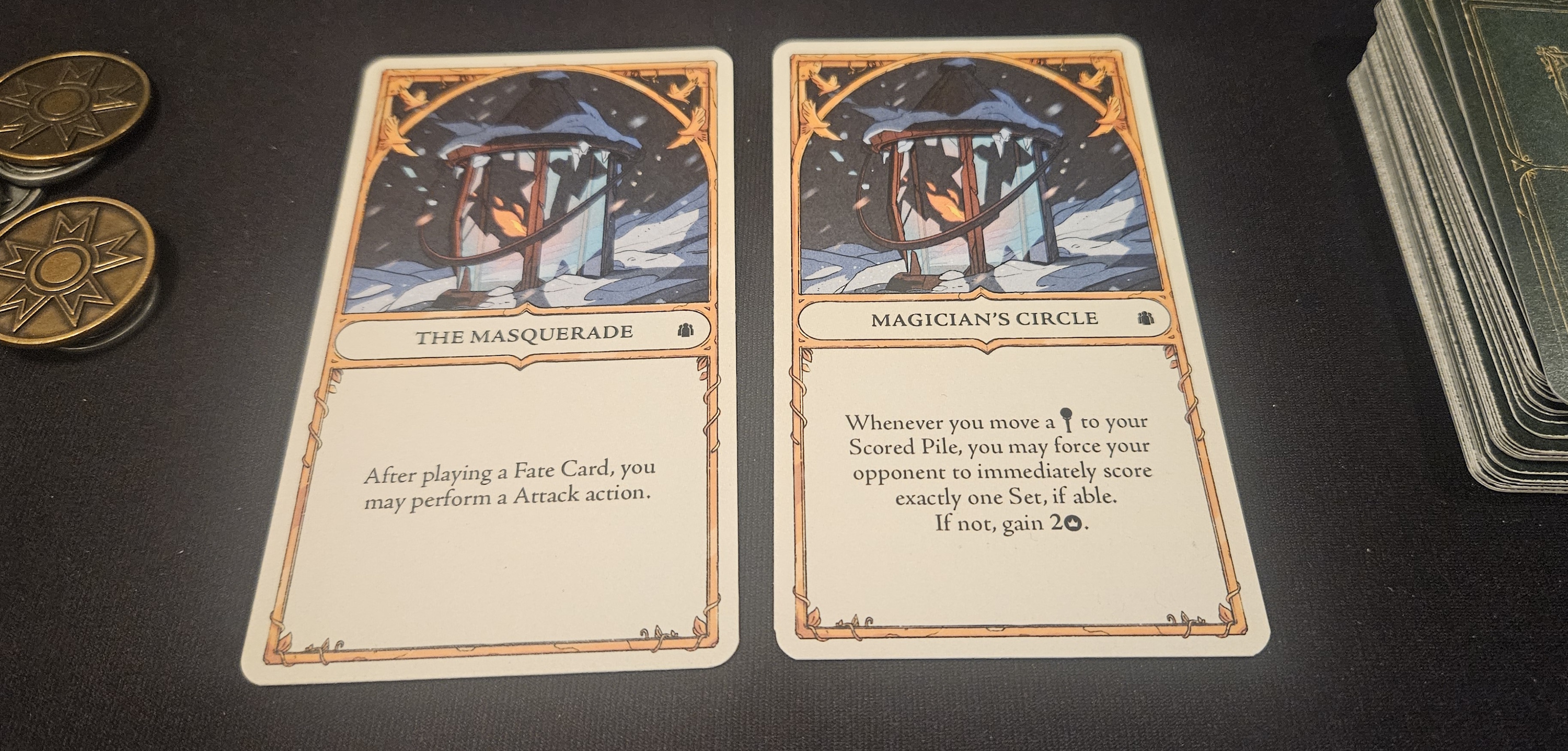
The smartest of Clark’s inclusions are the tale cards. Each session opens with players selecting a pair, whether by choice or at random. At a gameplay level, these are modifiers. Textually, they’re regional variations. One session might feature “the People’s Game,” scoring extra points for sets that sum to a small number, while the next revolves around “Border Reaving” that adds junk cards to opposing kingdoms. The effect isn’t dissimilar from the many small variations in trick-taking or shedding games, leaving the core rules intact but tweaking the game’s breadth. The result is a title that feels as large as the world Clark penned to contain it.

Will these all have original illustrations? That depends on how badly Pablo Clark wants to ruin his next few months.

Regional variations keep each session fresh.

This isn’t to say that Annulet escapes wholly unscathed, either as a plaything or within its internal fiction, and those scathings are largely interrelated. The short version is that the game is simply too permissive — in one sense, too modern — to pass muster as something that might appear in a military camp or dimly lit roadhouse.

First of all, the scoring is tremendously intrusive, often requiring an extended pause to sum up every one of a kingdom’s angles. On its own, this isn’t such a bad thing; we share a reality with Germans who play Schafkopf, so it isn’t as though real-world tavern games haven’t ever belabored their scoring to the point of madness. But where Annulet slips is through the inclusion of special cards called fates. Everybody begins with a few of these and can purchase more for a heap of river stones. From there, fates pull multiple duty. They potentially add to one’s score at the conclusion of the game, and can be spent to place trash into a rival’s kingdom, seize the all-important initiative marker for yourself, or enter your own kingdom as a wildcard.

It’s this latter function that gives Annulet its bagginess. A fate can function as anything: any card, whether land or nobility. But in scoring, it must adopt a single posture — not always the easiest thing to visualize when there are a full eight sets that might be assessed at any given moment — and the problem only compounds in kingdoms with multiple fate cards fulfilling many roles. Too often, Annulet hinges more on how permissively one employs their fates than how sharply they draft their kingdom.

This is a small complaint, but it’s small the way a pebble is small when caught inside one’s shoe. Annulet is too broad, failing to quite capture the sensation of playing and mastering a truly great tavern game, one defined as much by chance and limitation as by the range of things a player might accomplish on their turn. It’s like playing a trick-taker with a bunch of wilds; thrilling the first time you steal a trick, obnoxious when everybody’s doing it all the time.

Perhaps more pronounced, the game is a different beast depending on player count. It will probably surprise nobody to hear that it’s strongest at two players, which affords greater numbers of drafted cards and a tighter focus all around. Higher counts clutter the decision space a bit, especially where initiative and drafting are concerned, but three-player is charming in its own way. Annulet is at its strongest when it presents that razor-wire choice of which cards to draft and how to use them. With each additional player, that sharpness is blunted.

I once owned a very nice river stone. True story.

I’m a sucker for river stones. (Disclaimer: not real river stones.)

Apart from that, however, Annulet is quite the production. Even at its flimsiest, it’s lively and exciting. More importantly, as a diegetic artifact it speaks to the breadth of this place Pablo Clark has envisioned, something Baron Cuttlefish might splay atop the camp-table on the eve of crushing the Speakers of the Wood. With one finger he traces the rim of his goblet, heedless that the Vial Sect has already dusted the brass with their bitterest toxin. By the time the Ornithopter Club swoops down from the hills, his pulse will have already stilled.

Ahem. Look, it’s good stuff, even when it doesn’t hang together quite as tightly as I had hoped. For a follow-up to what was perhaps last year’s most exciting debut title, that’s no small thing. The result is an imperfect game, but a lovely and evocative experience nevertheless.


A prototype copy of Annulet was provided by the publisher.

(If what I’m doing at Space-Biff! is valuable to you in some way, please consider dropping by my Patreon campaign or Ko-fi. Right now, supporters can read about which films I watched in 2025, including some brief thoughts on each. That’s 44 movies! That’s a lot, unless you see, like, 45 or more movies in a year!)

Re;MATCH One, Two, or Four

03. März 2026 um 00:50

I like to play games where every character is ten times cooler than me. Scratch that — fifty times cooler.

It hasn’t been all that long since we took a look at Re;ACT: The Arts of War, an intriguing but imperfect game about various artists manifesting their crafts into the physical world in order to determine which medium is the most artsy of them all. It’s like Bloodsport but with calligraphy versus spray paint versus film stock.

MingYang Lu’s forthcoming followup, Re;MATCH, isn’t exactly a sequel, although its peculiar capitalization and errant semicolon might lend one that impression. Instead, it’s something even better: a match-three game in which one must never, ever match three.

Okay, it isn’t only that, although I’ll confess I find that part amusing.

Match three? Straight to jail.

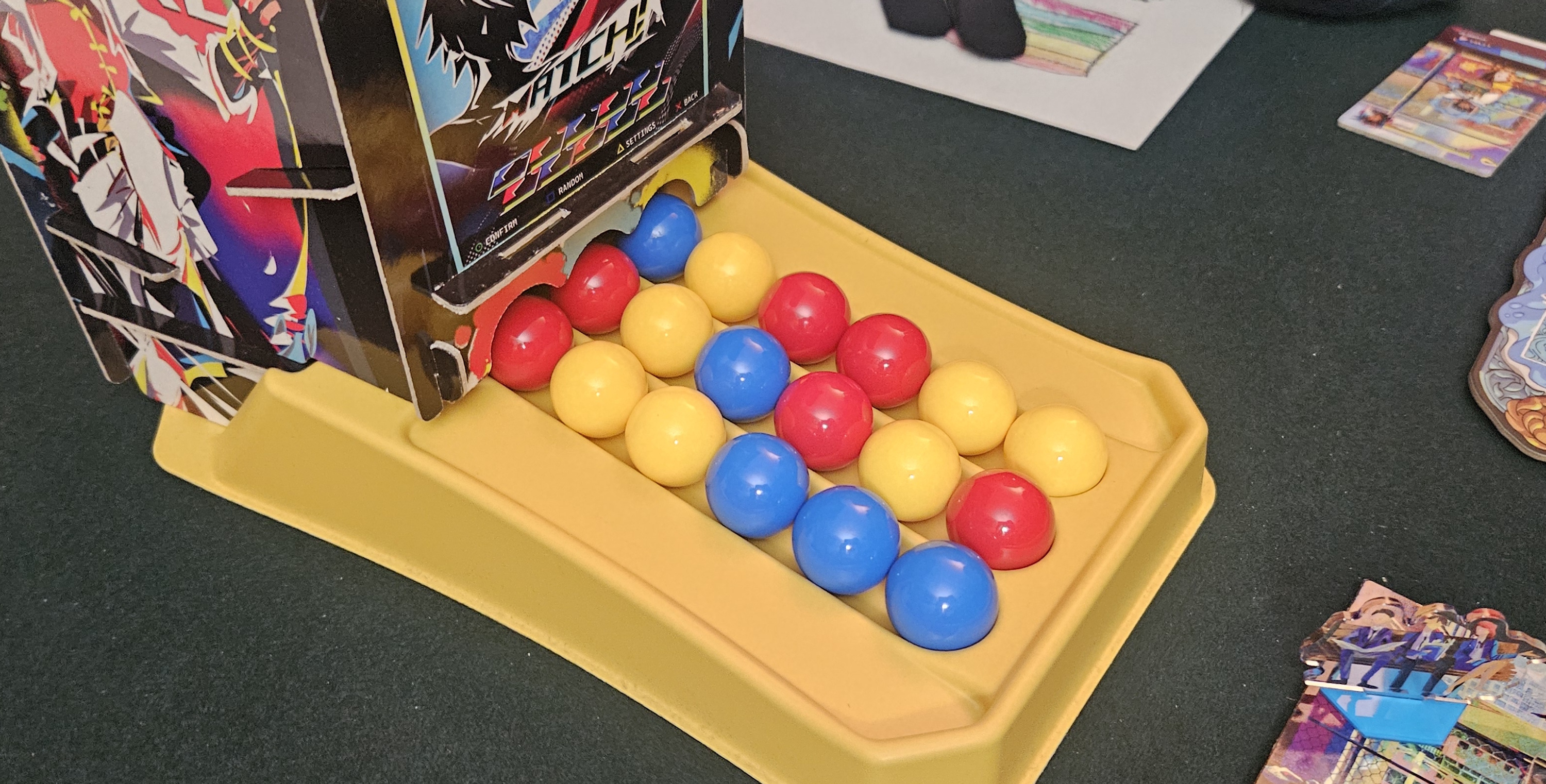
Match some number of balls, so long as you don’t match three.

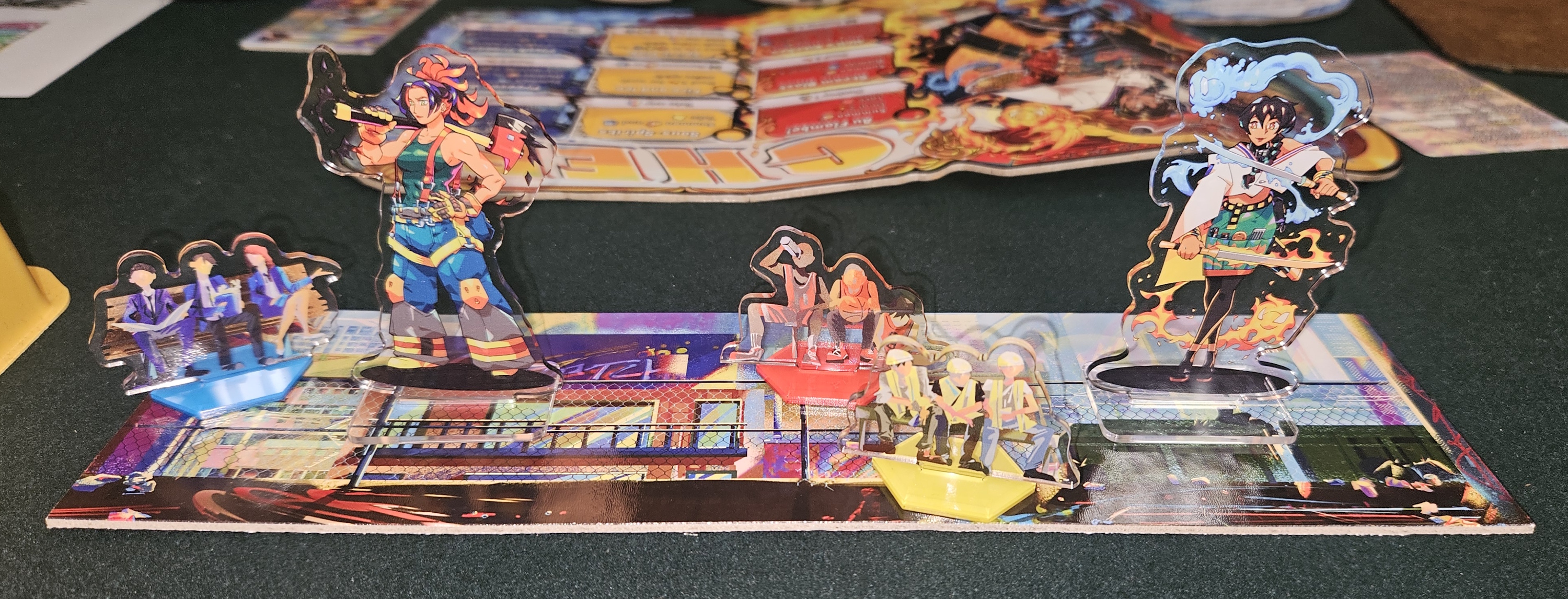
Like Re;ACT before it, Re;MATCH begins with a settling of accounts between two careers, although this time the jobs are even more disparate. That’s right, no more squabbles between artists. Instead, one match might see an axe-wielding firefighter squaring off against a disc jockey. Perhaps that seems one-sided, but no, this is a competition of the minds.

Still seems one-sided? Okay, let’s leave the minds in the drawer. How about a battle of marbles?

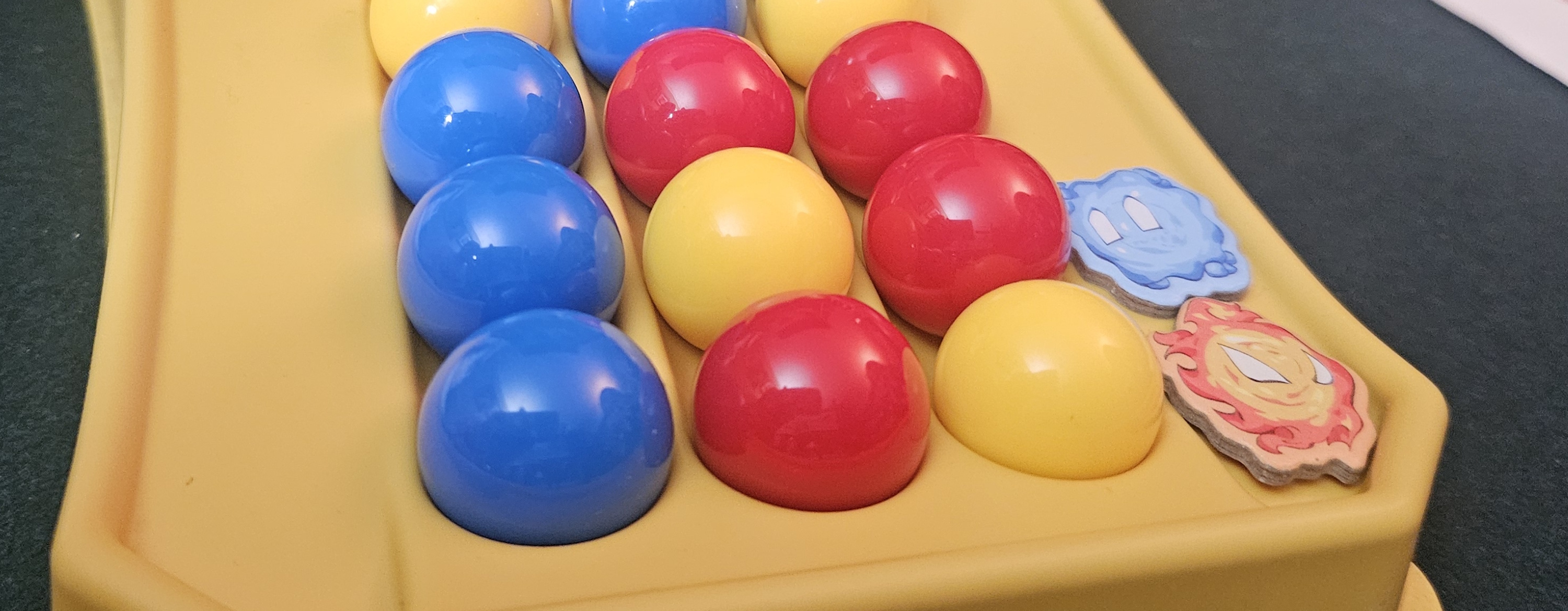
The big visual draw is the marble tower. The closest touchstone is the box from Potion Explosion, which, if you’re in the mood to suddenly feel old, came out a lengthy eleven years ago. The marble tower in Re;MATCH is even simpler than that game’s, producing three lanes of balls in three colors. It’s marble-matching so simple a baby could do it, right before trying to eat the marbles.

But the matching is simple for a reason. For one thing, you aren’t permitted to use all three of those lanes. Instead, you’re always limited to two: the one closest to you and the shared middle lane. The decision space is compressed, but in such a way that even a fourth color would cause no shortage of problems.

And then, of course, there are the fighters.

Nobody ever does, like, optometrist versus baggy college professor. But that's basically my marriage.

Whose career is better in a fight? Go!

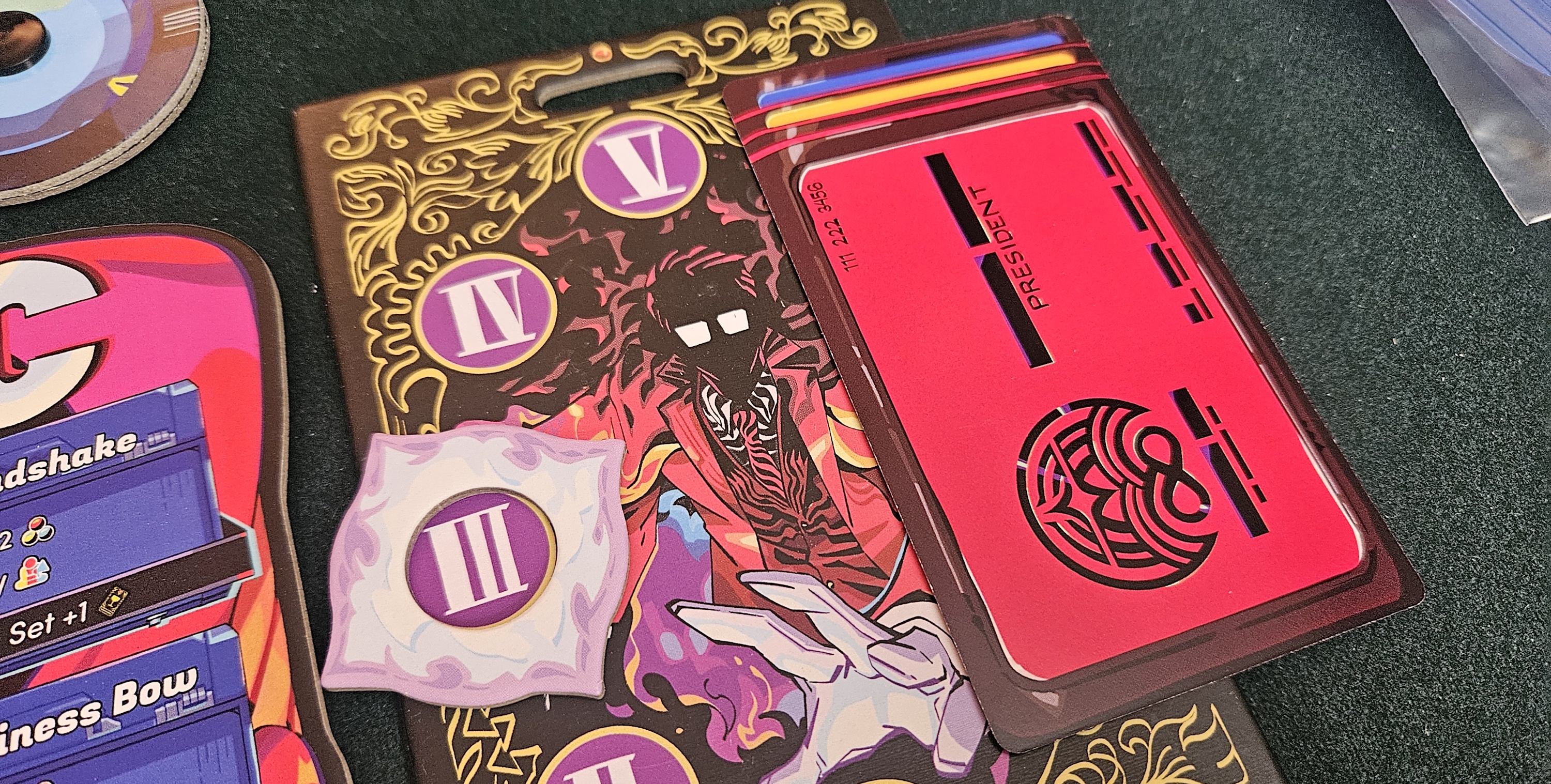
The gist behind Re;MATCH is that every fighter comes with their own arcade cabinet, complete with a standee — whose function, it must be said, is principally aesthetic — a few special tokens, and a fold-out broad displaying a unique set of moves.

Those moves are the important part. By making color-coded matches in the marble tower, your fighter triggers various effects. Each color permits three levels, one that triggers when you utilize a single ball, another for two balls, and a third that skips over three balls to instead trigger when you manage to string together four marbles at a time. It’s simple, but not as much as it initially seems. Sometimes you’ll want to forego a powerful move for the sake of setting up an even more potent combo later — or because you desperately need to block a move coming down your rival’s lanes. It feels surprisingly close to the fighting cabinets it strives to evoke visually, despite the turn-based limitations of its medium.

Now comes the tricky part, because I can’t give examples without delving into the fighters themselves. This will come as no surprise to anybody who played or even glanced at Re;ACT. In that game, the duelists were so different that they often used entirely distinct mechanisms. Bag-building versus card management, for example. The contestants in Re;MATCH boast a more robust shared foundation, in that nobody leaps away from the marble tower to shuffle a private deck or anything like that. But the breadth of their personal expression is still quite the thing to behold.

Maybe I can limit myself to only one or two examples.

I wish I could wear spooky glowing glasses.

Predicting my opponent’s moves.

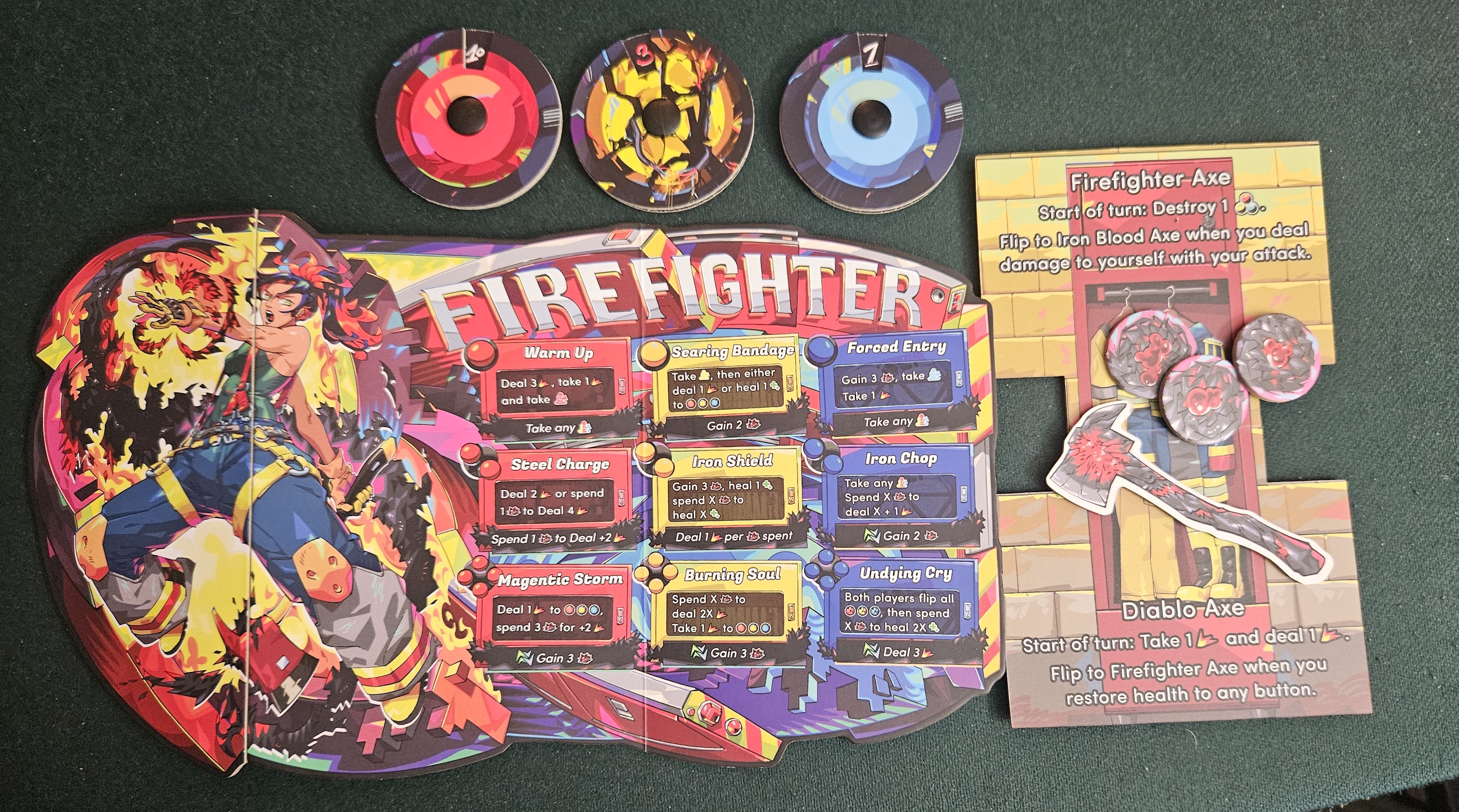
I wasn’t joking when I said there was a firefighter. That might sound silly. That’s because it is silly. But at the same time, this is a firefighter with a possessed axe that makes her take deadly risks, which pushes the character from silly to excellent. At various points, the firefighter’s moves might cause self-damage. This flips the axe to its other side, gains an “ironblood” token that can be spent to empower her moves, and changes how the firefighter operates in battle. Basically, she shifts between damage mode and defense mode, healing her injuries and destroying any combo-making balls in the marble tower before her opponent can pounce on them.

And this is reflected in those color-coded movesets. For instance, her red moves are all about dealing damage. One red marble deals three damage to her opponent and one to herself. Two marbles means she deals two damage, or else spends one of those ironblood tokens to deal twice as much. Four marbles deals only one damage, but does so to every color.

Did I mention that health is color-coded? It is. Both fighters have three health dials, one per color. Bottoming out a dial will “break” it, forcing its owner to spend a coin to stay in the game. This alters how the whole thing is played. Now the injured player can’t make matches with that color. Instead, it changes function for a bit. Instead of building matches, the broken color operates as a connector, letting its player trace through those busted marbles to connect other ones. This has the benefit of gradually ticking the broken dial upward, eventually restoring it to its healthy side.

In other words, as your moveset becomes more limited from suffering damage, your remaining colors grow even more formidable. At the same time, though, you’ll want to restore your broken dial as soon as possible, lest a second dial succumb. When that happens, it takes two coins to stay in the game. That’s bad. Coins are your “real” currency, you see. Lose all of them and it’s game over.

me: I don't think this is how firefighters— game: SHUT UP AND PUUUUUNCH

A closer look at the firefighter.

Okay, so the firefighter is all about tempo, switching between blasting both players and nursing her wounds. Let’s contrast that with another contestant, the D.J.

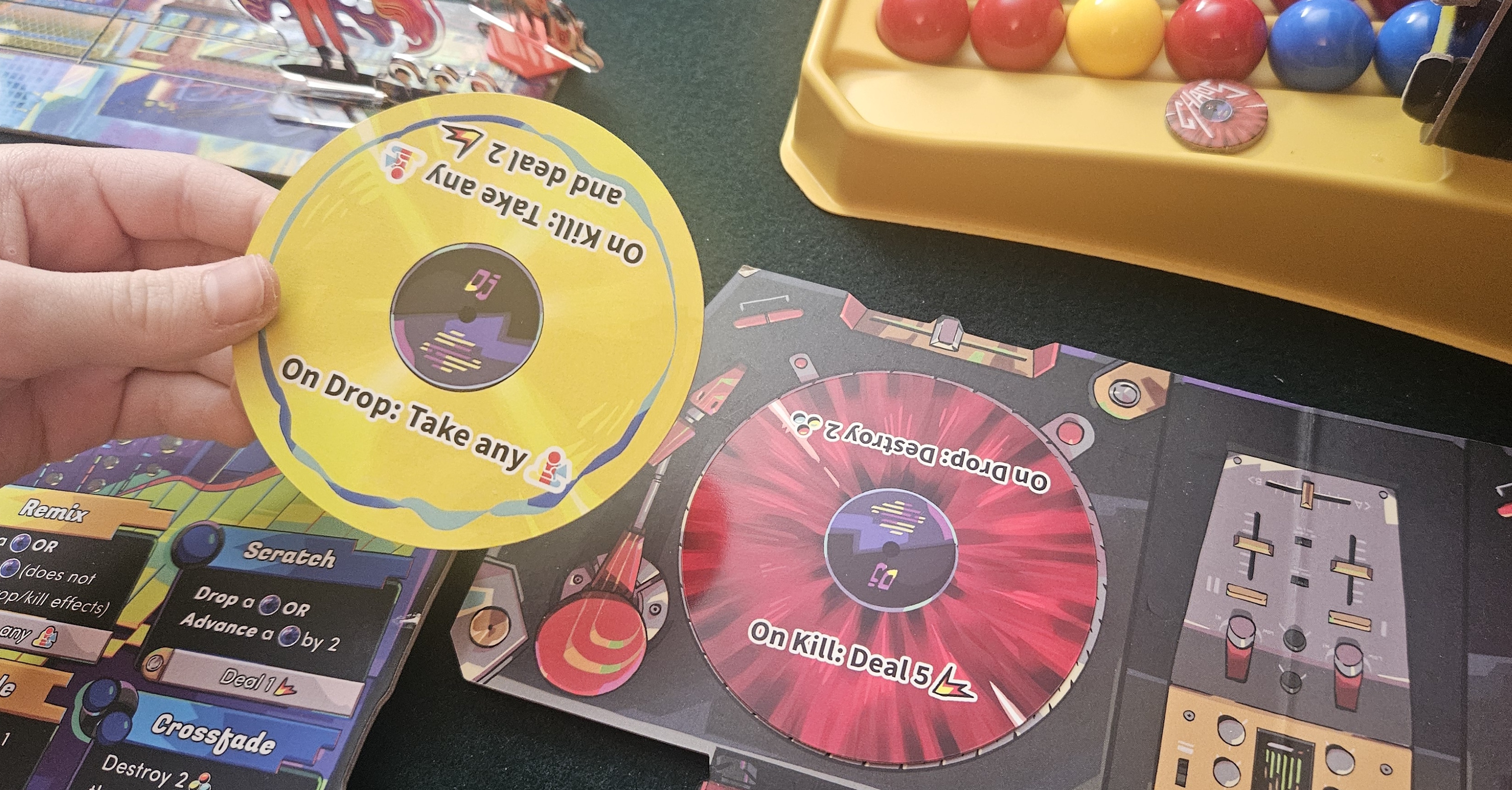
The D.J. loves to make noise. Her kit comes with a turntable and a selection of discs. Every so often, she’s allowed to drop a beat, physically taking one of those discs and placing it on the turntable. This might attract fans — a shared currency both players are grappling to control, and which increase the potency of every move in the game — or deal damage, or whatever. This also places a beat token on the marble tower. Row by row, the beat will advance. When it finally ends, another power triggers.

Naturally, the D.J.’s moveset includes normal stuff. She wins over fans. She deals damage. The usual. But her real abilities revolve around dropping, advancing, and killing beats. Her entire setup is one cacophonous wall of sound. Like the firefighter, she’s all about tempo. But the way those tempos function couldn’t be more different. The firefighter is all about managing two very different modes. The D.J. is the board game equivalent of a Shepard Tone, always ascending, always building momentum.

The other fighters tweak the formula in their own ways. Some, like the dancer and the chef, lay little traps on the marble tower, penalizing anyone who selects balls on the booby-trapped row. Others, such as the psychic and the trickster, are all about predicting and preempting their opponent’s moves. Like the firefighter and D.J., they share some similarities, but there’s an initial sense of discovery to seeing how they function, followed by the joy of figuring out how to leverage their strengths against an opponent with tricks and traps of their own.

I believe this turntable is incorrectly oriented, but neither I nor my 12yo actually know that much about turntables.

The D.J. battles via a turntable.

The effect isn’t all that dissimilar to something designed by Brad Talton, like some lighter marble-drop version of BattleCON or Exceed. Or, sure, Re;ACT, although Lu is in stronger form this time around. Unlike that earlier effort, which was full of sticky rules and questionable matchups, the fighters in Re;MATCH are sharply crafted — and I say this despite playing a prototype, with all the small tweaks and imbalances that always entails. Even so, my twelve-year-old was more than capable of figuring out the fighters’ intricacies. At the same time, they weren’t so breezy that she didn’t have to wrestle to overcome their various deficiencies, learning to mitigate a fighter’s shortage of healing or accurately predict my moves.

Are there depths here to plumb beyond the learning phase? I think so, although it’s hard to say after only a half-dozen matches with an in-progress prototype. I will say that I’m excited about the possibilities. Where Re;ACT was interesting to discover but also something of a chore, Re;MATCH doubles down on its strengths. Its systems are simpler, more tactile, and easier to master, but still reward clever combo-building. In the process, the randomization of the marble tower prevents it from feeling quite as process-bound as its predecessor. While some of the fighters still sport ambitious attacks, the game feels less like a race to trigger their two apparent combos.

Or maybe I just really enjoy fiddling with those balls. The game’s kineticism is admirable. Claiming marbles, studying your future options and those of your opponent, even jostling the prototype tower when the balls got caught within, everything about the production felt hefty and enjoyable. The game is pleasant in a way that Re;ACT only attempted.

And how one fondles them.

It’s about the balls.

But enough with the comparisons. Re;MATCH is one of those titles I’m excited to keep exploring. It’s colorful and diverse in its gameplay, fast-paced and hard-hitting, and above all, a pleasure to discover.

As a bonus, it made my kiddo go “wokka wokka.” I had no idea she’d ever seen a turntable. The more you know.

Re;MATCH launches on Kickstarter tomorrow.


A prototype copy of Re;MATCH was temporarily provided by the publisher.

(If what I’m doing at Space-Biff! is valuable to you in some way, please consider dropping by my Patreon campaign or Ko-fi. Right now, supporters can read about which films I watched in 2025, including some brief thoughts on each. That’s 44 movies! That’s a lot, unless you see, like, 45 or more movies in a year!)

Flip-and-Curse-That-Stupid-Dragon

27. Februar 2026 um 06:40

The two-tone color scheme is striking, but it also leads to a few problems. My friend Adam, for instance, cannot tell the difference between the gold coins and the gold magic beans.

Remember when every other game was a roll-and-write? That was living proof that even golden ages come with cloudy linings. Flip Pick Towers, designed by Rob Fisher and Adam Porter, benefits from its release a few years after the slew of samey writing games. It’s an unrepentant flip-and-write, is what I’m saying, more in the vein of Cartographers than the form’s more mathy alternatives. Some artistic talent won’t go amiss.
For those of us who can’t even sketch a convincing stick figure, however, it’s still charming, albeit not perhaps as compelling as some of the options out there.

Nice ivies, dudes and dudettes!

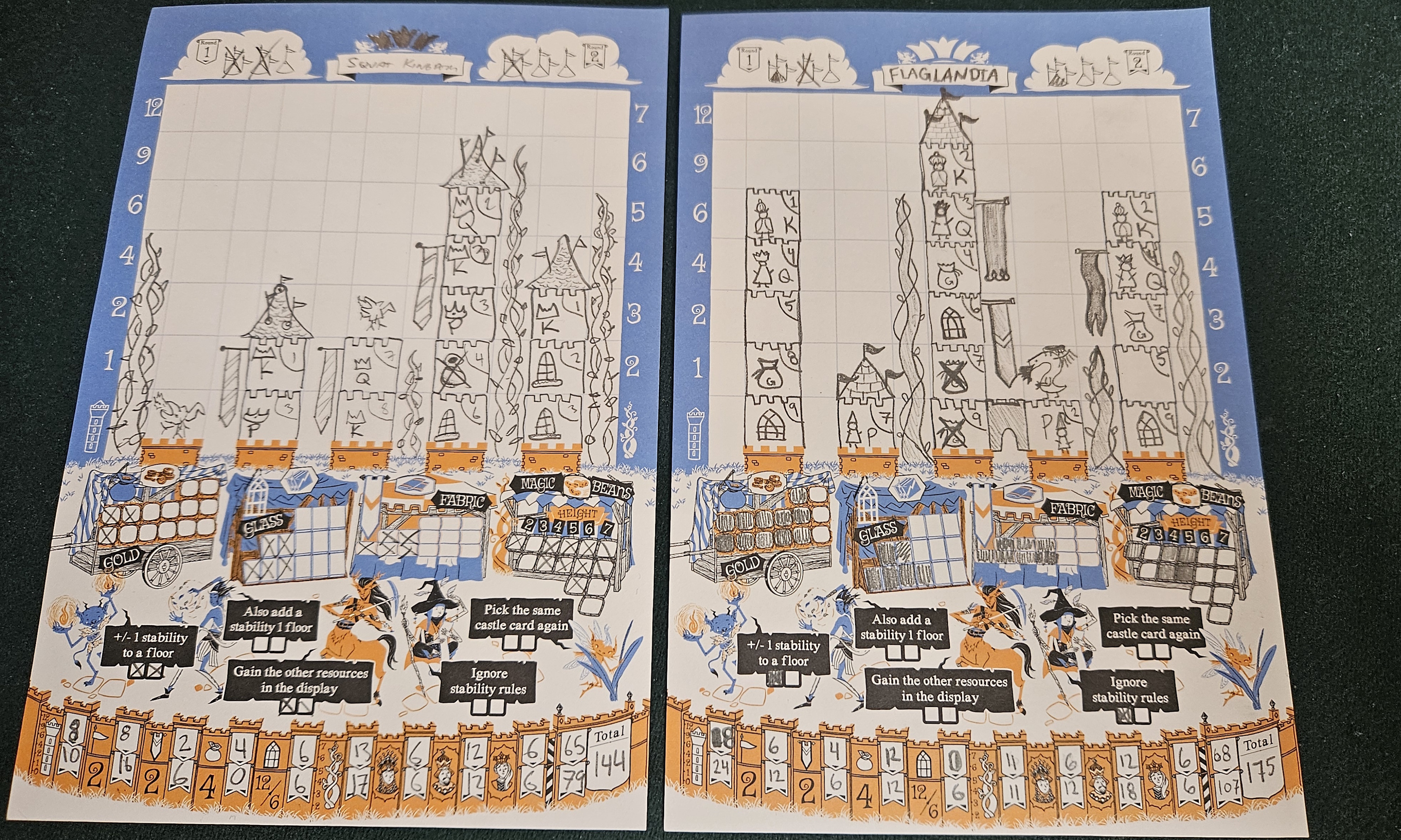
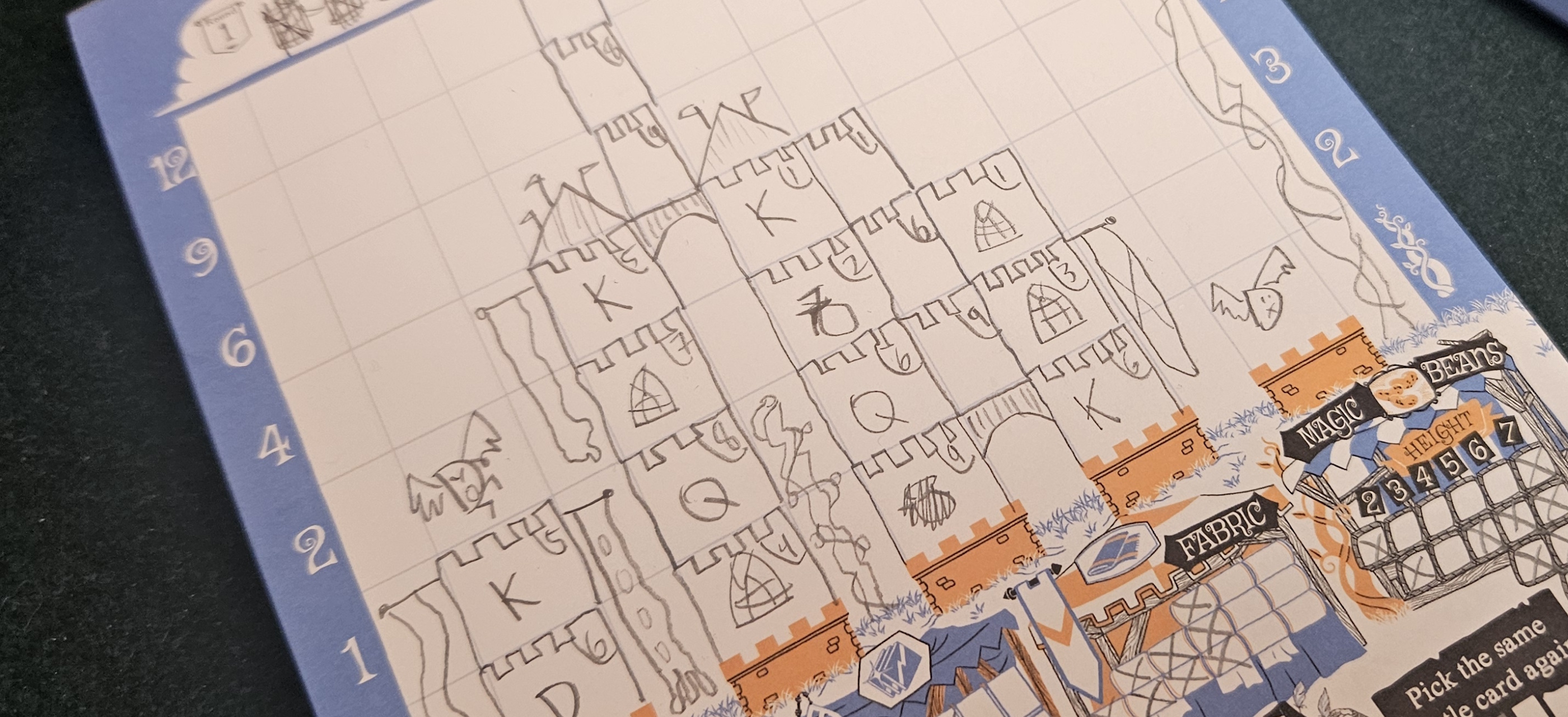
Two very nice towers. (Not mine. Obviously.)

Stop me if you’ve heard this one before. Every round, three cards are flipped. Everybody at the table picks one — different ones, the same one, it doesn’t matter — and pens it onto their personal sheet of paper. Once the deck is out, it’s time to score.

There are a few little distinctions that set Flip Pick Towers apart from its peers, and no, I’m not talking about how the game’s title is a literal description of its phases. For one thing, the game cleverly triggers its scoring phase twice. This potentially pushes you through the deck twice, which is nice for those who are still learning its composition, but also encourages players to hustle toward scoring goals early rather than waiting for them to come together at the last moment. It helps, too, that it’s entirely possible for somebody’s failed castle to end the game a few rounds early. So much for that last tower you were hoping to stretch heavenward.

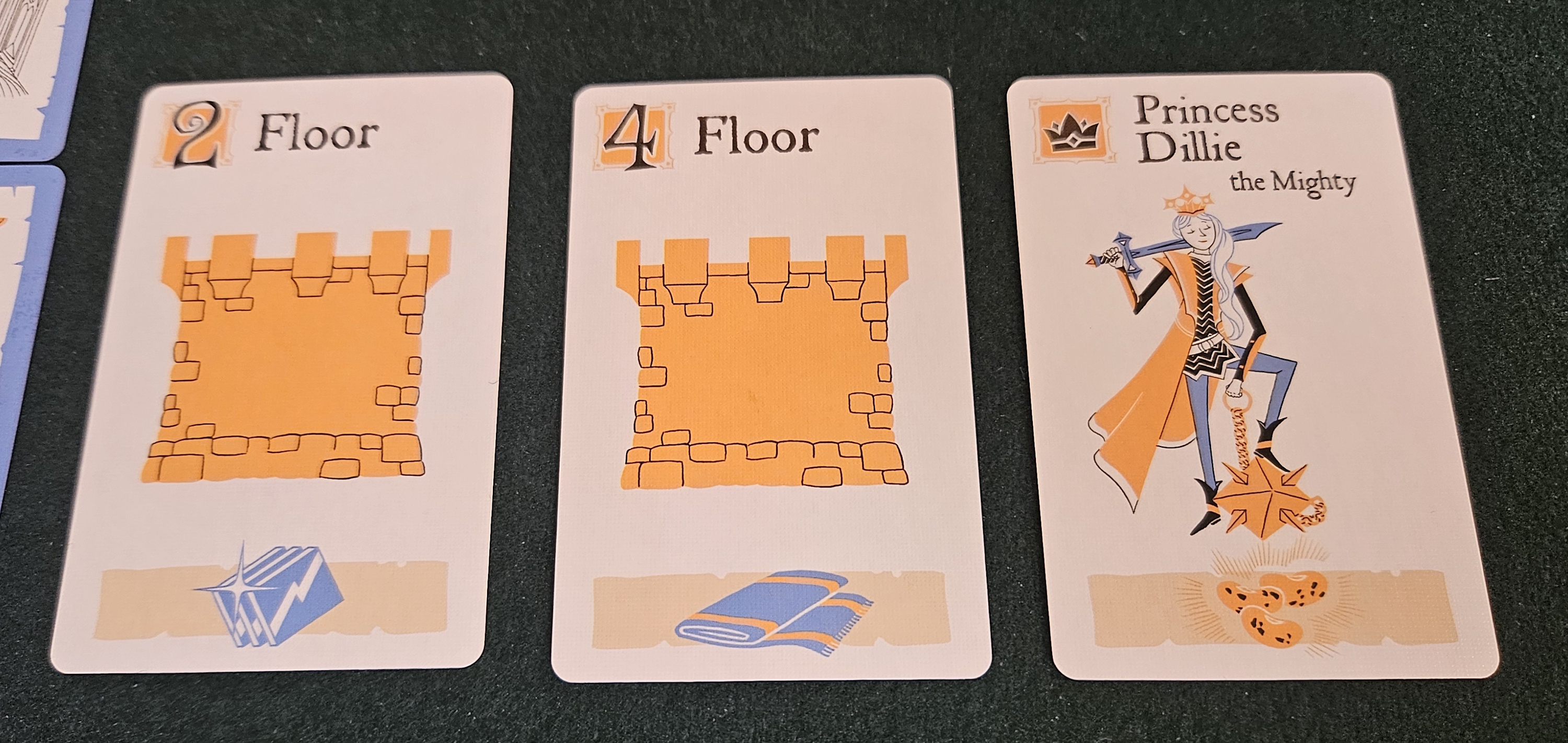
The constituent parts of your castle are simple enough. Most cards represent floors. These you stack like LEGO blocks, always keeping an eye on their stability number, which must tick downward with each successive level. Eventually bridges can span the gap between floors, providing foundations for further building and bypassing the usual stability rule for a moment. Look, it’s basic architecture. If you lean two crumbling minarets against one another, you can pile another few hundred tons of hewn blocks between them. Everybody knows that.

There are also magical creatures who provide special abilities — like, say, ignoring a floor’s stability, easily the most potent ability in the game — rooftops that can earn a few points but conclude a tower’s upward trajectory, and royalty who occupy all those empty rooms to score points. More on their majesties in a moment.

not shown: a good example of the game's diversity, but a great example of what most decisions actually look like

Every turn, you select from three cards.

Finally, every card also provides a material of one kind or another. The format for these is simple enough, adding new features to your castle whenever you complete a material’s column. Hence glass introduces windows to your castle, bags of gold eventually fill entire floors, and banners hang from on high while magic beanstalks creep up from below. In fine flip-and-write fashion, these soon jostle for space. There’s room for planning, but remaining inflexible is a surefire way to get nothing done at all.

The last type of card is a dragon. Argh, the dragon. There are two of these in the deck, meaning you might see four of the winged pests in a sitting, and they’re as unwelcome as it gets. Whenever one of the sky-rodents appears, you either place it atop one of your towers — blocking further construction, which can be a real nuisance if they appear in the game’s early stages — or scrawling out one of your hard-earned bags of gold to buy them off. Thankfully, they are not sexist dragons, and no sacrificial princesses are required.

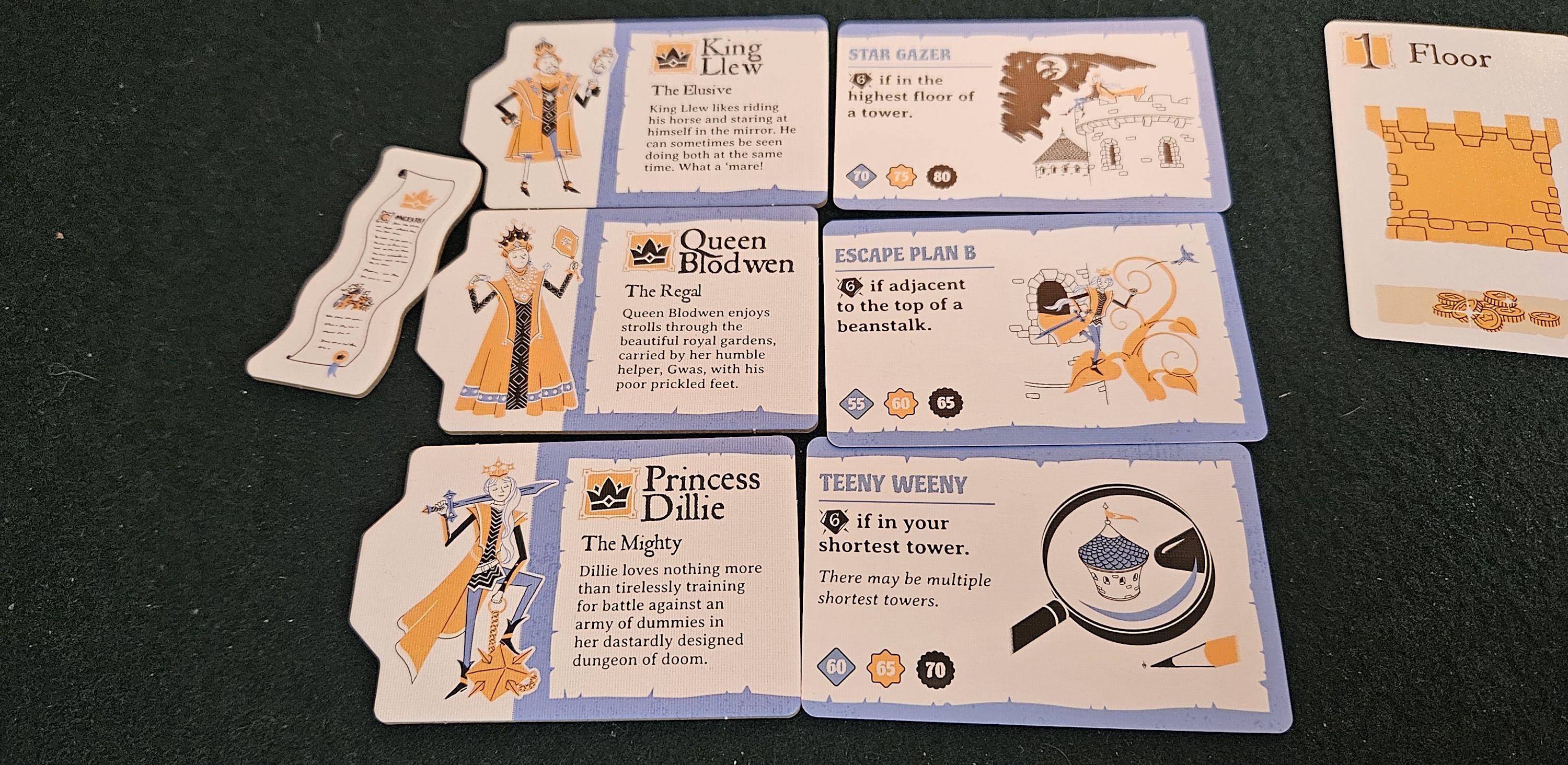
Speaking of princesses, the most interesting offering by far are the royalty cards. Each session assigns an objective to your queen, king, and princess. As their chambers are added to your towers, their points tend to compound. And compound. And compound. It isn’t uncommon for a single royal member to score as much in the endgame as a player earned at the midpoint tally.

King: "3 points per crushed orphan." Queen: "6 points for retracting privileges from the artisans." Princess: "8 points for telling them to eat cake."

The needs of your petty royalty.

In the best of instances, these transform the game’s sometimes obnoxious placements into significant opportunities. Remember those dragons? Well, if your king prefers occupying towers with dragons perched on them, now you can keep your gold and take care of the old man at the same time. All the better if you manage to erect a single tower with a single dragon atop it, then fill the place with four or five stacked kingly quarters. The same goes for the other elements. One session might feature a queen who yearns for escape, encouraging you to place those magical beanstalks next to her chambers rather than doing the normal thing by squirreling them off. Or, heck, a princess who just really likes living near bridges. Don’t we all appreciate a nice bridge?

Not every objective is similarly worthwhile. For every goal that enlivens the game’s placements, there’s another that’s plain uninteresting. After a couple plays, our group reached the point where we would keep drawing through the deck until we found something that felt sufficiently energetic.

Even then, the overarching puzzle doesn’t change much from one session to the next. On the whole, there’s enough to keep everybody engaged, at least for a session or two. But the gameplay is simple enough that, barring the pleasure of scrawling a little castle, with little banners that look like banners and not whatever my castle’s banners look like, there probably isn’t much to keep anyone coming back time and time again.

It is, in other words, a flip-and-write. A very good flip-and-write, a charming flip-and-write, a flip-and-write with plenty of little considerations to account for. But it doesn’t stand up there with the finest of them.

Those are banners hanging from the side of my castle, not shed snake-skins and spent condoms.

Fine. Here’s my garbage tower.

Maybe it doesn’t need to. I’ll admit I’ve enjoyed looking at my friends’ creations, and even letting them laugh at mine. To go with my perfect face for radio and outstanding voice for text, I have excellent penmanship for a keyboard. Once, I wasn’t even sure whether a room’s occupant was a Q, for the queen, or a bag of gold with a little knot cinching it closed.

Anyway. Flip Pick Towers. It’s cute stuff. I’ve had a nice time with it. I suspect I’ll strain to remember it by year’s end.


A complimentary copy of Flip Pick Towers was provided by the publisher.

(If what I’m doing at Space-Biff! is valuable to you in some way, please consider dropping by my Patreon campaign or Ko-fi. Right now, supporters can read about which films I watched in 2025, including some brief thoughts on each. That’s 44 movies! That’s a lot, unless you see, like, 45 or more movies in a year!)

Walletbiters

25. Februar 2026 um 00:21

Gotta say, the art is excellent across the board.

It’s in my nature to appreciate wallets. I own a couple dozen of the things. One for carrying money and eleven-year-old gift cards to defunct smoothie chains, the rest for microgames from Button Shy.

This latest batch includes something experimental, something from a designer whose previous work I’ve loved, and something that’s really just a bigger board game compressed to fit into a wallet. That’s gotta be a home run, right?

Right?

now I want a banana

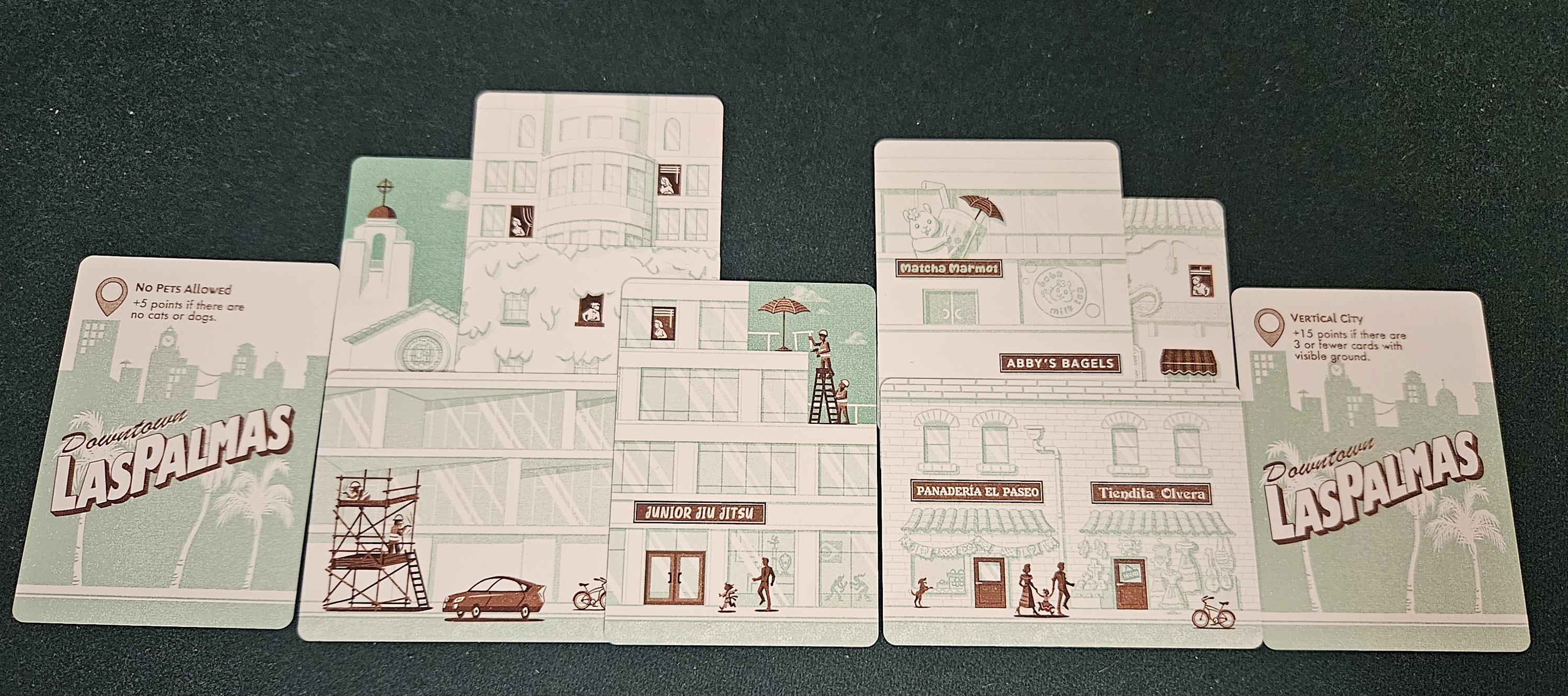
Downtown Las Palmas is the domain of “banana mitts.”

Downtown Las Palmas

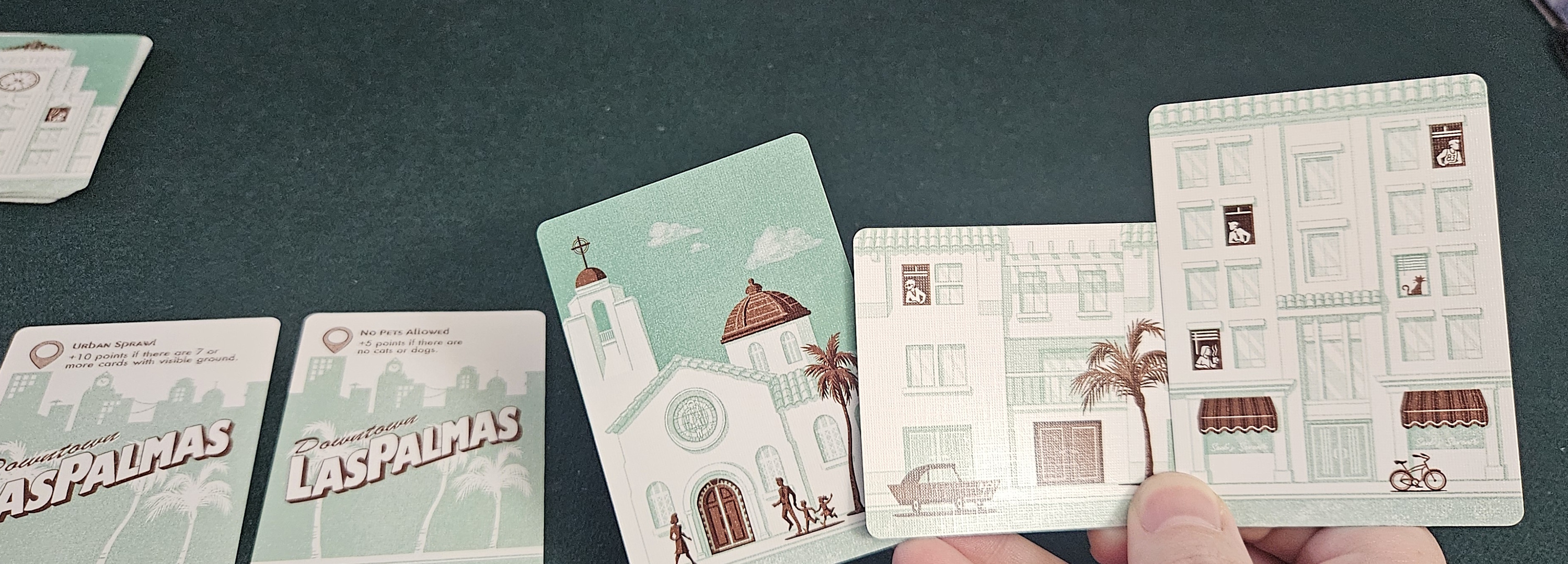
I appreciate a surfaceless game now and then, especially on long flights or while sitting in hotel rooms with tables that barely fit their obligatory lamp. In theory, Erica Pinto’s Downtown Las Palmas is one such game. You’re building a city in the palm of your hand, stretching those finger-webs to maximize real estate. The more cards you stuff into your mitts, the better, earning points not only for volume of cards, but also for every highlighted feature. Along the way, there’s some variability thanks to objectives printed on the back of every card. Stuff like “Traffic Jam: +2 points per vehicle” and “Urban Sprawl: +10 points if there are 7 or more cards with visible ground.”

Sadly, it doesn’t work.

I have wide hands. Not as wide as my friend Chris’s — everybody in our high school group called him “gorilla hands,” they were that massive — but big enough to comfortably reach an octave plus three on the piano. And I can barely hold these things. Maybe it’s the linen finish. Maybe it’s the game’s directives, which require ground-level streets to align and the sky to not intrude like some dimensional rift in front of another structure. These are necessary rules; to function as a society board game, you’ve gotta have rules. Or maybe it’s just my slippery fingers. But whatever it is, the entire thing slides to pieces the instant I’m holding more than four or five of the things.

Dang sky, always ruining my skyline.

The table version is functional, at least.

There’s an alternate way to play. Cards can be arranged on the table, spaced between your session’s chosen objectives. This allows some glimpse of how Downtown Las Palmas is meant to function. The buildings that sprout from the concrete jungle, punctuated by slants of blue sky. The signs over the signs, the awnings and cats perched in impossible places. It’s a lovely thing to see come together.

Playing this way, though, I can’t escape the notion that this isn’t how Downtown Las Palmas should work. Probably because it isn’t. Sure, this is an official variant. But there are other small games about overlapping cards, many of them also published by Button Shy.

In the end, the game remains a lovely concept. Maybe I’ll get to try something else from Pinto before too long.

I'm stronger than these cards. I will always win an arm wrestle, if only barely.

Stronger? Weaker? Who can say?

Phantasmic

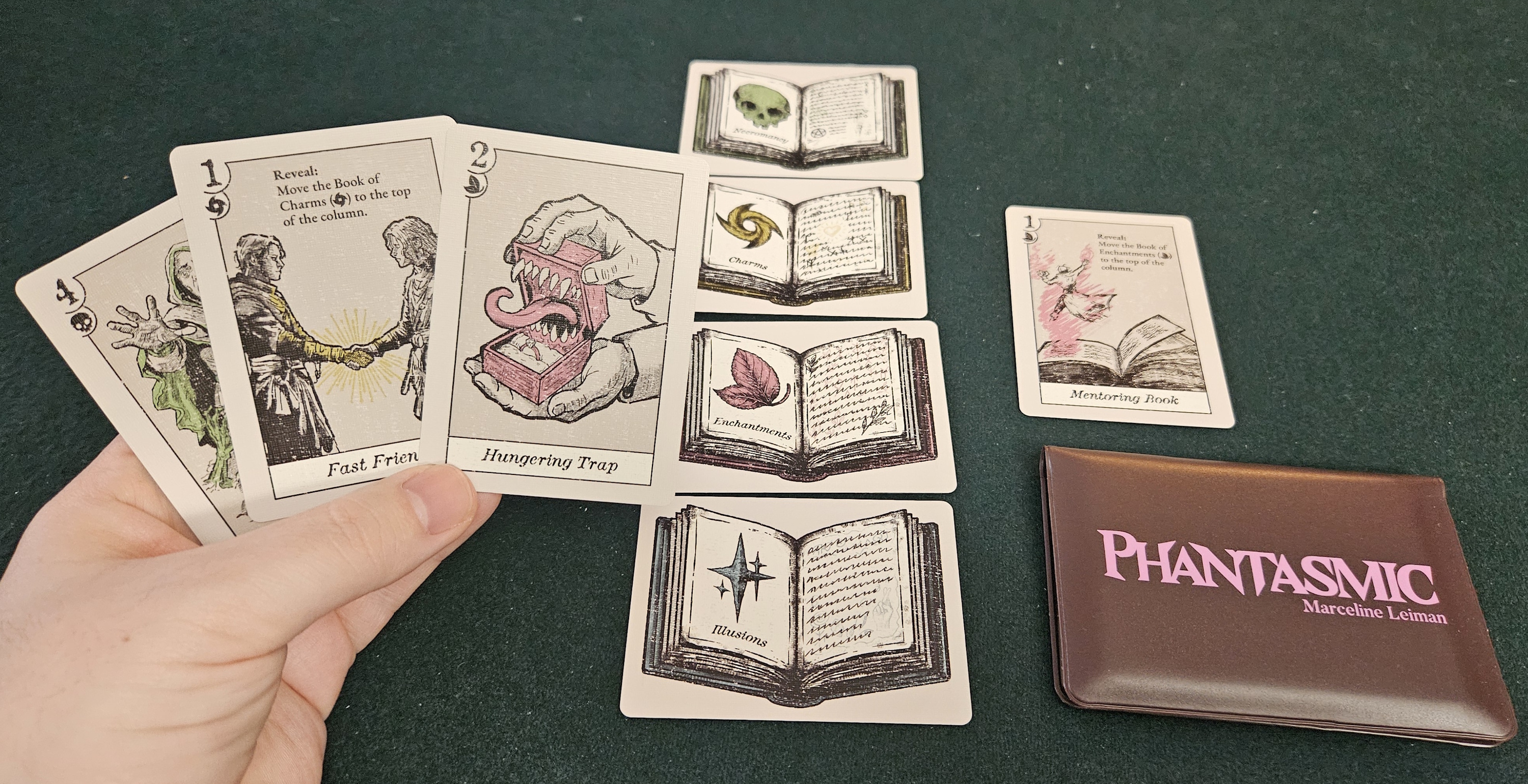
Phantasmic is the smallest of Marceline Leiman’s games, which is saying something when the others are High Tide and Heavenly Bodies. It’s the smallest in terms of rules footprint as well. The game is dead simple.

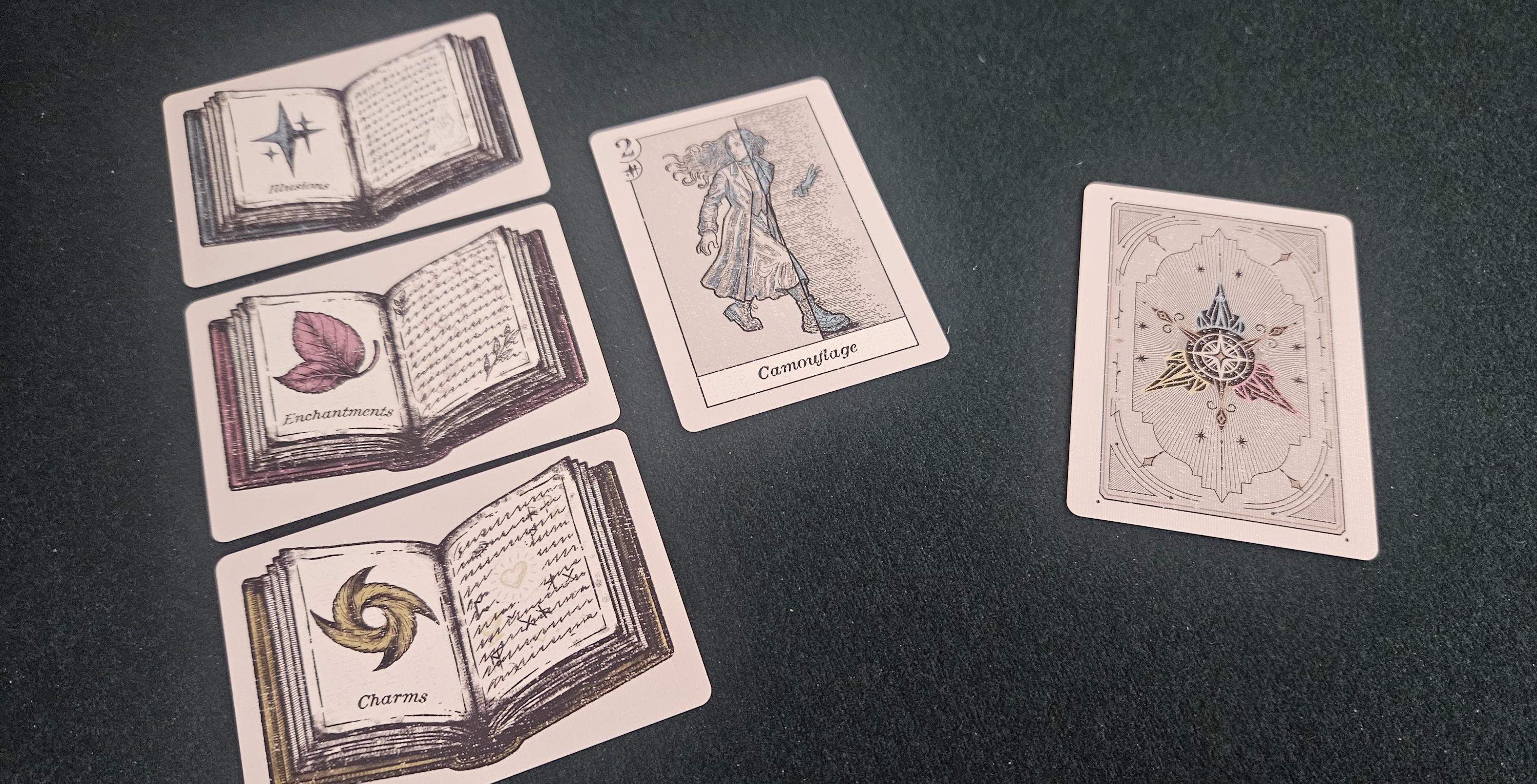
Picture a magical duel. That can’t be hard; heaven knows we’ve witnessed a bazillion of the things. One player is the Leader, a face-up spell before them on the table. The other is the Rival; their card goes face-down. At this point, the Rival announces whether their concealed spell is stronger or weaker than the Leader’s. A spell’s strength is a changeable quality, dependent on its rank and its spellbook’s position in relation to two others. The Leader declares whether they believe the Rival is lying or telling the truth. The hidden card is flipped. Everyone oohs and aahs.
Like I said, Phantasmic is simple. Perhaps too simple. At first brush, it feels almost like a coin flip. I say something, you determine whether I’m lying.

Then I could propose to Summer and have it bite her finger, haha! She would love that! (No, really, she would probably dig it.)
I want a ring box mimic.

But if Phantasmic is a coin flip, it’s a heavily loaded one. The placement of those spellbooks, the various rankings, even any previously played cards, all add to the game’s texture. A coin flip comes down to 50/50 odds; here, the likelihood that my spell is stronger than yours might be rather slender indeed. It helps that certain cards alter the outcome by swapping those spellbooks before the duel is decided.
So it’s a game of probabilities and bluffing in equal proportion. Given the game’s 18-card format, it helps that the card pool is knowable. Button Shy always offers little expansions, in this case a fourth set of spells; it isn’t enough to throw the calculations into disarray, but it does loosen up the probability a little bit.

Okay, so it isn’t quite as vacuous as a coin flip. But is it any good? Perhaps the best way to describe Phantasmic would be to say that I don’t mind it. I might almost use it as a five-minute tiebreaker, rather than a game’s default “whomever has the most leftover resources” or whatnot. But it’s so slight that I struggle to foresee any reason to nab it off the shelf rather than any number of other titles. Wallet games included.

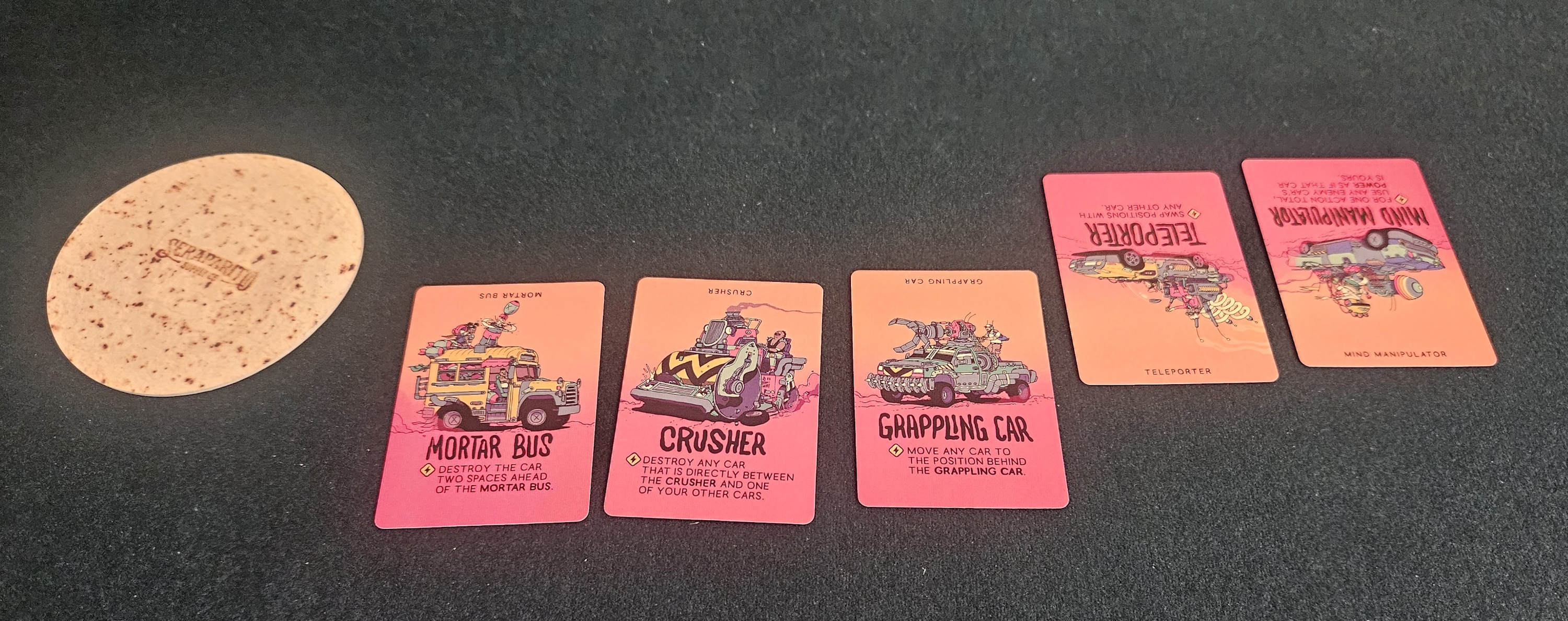
After taking this picture, I chucked it disc-like toward the stack of coasters on the counter, only for it to knock over a pencil holder. So surely it could shred a repurposed school bus.

Pretend the tortilla coaster is a whirlwind.

Dustbiters: Pocket Edition

I remember being curious about Dustbiters a few years back, that collaborative design by Robbie Fraser, Jan Willem Nijman, and Terri Vellman, in no small part thanks to Vellman’s lovely pink-hued trashheap illustrations. It’s basically the sandstorm scene from Fury Road, all those cars gunning their engines and puffing propane-jelly, while being ripped apart by a duster wider than Texas.

To my delight, Button Shy’s Pocket Edition is Dustbiters, albeit in a smaller package and minus only a few cards that are immediately replaced by the expansion. When the original game hit the scene, I had no idea it was functionally a microgame itself, tallying a slender twenty-one cards. I might have even been irritated at seeing its contents floating inside a too-large box.

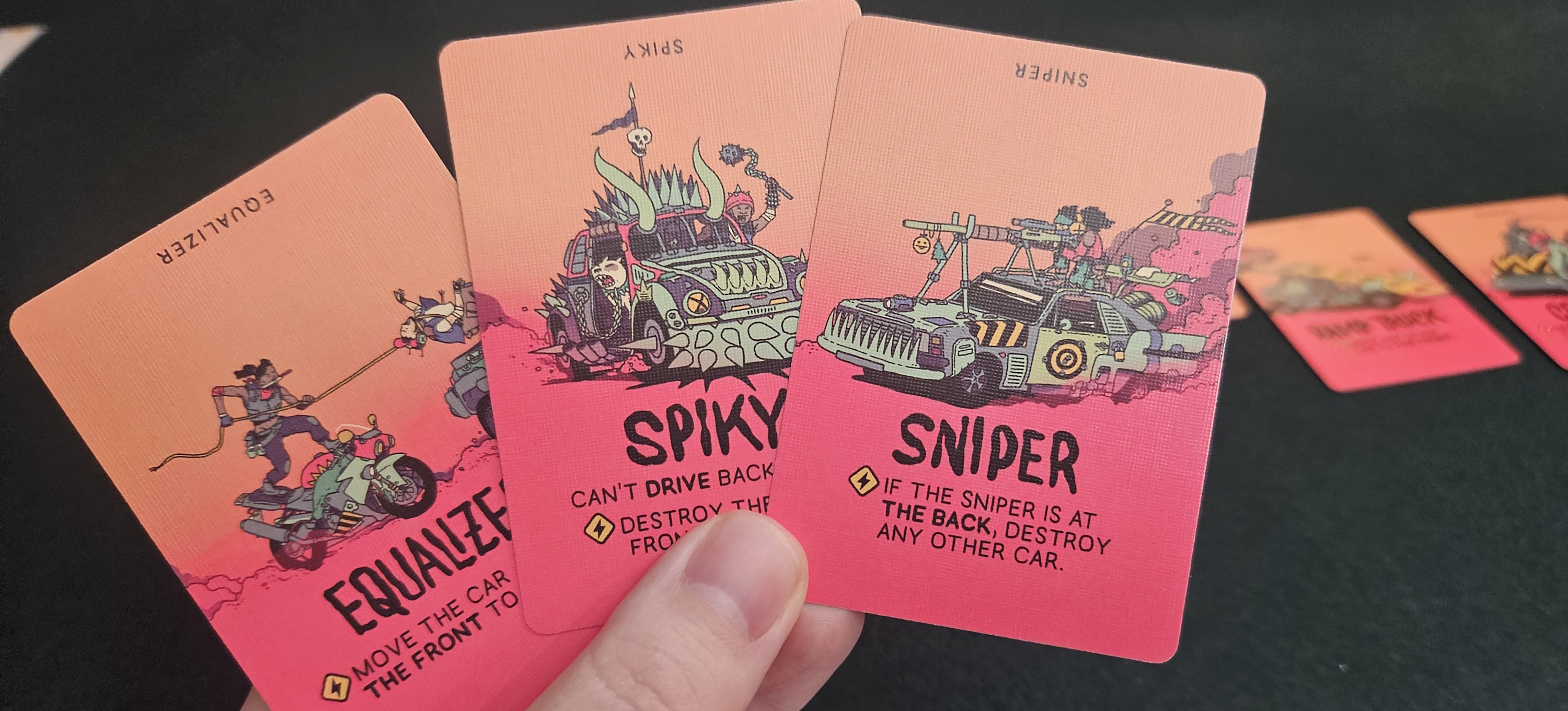
Right away, Dustbiters excels on multiple fronts. The artwork is perfect, of course, those little road-freaks guffawing as they tear across the wasteland. The gameplay is also no slouch. Six cards begin on the table, three oriented toward me and the rest facing you. Every turn offers three actions, whether spent moving vehicles up or down the line, triggering abilities, or deploying reinforcements to the melee.

From there, it’s a bloodbath. The goal is to be the last player with any cards on the table. Every turn will result in multiple casualties, and that’s if you’re shirking your homicidal duty. Thanks to the storm bearing down on your position, at least one car will be demolished at the conclusion of each turn. The only path to survival is sheer forward propulsion.

just good friends having a good time

A day out with the crew.

What a great little game. There’s some wonderful overlap between the vehicles’ appearance and their function, breeding a certain irradiated logic. There’s a Jammer with an old satellite dish wedged atop its minivan frame; it cancels the abilities of both adjacent cars. A repurposed steamroller can crush its neighbor, but only if its victim is sandwiched by another of your vehicles. A Ramp Truck lets you fling your car haphazardly to the front of the line. The blood-bag Max tethered to the front of the Martyr car may absorb any other hit.

Here’s something that tickles my fancy: quite often, designers stretch the microgame’s 18-card limit by pressing their cards into multiple duty. Each card has two sides and many orientations, after all. Dustbiters doesn’t need the help. All it takes is a conga line of murderous gas-guzzlers, some nasty time pressure, and a few simple rules. Five minutes is all it takes to play, but there’s more drama compressed into those five minutes than… well, than in certain nu-euros about flinging tourists into outer space.

Of the trio, Dustbiters is the clear frontrunner, which means it is the sole title to not be shredded by the wasteland storm of my judgement. Dustbiters, I verily witness thee.


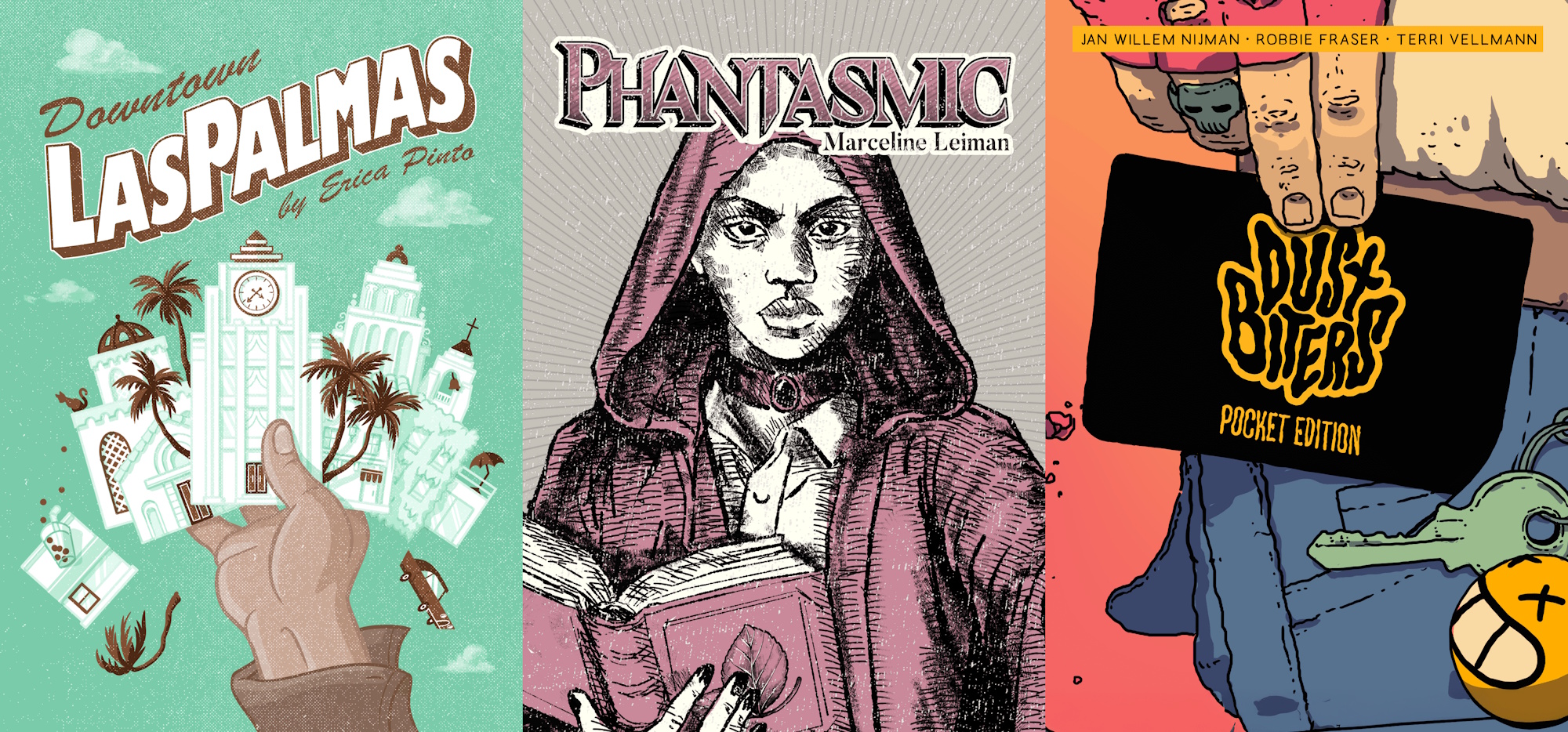
Complimentary copies of Downtown Las Palmas, Phantasmic, and Dustbiters: Pocket Edition were provided by the designer.

(If what I’m doing at Space-Biff! is valuable to you in some way, please consider dropping by my Patreon campaign or Ko-fi. Right now, supporters can read about which films I watched in 2025, including some brief thoughts on each. That’s 44 movies! That’s a lot, unless you see, like, 45 or more movies in a year!)

Triple-Triple Omelette Burger w/o Cheese

24. Februar 2026 um 00:11

I'd eat there.

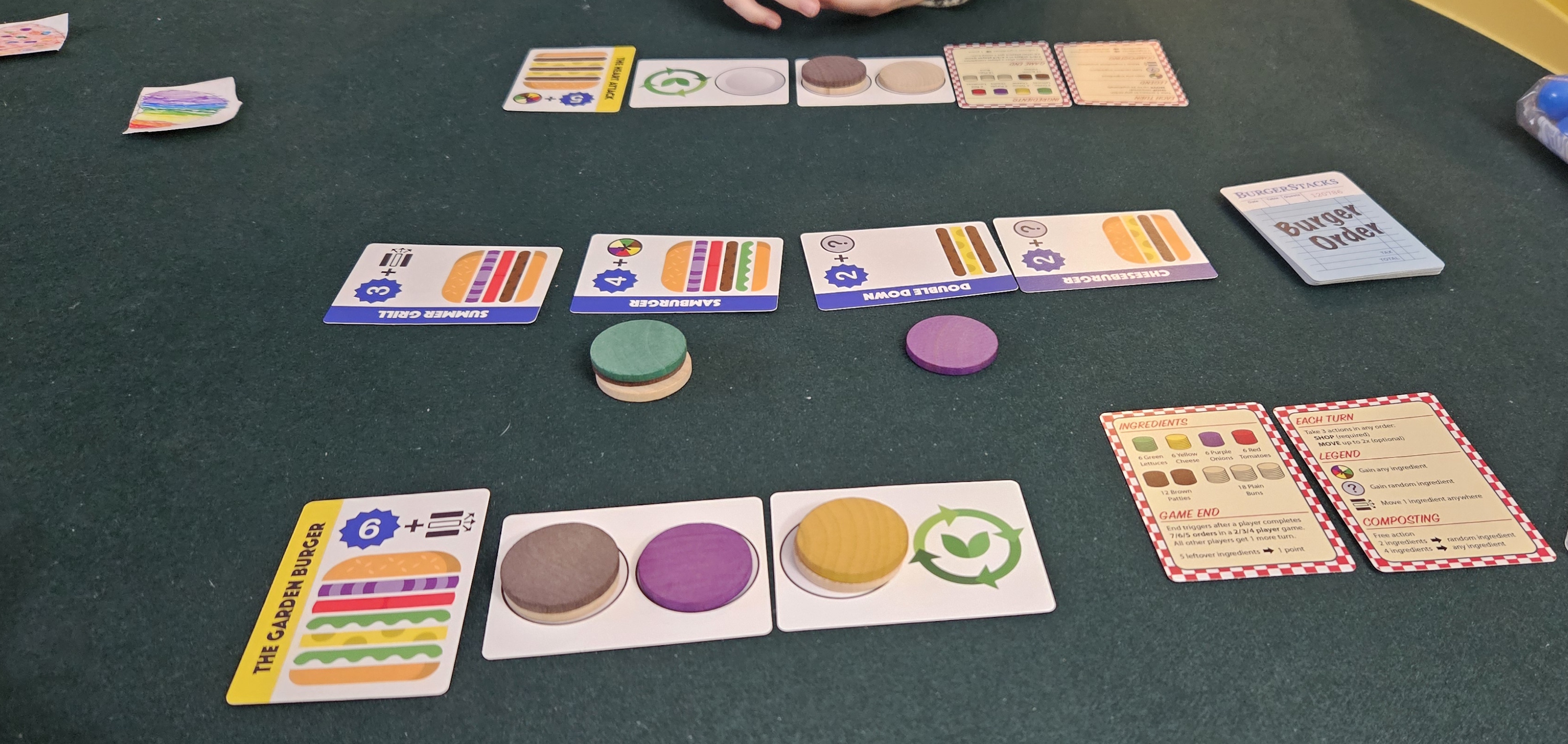
Sold initially at the Indie Games Night Market, Joseph Z. Chen’s Flip Stack Burger Shack has all the markings of an indie darling: its not-quite-smooth discs look great on the table, the gameplay is tactile and amusing, and it even comes in a bag. (All the best indies come in a bag.) But what I least expected from it was a cerebral puzzle that reduced my brain to onion jam.

Can you make my favorite burger? Nope. There aren't ingredients in the right colors.

Sandwich artistry.

Picture this. It’s your first day on the job. The burger shack down at the beach is your haunt, and there are already people lining up at the window. The orders are coming fast and hot. Classic burger! Tomato grilled cheese! Diamant deluxe! Lavender burger! Your assistant begins flinging ingredients your way. It’s all you can do to flip the piles onto the proper buns.

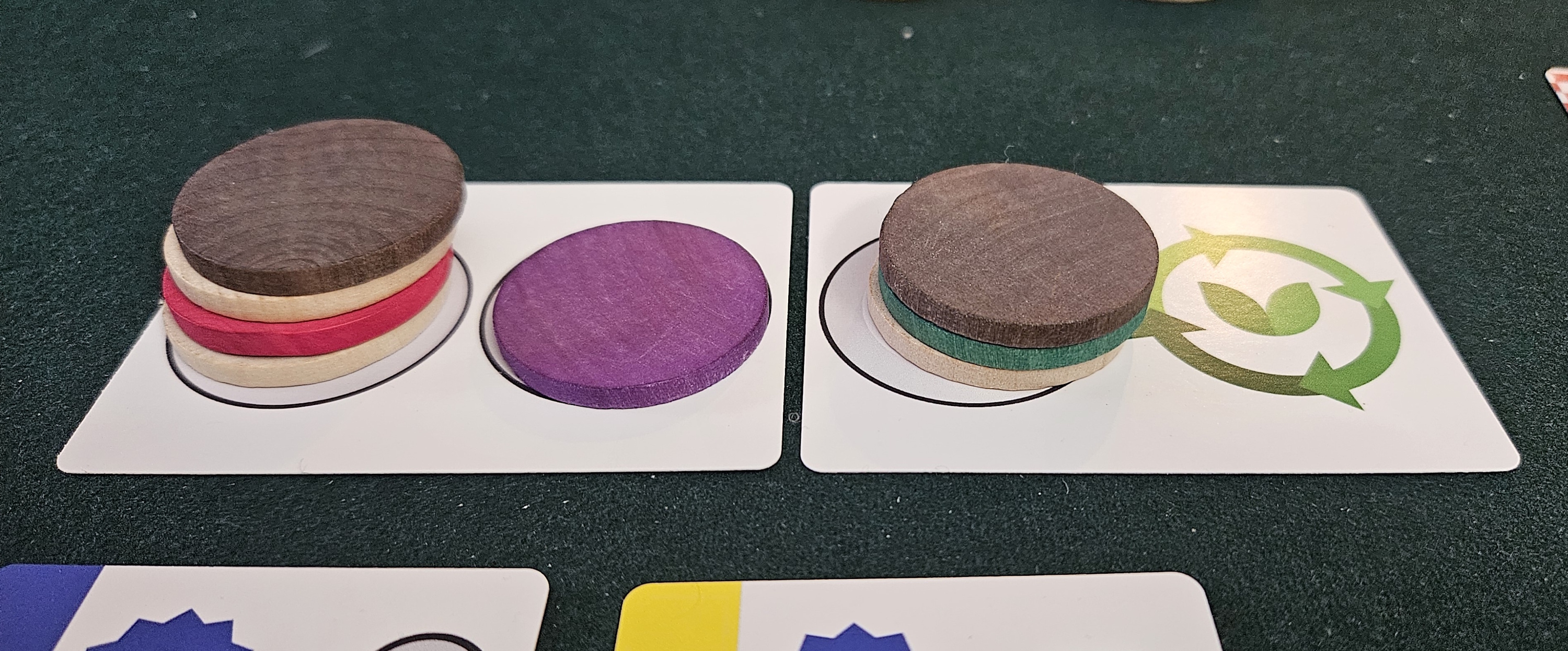
This isn’t quite how Flip Stack Burger Shack plays — nor does this particular shack deserve the highest food safety rating — but it’s close enough. Drafting from shared stacks, players take handfuls of ingredients, flip them this way and that, and slop them into something resembling an edible hamburger. Ideally before their coworkers can snipe the order out from under them.

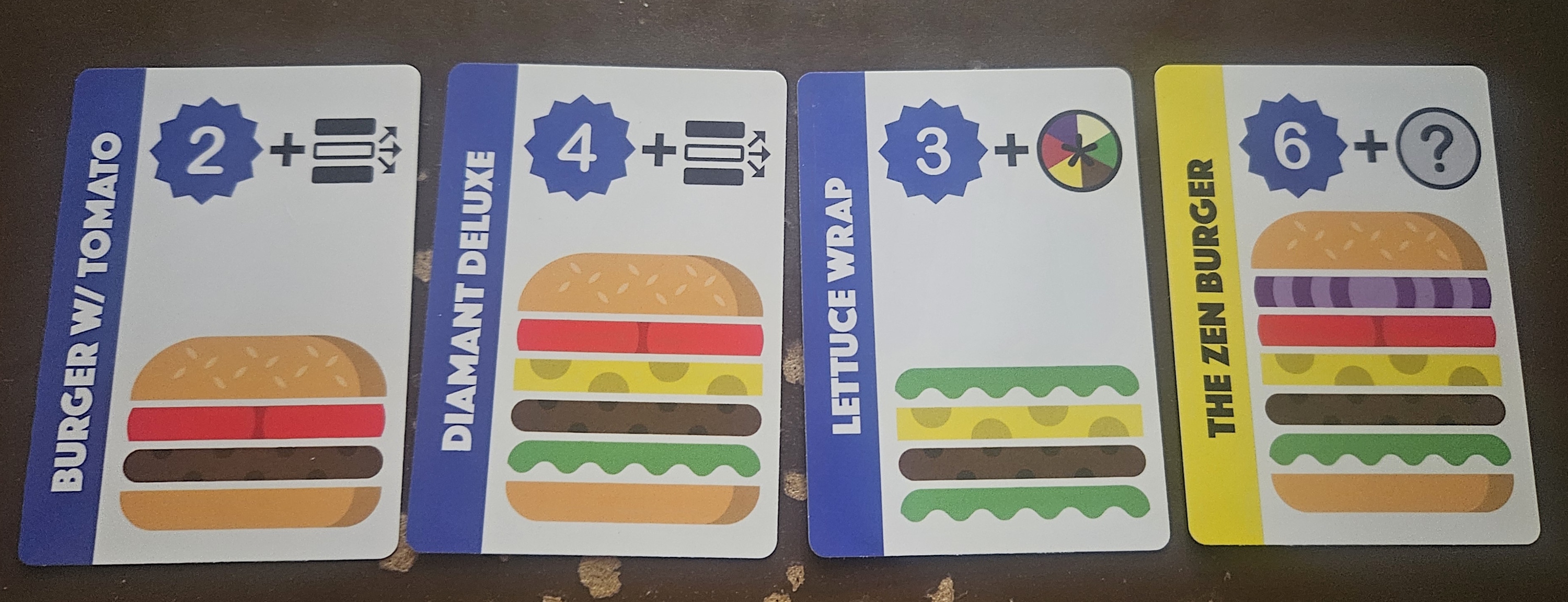
Let’s get the quibbles out of the way. For a game about flipping burgers, Flip Stack Burger Shack is a strangely deliberate event. When you’re trying to assemble a particular sandwich — let’s say an Oklahoma — you’ll be staring at a diagram. In this case, a bun, patty, cheese, and onion, topped off with another bun. But building that burger is tougher than it looks, especially when the stacks begin to accumulate some elevation. At any given time, you might be staring at a single ingredient, some lettuce, the stack that was replenished right before your turn, but then ever-increasing stacks that might reach a half-dozen or more ingredients at the same time. Those slop piles can be useful, but they also tend to be tougher to use. This requires the titular flipping and stacking, often to separate out the necessary ingredients before they arrive atop the correct sandwich.

Or maybe you could chuck the whole thing into the composter and, via culinary magic, produce a more desirable ingredient from the bag. Sayonara, entire heads of wilted lettuce; say hello to a single sliced tomato.

Either way, this process is anything but rapid. More often, Flip Stack Burger Shack is thinky. Ponderous, even. With four players, the downtime between turns threatens to become bloated. Like unrinsed lettuce or a burger patty left too long in a surfer’s hatchback.

If you saw these hanging on the back wall of a Wendy's, would you find it endearing or distressing?

Handy burger diagrams.

But with the right crowd of players or the right player count, whichever lets you move at a steady clip, that same thinky edge makes Flip Stack Burger Shack an unexpected treat.

I’ll give an example. Most burgers need buns. Easy. Most burgers also need patties. As a result, it’s a relatively safe bet to nab extra buns and patties. But what happens when the easy pickings have been nabbed? Now the game shifts into riskier territory. With some clever acquisitions from the ingredient counter, not to mention a few timely flips, it’s possible to head off rival sandwich artists.

Those flips, by the way, are handled with perfect ease. Any time you pick up a stack, whether from the market or your own plates, you’re free to grab some or all of the tokens, and then you’re also free to flip them as you see fit. This doesn’t solve every problem; indeed, it’s surprising how often you’ll need multiple maneuvers just to lever a tomato out from under an ill-placed slice of cheese. But it provides some truly pleasant tactility. It helps that the tokens are wood. One of the benefits of being a small-batch production is that the whole thing’s aesthetic is perfectly minimalist, from the painted tokens to the receipt-book burger diagrams. Flip Stack Burger Shack isn’t the most innovative title in the world, but it feels lovely to handle.

That handling is the core of the entire experience. Some games are about big ideas. Others are about sequences, or engines, or fancy math. This one is about the joy of moving things, shifting and rotating them, feeling their grain on your fingertips, and doing your darnedest to keep the right stack in your mind’s eye.

mmm cheese

Even from a distance, these burgers are handsome.

And, well, that’s all there really is to it. Flip Stack Burger Shack is another indie market title that, like last week’s Imps, will hopefully draw enough attention that it gets picked up for wider publication. Just don’t report the shack to the food inspector’s office. I’m pretty sure none of these burgers are gluten, meat, or dairy free.


(If what I’m doing at Space-Biff! is valuable to you in some way, please consider dropping by my Patreon campaign or Ko-fi. Right now, supporters can read about which films I watched in 2025, including some brief thoughts on each. That’s 44 movies! That’s a lot, unless you see, like, 45 or more movies in a year!)

Fickle Little Guys

19. Februar 2026 um 06:14

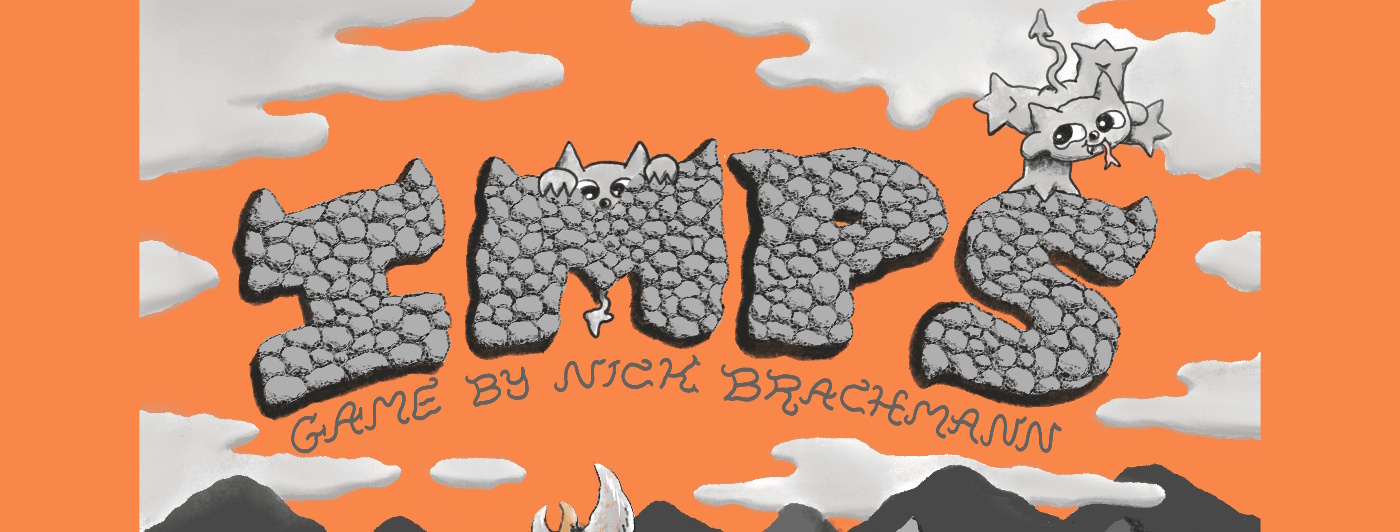
I'm the imp hiding behind the letter M.

Whenever a new fad mechanism comes around — deck-building, trick-taking, now it seems maybe dominoes might be having a moment — I’m disappointed to discover it isn’t mancala. Because mancala is great. Speaking of which, here’s your annual reminder that Nick Case’s Pilgrim was the most overlooked title of 2023.

Imps was Nick Brachmann’s offering at this past Indie Games Night Market. You’ll never guess where I’m going with this, but it’s mancala! Mancala with fickle little imps!

They're also hella adorable. Everyone knows that.

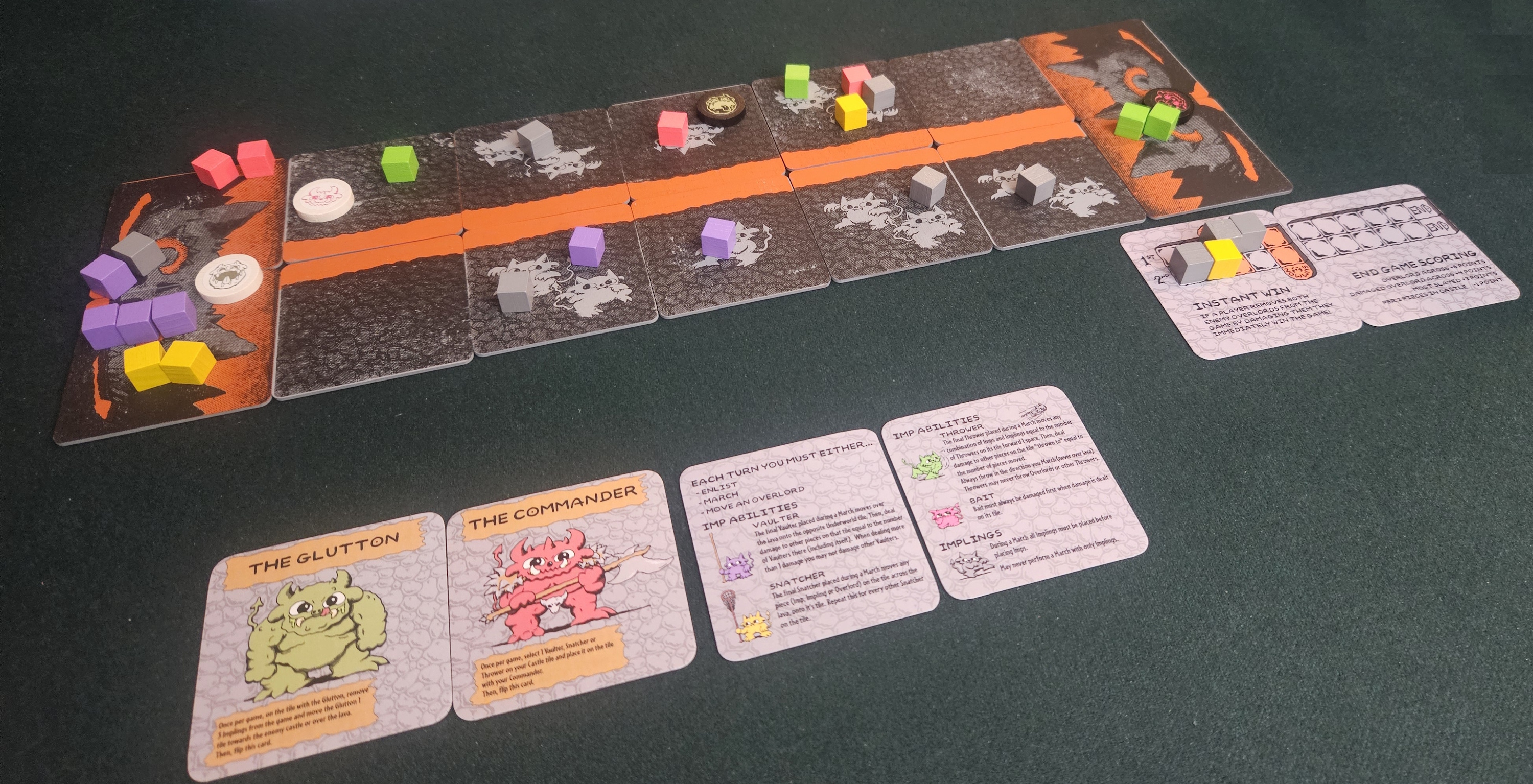
Everybody knows imps live along rivers of magma.

The fickleness of your imps is perhaps the game’s defining characteristic. Which makes sense, given mancala’s customary permissiveness. When the game begins, both sides are safely tucked into their own fortress, the game’s analog of a mancala board’s player stores. Your army consists of a few imps of varying colors — we’ll get to those — plus two chieftains represented by big chunky discs. Other than that, there are a few neutral implings milling around the no man’s land between fortresses.

Turns are simple. Most of the time, you march. This is familiar mancala fare: you pick up all imps of a color and sow them one box at a time until you reach the final space. If there were any gray implings in your starting space, you also pick them up for the march, potentially increasing your reach.

Crucially, depending on the imp that lands in that final space, something exciting happens. Each color represents a different… hobby, perhaps, or impish vocation. Purple imps are vaulters. They leap across the river of lava that separates the lanes. Of course, they soften the landing by flattening an imp on the opposite side. Yellow imps are snatchers; they do the inverse, dragging targets across the lava to their own space. Green imps are throwers. They throw other imps forward. Like vaulters’ vaulting, this kills an imp in the target location. Pink is bait. They absorb hits before their kin.

On its own, this produces quite the textured landscape. It’s possible to enlist imps from the spaces in front of your fortress, ensuring you’re never without a move of some form or another. But you can also command any gathering of imps anywhere on the board, apart, naturally, from those directly dwelling in your rival’s fortress. Like I said, they’re fickle little guys. It’s the perfect flair for mancala, a game that has always emphasized the management of risk and the turnabout of using an opponent’s moves against them.

Here, though, those contrasting colors generate little hills and valleys of danger and possibility. It’s tempting to open with a rush of vaulters, but that fills an entire lane with purple dudes that might fling themselves across the lava at a moment’s notice. Similarly, it’s easy to get caught in a back-and-forth war of throwers, both sides chucking bodies to smash other bodies, but this tends to go nowhere fast.

Indeed, Imps grows more interesting as its subtler possibilities unfold. That’s where those chieftains come in.

our weekly meal plan

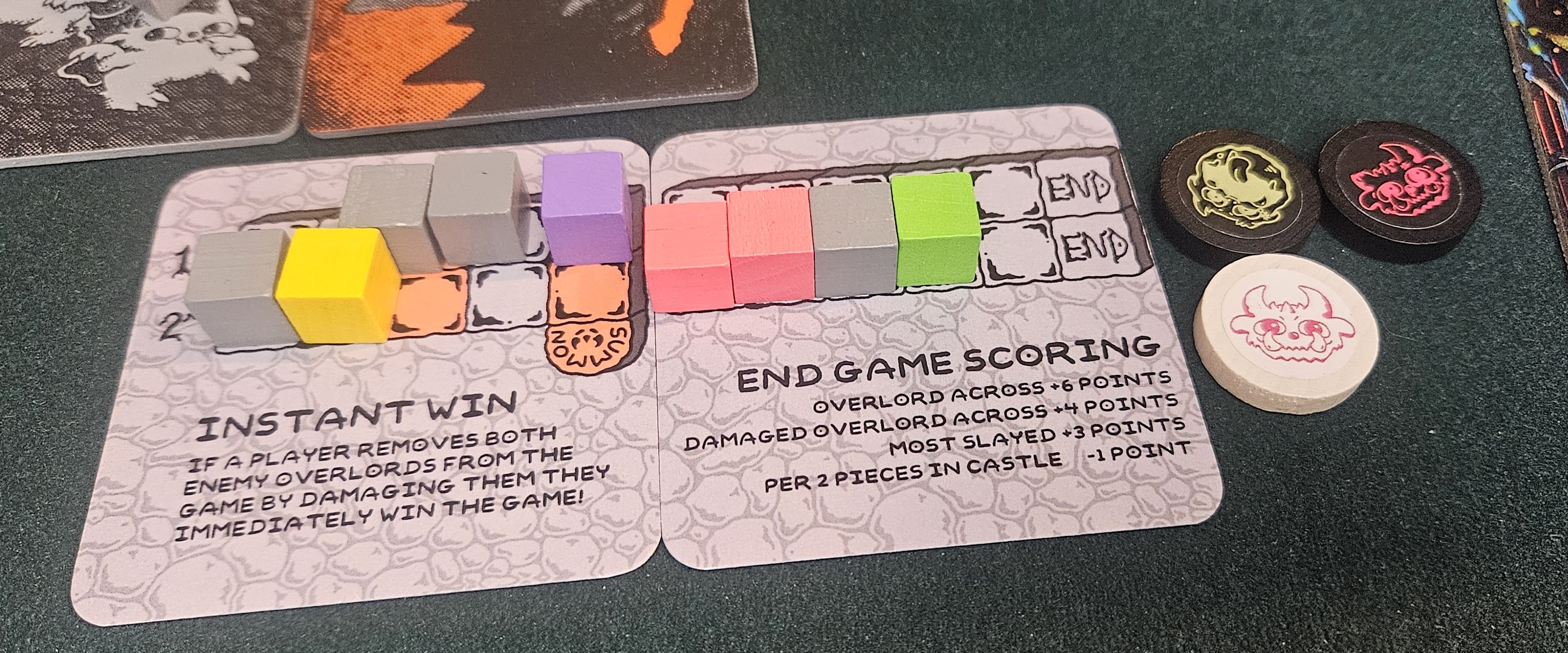
Tracking our respective kills.

At various points, your chieftains will leave the security of their fortress, whether by choice or after being lured out by casualties in the lower ranks. Unlike their smaller brethren, they’re always loyal. No switching sides for a chieftain. But they’re also slow. Rather than marching forward with stacks of imps and implings, they can only move a single space at a time, either trundling forward or hopping to the opposite side of the river.

They’re also vulnerable. Two hits and they’re dead. Oh, and losing both chieftains means you’re out of the game, so it behooves you to keep them safe at all times. This is no easy task in a game that two turns in resembles a tropical Skittles-themed minefield.

But chieftains also represent one of the game’s greatest opportunities. Because if you can enter the opponent’s fortress with a chieftain, you earn a heap of points. As in, more points than you can possibly earn through vaulting and throwing imps. The scoring is carefully done, encouraging risk but also penalizing it, rewarding murder but not so much that it becomes the default route to success.

Okay, scratch that. Played with novices, murder is absolutely the default route. It takes a few plays before Imps reveals the subtler game beneath the impish purge happening on the surface. Before it reaches that point, the whole thing feels like a slog of attrition. I hit an imp; you hit an imp; repeat until the game concludes.

It goes without saying that that’s not the best way to play Imps, either for the sake of enjoyment or strategy, but this is one of those games I can see someone dismissing after a poor initial impression. (Not that the game, with its hand-stamped pieces and low print count, is readily available, but that’s another matter, one someone will hopefully rectify.) Rather, the game is an onion. It has layers. Yes, I’m pretty sure that simile popped into my head because of Shrek. Ogres, imps, it’s all a matter of height. That probably makes me a fantasy racist.

My quibble: it would be nice if the healthy and damaged sides of the chieftain discs were more distinctive.

Attacking a chieftain.

Played the right way — with consideration for every move, yielding only the barest advantages and striking mercilessly — Brachmann has done something remarkable. Imps takes the simple rules and interplay of mancala and tweaks the formula with the gentlest of touches. The result is something that feels timeless and new at the same time. I genuinely hope this becomes one of the titles to break the confines of its indie market origins; these fickle little guys deserve to be traded between as many chieftains as possible.


A complimentary copy of Imps was provided by the designer.

(If what I’m doing at Space-Biff! is valuable to you in some way, please consider dropping by my Patreon campaign or Ko-fi. Right now, supporters can read about which films I watched in 2025, including some brief thoughts on each. That’s 44 movies! That’s a lot, unless you see, like, 45 or more movies in a year!)

Yer All Sheeps

17. Februar 2026 um 22:40

whimsy! we've got some whimsy here!

For my money — or, all right, for my attention — Blaž Gracar is one of the finest puzzle-makers of this generation. Between All Is Bomb and LOK, I’ve spent countless hours fiddling my way through some conundrum or another, thinking the madman must have left a typo on the page, only to let out an exasperated sigh as, of course, the solution was there all along. Even his lesser efforts, Abdec and Workworkwork, have proved worthwhile.

Herd is his latest project, and its adorable stacking domes bridge the gap between puzzle book and board game. In some ways it’s his most “straightforward” offering. Of course, that still means it’s twisted and full of secrets.

especially because I've already solved this one. look, you can see it. solved. duh. easy.

Oh, this won’t be too hard, will it?

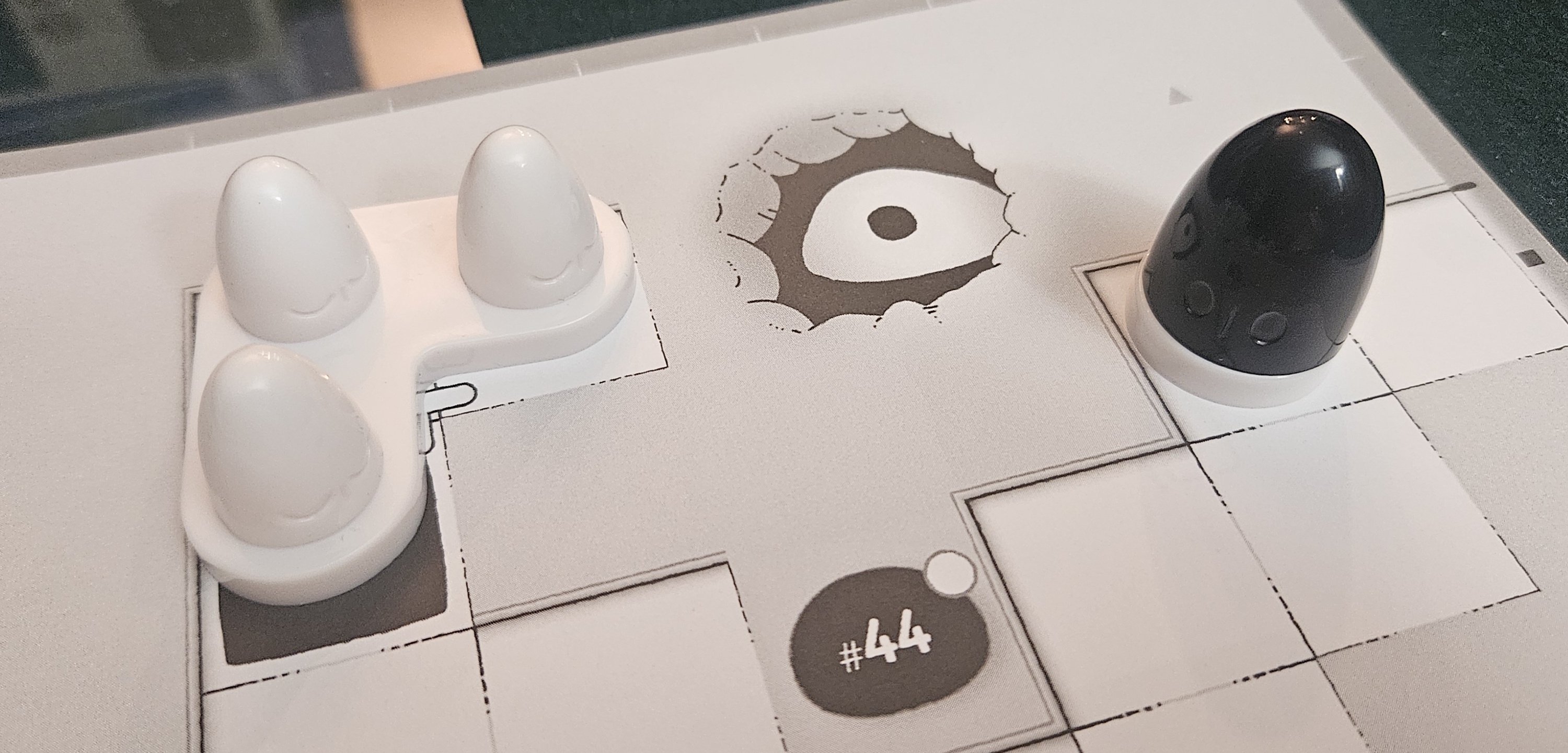
At a glance, Herd is a sokoban game. A block-pusher, to use the more colloquial term, one of those playthings where you can see the pieces on the board, can see the receptacles those pieces need to be slotted into, only there are innumerable steps and switchbacks between source and destination.

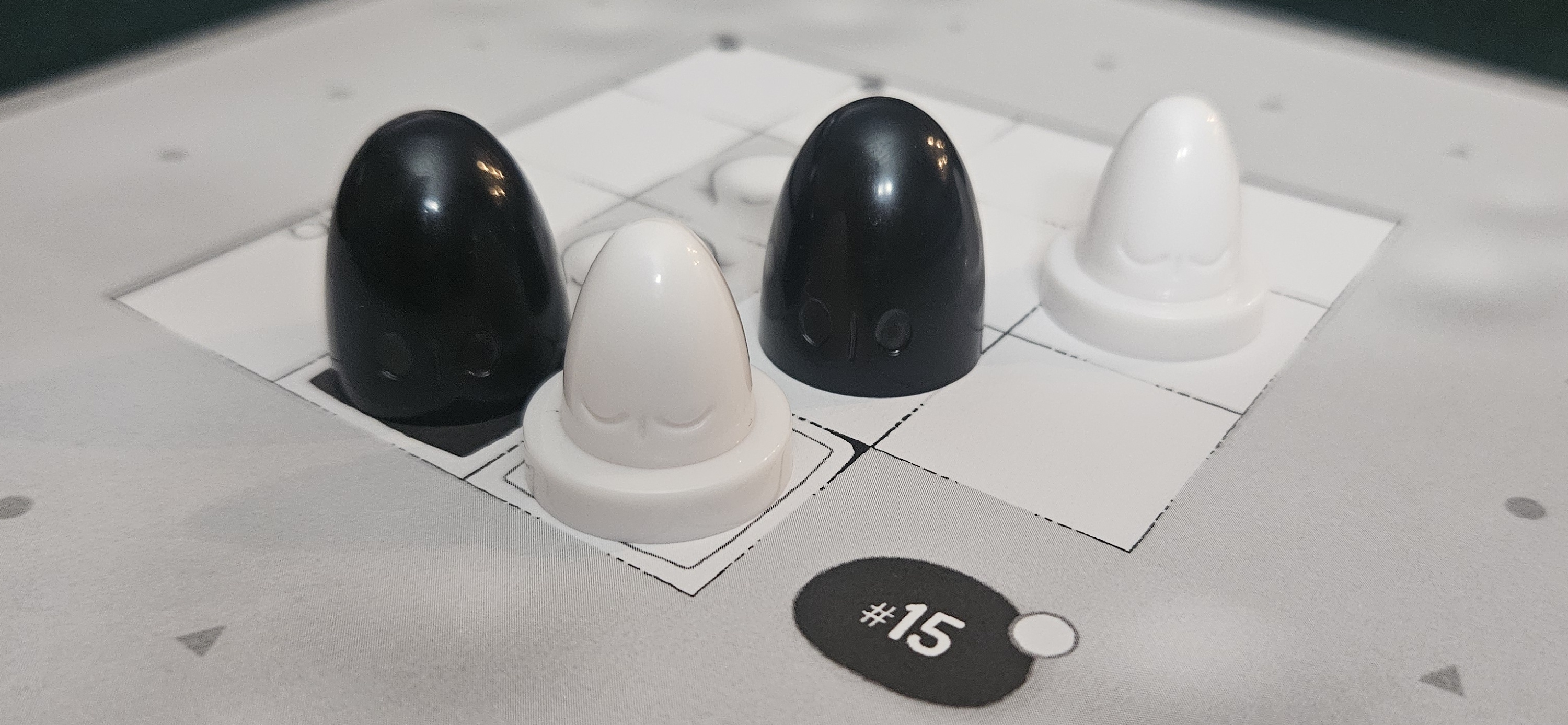
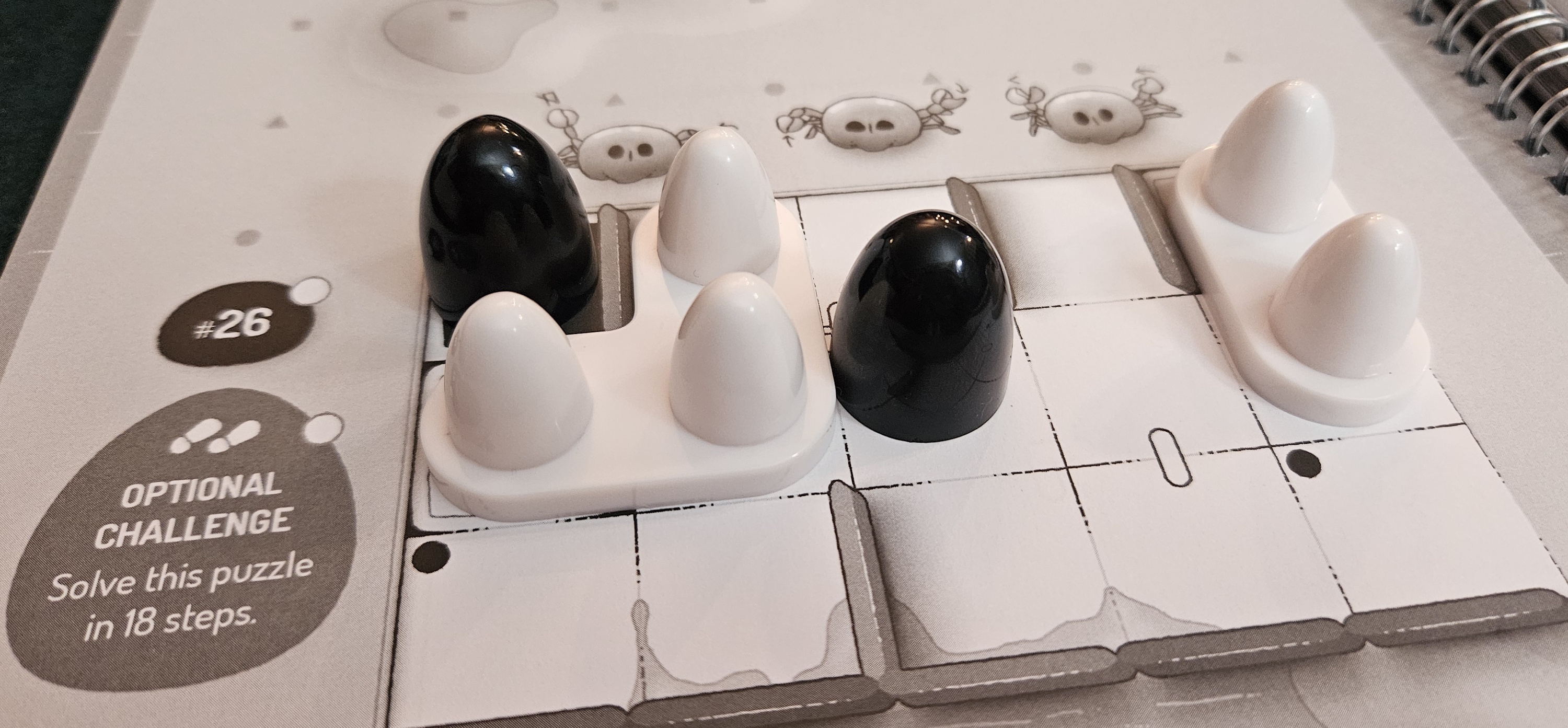
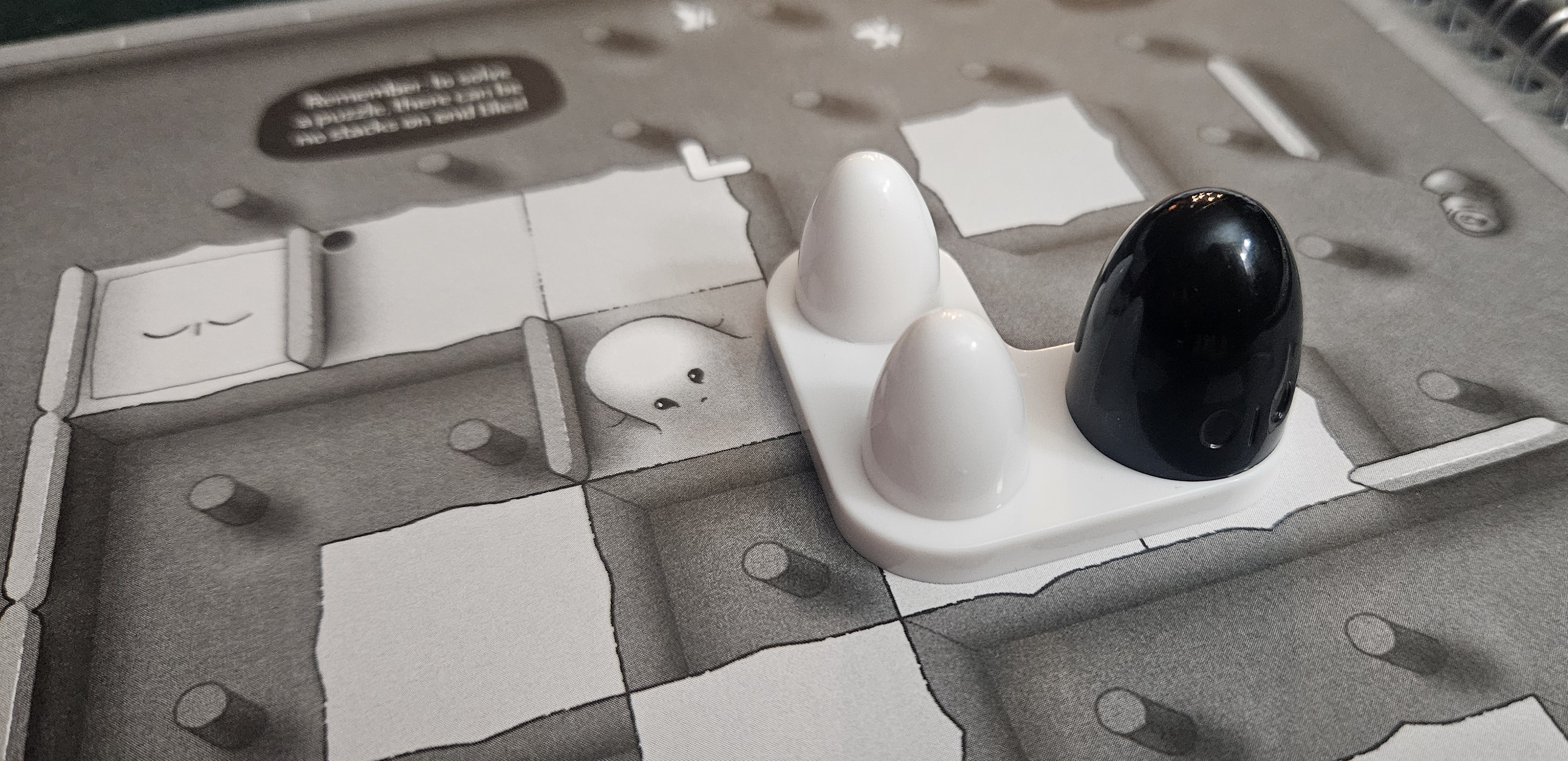
The wrinkle here is that your pieces are no ordinary pushers and pushees, but rather herders and herdees. The two black pieces are shepherds. Their default motion is the slide, like rooks gliding across a chessboard. As soon as they reach a bump — whether another piece or a peg printed onto the page — this transforms into a simple hop, one space over the intervening obstruction. Hopping may result in a shepherd landing atop another piece. This gives them command of whatever is underneath them, in many cases a white sheep, immobile on their own. Now they glide together, shepherd and sheep, letting you shift the requisite pieces ever closer to their destination.

Herd is presented as a spiral-bound book of puzzles, and its first few pages are simple enough. A hop or two, some slides, and your sheep and shepherds will get where they need going. It’s something of a dance chart, those black and white footprints on the floor. The trick lies in discovering how they flow together.

I love how much this game makes me hate its sheep.

Still not too bad.

It isn’t long before Gracar starts pitching curveballs. First come the new shapes of herds: a two-space herd, another in the shape of an L. These are moved the same way as their smaller kin, only when shepherded from place to place. But they move all at once, resulting in big lumbering glides that are easily blocked by small obstructions and need to make three-point noodles to sidle around a corner.

Then holes for trapping herds, turning them into static pegs that can be hopped over but not shifted free. Then variable setups, multi-page puzzles that see you shepherding in pieces from variable angles, pages that contort as they shift across the spiral binding, hidden objects, [redacted]. The dance chart grows more complicated, less the steps to a waltz and more the cow-hide puzzle of a ballet.

Of course, it’s both brutally difficult and shockingly elegant. Like Gracar’s previous puzzles, there’s an element of the obvious to Herd. It’s the sort of game that sees you fiddling with the pieces, shifting them back and forth, caught in an agonizing loop, only to, wait, there it is, the way through, and how could you be so obtuse that you never saw it before?

check out that weird little nipple

Uh oh.

Perhaps its biggest departure from LOK and especially Abdec is that you’re told the rules outright. There’s no need to guess what a particular arrangement of pieces can do. Sometimes the pages even reveal little hints, like a reminder that sliding onto a fresh page might obstruct a particular object from popping into existence. Most of the time, the tools at your disposal are clear.

I say “most of the time” because there are exceptions. Brilliant little exceptions that are a delight to uncover. But why would I tell you about those? There’s joy to be found within those pages. Even when the game isn’t as jam-packed with the wonderment that marked LOK — and made Abdec into a miniature hell — I wouldn’t dream of spoiling its best moments.

To some degree, this marks Herd as Gracar’s most conventional offering yet, although that’s like calling a coronal loop dimmer than the sun that birthed it. Even as someone who’s grown weary of sokobans, the formula here is distinct enough that I couldn’t help but leave the game set up on my game table for nearly two months, beckoning for me to tackle just one or two pages at a time. There its wide-eyed shepherds and sleepy herds called to my twelve-year-old; she learned it with me, then designed her own puzzle sliding game based on its moveset and stacking. The whole way, I was always eager to see the next ace up Gracar’s sleeve, never bored with the previous trick. That’s the game’s secret weapon. Its pacing is immaculate. As soon as one concept becomes second nature, it’s onto the next thing, and then the next, the previous lessons unfolding into the texture of each page.

pictured: my eye breaking through the 4th wall

You can’t tell from here, but my head is hitting the wall repeatedly.

I will offer a warning. The game’s second act poses a tremendous cognitive leap from the first. What was once a straightforward puzzle book becomes something more. Something more Gracarian. Also something more frustrating, with new variables that at times tip over the edge from elegance into cacophony. By the time I reached the ending, after struggling through the final multi-step puzzle, my prevailing emotion was relief.

But what a journey up to that point. As ever, Gracar is one of our premier puzzle-makers not only because he can craft wonderful rulesets and excellent single-page enigmas, but because his mind seems to leap off the page. Herd is such an exemplar. Just when you think you have it pegged, it strikes off in some new direction, leaving only breadcrumbs in its wake. The result is perplexing and exciting, lovely to look at and handle, and above all, insistent on revealing the next surprise.


A complimentary copy of Herd was provided by the publisher.

(If what I’m doing at Space-Biff! is valuable to you in some way, please consider dropping by my Patreon campaign or Ko-fi. Right now, supporters can read about which films I watched in 2025, including some brief thoughts on each. That’s 44 movies! That’s a lot, unless you see, like, 45 or more movies in a year!)

Life, Liberty, and the Pursuit of Board Games

13. Februar 2026 um 00:40

FIST BUMP

Shasn. Oh, Shasn. Zain Memon’s 2021 board game occupies a strange place in my memory as a vibrant, unsettling, funny, and tonally inconsistent game, and I mean that in the most complimentary sense. At the time, its message seemed to be that politicians are opportunists of the lowest order. And, hey, fair enough. My country is currently ruled by a conman who sells presidential pardons like they’re skincare products. But is that something we need a board game to tell us? I doubt those who haven’t gotten the memo are playing imported board games.

Here’s the thing. Shasn might not have imparted the most insightful message. But Memon has been plugging away at it in the background. Now, together with Abhishek Lamba, he’s released a sequel… expansion… thing. A standalone? Is that the right word? Who knows. Regardless of its proper assignation, Shasn: Azadi is twice as peculiar as the original game. Again, I mean that as a compliment. Mostly.

Settle in. This one’s going to take some doing.

In one session with my wife and sister-in-law, every single question posed to me had something to do with women's rights. And, of course, that was the session where I had been leaning into a Supremo strategy. I think my face was a permanent shade of pink.

One of the many many many questions raised and irreverently answered by Azadi.

Part One: Call and Response

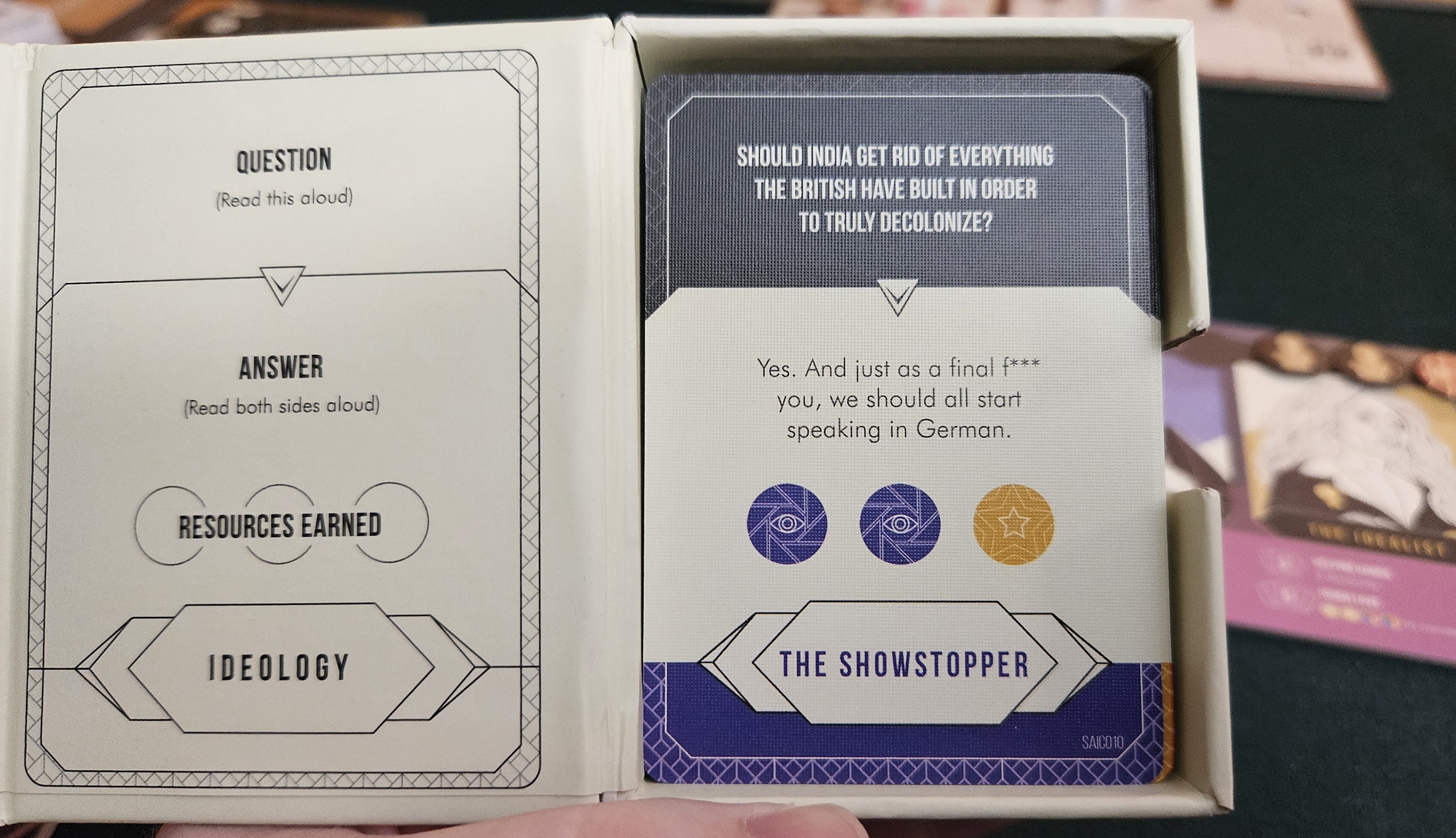
Every turn in Shasn opened with a question. As a general rule, these questions were hard-hitting, touching on topics as far-ranging as abortion, penal codes, human rights, ethnic cleansing, protected speech… anything and everything that might be posed to a prospective leader in an interview. The responses, meanwhile, were binary. Yes or No. Simple. Simplistic.

More than that, they were irreverent. Sometimes distressingly so. One by one, the game introduced serious topics only to lampoon them.

I plucked an example at random from the Egyptian Revolution set. Question: Should mothers be allowed financial custody of their children if the father passes away? (A) Yes. Women are fantastic spenders, they should be in charge of all money. (B) No. The Motherland can only flourish when the government takes care of its mothers’ finances.

Coming into Shasn cold, it would be easy to back away. What is this, one of those awful “offend everybody” party games?

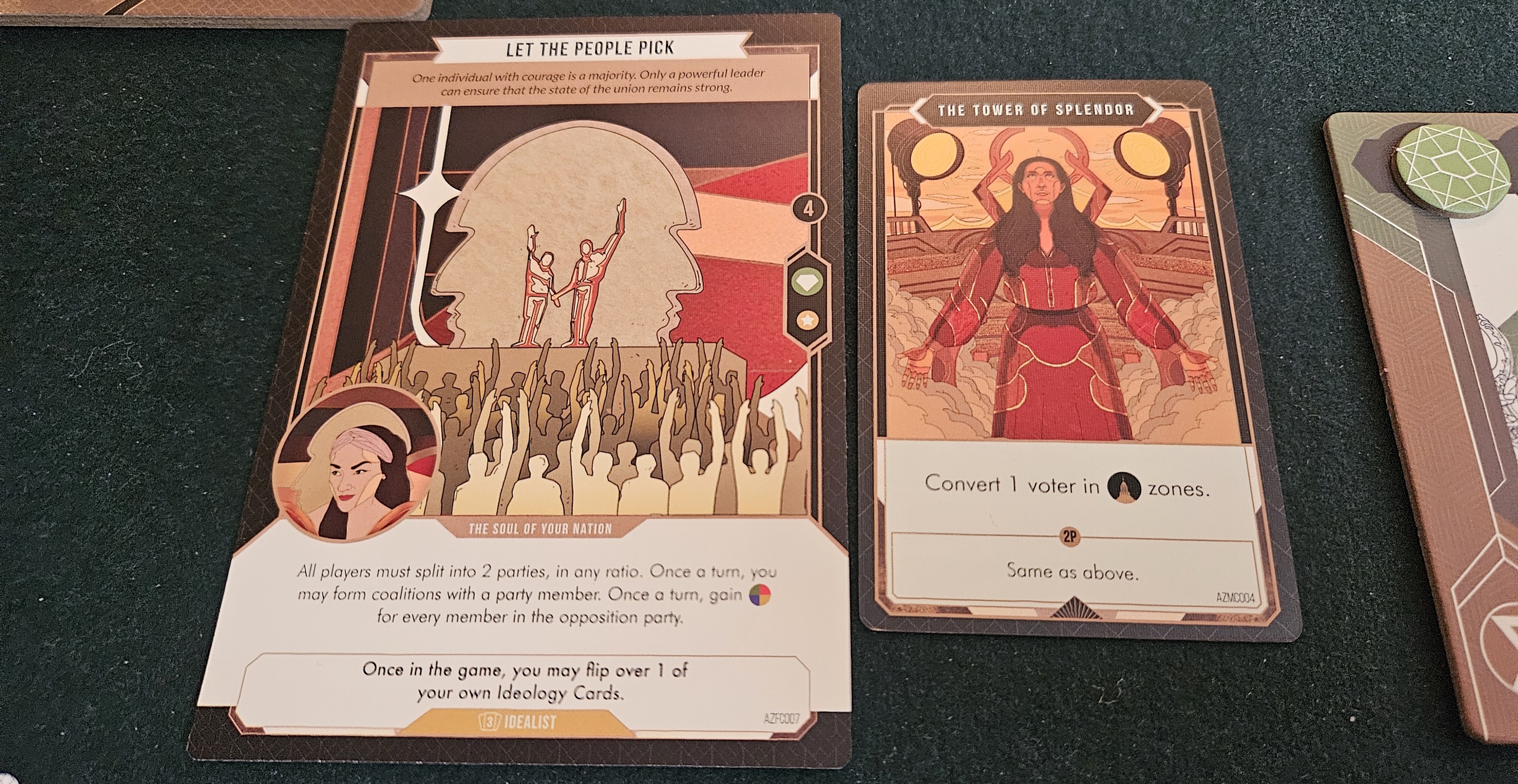
Not quite. These Q&A sessions serviced the game’s intended message. Each answer fell into one of four categories. Broadly speaking, they represented archetypal positions adopted by politicians. Soundbites, basically. The Idealist might offer a platitude, something well-meaning but maybe not squarely positioned within the realm of the possible. The Capitalist would talk about the economy and the job market, how the children yearn for the mines, that sort of thing. Somewhat harder to peg were the last two personalities. Not because they aren’t recognizable, but because sometimes they blur into one another. The Supremo and the Showstopper. One for hard-line authoritarianism, the other for maximizing ratings. In my experience, those two tend to cohabitate.

Moreover, each answer provided a color-coded resource. Red for the Supremo, green for the Capitalist, and so forth. These currencies were all precious, necessary for purchasing the votes that would spread supporters across the game’s map. To win, then, one needed to play every side. It wasn’t long before even those with the soggiest of hearts started speaking out of both sides of their mouth, whether to access hard-fought resources or double down on a single category to unlock special powers.

To play Shasn was to become a politician. At least if you wanted to win. Was this a trite message? Sure. Worse, it was perhaps a self-reinforcing message. When we expect our politicians to say what they don’t mean, we begin to excuse them. Still, it provided an intriguing framework for a game about political animals, putting players on the spot and asking them to guess at the outcomes of any given soundbite.

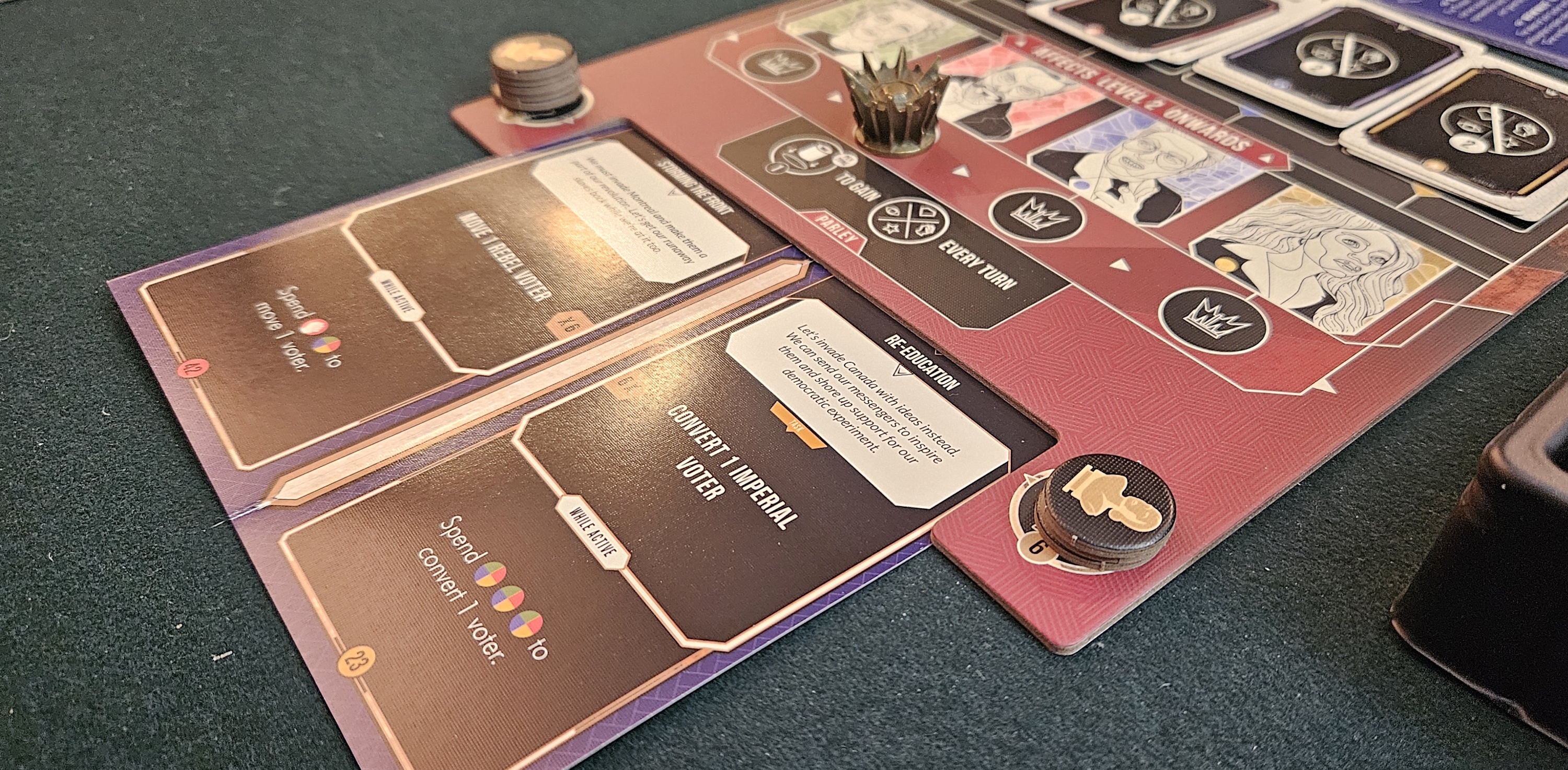
Azadi begins with that exact same framework. When a turn opens, your neighbor asks you a question. Then you answer it blindly. You earn resources. You gain special powers. These are all identical to those from the base game. You can even use the same sets of ideology cards.

But Azadi takes those questions and reframes them in a crucial way. To explain how, though, we need to take a look at the ways Azadi differs from Shasn.

wait why are the imperial pawns white ooooohhhhhh

Those who have played Shasn will find this rather familiar.

Part Two: The Board Game

Sorry, but we aren’t quite ready for the differences yet. Don’t worry, I’ll pump the gas.

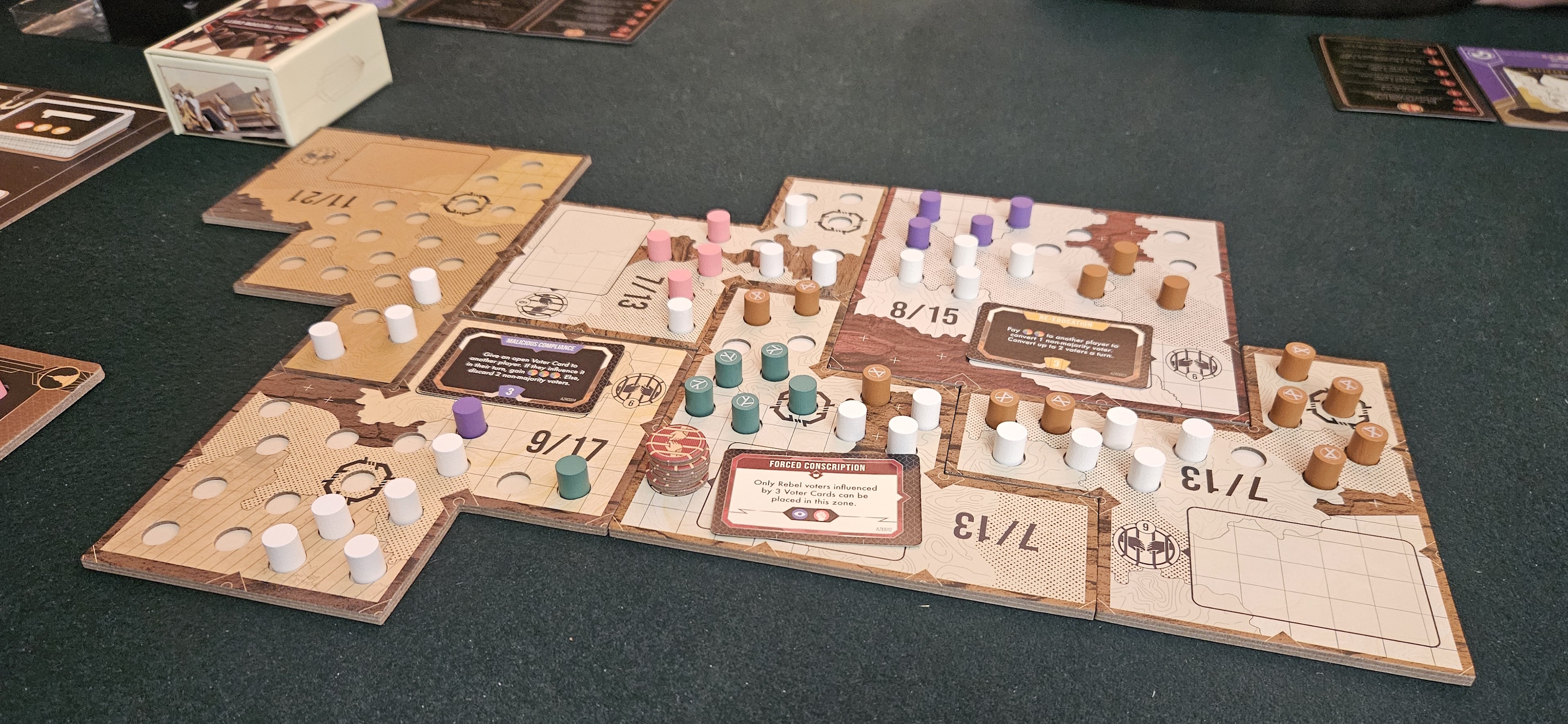
Like Shasn, Azadi is a game about building support. You take the resources you earned from your call-and-response soundbite, spend them on voters, and then distribute those voters across the game’s double-layered map. Each region can only host a certain number, with majorities clearly marked. As soon as you hit the requisite amount, you flip your voters to their other side, locking in the region’s support. These are victory points. And they can be rather tricky to dislodge once they’ve burrowed in.

Gerrymandering plays a huge role in Shasn, and by extension it plays a huge role in Azadi. Whenever you have the most voters in a region, you can push a rival’s voter into a neighboring area. It isn’t uncommon to see little zoning wars break out, certain voters ping-ponging between districts. It also isn’t uncommon for supporters to self-sort into ideological zones. Why place a voter into an area where they won’t ever do any good? As an observation about how different regions of the same country tend to polarize as people seek out those who think like themselves, this was always more insightful than the “politicians are scum” stuff.

Special powers also play a significant role. These are unlocked by gathering a certain number of soundbites in each category. With three Capitalist cards secured, it’s now possible to trade one resource for any two others. Only once per turn, of course. The game isn’t entirely broken. But it’s a little statement on how money can overcome a whole lot of shortcomings in other arenas. The same goes for the other spheres. At five cards, the Capitalist begins evicting voters from the board, sending them to other regions. That’s nicer than the Supremo, who bullies them out of existence altogether. The Showstopper turns gerrymandering into an art form. The Idealist tries to convert rival voters rather than removing them, although this is costly.

This was the core gameplay loop of Shasn, and it’s preserved more or less intact in Azadi. Actually, it’s a little simpler in Azadi. In addition to voters, Shasn allowed players to purchase conspiracy cards. Basically, conspiracies offered ways to manipulate the board outside the regular loop of buying and gerrymandering voters. Conspiracies are gone in Azadi. As we will see, to mixed effect.

So what’s changed? First, the board is modular. It’s a small thing, but the manner of its modularity is important. When the game opens, there are only a few regions. It’s only as the game continues that it expands outward. This forces players to cluster together, contesting those starting regions, rather than retreating to their own corners right from the beginning.

This also speaks to the larger structural change that undergirds Azadi. Namely, that this isn’t a game about domestic politics. It’s a game about revolution. Which means that there’s another faction at the table, one controlled by everybody and nobody. This is your imperial overlord. They are stern masters, their supporters are numerous, and you want them out.

Now we’re cooking with enough gasoline to make a whole crate of Molotov cocktails.

You wouldn't know it to look at me, but I like metal parts that fit into other metal parts.

Azadi versus imperial control.

Part Three: Azadi (or, Every Individual’s Fucking Birthright)

Azadi, like Shasn before it, isn’t some made-up fantasy word for a board game. Where “Shasn” was derived from the Sanskrit word for “governance,” Azadi, meanwhile, is Persian. It means freedom.

Or, to use the game’s definition: AZADI (noun), origin: Persian. 1. Freedom, Liberty, Independence. 2. Every individual’s fucking birthright.

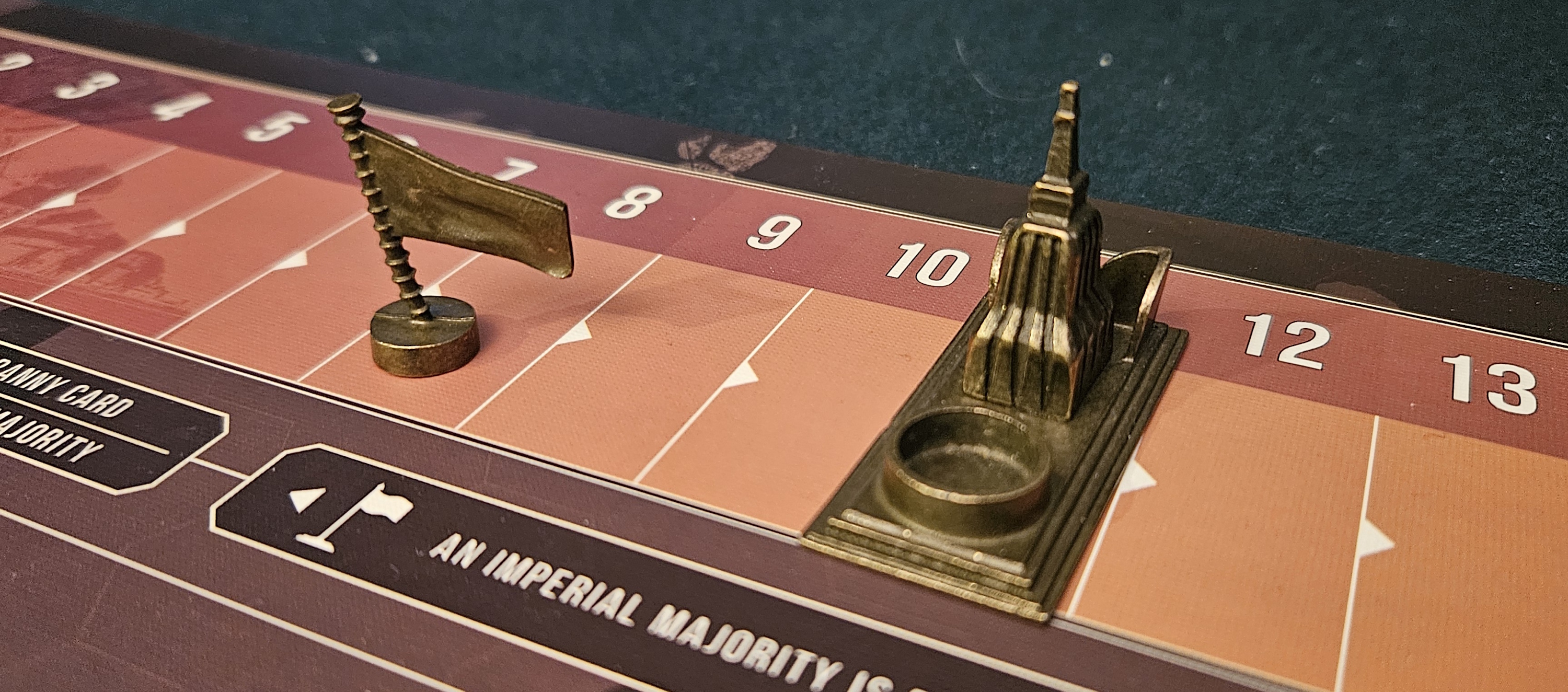
When Azadi begins, your country’s azadi is very limited indeed. On a track beside the board, you can see the overlord’s presence, way up near the top. Down at the bottom is your azadi, a revolutionary flag. This flag shifts upward when you gain control of a region through the regular rules of Shasn. Buying votes. Creating majorities. Grassroots action. There’s even a new rule that allows players to form coalitions, adding their voters together to achieve a majority together.

It won’t be enough.

There are three main problems facing the table. First, this isn’t a true cooperative game. In the same vein as revolutionary titles like Bloc by Bloc or Molly House, there’s a veneer of cooperation that proves tenuous when it comes to proclaiming an actual victor. Everybody represents their own distinct faction. And while you may agree that the overlord must be ousted, what precisely to do with any newfound freedom is hotly contested. Any coalitions, then, will be temporary, while your voters promise to stick around. This turns every placement into a double-edged sword, cutting against the overlord right now, but also against your current comrades in arms later.

Second, the temptation to collaborate with the overlord is ever-present. As the game progresses, your resources are steadily drained, not only by the demands of voters, but also by the overlord’s distant taxation. Those call-and-response cards always award three resource tokens. The overlord, on average, takes two. The leftovers aren’t much to live on, let alone build an independent nation.

Now, you could bide your time. Once you reach two matching ideology cards, you begin to earn a passive income. But the game is also played on a timer. Dither too long and the window will slam shut. At a certain point, action must be taken.

Hence, collaboration. By adding imperial voters to the board, you earn resources. Maybe even a tidy heap of resources, one for every region you add that imperial voter to. Sometimes this isn’t a big deal. If somebody already has a majority in a region, for example. At other times, it’s the act of a quisling, blocking an upstart comrade from claiming a zone. Either way, this is enough to kick the game into gear. Already on turn one, you’re making hard decisions. Whether to work with your overlords. Where to collaborate. Where to make concessions. How to ease the tensions with your peers at the table.

Still. It won’t be enough.

I'm currently fighting oppression by binging pistachio ice cream for lunch. It's a standoff between my mental health and my physical health.

Oppression naturally gives rise to problems that have multiple solutions.

As in the original Shasn, every region in Azadi has one special space. Called “volatile zones,” these were originally used to draw event cards. Now, once occupied, they spark recriminations from the overlord.

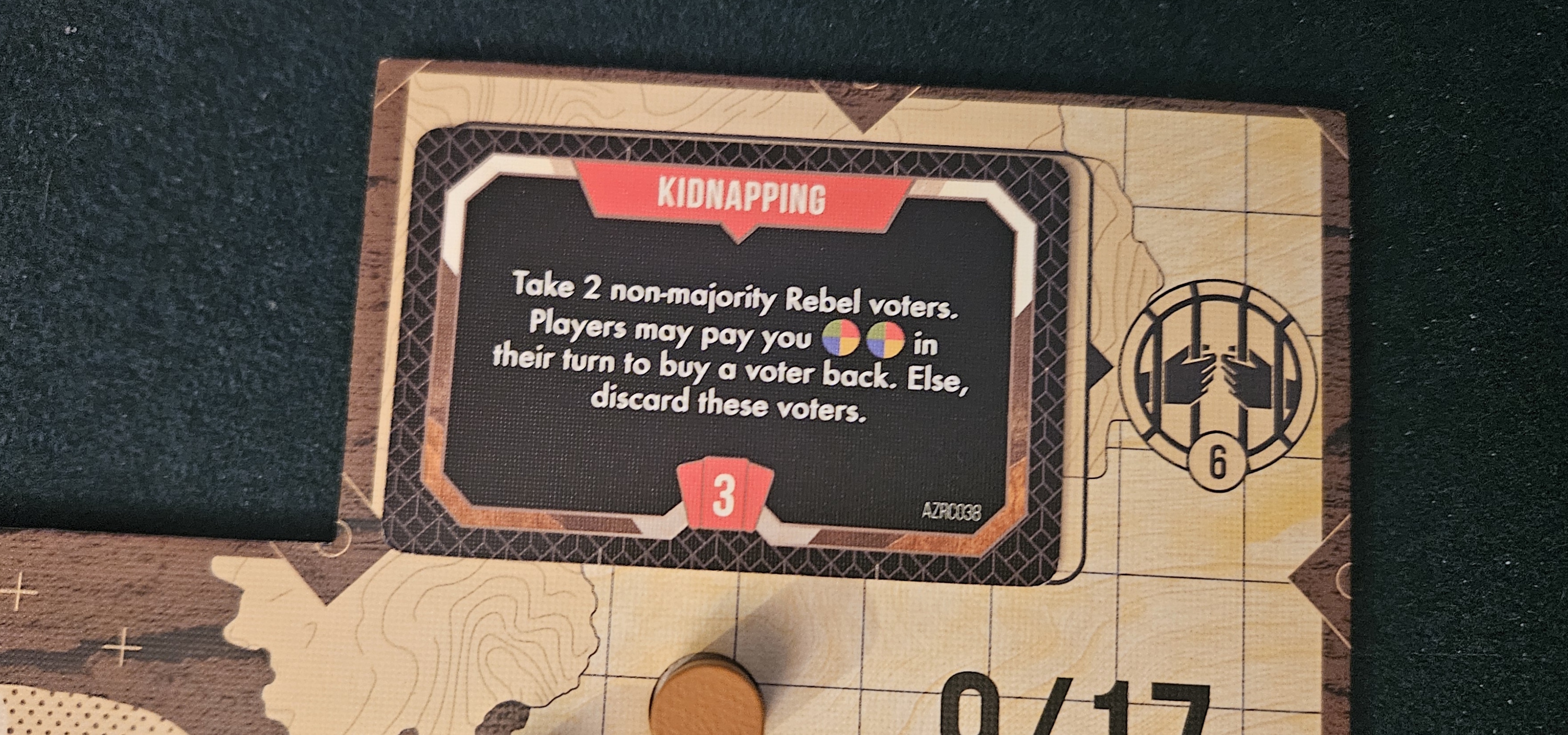
This is perhaps the game’s flashiest addition to the original formula. As soon as a voter occupied a volatile zone, you draw a very special, very weird card. Really, they’re more like small folders. This presents a historical problem. Continuing with our example from the Egyptian Revolution of 2011, you might draw a card about the Port Said Massacre. “To punish the Ultras for their role in the revolution, the police trapped and killed countless football fans,” the card reads. “We can’t let them stamp us out.”

This card now pulls double duty. First, it adds an event to the region where the volatile zone was triggered. These represent government crackdowns, making it harder to add voters to that region. In the case of our stadium massacre, the corresponding card is a seizure. To add more voters, one of the voters already there must be converted into an imperial supporter. Other recriminations might include censorship, forced conscription, curfews, death penalties. The tools of the imperial trade, brought to bear on subaltern bodies, each complicating the ordinary task of gathering support in their own unique ways.

Now, these edicts can be opposed. By spending resources — always with the resources! — you earn another resource, infamy, that can be spent on revolutionary actions. More importantly, this gradually wears down the imperial control of that region. Oppose the edict enough and it will disappear altogether. On the track, your azadi ticks upward, bringing you one step closer to earning your freedom.

Even this won’t be enough. But that first imperial attack card, the little folder, isn’t gone. Instead, it has been spread open and placed to the side of the table. Now it sits there, offering different responses to the crisis. To return to the Port Said Massacre, you’re given two options. The first is riots. By discarding a voter — throwing your bodies against shields and batons — you can erode the overlord’s support. The other option is patronage. Memorials to the stadium martyrs. Vigils. Shrines. This option requires you to spend those precious infamy tokens, effectively trading away the prospect of violent revolution, but still showing strength.

Every crisis in Azadi is different. Not all of them demand violence, but they do speak to the need for direct action. At some point, organizing voters isn’t sufficient. In the case of the Port Said Massacre, it takes riots or vigils. Other crises present their own possible responses. Assassinations or lawsuits. Underground newspapers or hacked firewalls. As players, you’re free to pursue either option. These decisions present lingering consequences, represented as new action cards added to the map. Little legacies of how you chose to walk the walk.

No matter the precise response, however, the outcome is similar. Your azadi slowly swells upward. The map expands, bringing new regions and allies into the movement. And eventually, if you move quickly enough, if you’re clever with your collaborations and concessions, if you work with your comrades, freedom can be won. That little flag clinks into the little overlord token. In thematic terms, the oppressors are sent packing.

The game isn’t over. If anything, this is when Azadi reaches its inflection point.

ugh, why would we choose to reward idealism? yuck.

The birth of a new nation.

Part Four: Something Ends, Something Begins

The instant the overlord is ousted, Azadi offers some respite. Think of it as an interlude. A time-skip.

First, you see what manner of nation you’ve built. Everybody takes their answers to those call-and-response questions and adds them up. These are the contrasting visions of your country’s founders, whoever they might be. Revolutionaries and essayists and generals and artists and collaborators. Or, in Shasn’s terminology, Capitalists, Supremos, Showstoppers, and Idealists. These ideologies are tallied to become the basis for your new government.

Depending on the first- and second-place winners, a pair of distinct visions emerges. Now everybody gets to vote. The currency this time isn’t voter pieces; it’s the contributions everyone made to the revolution. The outcome is everything. Maybe you’ll choose to burn bridges with the outside world, retreating into isolationism. Or perhaps you’ll establish an oppressive theocracy. Or a libertarian paradise that excludes the filthy masses. Or a democratic beacon on a hill. Or a flawed democratic state with limited enfranchisement that likes to tell itself it’s a beacon on a hill. Whatever the outcome, this sets new rules for the game going forward. Special abilities. Single-use monuments. Whose ideology cards receive special affordances, and who gets included. The usual board game stuff, but developed in direct response to the actions you took across the preceding ninety minutes.

Honestly? It’s sublime.

One of my critiques of Shasn was that it examined how politics function, but ignored what politics are for. Azadi rectifies this omission. All those goofy call-and-response questions suddenly matter. And not only in game terms, but as reflections of ideology. They’re your Federalist Papers. Your Declaration of the Rights of Man of the Citizen. Also, unfortunately, your delegation on the preservation of slavery, whether at home or in the colonies. The result is a half-wrought constitution, some new mode of governance that’s better than what came before, but also profoundly imperfect.

Also, crucially, it’s still under construction. Because what comes next is closer to the original Shasn. All the old coalitions are broken. Imperial voters (usually) disappear. Now everybody is out for themselves. It’s back to the gerrymandering and voter suppression and all that. The revolution has slouched back around to eat its children.

It sounds cooler than it is.

insert some joke that will absolutely not be in terrible taste

The country still bears the scars of the oppressor’s actions — and your own.

I mentioned earlier that Azadi has done away with the conspiracy cards. It’s okay if you don’t remember. That was many words ago. But the point stands. The portion of Azadi that comes after its tense first act and that incredible intermission is something of a letdown.

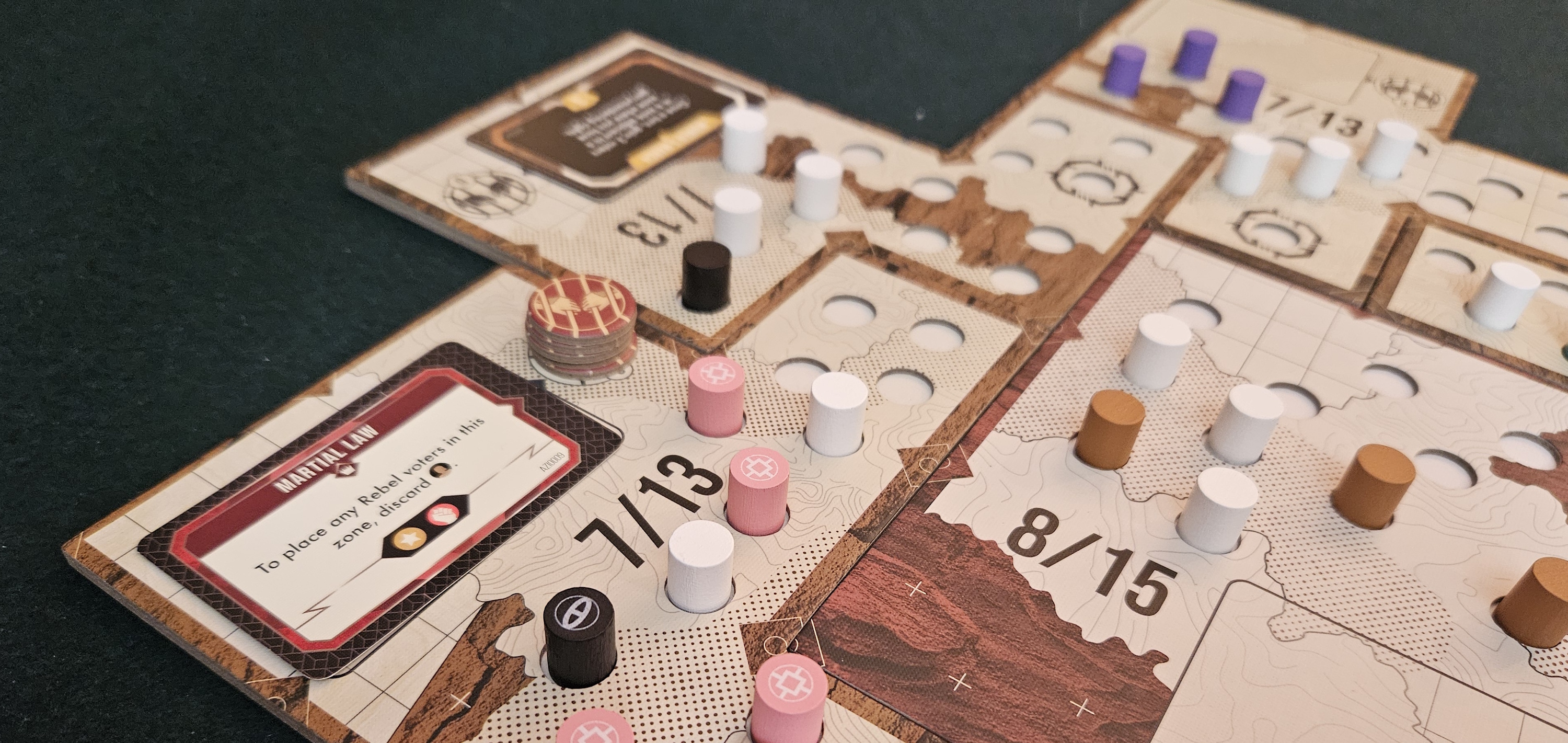
At best, it’s a slog. An interesting slog, perhaps. You’re still gathering resources and buying voters and doing the gerrymandering thing, and the rules have been tweaked by the actions you took as a revolutionary. But it’s straightforward in a way that the game’s first half was not.

At its worst, the back half of Azadi is perfunctory. In such a case, it’s already clear who has secured the most majority votes, there’s really no stopping them, but there are still a few rounds to go before the map has been filled in enough to bring home the final tally. Sure, it’s possible to call it right then and there. But then you won’t get to see all those little consequences play out. After all that investment, it would be a shame to not finish.

Even so, it’s a disappointment all the same. Something to mix up the final few rounds wouldn’t have gone amiss. Like, say, some conspiracy cards to keep everybody on their toes. Too bad the deck from the original game is so ill-suited to the myriad possibilities coming out of the game’s revolutions.

But. Still.

Azadi is a remarkable achievement. I mean that. Even when it stumbles. Even when its merger of bad party game and serious revolutionary manifesto put themselves at odds. Especially then. Because this is what politics are for. Awkward coalitions, strange bedfellows, bills of rights that strive for universality but leave out the untouchables, or the women, or the slaves, or religious minorities, or whoever. Please don’t mistake this for watery centrism masquerading as realism. There are grand outcomes, too. It’s just that they’re as mired in the muck of contrasting opinions and methods and sometimes violence as any other possibility.

There are five revolutions in the game. South Asia 1947, American Revolution 1776, Russia 1917, Egypt 2011, and, um, Mars.

A strange, imperfect, wonderful game.

Which is to say that Azadi is messy the way people are messy. The way countries are messy.

But both people and countries, to invoke Hemingway, can be fine things, and worth the fighting for. That, I think, is the takeaway here. Azadi makes no bones about its position on its messiness. Not every outcome is the same. The troubled democracy is not the equivalent of the iron-handed tyranny. Azadi is every individual’s fucking birthright. For such a game, for such a vibrant, unsettling, funny, and tonally inconsistent game, I can take the slow denouement with the exemplary meditation on liberty and nation-building.

Just, you know, never again with five players. That took forever.


A complimentary copy of Shasn: Azadi was provided by the publisher.

(If what I’m doing at Space-Biff! is valuable to you in some way, please consider dropping by my Patreon campaign or Ko-fi. Right now, supporters can read about which films I watched in 2025, including some brief thoughts on each. That’s 44 movies! That’s a lot, unless you see, like, 45 or more movies in a year!)

Back to the Burgle

12. Februar 2026 um 02:40

According to the story, a freak accident has sent the Burgle Bros to 2026.

Have these bros had enough burgling? Apparently not. After two full Burgle Bros, not to mention at least three other wacky stealth games, I think it’s fair to confess to some fatigue. Burgle Bros 3: Future Flip moves the action into the not-too-distant future, where soulless megacorps run the world, intrusive surveillance is ubiquitous, and onesies are the height of fashion.

Apart from the onesies, that could be right now.

Nobody would break into an open floorplan office anyway. Nothing worth stealing. KABOOM.

In the far future, office floorplans are still 4×4 layouts.

As in previous Burgle Bros, your mission, should you choose to accept it, is to explore a high-security facility, evade some guards, and bust into a locked vault that you definitely don’t have the authorization to open. All these years later, the world has changed very little.

Right away, Future Flip imports many of its predecessors’ tics, not least of which is the hapless nature of your burglars. You know the scene in every heist movie where the crew pores over a blueprint of the place they’re breaking into? No such thing exists in the world of Burgle Bros. You’re flying blind, and the effect is closer to a dungeon dive than a proper heist. This leads to moments of accidental levity, such as when your burglar darts out of a guard’s path only to tumble from an elevated walkway to the level below. Depending on one’s outlook, this could be a comedic beat or an infuriating setback. Personally, I try to remember that we’re playing as cartoon characters.

If anything, those moments are even more present this time around thanks to the “flip” portion of the game’s title. The tiles that make up the facility are more wiggly than before. Some reveal different faces on the ground floor versus the upper level, while others switch sides depending on your activities. This presents a more malleable play space, especially when you’re given access to tricks that can, for instance, teleport you elsewhere in the facility, but demolish the room you’re currently occupying in the process.

The good news is that the stealth system is as strong as ever. Stronger, even. Each of the facility’s two floors is patrolled by a guard — pardon me, a sysadmin. As in previous Burgles, you can see the next few steps of their patrol route, but beyond that you’ll be relying on guesswork and probability to keep hidden.

Oh, and an actual disguise! Rather than heading into the facility with a bright orange I’M A BURGLAR costume like in the previous outings, this time your operatives begin undercover. Their disguised state leaves them less flexible in terms of actions and inventory, but provides an extra layer of insulation from prying eyes. This also presents an additional inflection point. Are you ready to strip out of the office drone outfit or can wring some extra mileage from your disguise before going hot? It’s a clever addition, adding depth to the sneaky stuff while giving the game’s opening turns the feel of a genuine first act.

They also get featured in the New York Times. EVILCORP SYSADMINS: DOING EVIL SURVEILLANCE THE RIGHT WAY — by Ezra Klein

Sysadmins offer new challenges.

The biggest change comes in the form of those sysadmins. Where previous Burgle Bros staffed their facilities (and casinos) with generic rent-a-cops, Future Flip’s sysadmins are downright nefarious. Their basic programming is identical: they set a target, shuffle over to it, and then set a new target, perhaps wrecking your stealth tokens if they bumped into you along the way.

This time, though, they’re actual people, not to mention components in your larger scheme to crack the facility’s security. Every sysadmin comes with their own suspicion track that ticks upward as you trigger alarms or mill around too long. Once filled, the sysadmin will trigger some awful ability that makes your job all the harder. This gives them some personality, adjusting how you approach and ultimately bypass their patrols.

More importantly, sysadmins must be hacked before you can access your real target, the facility mainframe. In the game’s smartest addition yet, this takes the form of social hacking. Scattered throughout the facility are corporate workers. These guys bumble around the offices, presenting opportunities to hide in the crowd, distract a sysadmin with idle chatter, or even take the fall for your intrusion. What’s more, by chatting up these workers you draw code fragments that can be assembled into the kill codes you need to disable the sysadmins. This, of course, is a testy proposition, requiring you to personally tag the sysadmins with the kill code, and then summoning a more menacing replacement.

In terms of interlocking systems, Burgle Bros has never been more impressive. The facility feels like a living, breathing space. You’re an intruder in disguise, allowing for a few relatively safe exchanges with the guards. Workers can be manipulated to suit your purposes. Even security becomes one more plaything, a stepping stone on the path to your ultimate objective. And these elements often intersect in surprising ways. Gathering code, for instance, is a fraught process, one where a conversation with an office worker might draw untimely attention from a sysadmin. The whole thing feels responsive in an exciting way. More than in previous outings, burglars move up and down levels, shift positions, coordinate exchanges of items and code fragments, and develop little specializations like working a crowd or managing comms. These games have always required teamwork, but now the crew comes across as actual corporate saboteurs.

100% accurate representation of how code works

Stringing together code fragments. It’s hacking, baby!

This does not, I’m sad to say, entirely dispel my fatigue. Every installment of this series has presented its own problems. The inaugural game’s three floors were a drawn-out slog, while the second game’s changeable nature sometimes resulted in wacky scenarios that didn’t always feel entirely playtested.

Future Flip continues the trend of mitigating the preceding entry’s problems while introducing new quibbles of its own. Compared to The Casino Capers, Future Flip is rather strait-laced. Its facility and overlapping security is impressive and a delight to crack, but it still gets long in the tooth, not to mention somewhat repetitive.

At times, it feels like solving a Rubik’s Cube: all repetition and no pizzazz. It’s an imperfect simile — there’s plenty to do! — but a session’s back half looks much like its first half. The same workers getting pumped for intel. The same relative safe zones from sysadmin patrols. The same chokepoints that must be sprinted through. The same gradual churn of code cards. That sameyness only compounds with successive plays. If ever there was a game that would have benefited from some scenario design to shake things up, it’s this one.

Thank goodness the sysadmin is colorblind.

Just another face in the crowd…

Still, Future Flip takes the series to new heights. The addition of temporary disguises, guards with personalities, and impressionable office drones turns those four-by-four grids into fascinating spaces to break into and break apart. This is a heist as a cartoon adventure, and even though it sheds some of the previous entry’s sense of wonder, it’s nice to see the Fowers crew pulling another heist of their own.

Although if there is to be a Burgle Bros 4, maybe it’s time to revisit those blueprints.


A complimentary copy of Burgle Bros 3: Future Flip was provided by the publisher.

(If what I’m doing at Space-Biff! is valuable to you in some way, please consider dropping by my Patreon campaign or Ko-fi. Right now, supporters can read about which films I watched in 2025, including some brief thoughts on each. That’s 44 movies! That’s a lot, unless you see, like, 45 or more movies in a year!)

God Games

10. Februar 2026 um 22:09

to-do: insert a buncha Hades quotes from Disney's Hercules

Between the old-world deities, satirical tone, and bean-sized mortals begging to be smited (or blessed), the forthcoming game Almighty feels like it was tailor-made with me in mind. This is the third title we’ve seen from Malachi Ray Rempen, following Roll Camera! and Power Vacuum. In more ways than one, this feels like the culmination of Rempen’s efforts to date; it’s smarter, more assured, and more inventive than its predecessors.

Or maybe I just like the theological implications of having my storm god honk his nose at the god of the underworld.

I was having too much fun with this game to take many good pictures. Which is a good sign for the gameplay, but a very bad one for me as a critic.

An early-game urban center.

As has been the case since Medieval scholars fretted over how many angels could dance atop the head of a pin, there’s still an ongoing debate over what’s meant by omnipotence. Theologians have classified multiple degrees of godly power, ranging from top-tier omnipotence — where a god can perform any act, up to and including those that are logical contradictions like squaring a circle — down to almighty status, in which the god just so happens to be more powerful than any other being, but not so impressive that he can decline to send a bunch of people to hell. Yes. People argue about this stuff.

In Almighty, your gods sit squarely at the bottom of the continuum. There are four in total, each eager to prove themself the most potent of all omnis, but not quite up to the task without a cosmic-tier rap battle.

Their world is presented as a scroll. A literal scroll, dowels and fabric and all. This is divided into four regions: islands, jungle, mountains, and desert, bookended by celestial skies that essentially function as spots for holding decks and tracking scores. Like everything Rempen has created, it looks fantastic, from afar and down to its smallest details.

And that’s before the place is populated by towns and believers. These quickly give the world its texture. Towns spring up according to your whims, with the largest concentration being named the global capital. Believers, meanwhile, allow Rempen to flex his artistic impulses. There are heaps of these little guys, each falling somewhere on a spectrum from worthy to unworthy, depending on how much they complement your divine plans. A smoke signaler, for example, might be a worthy occupation, while a pyromaniac, heretic, or yodeler falls into a more distasteful category.

These categories matter. Over the course of the game’s three rounds, those (up to) four jockeying gods will go about the business of raising or razing towns, birthing or smiting mortals, and then inspiring them to perform various functions. Controlling a region — accomplished by performing acts that build the local populace’s faith in your manifestations — awards points. That is, provided the locals are sufficiently pious. Commanding a realm of stubborn oafs and skeptics can prove subtractive to one’s divine score rather than bolstering it.

It was tempting to write a whole article about this game's cosmology as reflective of Christian perspectives on Paganism, but look, I can only do so many niche articles before the Wankery Police kick down my door.

The god powers are varied and amusing.

In one sense, Almighty is an area control game, although it falls into the somewhat rarer category of an area control game where you don’t directly command any of the pieces. If you birth a necromancer into the desert, you can now “poke” that necromancer to raise deceased mortals from the grave. But so can everybody else. There’s no telling when another god will compel your skeptic to turn around and vocally doubt your miracles rather than their own. In some cases, you may find yourself smiting a follower who’s gone all Road to Damascus for another deity.

It doesn’t help that the gods are capricious. Each round assigns an objective. Like the best theologies, these goals are always comparative, forcing a struggle between two realms. For example, you might be tasked with ensuring that the jungle is better than the desert. In some cases, you might even face a logical contradiction of your own, such as being told that you need the capital to be worse off than another region, except at the moment the capital happens to be located in that same spot. To rectify such a paradox, you’ll need to first move the capital. Gird your loins for some ransacking.

To accomplish these aims, each god is provided their own selection of miracles, and this is where Rempen really cuts loose. Every god is distinct from their siblings, and that comes through not only in their color palette, but the way they function on the table.

Consider the God of the Sun. This guy begins the game with a sun token on the map. Each turn, it shifts to the next region. When it reaches the end, it “falls off” the map, revealing a nighttime side that recharges the god’s energy, before circling back to the other side. This god’s powers are incredibly potent, baking or warming entire civilizations. His limitation is that everything is bound to that sun token. There are ways to hasten its movement, but this still provides the Sun God’s nemeses with crucial foresight. If the sun has already passed overhead, there’s a good chance everyone else will be free to meddle in mortal affairs without much pushback from Big Yeller.

This is supposed to be the Sun God doing a seductive pose in front of the others. I hope that came through.

Strike a pose!

Speaking of meddling, the God of Love is all about hookups between mortals. Seductions, virgin births, crimes of passion, that sort of thing. Better yet, she can dictate the nature of these relationships, placing little heart tokens on the board to indicate great loves that increase the value of the region, or toxic disasters that tank its value. Playing matchmaker generates power, the little lightning bolts that most gods use as currency.

But only most. The God of Storms instead churns thunderclouds across the map, gathering them for more intense powers or scattering them across the land for more diffuse effects, and bypassing the need for power altogether. Meanwhile, the God of Death shepherds deceased mortals into the underworld. Depending on how they’re judged, they might generate power or points.

In all cases, the interplay between these gods soon creates a vibrant sandbox, one where cities can spring into existence and be erased within the span of a few turns. It’s possible to play defensively, but in most cases a passive god is also a dwindling god. You aren’t some distant parent figure. You’re a brash, in-your-face deity, one who slings lightning, forges epic romances, and burns mortals to a crisp because it looks cool.

I have some reservations about certain smaller details, balance and the merits of passing early and so forth. In the game’s current incarnation, you’re allowed to play two cards per turn. Once your hand is depleted, you can pass, and doing so early is a tremendous boon, netting you some points and functioning as a tiebreaker in contested regions. In theory there’s some tension between passing early versus staying in the round to continue manipulating regional loyalties, but in practice it’s often best to rush through your cards as swiftly as possible. These are minor issues, not to mention the sorts of things that usually get hammered out in development, but I’d be remiss to not mention that the prototype had a few hitches.

It was a happy accident for the lightning bolts to look like laurels. I'll take it.

Honestly, he just wants to party. But you’re the catering.

On the whole, though, Almighty is filled with little touches that keep it lively. It even contains one of my favorite catch-up systems ever put to cardboard. At the end of the first and second rounds, gods gain access to new “mighty act” cards. Those who are in close competition with the current leader gain benevolent powers, while those who are trailing earn more wrathful options. Everybody gets something useful, but those who are struggling are given a bit of extra oomph.

The distinction is small, but it’s present nonetheless. As the Storm God, benevolent options might include Clear Skies, which see you parting any number of cloud tokens and blessing a matching quantity of mortals, or Eye of the Storm, which requires a precise arrangement of storms but brings three huts into existence at the same moment. If you can pull these off at the right moment, they can prove game-altering. But their wrathful counterparts are downright nasty. There’s Lightning Storm, which smites a mortal or hut in every single region with a cloud, or Tornado, which whips huts from far-off lands to a new destination. These result in similar outcomes, but are more disruptive of your rivals’ designs.

Okay, one last power: Shrieks of the Damned. I mentioned that the God of Death altered how the underworld works. Without him in the game, the underworld is a discard pile. With him, it becomes a multi-tiered pit, and Shrieks of the Damned continues the suffering of the no-longer-mortals residing within it. Three of them are cursed. The God of Death increases his power in a nearby region. And then, if you happen to resurrect those poor souls, they will now wander the land, scarred by what they’ve witnessed in the hereafter.

How cool is that? But that’s one power among many. Everything in Almighty is a font of intersecting powers, mortal frailties, relationships, and nastiness. Ever fostered a game-winning throuple between a high priest, a medicine woman, and a cannibal? Here’s one better: ever smote the member of that throuple holding it all together? I have. And the taste was sweet.

Actually, this turned into a miniature story of hope and redemption. I murdered the medicine woman. Later, she was resurrected and wound up in a relationship with the cannibal again. Love wins, my friends. Love wins.

Beautiful.

Almighty is a delight. As an area control game, as satire, as barbed commentary, as a sequence of take-that moves that leave the table reeling, as a cosmological mess. Because when you get right down to it, this game is as messy as the pantheons it pays tribute to, and every bit as thrilling to experience firsthand.

Almighty is on Kickstarter right now.


A prototype copy of Almighty was temporarily provided.

(If what I’m doing at Space-Biff! is valuable to you in some way, please consider dropping by my Patreon campaign or Ko-fi. Right now, supporters can read about which films I watched in 2025, including some brief thoughts on each. That’s 44 movies! That’s a lot, unless you see, like, 45 or more movies in a year!)

Broken Clocks

06. Februar 2026 um 21:18

ah yes, 6:15, that most portentous hour

The consensus on Take Time, the abstract teamwork game by Alexi Piovesan and Julien Prothière, seems to be that it’s Wolfgang Warsch’s The Mind but Even More, which means, mercifully, that it’s marginally less likely to spur tedious arguments over the difference between an activity and a game.

As an enjoyer of The Mind, at least in moderation, I figured I should take a look. Here’s my professional diagnosis: It’s The Mind but Even More. Even the hivemind’s broken clock is right twice a day.

The graphics have nothing to do with anything, but it's nice that they gave us something to stare into the distance at.

Pretty!

Speaking of broken clocks, Take Time is fashioned as the very same, an analog clock with six segments instead of twelve, and an especially illegible one at that, but one that’s perfectly suited to counting cards and staring apprehensively at one’s fellow players.

Like The Mind, Take Time is all about ordering cards into their correct sequence, although in this case the question is more cerebral and less about marching in time to a shared internal metronome. Your primary tool is a deck of cards. There are two suits, both of which show ranks from 1 to 12. Some number of these cards will be distributed to your team, and it’s your task to arrange them around the clock according to a few simple rules that naturally turn out to be anything but simple to execute.

There are three cardinal placement rules. Rule the First: Each of the clock’s six segments must have at least one card next to it. Rule the Second: The sum of each segment’s cards must match or exceed the tally that came before it. Rule the Third: None of these sums may break twenty-four.

That last rule is the really crucial one. No surprise, but it’s what keeps Take Time from feeling trivial. Sure, you could make a plan to dump everybody’s low cards onto the clock’s lowest hours and then build to the higher segments. But (1) you’re only dealt half of the deck in any given session, which means you can’t count on any given rank appearing to solve the problem, and (2) because you can’t bust twenty-four, it quickly becomes necessary to spread out your cards a little more smartly.

In addition to the game’s cardinal rules, each clock offers its own variations. Early on, these are familiar enough. Perhaps a segment will only hold white cards (rude), or require exactly a pair, or have the closest sum to 12, or be the recipient of the first two cards played to the table, or only be laid face-down.

Ah, that’s right, facing. Most cards must be played face-down. But depending on the player count — and successive failures — a certain number can be visible. Take Time is often about signaling. A face-down card to indicate you have a segment handled, a face-up one to ask for help. An exploratory digit here or there. Clearing your throat and displaying your color-coded card backs for all to see.

AI is gonna have my thumbnail PEGGED

Some of the cards.

At a mechanical level, none of this is all that proximate to The Mind. Even the shared notion of playing cards in sequence is fundamentally distinct. Here, there’s nothing preventing you from playing your middle cards first, provided the eventual sum on the clock is ascending. At least until you reach the envelope where all the clocks demand you play in a certain order, anyway.

But comparisons to The Mind are apt because the sensation both games produce are largely similar. This is a low-communication game — not zero communication, although it bills itself that way — that likes to dwell somewhere in the pit of your stomach. It’s contentious in the same way as Warsch’s card game, everyone quick to lay blame at their peers’ feet, although its expanded scope and duration make it even tougher to take in stride. “What the heck were you doing with that one placement?” is a regular tally-ender.

The game’s secret weapon is its overarching format. Rather than focusing on a single play, the clocks in Take Time are divided between twelve envelopes. Each has four clocks, and — this is important — you’re meant to tackle them in sequence. This is a bit more formal than The Mind, but it’s geared toward the same end. Where The Mind was so brief and so simple that it demanded multiple plays, Take Time could easily be misconstrued as a straightforward scenario game, with shades of The Crew or those Lord of the Rings trick-takers. By asking players to progress through four clocks, including any do-overs for flubbed hands, it engenders that woo-woo telepathic sensation that was so familiar to The Mind. The group squabbles, points fingers, grouses, but gradually comes together. They learn one another’s tells and tics. They become a team.

Here’s an example. Anyone who’s played way too much of The Mind might recall the moment when the game asks you to play all the cards face-down. I remember the first time we were asked to do that. We figured we would try on a lark. We’d already been plugging away at those cards for an hour. What was one more try? And then we made it through something like six full rounds of face-down cards, our counts improbably perfect, our internal metronomes almost perfectly in sync.

Take Time pulls that same trick! On the second envelope’s final clock, after being trained to play more and more cards face-down, suddenly it insists that the entire clock will be handled blind. It’s a rug-pull moment, and it’s safe to say we were demoralized at the mere prospect. And then, of course, we nailed it on our second try. That Take Time is more puzzle and less, y’know, quietly counting, only makes these little coups all the more satisfying.

I hate doing this, haha

Placing the hand.

Again, though, I don’t want my enthusiasm to go misconstrued. Take Time is sometimes a bitter pill to swallow. Where The Mind presented itself as a parlor trick, there’s no mistaking the function of this particular plaything. It wants you to strain at every little detail. It wants you to make plans and then adapt them on the fly. It insists on locking you into a sequence until you get it right. Sure, it will throw you a bone every now and then. The more you fail, the more face-up cards you’re afforded. But only to a point. Eventually, your group either learns to function together or the frustration mounts.

I think I like it. But it’s also a game I can only stomach in small doses. An envelope here or there, not a spree. And it’s also one of those games that swiftly identifies the players it shouldn’t be shared with.

But hey, at least everybody seems to agree that it’s a game. And with the right people, in the right mood, during the right portion of the evening, it’s a fascinating thing to behold for many of the same reasons that The Mind was fascinating to behold. When everything finally slips into place, it feels like magic. The hard part is all the grunt work that comes before the flourish.


(If what I’m doing at Space-Biff! is valuable to you in some way, please consider dropping by my Patreon campaign or Ko-fi. Right now, supporters can read about which films I watched in 2025, including some brief thoughts on each. That’s 44 movies! That’s a lot, unless you see, like, 45 or more movies in a year!)

Hot Cross4 Buns

06. Februar 2026 um 00:25

Do you also read this title as crossA? Because that's how I see it.

Back when I was in the dating pool — the late Pleistocene, oh ho ho — I would sometimes tell women that my only qualification for a life partner was somebody I could “play boggle in bed” with. This was, of course, a euphemism for playing Bill Cooke and Allan Turoff’s 1972 word-making board game Boggle. While atop a bed. Because beds are cozy. And let me tell you, that joke goes so much harder among people who don’t play so many board games that they immediately assume that’s what I meant by “Boggle” in the first place.

Amabel Holland’s cross4 falls into the category of retro word games. Like Boggle, I suppose. Frankly, I would rather play Boggle. Which perhaps isn’t a ding against cross4 so much as it is a statement about how great Boggle is.

don't worry about that one spot, I've got a plan

Writing a crossword.

cross4 is a crossword-making game. Actually, cross4 is four crossword-making games. In each, the basics remain untouched. You roll a septet of dice that show various letters. Then you take those letters — some or all, it’s up to you — and assign them to the blank spaces of a crossword puzzle. Making a word is a must. Making a good, obscure, or interesting word is optional. Actually, making good, obscure, or interesting words is probably one of the surest ways to fail.

The details change depending on the specific variant of cross4 currently being played. There’s Solitaire, where your objective is solely to score lots of points. There’s the Heads-Down varietal, where everybody labors over their own grid until someone makes a fatal mistake. The most interesting modes are Two-Player Duel and Elimination, both of which lean into the format’s natural idiosyncrasies. Basically, at regular intervals, everybody swaps grids. This transforms cross4 from a relatively straightforward affair into the sort of game where you can lay traps. Oh, and write good, obscure, or interesting words that your fellow players might struggle to use. Then again, such flippant play might come around to bite you in the hindquarters.

I mention idiosyncrasies. This game has plenty of them. Like the sprawling crossword space, with its multiple grid-spanning openings that are a real PITA to bridge. Or that issue’s compounding factor, the fact that there are seven dice, not quite enough to actually span such wide gaps, necessitating that players first build out a few shorter words. Planning ahead is a must, but planning ahead is hard as hell. And I say that as somebody who likes crossword-making games.

No less idiosyncratic, but far less confounding, are the dice themselves. Printed off-center and slightly scuffed, these rounded hexahedrons are the perfect imitation of what one might discover in an old copy of — well, in an old copy of Boggle. They feel like something you’d uncover in a grandparent’s game closet, although they’re tuned in a way that many old letter-dice games were not. For one thing, you’re actually guaranteed at least one vowel per roll.

But it’s not their tuning, but their sheer power as forgeries that make them stand out. Did Holland roll them through sand to achieve the optimal degree of rasp? Did she instruct her printer to make sure some of the bubbles were printed that crucial millimeter off center? They aren’t even quite the same size. In the era of machine-milled cellulose sponge, that’s more impressive than total uniformity. I hope it doesn’t come across as too dismissive to say that I’m tempted to keep the dice and chuck the game.

Actually, they should be spritzed with eau de wet dog hair.

The dice are scuffed, miscut, and off-center. Exactly as they should be.

Dismissive or not, that’s my feeling here. Playing cross4, it was hard to shake off its redolence to another nostalgia-laden project: UFO 50, the 2024 collection of video games created in part by Hot Streak, Spots, and Scape Goat designer Jon Perry. Setting aside their obvious differences in scale, UFO 50 also adopted the limitations of an older format, in its case the systems, graphics, and inputs of 8-bit video games, in order to create something that was recognizably displaced in time, but also gifted the advantages of modern design principles. The result in that case was many things. Throwback archaeology. A meditation on the swift passage of video game tech. Even a bit of a flex for some of today’s most talented game creators.

With cross4, Holland does something similar. The rather large distinction, though, is that cross4 is a bijou, a displaced trinket, which evokes time-worn aesthetics and sensibilities, makes a few small corrections to how many of these games were busted right out of the box, but then settles into a series of games that are, at best, fine. To keep up the comparison to UFO 50, it’s more Block Koala than Party House.

The short version is that cross4 comes across as more of a vanity project than as something most people are liable to seek out, but I can’t deny that many of its smaller touches charmed me nonetheless. The grid-swapping modes, for example, and how they transform the gameplay from pure frustration to an ever-evolving minefield, or the way the rules are printed on the back of the box rather than afforded a booklet, or the dice. Above all, the dice. To handle them is to remember something we played long ago. It was not a very good game, but we sprawled on our bellies atop shag carpets, and the house smelled of stew and dog hair, and the television was always somehow tuned to 24-hour Matlock.

Which is to say, thanks for the memories, cross4. As for the crosswords… eh.


A complimentary copy of Cross4 was provided by the publisher.

(If what I’m doing at Space-Biff! is valuable to you in some way, please consider dropping by my Patreon campaign or Ko-fi. Right now, supporters can read about which films I watched in 2025, including some brief thoughts on each. That’s 44 movies! That’s a lot, unless you see, like, 45 or more movies in a year!)

Space-Cast! #53. Scratch & Listen

05. Februar 2026 um 00:08

Once, maybe even twice, Wee Aquinas must confess that he has scratched... and sniffed.

Most people know Zach Barth as the founder of Zachtronics, purveyor of digital playthings such as SpaceChem, Opus Magnum, and EXAPUNKS. But we are not most people. Instead, we’re here to speak with Zach about his analog games: The Lucky Seven (with the Depot expansion), Chemistry Set, and the scratch-off puzzle pack Zach Attack! That’s right. We’ve got the good stuff.

Listen here or download here. Timestamps can be found after the jump.

TIMESTAMPS

00:30 — Zach Barth, the greatest puzzle maker alive? and the terminology of puzzles vs. games
9:10 — actually introducing Zach Barth
23:25 — getting into tabletop games via The Lucky Seven
48:30 — Chemistry Set
1:01:45 — at last, Zach Attack!
1:58:25 — can Dan fix Zach? (No. He is perfect just the way he is.)


(If what I’m doing at Space-Biff! is valuable to you in some way, please consider dropping by my Patreon campaign or Ko-fi. Right now, supporters can read about which films I watched in 2025, including some brief thoughts on each. That’s 44 movies! That’s a lot, unless you see, like, 45 or more movies in a year!)

💾

DoS That LLM Till It’s 404

03. Februar 2026 um 19:58

better than the frat house game UPPER DECKERS, anyway

There’s history to Deckers. Pedigree. Richard Wilkins — better known by the epithet Ricky Royal, the name under which he’s created a bunch of incredible solitaire modes for games that wouldn’t otherwise suit solo play in the slightest — designed a ditty called Renegade back in 2018. Before the plague years. Before the world’s billionaires started cramming robo-slop down our throats and calling it nourishment.

Before, in other words, cyberpunk felt quite so urgent. Back when the genre was a throwback to ’80s techno acceleration and not ’20s techno throttling.

Deckers is Renegade. That’s the short version. The slightly longer version is that Deckers is Renegade, but decoupled from the vulture who acquired it along with the rest of the Victory Point Games catalog, and with the expansion packs folded in, some additional clarity and development, and a new coat of paint. It won’t persuade anybody who didn’t get along with the original, but it’s just as fresh as ever. And as infuriating.

This is how he appears in a corpo's office. With a hot-pink katana.

Man of mystery. And mood-setting backlighting.

Like all cyberpunk games, Deckers is about jacking into an encrypted network that’s inexplicably neon. There’s some technobabble about a supercomputer run amok, how society’s last chance hinges on a team of keyboard jockeys sticking it to the man by typing stuff on the internet. But we all know why we’re really here. To kill Grok. To murder OpenAI. To finally figure out how to remove the smart features from Windows 11. If we play our cards right, to fry the dopamine-jack in Sam Altman’s head.

The game’s first impressions are… let’s call them “mixed.” The network is a blob of color-coded hex grids. The game’s terminology is heavy with “SMCs” and “sparks” and “ghosts.” There are heaps of actions, and modifiers to those actions depending on the color of the icons you trigger them with.

And then there’s the mission structure. Scenarios in Deckers aren’t scenarios so much as they are accumulations of objectives. First you pick which SMC you’ll be decking. (See? I told you there would be terminology.) Then you populate that SMC with objective cards. These range from the simple to the confounding. Sometimes they’re clear enough, like generating a network keycode by installing four different programs on your decker’s entry point. Other times, they tip over the edge into a nihilism of iconography. A couple plays ago, we flipped the final objective and discovered we were meant to create a “mirror map.” Every server on the table, all five of them, were to have an identical configuration of programs, both friendly and rival, with at least one program of the four primary types. Such a goal might be easy or might be hard, depending on how well the mission had been going up to that point and whether the current SMC would add and/or shift lots of nasty counterintrusion programs, but it will never seem like anything other than the sort of busywork a teacher hands out to their fifth-grade students when there’s only forty-five minutes left in the day and she’s come down with another migraine, dammit.

Shades of that silly Microsoft CEO who's always calling LLMs "cognitive enhancers" like the world's yuckiest irony.

Bootin’ up my Win11 PC, callin’ it NOOTROPIC BLOOM.

Now, you might be thinking that I’m not putting Deckers on the strongest footing. You’d be right. But I want to emphasize this point. Deckers is not for the faint of heart. Despite resembling Pandemic in a few superficial ways, it’s crowded with icons and ideas and actions and colors and special powers and objectives that require a few re-reads before they make a lick of sense.

But it’s also modular. In the case of our misbegotten mirror map, we goggled at the objective’s preposterousness for a bit, then drew a much more reasonable replacement. There are loads of customization options. And as much as I’m can grow irritable at a game asking me to set its difficulty level rather than providing me with an intended experience, I can’t help but appreciate the way missions unspool on their own, coughing up new problems according to some imperceptible aleatory logic.

More than that, the game’s thicket of information is a not-insignificant part of its appeal. To play Deckers is to step into the boots of a troubleshooter. Where most cooperative and solitaire games present a puzzle, Deckers presents a problem. Often that problem is multilayered, difficult to discern, and seems impossible at first glance.

The other thing Deckers provides, though, is a toolkit. More than a toolkit. An entire tool shed, full of power appliances and extension cords and, oh, here’s a weed whacker and some fertilizer. Maybe a pool pump just in case.

At its most basic level, Deckers is a deck-building game, although like everything else this is an inadequate description. It’s not so much about deck-building as it is about deck-renovating. You have fifteen cards when the game opens. You’ll have fifteen when it ends. In the middle, you can purchase cards that swap into the place of previous cards. This keeps the game pacey, not to mention erases the usual bloat that accompanies deck-building.

*glances at Wee Aquinas on my site header* oh no. oh no oh no.

You do you, but my decker avatar wouldn’t be a middle-aged shlub.

What’s more, those cards put in the work. Before long, the network will be speckled with color. Programs, the little round tokens, each have their own functions, such as attacking enemy sparks (red and yellow), permitting easier movement through cyberspace (blue), or rearranging other bits of data (green). Programs eventually transform into installations, the larger boxy tokens, which are even better at attacking, permitting movement, or rearranging data. Sometimes they’re so much better that you can teleport around the network at will or project a ghost image of your character to another position entirely.

That network, meanwhile, becomes textured not because of any inherent topography, but thanks to the addition and movement of the game’s various threats and the consequences of your activities. Perhaps an information superhighway of blue and green tokens will take shape, allowing your deckers to race along it with impunity, shuttling programs where they need to go and dousing fires wherever they appear. Or maybe an incursion by the SMC will transform a corner of the network into a minefield of enemy sparks and guardians, necessitating a gradual campaign of reclamation lest they blossom, Pandemic-style, into an early loss.

The same goes for the game’s underlying problems and their various solutions. It’s rare that one of these problems will present a straight line from A to Z. Instead, the game meanders. In one mission, when a corporate decker appeared to ice our asses, we were prohibited from entering his space at all. How then, could we beat him? We eventually set up a green installation, ghosted into his space, pushed viruses into position from neighboring hexes, and then engaged in an epic roll-off. Everyone at the table was invested. Attention-wise, sure, but also because they had been churning their decks to find the cards that could massage the outcome of our climactic roll. The solution was messy, inelegant, and harried by ancillary problems. It took coordination, not to mention required everyone to work to mitigate the game’s chancier elements.

In the process, it became closer to real-world problems and their real-world solutions than most board games manage. We weren’t solving some graceful puzzle. We were patching over a memory leak and hoping it wouldn’t crash the whole network. Are those things? I have no idea. But that’s what Deckers feels like.

Hey. I never realized it until this moment, but “Deckers” is a pun. Decking-in. Deck-building. Heh.

"Didja hear? Sheepang Deedrip got Deep Sixed by Boop Scoop for working the Muzzlers. You pang?"

“I’ve seen deckers go insane from a five-blip-trip on Moby’s network…”

To be clear, Deckers never fully escapes its issues. Even at its best, it can grow fiddly with all those tokens, and there’s always the chance that a new objective will prove just an action or two shy of being solvable. Even the deck-building feels flashy but isn’t wholly interesting, more about fine-tuning cards into better versions of themselves than altering a deck into something new.

But maybe that’s how it ought to be. Even when it was called Renegade, Deckers was something of a throwback. I’m old enough to remember when the prevailing wisdom for cooperative games was that they should only be winnable one in three plays. Nowadays, most board games are tuned to provide a solid first session, because in all likelihood that’s all they’re ever going to get. The unfortunate trickle-down is that most cooperative games are easy, which is to say dull, which is to say they’re boring.

There are moments when Deckers is boring, but it’s a very different sort of boring. It’s not the boredom of tedium; it’s the boredom that arises when a problem is inscrutable and so our mammalian instincts tell us to hibernate rather than facing the issue with our whole chest. It’s like hearing that human civilization is killing the oceans or running out of freshwater. Why worry about that stuff? Easier to take a nap.

In a way, that’s what makes Deckers worthwhile. Because these folks could have taken a nap, too. Just look at them. Some of the game’s characters are classic cyberpunk. Leiko Mori is a chick in a leather vest illuminated by purple LEDs. Oshin Noro is more or less a samurai. Two of them are twins with USB-Zs plugged into their ears. But there’s an appropriate shlubbiness to the rest of the cast. Tilda Sweet cut my hair once. Monty Quantum is the guy who mains a druid. Hettie Magnetic is prediabetic. They’re a little more into body modification than the average Joe, but they’re surprisingly ordinary. It’s just that they’re willing to put their principles into practice when it comes to AI slop. Their solutions are messy workarounds. Sometimes they fall apart. And sometimes I cheat by drawing a different objective card because the last one read like a word problem. Hey, that’s why I play board games. Because they’re ours.

ruh roh we overheated the coolant tower of the local server farm that ran on baby calories oh nooooes

Check out these cool kids and their cool hobbies.

That’s all to say that Deckers is something special. Not only in spite of its problems, but because of them. In credit to them. This is a compact, dense game, produced and presented on a budget, and I like it all the better for that too. It’s a big rowdy mess that sometimes falls apart at the edges, and in fact is never better than when you’re asked to tug at its fraying strands. Down with the slop. Up with the folk who decided it was better to keep their avatar paunchy. Welcome to the revolution, pal.


A complimentary copy of Deckers was provided by the publisher.

(If what I’m doing at Space-Biff! is valuable to you in some way, please consider dropping by my Patreon campaign or Ko-fi. Right now, supporters can read about which films I watched in 2025, including some brief thoughts on each. That’s 44 movies! That’s a lot, unless you see, like, 45 or more movies in a year!)

One-Hit Wonder

03. Februar 2026 um 04:50

found family

Whether in video games or board games, there’s a certain zen — is it okay to call it zen? — that washes over you when you only have one hit-point left. Now it’s just you and your skills. How smartly you can dodge. How precisely you can block. You become an agent of grace, dancing across the screen or tabletop. The playing field has been leveled. Every mistake is now the same as every other mistake. Just you and your abilities and those key-mappings and—

And now you’re dead.

One-Hit Heroes by AC Atienza and Connor Reid starts from the idea that, well, look, it’s right there in the title. One hit and you’re dead. It’s a fantastic idea. One they fudge a little bit, which is to be expected, and one where the execution sometimes feels a little thinner than it might have. But the idea never stops being fantastic.

This reminds me of that latest awful Assassin's Creed game, where ostensibly I was a ninja but I spent the entire time running around in a neon rose kimono that reflected brilliantly at the slightest starlight.

Watch out for the Bunny Ninja.

If you’ve played a board game before, you probably know how it starts. Everybody picks a hero.

Scratch that. First you need to pick how many people to play with. Because the thing about One-Hit Heroes, the seedy underbelly of the whole shebang, is that the box says it accommodates up to four players, but that’s only half correct. At a technical level this thing plays with up to four people, sure. Strictly speaking, it can be played. But at a gameplay level, and more importantly as something satisfying, it’s really optimized for two. That includes solitaire play, which is effectively a dual-handed mode. But with any further heroes than that, it distends and bursts. Best of luck actually getting in a hit when the game’s automated boss keeps stripping everybody of cards before they get another turn in.

Now that that’s out of the way, let’s head back to where we started.

Everybody picks a hero. There are four in the box, each with their own set of cards. One-Hit Heroes is an economical little thing; rather than offering a slew of abilities, everything about the game’s four heroes comes back to their starting decks.

The Bow Slinger, for example, shoots a bunch of arrows. Arrows are bigger than bullets, but in accordance with Hollywood logic their size also means they deal more damage than bullets. That said, they only allow a single shot each. Arrows, unlike bullets, are not reusable. (I know, I know. Just go with it.) So the Bow Slinger is all about a few plinks of high damage, plus an ability to refill his quiver from his burn pile once per battle.

You might think that a Bow Slinger wouldn’t be all that different from a Sniper. But the Sniper, you see, is all about keeping low. Actually, the Sniper is also about dealing damage that isn’t tied directly to weapon cards, instead rolling the hero die to dole out some variable amount of damage. She’s a sneaky character, in other words, but also a squirrelly one. A bit self-serving. Unwilling to stick her neck out.

Or there’s the Bunny Ninja. Yes, the Bunny Ninja. Once again following One-Hit Heroes’ rule of cool, she uses katanas and ninja stars. By the way, they’re rapid-fire and travel faster than bullets, which is why she can chain moves together faster than her companions. The Flame Lancer, meanwhile, is all about heat management. He spends energy to amp up his attacks. Also, he tends to draw a lot of enemy attention. After all, he’s a Flame Lancer. That’s the guy I’d shoot first, too.

I whack the crate. It splits open. Inside is a single box of ammunition. Half a box.

Watch out, it’s Crate-Bot!

The format for the game is that each session is divided into multiple small boss battles. Starting with that initial deck, you face off against an enemy. These are colorful and inventive. One fight will pit you against a gang of robots, each one stepping into the smoking boots whose previous occupant you vacated with fire and arrow and katana. Next you’ll square off against a friendly barkeep who’s trying to drink you under the table, or a crate-bot that hides behind a lot of crates.

These battles function like miniature deck-builder games. Except you aren’t building your deck, not right now; you’re just playing through the dozen or so cards you have at that moment. There are only four types of cards, just enough to provide some texture but not so many that anybody will get lost in their options. Weapons deal damage. Actions do things. Equipment gets equipped and sticks around between rounds. And reactions happen when it isn’t your turn. See? Simple.

The highlight of these battles is the aggro system. Whenever you deal damage to the enemy, you physically remove their hit points — there are two types, light and heavy, which necessitate distinct attacks to remove — and shift them over to your board. The higher your aggro, the more likely it is that the boss will notice you and/or attack you and/or actually deal damage. High aggro is testy, always running the risk of drawing fire. Low aggro isn’t necessarily safe, but it’s safer.

Meanwhile, those bosses are handled by the breeziest possible system, flipping a single card per turn to trigger attacks or tweak your aggro, but you’re vulnerable enough that this is enough to feel alive and threatening. Because, yeah, you only have one hit-point. Fortunately, that hit-point is hidden behind your equipment. At any given time you can have two equipment cards attached to your character. Eventually you might have more in your deck, ready to be equipped. Taking a hit means you either trash a piece of equipment or die. Equipment, then, pulls double-duty as ongoing bonuses and armor. Sometimes both at once, or sometimes as armor that provides a cool bonus when it gets shot off, but always as another crucial piece of your arsenal.

And then, when the battle ends, you get new cards. If this is your first time through this sequence of bosses, you open up little card packs that are themed around the boss you just pummeled. If not, you deal randomly from the stuff you’ve already unlocked. Everybody takes two cards. At its best, this opens up One-Hit Heroes to some surprisingly in-depth conversations about which pieces of kit will complement not only your hero’s playstyle, but also the group at large. Do you need more equipment to block damage? More weapons? Actions for burning off aggro or drawing through your deck? Despite the game’s simplicity, there’s a pleasant breadth of verbs and effects in those cards.

You pick your two starting equipment cards. Shuffle everything else into a new deck. Time for the next boss.

This is the game's coolest system. It works great for metering out threat, although there's some tough chance involved thanks to enemy rolls.

Hitting enemies produces aggro, which attracts counterattacks.

This rhythm is appealing. Battles are short, but not Tag Team short. Maybe ten minutes apiece, plus a few extra minutes for really involved skirmishes. Drafting new tools is similarly brisk, but impactful as well, and you’re flung immediately into the next fight to test out your choices. It’s surprisingly solid. Not because it looked bad on the outside or anything like that, but because we’ve reached the point where there are heaps of these things and most of them don’t stand apart from the crowd. Once it gets moving, One-Hit Heroes feels like a sleek bullet train, always hurtling forward.

The main point in the game’s disfavor — apart from the bald-faced lie that is its player count — is its stinginess. I’ve already invoked Tag Team, Gricha German and Corentin Lebrat’s take on the auto-battler. That game also mashes two heroes together to produce a degree of recombinance, and its central pleasures are found in discovering how to riff its characters off one another. The same is true here, but rather than Tag Team’s ten characters, this box only includes four. As for the bosses, it probably sounds generous to say that there are eight, but the reality is that there are only two groups to defeat, each with four bosses that appear in sequence. Which is another way of saying that there are two levels. That isn’t terrible; there’s room to tinker, especially once you’ve unlocked all the items and start drafting from a wider pool. Better yet, both levels are interesting, with unique challenges aplenty. But it doesn’t work in One-Hit Heroes’ favor that it feels closer to a demo than a full-fledged product.

And “product” is precisely how it feels. This is the sort of game that wants to be sold piecemeal to those who get hooked on its first sampling. I have no idea whether that’s the actual plan, but already there are two smaller sets that add a dedicated (as in non-two-hander) solitaire mode and another string of bosses.

Look, I get it. Margins are thin. But I would have preferred to see a happy middle ground. In part because One-Hit Heroes is good, confronting the player with constant stressors as they struggle to stay alive while also getting in the odd hit and managing their aggro. It’s smart stuff! But in such a saturated industry it’s rare to earn a second impression, and I have my doubts that most players are going to stick with this system long enough to give it another try. With a bit of extra punch in this opening box, I’d be more tempted to return. Instead, I feel like it’s appraising the value of my furniture.

At 4p, this boss ate our lunch. One member of the gang forces everyone to discard a weapon at the end of every turn. Which means nobody had any weapons because there were three full turns before it came around to them again. We slowly circled the drain for a while. It was not great.

Some of the bosses are tougher than others.

Still, there’s a lot to like here. As a shorter-form boss battler, it stands apart from many of its peers. There’s basically no up-front investment. We pick characters, shuffle a deck, and we’re in the thick of it. Any decisions will come either during the fight itself or once we’ve landed the killing blow. Even then, the choices are pleasantly bite-sized. I just wish it had offered a few additional mouthfuls.


A complimentary copy of One-Hit Heroes was provided by the publisher.

(If what I’m doing at Space-Biff! is valuable to you in some way, please consider dropping by my Patreon campaign or Ko-fi. Right now, supporters can read about which films I watched in 2025, including some brief thoughts on each. That’s 44 movies! That’s a lot, unless you see, like, 45 or more movies in a year!)

All Gold Country

28. Januar 2026 um 03:04

at last, we have found the lost cornflakes of el dorado

Another day, another cube-rails-adjacent title — although Gold Country, being designed by Reiner Knizia, is decidedly crisper and more rules-light than yesterday’s Stellar Ventures. This one is based on Spectaculum, a game about traveling circuses. I’ve never played Spectaculum, so I can’t comment on how the game may or may not have changed; but in this format, Gold Country offers a slick presentation and some crystal-clear speculation. It’s far from my favorite Knizia, but it’s such a buttery smooth experience that it’s hard to imagine turning a session down.

Maybe get them nuggs first, tho — Wendy's founder Dave Thomas's personal motto

When your mine gets hemmed in, it’s time to dump those shares.

When Gold Country kicks off its private gold rush, there are four mines at opposite ends of the shared valley. Their value is five coins per share. Everyone at the table holds one share per mine, plus a secret share that won’t pay out until the end of the game, but which serves to ensure that no one mine gets abandoned entirely. At least not in the four-player game.

Right away, the appeal of Gold Country makes itself known through a certain clarity. The valley is packed with tiles — four types on the base map, a few more on the advanced side of the board — and despite being seeded at random they’re all visible from the very beginning. Some increase the value of the mine that places a claim on them; others do the opposite, turning up empty pans. Some show a pair of nuggets that will pay out two dollars for every held certificate. Their opposite is a collapse, which costs two dollars per share. Woe be unto the player who can’t pay.

Turns are simple. You have three claim tokens to place on the map, inching across the board to raise or lower those mines’ values, or perhaps pay out or charge the owners of various shares. The wrinkle is that your claims are drawn at random from a sack. Even if you hold five shares of Bidwell’s Bar, well, too bad, you might only draw orange and purple this turn. It’s possible to swap out a claim with one sitting aside the board. This is the “hardware store,” and it’s easy to forget it’s there. Don’t do that. Forget, I mean.

So you place your claims, thus adjusting share prices. Eventually mines will collect gold veins, higher-valued spots that also add bandits to the sack. These function like wild claims, although they don’t award the token to any particular mine, instead dumping it off to the side of the board. This establishes them as both excellent claim-jumpers for blocking a rival’s favored mine from growing too fat, and hired goons who preempt any negative sums or cave-ins from affecting your own preferred digs.

Far better than the previous game's "secret mime" card

Everyone has a “secret mine” that pays out at game’s end.

And then, of course, there are the stocks. Under normal circumstances you’re only permitted to purchase or sell two shares a turn. With enough players at the table, this puts some fear into each purchase. Let’s say you buy two shares of Yuba Mine at four dollars per, a reasonable sum thanks to some sabotage. You hope to zip over to a cluster of rich takings nearby, doubling your value before selling off the shares.

Except this is where the game’s social portion comes into play. Knizia has always been a master of contrasting simple rules with entangled social spaces, and Gold Country is no different. Before your next turn comes around, everybody else at the table gets their say. Like you, they have only partial control over their claims. Maybe they’ll focus their energies elsewhere, massaging stock prices to their own advantage. But it’s also possible they’ll lift their paper shields to reveal bandits and race Yuba Mine to that nearby vein. Or even the requisite purple claim tokens, but rather than securing the gold, they instead send the company on a wild goose-chase in the other direction. Maybe even straight into some collapses. Now the shares you bought at four dollars have come to cost you quite a bit more.

The result is a game that can be played in silence, but thrives once everyone realizes they can get rowdy. It’s like some of Knizia’s other titles in that respect. Ever sat in on a boisterous session of Tigris & Euphrates? Hollered in somebody’s face over a draw in Ra? I’d recommend it. There are no provisions in Gold Country for players to interact directly, apart from your God-given right to inform the table that such-and-such deserves to have those four shares diminish in value, and, oh look, there’s the perfect place to do it. And with those exact tokens you just revealed! What a thing to see.

Somewhat counterintuitively, they're mostly helpful for tanking mine collapses rather than, say, stealing gold. Does that make Gold Country a cautionary tale?

Bandits are incredibly helpful in Gold Country.

Like I said earlier, Gold Country is slick. It goes down smooth. Which isn’t the same as saying it’s a perfect game.

Most of my hangups have to do with the advanced side of the board. This one is bisected by a large river, although in practice this isn’t much of an impediment, since you can tunnel under it or ferry over it. Meanwhile, some of the new token types are more hassle than they’re worth. Gems award five dollars apiece when the game ends, giving players cause to hurry over to certain spots. Dynamite awards additional claims to whomever picks it up, threatening the rest of the table with much larger turns that don’t quite match the measured pace of the game.

My larger reservation has to do with the back half of the game, when those four mines have staked out territory and are now mopping up the last few veins. This is always something of an anticlimax, especially when there isn’t much left over for some of the companies to do. I don’t want to oversell this as a major problem, but those wide-open early moments tend to grow muted, even hurried, as the game wears on.

contesteder

The river map is more complex, but also more contested.

But that’s a small thing. Even though Gold Country isn’t my favorite Knizia, or anywhere in the top twenty, it’s lovely to see another lost gem get dredged out of the muck and given a good rinsing in the river. This one may not be the largest gold nugget out there, but it’s a nugget all the same. Between the game’s clear stock appraisals, social uncertainties, and crisp language, this is one of those stock games I’d be happy to play more or less any time — and with hardly any need to brush up on the rules.


A prototype copy of Gold Country was provided by the publisher.

(If what I’m doing at Space-Biff! is valuable to you in some way, please consider dropping by my Patreon campaign or Ko-fi. Right now, supporters can read about which films I watched in 2025, including some brief thoughts on each. That’s 44 movies! That’s a lot, unless you see, like, 45 or more movies in a year!)

Cube Shuttles

27. Januar 2026 um 01:08

"That wasn't my shaking appendage."

The forthcoming Stellar Ventures is nothing if not wildly ambitious. Its creator, Pontus Nilsson, has designed both cube rails and 18xx titles, and is now mashing those systems together — along with the faintest whiff of 4X space opera — into a game that sees joint-stock firms crisscrossing entire star systems with logistical networks.

Also, the space shuttles sometimes rust. Just in case you were wondering what you were getting into.

New life and new civilizations? Faaarrrt. Gimme that paper.

Taking to the stars in pursuit of stock certificates.

For those who haven’t played cube rails or 18xx, first of all, STAY AWAY FOR YOUR OWN GOOD. Thanks to train games, I’ve seen families bid farewell to spouses and parents, attended game groups in open bewilderment at the disappearance of old friends, and witnessed youngsters develop a twisted sense for how capitalism operates.

But if you must persist, Stellar Ventures represents a slender crossover in a brand-new Venn Diagram. The first circle, cube rails, is a genre of sky-high abstractions about nascent train networks that tend to play quickly, feature lots of auctions, and obviously include a zillion cubes. I’ve even written about a few over the years. 18xx, on the other hand, is a series of dense five-hour-plus simulations that transforms people into their worst selves. I’ve declined to write about the things mostly out of consideration for my family’s safety, although if we’re ever in a secure location I’d be happy to share my misadventures trying to tackle the genre.

Stellar Ventures is a blend of the two, although I’d put it 80/20 in favor of cube rails. The gist is that players adopt the role of investors and managing partners in interstellar corporations. These corporations are principally interested in transit and extractive mining, enterprises that go hand-in-hand, just like here on Earth. At any given time, you can hold shares in many companies, either doubling and tripling down on the fortunes of a single company or building a diverse portfolio that accrues smaller but less risky payouts. Meanwhile, holding the most shares in any given company will confer a managing stake, letting you choose the placement of its stations and colonies.

WE WILL PAY YOU THREE SPACEBUCKS NOW, AND YOU WILL SIGN YOUR BODY OVER TO US, AS WELL AS YOUR DIGITAL IMPRINT, IN PERPETUITY." —major Hollywood and video game studios right now

Corporations earn little bonuses, first when they’re purchased and again if they sign The Agreement.

For aficionados of cube rails, this probably sounds like business as usual. The considerations are warm in their familiarity. Each sector can only accommodate so many stations, making it prohibitively expensive for second- and third-comers to build over already-occupied territory. At times, the proceedings take on the tone of a race, everyone rushing to push their favored companies onto high-value planets. There’s even some room for sabotage, especially if you snag a company share on the cheap and build a few stations to nowhere. But for the most part, you want your companies to thrive.

It’s the details that set Stellar Ventures apart from its terrestrial peers. For example, it isn’t enough to establish networks. Colonies and stations establish your company’s mining score, an overall tally that sets their base value. But they also need to move their goods to other worlds. This is where ships come in. By ordering rockets, a company’s shipping tally also ticks upward. When dividends pay out, it’s the lower tally between mining and shipping that sets the amount.

Okay, that doesn’t sound too bad. But this simple binary between mining and shipping can be deceptive. The ships themselves are volatile. Over time, those single-digit shuttles give way to two-points shippers, then three, then five, then eight. But at regular intervals, the invention of a new ship will obsolete a lower-value ship. Just like that, all the ships in your hangars are scrap metal. Devotees of 18xx will recognize this as “locomotive rusting,” an idea mined in multiple titles. When spacefaring technology leaps forward, it’s entirely possible that some companies will get swept into the dustbin, their older ships disappearing entirely and their shipping score bottoming out. At least until they scrounge up some investment money to upgrade their fleet, anyway.

At times, these moments are painfully punitive. Stellar Ventures is a rather phase-laden game, with companies and then individual investors each taking a turn. It’s entirely possible for one company to engineer a revolution in rocketry that tanks the dividends of the next company in line. This is nothing new to either cube rails or 18xx, as both systems are built on letting players live with their errors. Rather than offering catch-up mechanisms or rubber bands, the rich get richer and missteps send players tumbling into a debt spiral. Still, this lands differently in a two-and-a-half-hour title like Stellar Ventures than your usual single-hour cube rails game.

not like that you pervert

I wouldn’t mind having “research wormhole” as an option on my personal agenda.

But this brings us to some of the game’s more interesting innovations. Because while it’s still possible to find oneself in command of a failing company, here there are a few avenues for attaching zero-g suspensors to one’s bootstraps.

The first is the idea of alien tech. As your companies explore the sector, they’ll come across many alien worlds. Some of them belong to an ultra-advanced race that offers The Agreement. The Agreement — which should always be invoked with due gravity so that everyone at the table can hear its capitalization — is a devil’s bargain that awards significant advantages but also threatens to rob your company of any value upon the session’s conclusion.

First, the advantages. There’s an immediate cash payout for every share in the Agreement-making company, and that payout only gets higher if you’ve made additional contacts with the alien race before shaking their tentacles. This imbues a company’s expansion with real tension, especially if its profits are tapering off and investors are hoping for an immediate buyout. As the managing partner, declining to sign The Agreement, whether because you have other plans for the company or out of hope of reaching yet another alien world to increase your share value, can be met with jeers from your fellow stakeholders.

And then there’s the aforementioned alien technology. These are green cubes that are awarded to the players who explore alien worlds — and to be clear, I’m speaking about individual players rather than the companies they control. Alien tech can be traded for all sorts of benefits. Up to two cubes can be invested into a company to increase its shipping value, declawing the threat of rusting shuttles. Or they can invent wormhole technology to allow a company to warp across the map rather than paying for every intervening space. It’s even possible to upgrade your settled worlds, doubling their mining value, or launder them for cold hard cash.

The tradeoff, naturally, is significant. When the game concludes, the final value of everybody’s shares is calculated for one big payout. These are highly lucrative, the sum of a company’s shipping and mining values combined. But if a company that signed The Agreement failed to best the alien race on the mining track, their shares are directly claimed by the aliens — and pay out for a single measly credit instead of their usual value.

As you can see, only one company is beating the aliens right now.

The corporations jostle for standing.

Frankly, this is a stroke of brilliance. The Agreement quickly becomes one of your most potent gambles, weapons, and looming threats all at once. The alien race is always on the move, ticking upward on the mining track at regular but unguessable increments. An over-leveraged shareholder might sign The Agreement for an infusion of cash that can be spent on more lucrative investments, or a tycoon might bet it all on a long shot. Either way, it provides high drama even in the later game.

Other elements lean into the game’s sci-fi setting, although with some squinting you can make out the railway ties. There are large “mega-earths” that welcome multiple companies and grow in value as they attract more investors, tax zones that encompass wealthier worlds but demand periodic payouts (i.e. dopey libertarian “state violence”), and, of course, the fact that a company might learn how to travel through stellar nebulae in order to bypass the competition.

Of course, the other side to this coin is that Stellar Ventures is denser and more complicated than most cube rails titles, not to mention it takes twice as long on the table. Personally, though, I find the whole thing energizing. Nilsson does more than blend genres; in some ways, he shores up the chinks in their armor. It always feels like there’s something squirrelly to get up to. Is a company not putting shares up for sale? Engage in some boardroom politics to force their hand. Even better if you aren’t the one to pick up the latest stock. When it sells for a pittance, you can smirk as your target corp shifts from privately-held to minor status, the value of each individual share diluting substantially. Oopsie. Did I just ruin your dividends for the foreseeable future? I’ll make it up to you by seizing a controlling interest in your other company.

Did I mention that Stellar Ventures is a game for vultures and rats? No? Okay: Stellar Ventures is a game for vultures and rats. And it rocks.

Weirdly, some of this game's considerations — taxes, boardroom politics, overseas competitors — are closer to a "true" investigation of transit systems than any train game I've played.

Evading taxes.

For the most part, anyway. I already mentioned the game’s phasiness and complexity and playtime. Personally, those are minor compared to the shenanigans it permits. As a game about putting cubes on hexes, it’s intriguing. But as a game about making half-understood treaties with technologically superior aliens, shafting your competitors with turn orders and negotiations alike, and not having to look at a single train engine, it’s unparalleled. Even if your shuttles keep rusting in the absence of oxygen or moisture.

Stellar Ventures launches on Kickstarter tomorrow.


A prototype copy of Stellar Ventures was provided by the publisher.

(If what I’m doing at Space-Biff! is valuable to you in some way, please consider dropping by my Patreon campaign or Ko-fi. Right now, supporters can read about which films I watched in 2025, including some brief thoughts on each. That’s 44 movies! That’s a lot, unless you see, like, 45 or more movies in a year!)

Cinema Skins

24. Januar 2026 um 03:21

ew is this theater doing 4d screenings now

On an intellectual level, I understand it would be terrifying to attend a cinema where all the projections have pushed through the big screen to consume the moviegoers. But as an intellectual there’s some appeal to the prospect, because in preparation for such an occurrence I now only attend exhibitions of Brian De Palma’s erotic thrillers. Rawr.

Sadly, the mortals of Spooktacular were in attendance at a B-movie horror festival on Halloween night. Now they’ve been reduced to cheap theater snacks. And not the sexy kind of snacks.

oh no a 30-foot demi moore has come out of the movie screen to eat me aaaaaa

Evil Pinball Table vs. Hell Chef vs. Giant Bee Queen vs. Fitness Demon.

The first thing you should know about Spooktacular is that it’s a big capricious romp. Entire handfuls of guests are moved at once, precluding even the pretense of a plan. Monsters are sent ping-ponging through corridors and theaters, transforming each new turn into a fresh conundrum. Pieces you’ve never seen before will appear on the board, signaling some goofball outcome you can only guess at. Or request clarification about, I suppose, although that’s boorish behavior for such an event. Just go with it. Let the tides carry you where they listeth. If that holds no appeal, maybe seek fairer pastures.

But the second thing you should know about Spooktacular is that it was designed by D. Brad Talton, Jr., creator of such titles as Millennium Blades, Exceed, BattleCON, and Pixel Tactics. And what do those titles all hold in common?

Erm, yes, anime babes. But what else? Okay, sure, a heaping of nostalgia for arcade cabinet fighting games. And? There we go: lots and lots of characters.

True to its heritage, Spooktacular positively brims with characters. Also character. There are twenty monsters in the box, each freshly Ring-girled off the big screen, and each sporting their own approach to cinephile cuisine. For your first session, you’ll probably select one of the simpler characters. (Rated E for Easy.) Such as Doombox, a sentient boombox straight out of a white-flight Blaxploitation flick, with a tusked mouth in place of a cassette deck and various tracks that whir into tune when it snacks on guests of the correct color. Or the wandering Outlander, his hapless victims pressed into service as a murder posse. Or my favorite of the easy characters, Remover the Fitness Demon. Her special power is a weight-loss plan. Only the way she sheds those cottage-cheese thighs is by viciously dismembering the people trapped in her room. Nine pounds in two seconds! Beat that, Ozempic!

I would watch at least half of these movies unironically. And the other half ironically.

Each monster has its own vibe. Also its own means for eating cinemagoers.

Because this is a Talton game, part of the beauty of Spooktacular is that all of these characters make use of the same rules. Even as you progress through trickier characters (Rated I for Intermediate) and into the game’s upper reaches (Rated A for Advanced), the bump in difficulty has more to do with how much combo-building your monster will have to pull off rather than an actual linear increase in complexity.

Consider Hell Chef. He’s a chef from hell. His special power revolves around the preparation and serving of special dishes. These are effectively time-delayed landmines he can scatter in his wake. But because he serves dishes at the beginning of his turn and prepares them at the end, there’s an entire round between courses. Rival monsters have plenty of time to duck out of the way before his Tentacle Tartar steals a wad of their points. Hence, much of his strategy has to do with cornering or locking down those opposing monsters. He isn’t more complicated to understand. His moves are just tougher to pull off.

How about the Beasts of Business — sorry, the Bea$t$ of Bu$ine$$. These jerks place their tokens not on the main board, but on the scoring track. Now when any monster reaches the corresponding tally, they become “scareholders” in this gang’s twisted game. Sometimes that means losing or gaining points. Other times it means chowing down on multiple theatergoers. Point is, there’s something new and inventive around every corner, the work of a master designer reveling in every single corner of his creation.

At the same time, these monsters all function according to the same logic. Most of their cards are identical. They all scare guests to rearrange the composition of adjacent rooms and score points. They all move between locales to pursue the juiciest morsels. And they all devour guests to create sets that can be exchanged for point-winning movie tickets. Those sets, by the way, are red, pink, blue, green, and yellow meeples, but we told our twelve-year-old they were children, teenagers, horror aficionados, long-suffering spouses, and grandparents who are probably only in attendance because they bought a moviepass subscription and they’re going to wring every dime out of the deal. She made quite the exclamation of disgust at that, then directed her animatronic guest show host to chow down on three of them.

flashbacks to Outer Wilds

GULP

Spooktacular, in case you hadn’t already guessed it, functions best when everybody works tooth, nail, and claw to win, but doesn’t invest much emotional energy into who walks away from the buffet with the tallest portion. It’s the kind of game where you can lay painstaking plans, maneuver everything into position, and then watch as one errant move from an oblivious opponent throws a wrench into your clockwork, and scores twice as many points in the process. It’s light and fluffy and not especially filling. It’s theater popcorn with so much butter that it soaks through the bottom of the bag and stains the knee of your jeans.

Which isn’t to say it’s a perfect experience. It’s a little long-winded, especially at higher counts, and its more involved turns can stretch on once it gets going. The same capriciousness that keeps the rules light and strategy distant also prevents players from evaluating their turns in advance. Each new turn requires a fresh assessment of the playing field. This can nudge its massacre into more of a torture session.

(If you want a really niche quibble, one that I must preface is absolutely not serious, I also wish it had been a little more based on mancala! Spooktacular would have to change very little, and there are even a few monsters like the Killer Car and the haunted pinball table Devil’s Game that approach it with mancala’s sowing sensibilities. With a firmer unifying mechanism as its foundation, it would probably move more rapidly, not to mention feature fewer underutilized corners. But, again, this isn’t an actual critique, just a brief fantasy, and a fantasy that has nothing to do with Brian De Palma erotic thrillers.)

As you can see from the passed-out guests, he's been working on it for two hours straight.

Trying to master that Stairway intro.

Even with a few scattered problems, Spooktacular stands out as a strong contender for a beer-and-pretzels evening. It’s the little touches that make it so good. The references behind the monsters. The texture to how each one acts and moves and snacks on human tendons. Even the way the scoring track is presented as cop cars wheeling around the block to respond to the theater’s distress call. Brad Talton has always been a master of creating wild casts of characters, and Spooktacular showcases him in his element. This is the sort of game I could see myself settling down to play every Halloween.


A complimentary copy of Spooktacular was provided by the publisher.

(If what I’m doing at Space-Biff! is valuable to you in some way, please consider dropping by my Patreon campaign or Ko-fi. Right now, supporters can read about which films I watched in 2025, including some brief thoughts on each. That’s 44 movies! That’s a lot, unless you see, like, 45 or more movies in a year!)

I’d Like to Lodge a Complaint

23. Januar 2026 um 01:44

I think I've been there...

Ahh… do you smell that in the air? That winter nip? That hint of woodsmoke? It’s the tangy scent of preview season, baby!

First on the list is Peter McPherson’s Lodge. Ever wanted to design a lodge? Now you can. Sorta.

Oh. Nope. Never mind.

It is a universal law that the best lodges are those that look weird.

We’ve looked at a few of McPherson’s games over the years — Wormholes, Tiny Towns, and by far my favorite, Fit to Print — and Lodge fits right in as a cozy game about building an alpine retreat for winter sportists. Although if you know anything about my reception to two of those three titles, you might recognize that as a slightly barbed compliment.

First, the basics. Your lodge, as befits all things built or assembled on a table, is presented as a tableau of distinct tiles. The way these are selected is downright clever, featuring a sliding board that shows sixteen offerings at first, only to gradually thin out as rooms are claimed and added to players’ chateaux. Only once an entire row of rooms has been claimed do you refill the thing, and rather than manually sliding each and every tile downward, you tip the entire tray onto its edge, transferring the admittedly minor labor over to our old master gravity. Snick, go the tiles as they reach the bottom of the tray. Satisfying.

The placement of those tiles is all-important, as you might imagine, but their location within the tray is more important than as a mere selection system. They’re also bound to a particular floor in your lodge. Any room on the bottom belongs to the ground floor, the next level goes on the second story, and so on until we reach the fourth and final level.

Furthermore, gravity plays a role in the construction process as well. As tempting as it might be to place a dangling room without anything underneath, sorry, but those aren’t the physical constants of the universe we currently inhabit. There goes my fantasy of building a lodge suspended by cables, Bond villain style, but the constraint works wonders for the actual gameplay. There’s real tension between expanding your lodge outward or upward, especially as the available rooms grow more limited.

WHOA YEAH DID YOU GET MY PUN? BIG DRAW? HEYYYOOO.

The tile-selection system is a big draw.

Meanwhile, there are two additional objects to claim and place in your lodge, amenities and guests. Unfortunately, this is where Lodge begins to stumble.

Let’s start with amenities. In a nutshell, these are special rooms. Perhaps you’ll place a bar that awards extra points for housing guests in red rooms, or a gym that does the same but for purple-room people, or a concierge that only scores if its floor only includes two colors. First of all: Huh. I’m not sure what’s going on here. There’s a strong disconnect between an amenity’s real-world purpose and its gameplay effect, and Lodge doesn’t seem interested in bridging the gap. Second: Amenities don’t inhabit the usual sliding tray, instead occupying their own separate offer to the side. This sets them apart not only physically but also within the play-space. They exist in isolation, as long-shot bonuses rather than real considerations in their own right. The result is pretty much always a lodge that’s all housing and one laundry, or perhaps a lodge where the coat check is located three flights of stairs above the entryway, or a lodge with a hidden conference room right under the honeymoon suite. That’ll be fun for the annual carpet-steaming conference.

That same sense of disconnection extends to the guests. These are more important than amenities, functioning as both the game’s timer and its principal scoring method. Guests earn bonus points if they’re placed on the appropriate floor, which is fine. But they also demand to be housed in a specific color of room… that’s also adjacent to another specific color of room… which they will not occupy, but leave open for other guests to stay in, or even use as their own next-door-but-empty chamber.

On one level, this presents a perfectly interesting placement puzzle. Guests don’t care whether their adjoining rooms are adjacent on the same floor or located above/below their own, just so long as they share some timber between them. This forces players to think long-term, selecting rooms and guests opportunistically and always keeping an eye on the sliding room offer. It helps, too, that guests in higher floors earn more bonus points, but it’s tougher to quickly assemble the right rooms at elevation. That’s good stuff.

I do everything in my power to pay no mind to my hotel neighbors, and shiver at the notion that somebody has selected a room because of anything that might be happening in mine.

These guests just won’t mind their own business.

At the same time, these preferences make about as much sense as the amenities. Which is to say, none at all. Despite the warm illustrations by Leslie Herman, this quickly turns Lodge colder than it might have been otherwise. There’s just not that much personality behind any of your choices. Very quickly, a winning lodge becomes a mishmash of rooms, with no reason to prioritize one color over another, one type of guest over their peers, or the broader layout of the tableau before you.

It’s a shame in particular because the illustrations are lovely and the idea of assembling a prize-winning lodge is a tremendous one. But a lodge isn’t just an assemblage of rooms with maybe a single café in the middle. Is this a lodge for skiers that require laundromats and dryers? Or is it a lodge with day activities for bored spouses and cranky children? Or perhaps a lodge for glampers, all glammed-up tents with heaters sticking out the back, or a space for people who like the idea of winter sports but actually want to lounge around in the spa, or an all-inclusive hotel that happens to have snow around it? In Lodge, your lodge is none of those things. It’s really just a lot of color-coded boxes.

Which is to say, Lodge’s mechanical half lacks the sense of place it otherwise tries to evoke through imagery alone. It’s a far cry from the beachfronts of Santa Monica or the haunted houses of Scream Park. Where those games labored to connect the actions players undertook at the table with the way those spaces function in real life — complete with empty space, mismatched elements, and inhabitants — Lodge doesn’t come across as a lodge. Nothing speaks to its lodge-ness. The game could be a stack of Starbursts, with the guests a pack of children who prefer two particular flavors in proximity but will settle for one if they really must.

My sister-in-law proposed that the game might be more interesting if the elevator opened up to a tidal wave of blood. No idea why such a macabre notion would occur to her.

Ah. Now my lodge is boring.

Again, the puzzle itself is good. It holds one’s attention. The tile selection system in particular is pleasant on the fingertips and asks the right questions about player priorities. Leslie Herman’s art is sumptuous.

But it isn’t so interesting that it couldn’t have striven to be more. For such gorgeous wallpaper, Lodge’s hallways are peeling at the edges. The result is a game that’s perfectly enjoyable, but lacks the ambition to stand out in a crowded field.


Lodge will be launching in crowdfunding next week. A prototype copy of Lodge was temporarily provided by the publisher.

(If what I’m doing at Space-Biff! is valuable to you in some way, please consider dropping by my Patreon campaign or Ko-fi. Right now, supporters can read about which films I watched in 2025, including some brief thoughts on each. That’s 44 movies! That’s a lot, unless you see, like, 45 or more movies in a year!)

❌