Normale Ansicht

Technically, It’s a Rigid Airship

13. Januar 2026 um 01:03

THE CELESTIA KINGDOM, I did not entitle this review

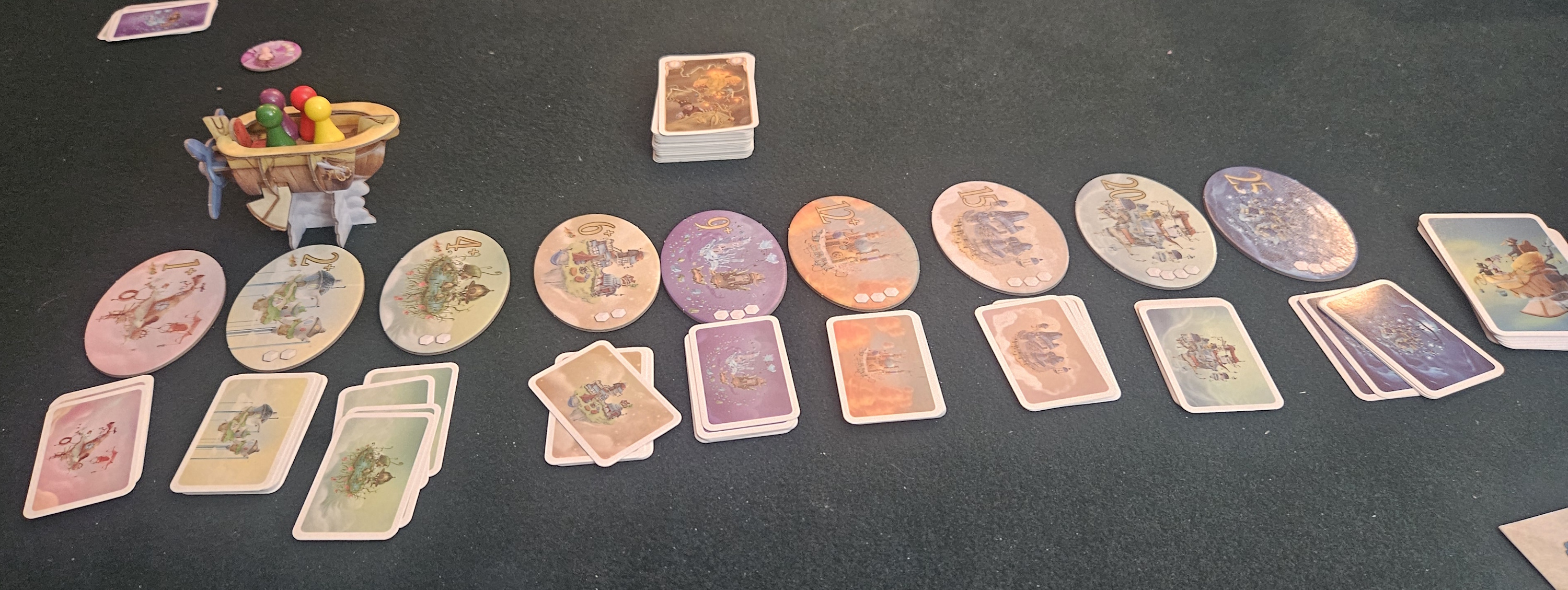
Aaron Weissblum’s Celestia is one of those games I’ve wanted to play again, if only out of curiosity. Cloud 9, the title it reimplements, originally hit shelves way back in 1999, the toddler era for modern board games, and although I prefer more recent expressions of press-your-luck like Deep Sea Adventure or MLEM: Space Agency, there’s no denying that Celestia manages to feel distinct from its peers despite some significant similarities.
this is a very old reference

One staticky sweater and it’s BOOM, oh the humanity!

Let’s start with the big parallel: like those other titles I mentioned, Celestia takes place on a perilous track filled with increasingly tasty rewards but also greater odds that your vessel — in this case a wooden airship that looks great on the table but shouldn’t be considered airworthy — will plummet to the ground in a shower of fire and splinters. There’s an even greater proximity to MLEM in that players take turns as the ship’s captain. Everybody is invited to gaze into their eyes and ask that most crucial of questions: “You got this?”

Yeah. I got this.

Or so the captain pro tem will reply, because Celestia is something of a bluffing game. Where most press-your-luck games are all about playing the odds, Weissblum’s is… well, also about playing the odds, but there’s some Boy Scout’s motto mixed in for good measure. To put it another way, players best come ready to lie their butts off and pray to the aleatory gods that their rolls will tumble aright, but it helps to bring the right cards along for the voyage.

Round by round, Celestia looks like this. On each leg of the journey, you check the odds of making it to the next port. Early on, this means two dice; by the end of the line, you’ll be chucking four. These dice present a number of threats: bad weather, different bad weather, carnivorous birds, or sky-pirates. There are blanks as well, which could transform even early hops into deadly charybdes or the last leg into little more than a summery jaunt.

At this point, everybody makes a choice. Either they stick with the current captain, believing them capable of facing whatever dangers appear along the journey, or they jump ship then and there. In most cases — a strong 90% of the time, if not more often — you’ll want to ditch the voyage well short of its final destination. This will earn a treasure from the current island. Naturally, these become more valuable with each passing landmass, tempting everyone to stick it out for just a little longer.
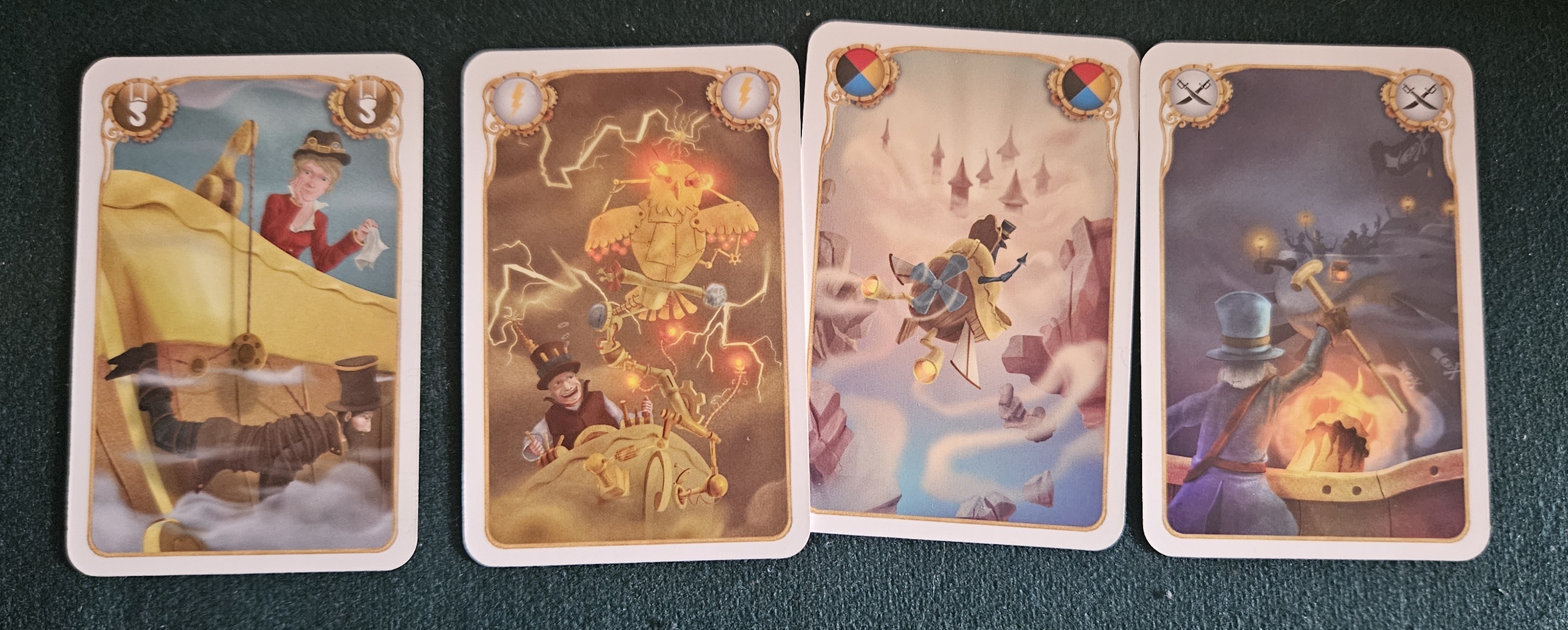
Unfortunately, very small distinctions in card timing make the special effects irritating to play properly.

Some of the cards. Yeah. There they are.

Anyway, the dice are cast and everyone chooses their fate. The captain then spends cards to face the current challenge or the blimp goes down. Either way, this process continues with a new captain, everyone rotating around and around until the voyage is finished one way or another. Then you go again. Eventually somebody obtains enough prizes to bring the session to its conclusion.

As I noted a moment ago, what makes Celestia interesting is that it’s strictly more than a press-your-luck game. It’s also about discussion, and assessing the odds that the captain is holding cards that can rise to the moment, and sometimes tricking people into staying in the boat so they can share your fate. Or maybe wincing a little. Just enough to persuade people that you can’t really sail past all those murderbirds, but not so much that they know you’re fibbing. Your goal, after all, is to earn more points than your fellow passengers.

Of course, there are special abilities, like jetpacks for ditching the ship at the last moment, acts of sabotage that reroll any blank dice, or jeweled spyglasses that are worth points but can be broken to usher the ship to its next port without incident. In some cases, these items can prove as frustrating as they are worthwhile, especially when some people keep drawing all the good stuff. Knizia balanced MLEM around the idea that everybody at the table had every special ability, but they were presented as astronaut abilities that had to be committed to a mission in advance. Here luck plays a double role, affecting both the results of its dice and what everyone pulls from the deck.

Still, it’s notable how much of a role deception plays in Celestia. Because players see the results of the roll before making their decision, it’s necessary to test the captain a bit. And because the role swaps so quickly, it isn’t long before everybody starts to take the measure of one another’s hand. In our last session, my wife was quick to remind the table that I’d failed my last outing as the captain because I wasn’t holding any storm cards. Fortunately, I’d drawn one in the interim, letting me race forward after leaving everybody marooned at the last port.
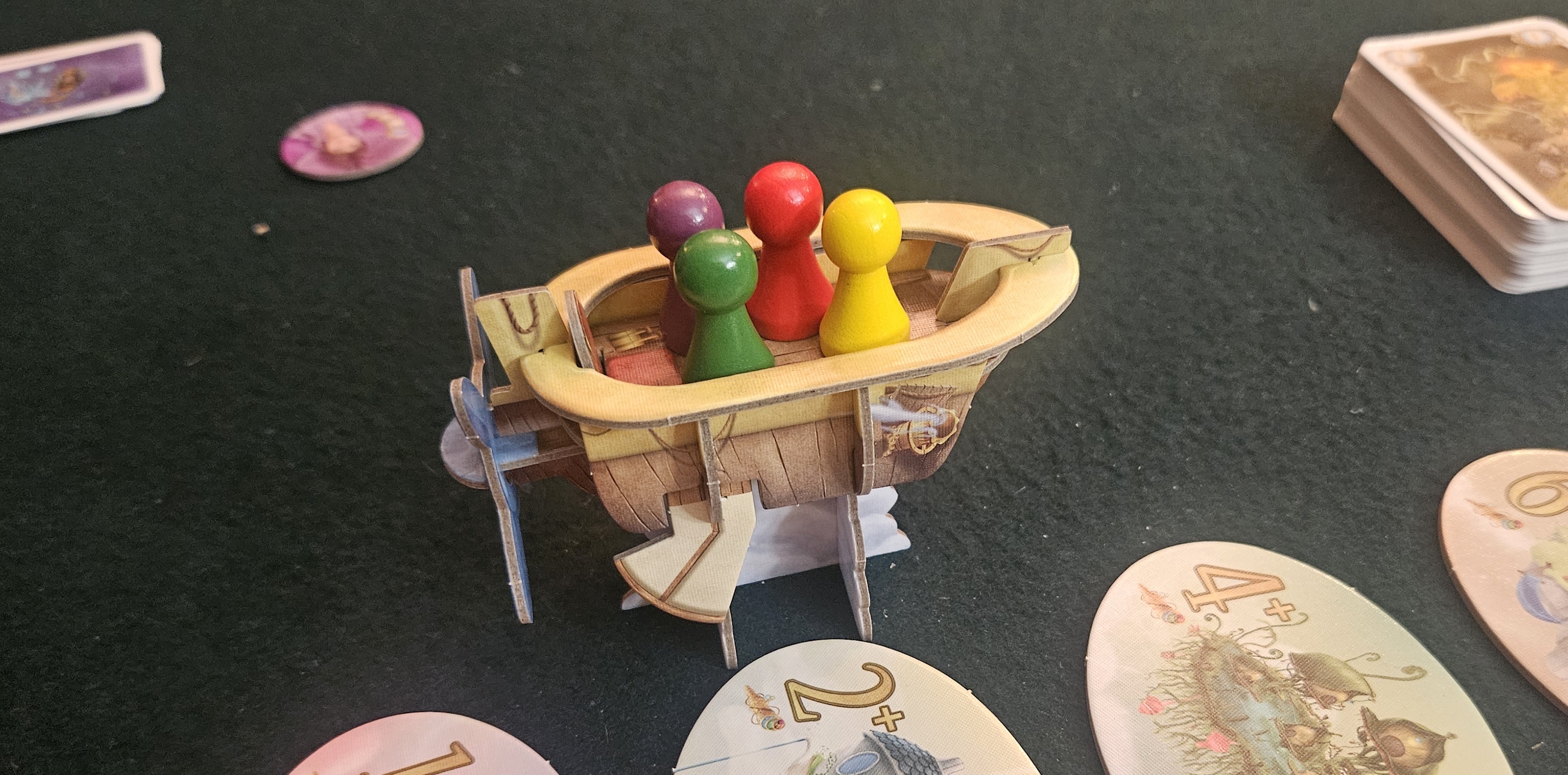
less making out with one's cousin, presumably

Like a hayride but for blimps.

Which is to say, Celestia may feel undirected early on, but as the game develops those decisions become more and more informed. It’s never quite as focused as I would like; the bluffing and the chancier elements hover in tension with one another rather than fully blending together. But it still stands apart from other games of its ilk by trying to have it both ways. If anything, it could have afforded to lean into its two-faced nature even further. As it stands, I don’t foresee myself returning to it, but it is an interesting example of how a system can feel different with even a few small adjustments.


A complimentary copy of Celestia was provided by the publisher.

(If what I’m doing at Space-Biff! is valuable to you in some way, please consider dropping by my Patreon campaign or Ko-fi. Right now, supporters can read about which films I watched in 2025, including some brief thoughts on each. That’s 44 movies! That’s a lot, unless you see, like, 45 or more movies in a year!)


A Rather Whistful War

10. Januar 2026 um 02:48

this guy does not approve of "whist" being a different color! he will whack it with his sword! take that, blue!

Fred Serval, one of wargaming’s great rabble-rousers, has a new game out. It might not sound like a new game, since I covered it a year and a halfish ago, but that was a convention freebie that required scissors and some buttons from your bottom drawer to play. A Very Civil Whist is now an actual game you can buy and play and push around, or maybe even press into service as a doorstop if that’s your thing.

I like it even more now than I did the first time.

check out these adorable lil dorks

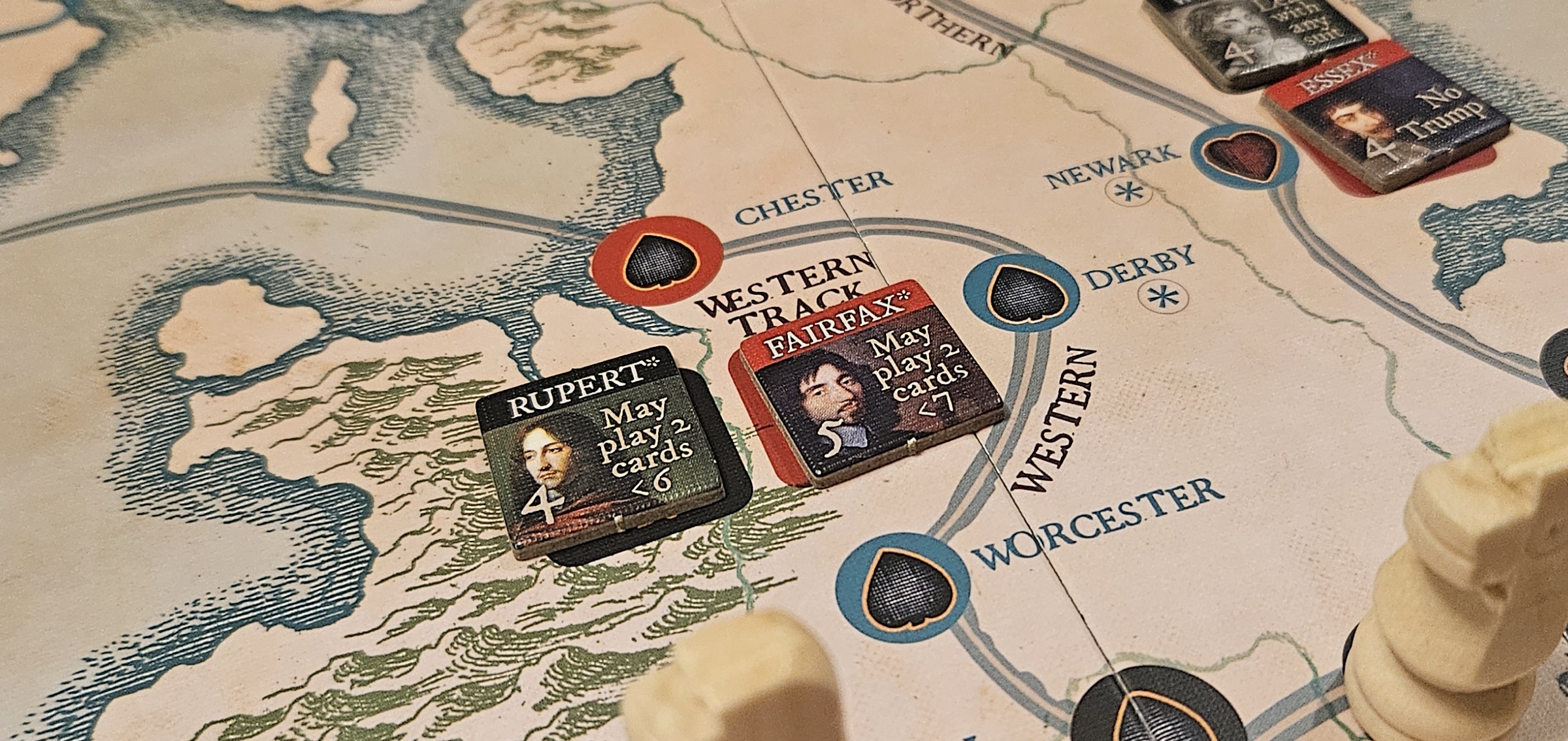
Chess knights indicate the position of the various fronts.

Even as an exercise in minimalism and design limitation, A Very Civil Whist is quite the thing to behold. Like the original one-sheet version, the game is largely playable with a single deck of cards that fulfills four different purposes at the same time. There’s an actual map board now, plus chunky cardboard counters for everything, and some chess pieces for tracking the fronts and foreign support in its ongoing English Civil War, but the highlight is still that deck of cards.

As you can probably tell from the game’s title, this is a trick-taker, although there are some wrinkles that prevent it from feeling too much like anything else out there. Like German Whist, there’s a drafting phase, in which both players deploy a small hand of cards in order to secure other cards, and some combination of your original hand and those later additions then serve as your tools for the battles, domestic and foreign support, and reactions to come.

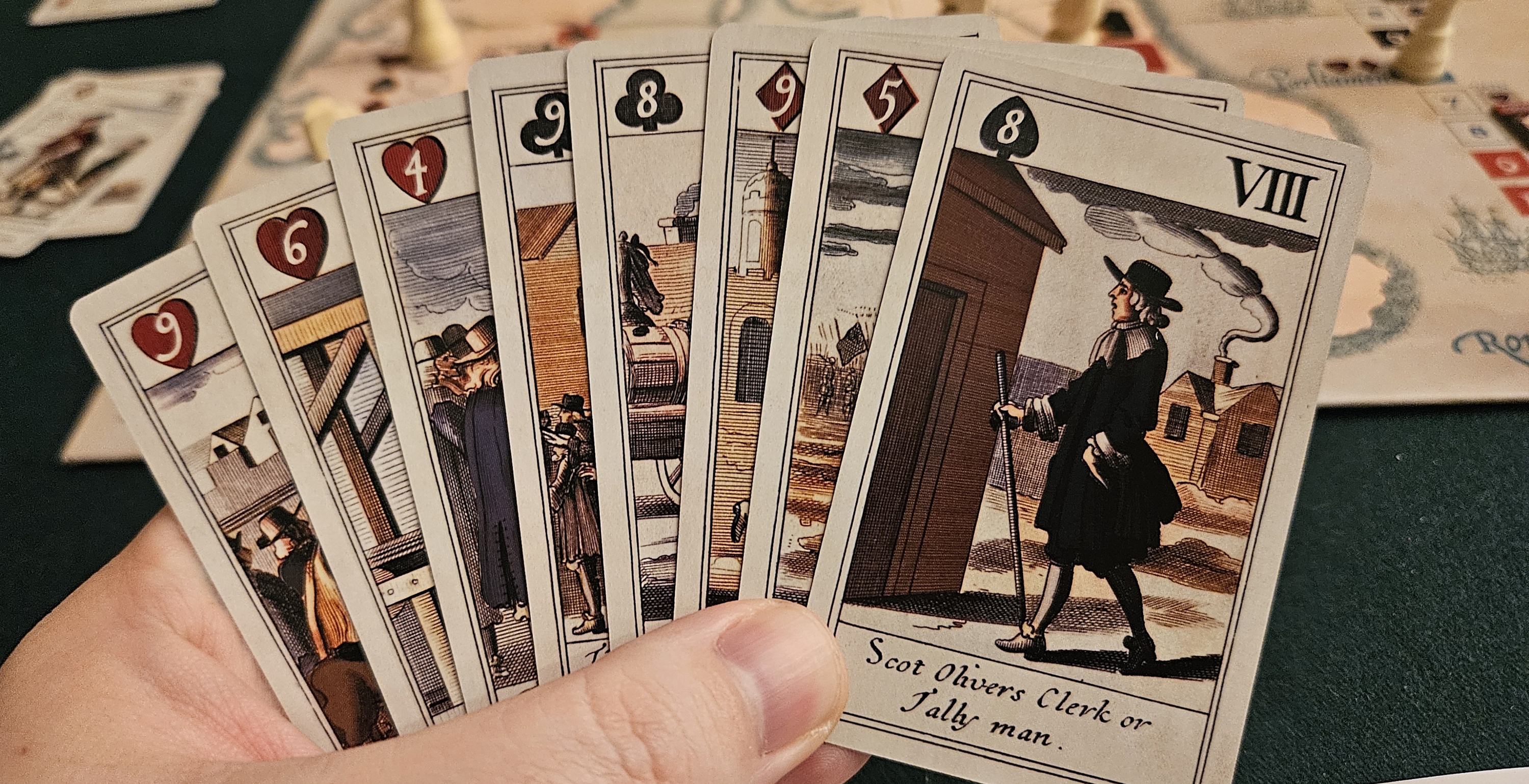
The deck is really something, both visually, thanks to the old woodblock prints that are their illustrations, and as a mechanical showcase. Most of the time, only the 4-9s get used in the trick-taking, tightening the scope in a way that’s even easier on card-counting, or at least card-vibing, than the form usually permits. The 10s serve as power-ups that unlock when your faction reaches a certain threshold: securing enough foreign support as the Royalists, say, or seizing some good ground in the northern war as Parliament. This basically confers an insta-win in that particular suit, although of course one should be suspicious of anything that seems like a sure strategy.

This will be my fashion sense when I'm old.

The woodblock-style cards are lovely.

The remainder of the cards still matter. The lower suits, those 1s through 3s, function as a casualty check. When an attack fails, you draw a pair from this deck and see whether they sum to a higher number than your commander’s resilience; if so, he atones for his dishonor by falling on the field of battle. This is, to put it lightly, a bummer, especially when one of your better leaders bites it early. In one of my more bruising sessions, I managed to bring out Oliver Cromwell only to watch as he tripped onto his own sword in his very first fight. Let’s call that a good outcome for the Irish Catholics.

Meanwhile, the face cards become events. A Very Civil Whist is a brisk game, only four hands long at maximum, which requires two events per round. But they’re high-impact things, not to mention load-bearing tendons in the game’s connective tissue. Queen Henrietta might appear to call upon a burst of foreign support from her home country, or new counters might enter play to provide a one-time boost to your odds in battle. My least-favorite event — and I mean that in the complimentary sense — is the one that allows Parliament to examine every pair of that round’s drafted cards in advance before hiding one of them face-down, turning the draft into a nasty bluffing minigame.

With the cards pulling so many duties, it may not seem like there’s enough to keep players engaged. Nothing could be further from the truth. A Very Civil Whist is nasty, brutish, and short, all qualities Serval leverages to the game’s benefit. The military fronts are seesaws, their tracks kin to States of Siege’s lanes, always under threat. Shoring up your domestic support is necessary to declare victory, but requires players to discard their most precious cards. Unlike some trick-takers, there is never a moment that feels foreordained; there’s always something to do, some weaselly advantage to be clawed over on your rival.

"Clubmen" could imply either that they wield clubs or belong to a club. Unless they're clubclubmen.

Events keep both sides of the war on their toes.

Which brings us to a larger question: is A Very Civil Whist worthwhile as more than a plaything? As a trick-taker, it’s very good. As a visual production, it look fantastic. But what about as an expression of its historical conflict? We are, presumably, interested in these games as portrayals of their conflicts, not merely as vague nods in their direction.

There will be some variance here. Between its approach to events and the way its verbs relate to its card-play, there’s no denying that this occupies the far end of the CDG wargaming spectrum. In other words, it’s profoundly abstract. With some imagination, one may imagine the cards as stand-ins for broader considerations: some diplomatic tact here, the New Model Army there. But I doubt anybody would argue it doesn’t require the aforementioned imagining.

Where A Very Civil Whist excels, I think, has less to do with the invocation of specific occurrences, and more to do with the closeness and acrimony of its conflict. One doesn’t gain a sense for the progression of the English Civil War so much as for its unprecedented and brutal nature. Like the term “civil war,” the game’s title is a bitter irony. There is nothing civil about it. The war’s actors may speak the same tongue, may wear the clothes of noblemen, may speak in lofty dialogue. But here they are, grubbing in the mud for advantage over their closest peers. Nobody will emerge from the game any closer to having memorized the war’s important dates or understood its underlying causes. But they may grasp some of its proximity, some flicker of the reverberations it will send down the centuries. This is the true starting point for the Age of Revolution. Some may mark its date later, up to a full century after these events. But, no, it is here, in these very English debates over the ultimate source of sovereignty, over which taxes are justly imposed and which are unfairly extorted, over questions of which kingdoms should be accepted to rule over others, over the framework of constitutions and who deserves to benefit from them, that the great upheavals mark their beginning.

Just like that, the war turns a corner. Now there can only be one.

That awkward moment when both men wear the same thing to the war.

In any case, it’s hard not to be drawn to A Very Civil Whist’s sheer audacity. It’s a single-deck game that prizes playing cards for their versatility as much as for their ubiquity, and deploys both traits to great effect. It’s a hybrid of trick-taking and wargame that manages to emphasize the strength of both forms even as it forges its own identity. It’s even another investigation of revolutionary history, making it the rightful partner of A Gest of Robin Hood and Red Flag Over Paris — and, in many ways, their superior.


A complimentary copy of A Very Civil Whist was provided by the publisher.

(If what I’m doing at Space-Biff! is valuable to you in some way, please consider dropping by my Patreon campaign or Ko-fi. Right now, supporters can read about which films I watched in 2025, including some brief thoughts on each. That’s 44 movies! That’s a lot, unless you see, like, 45 or more movies in a year!)

No More Mr. Mice Guy

08. Januar 2026 um 21:49

That fox is the horniest board game character I've ever seen, and I don't have even one ounce of furry in me.

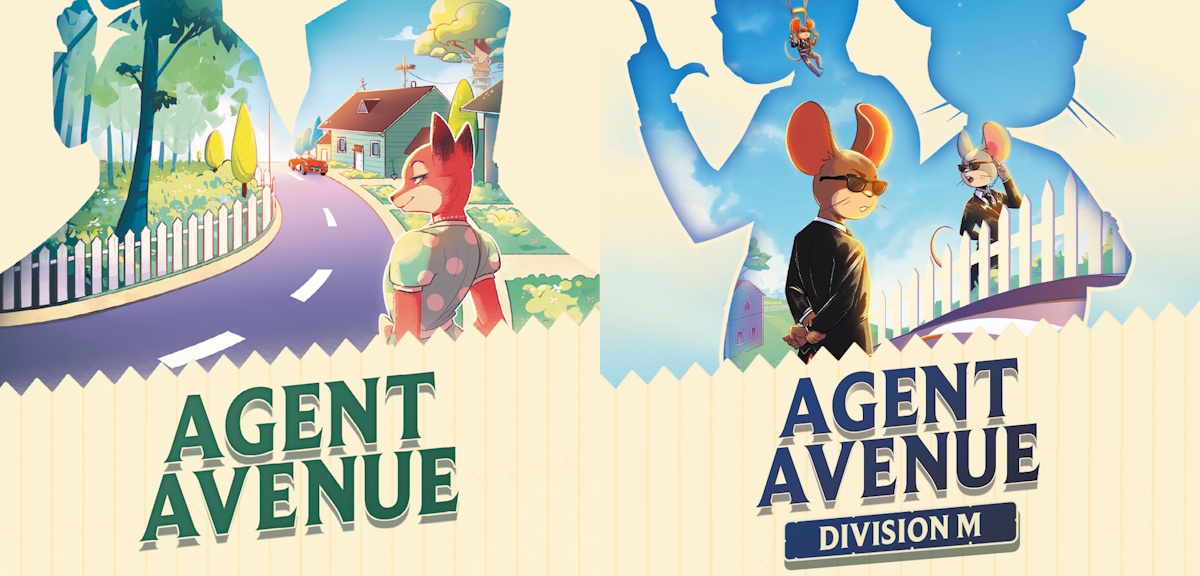
Sometimes one card makes all the difference. When I played Agent Avenue last year, I found it sharp but perhaps a millimeter thinner than I would like, resulting in an affinity for the four-player mode over the usual two-player duel. Now that I’ve added Division M to the mix, I can safely say the expansion functions like a shim under a chair’s mismatched leg.

Do you think their ears ever give away their position? Like sharks that are too dumb to know we can see their fins?

There they are. The MIBs. (Mice in Black.)

I say “one card,” but rest assured that Division M includes more than a single card. This is no depot expansion to The Lucky Seven. Which isn’t to say it’s exactly sprawling. There are six copies of the new card, plus fifteen black market cards for the advanced mode. Still a slender expansion, then, but it’s not like it ships in one of those singlet baseball card sleeves.

As before, players take on the role of rival secret agents who have moved into the same suburban community and are now enlisting their neighbors in a race to corner their opponent, a conceit that speaks to high drama without requiring more than a sentence of introduction and a few furry illustrations. The stakes are immediately clear: the board is a clockwise circuit, and whichever agent catches up to their rival delivers a presumable double-tap that concludes the session.

Similarly, the poison-pill gameplay returns wholly intact. Turns are simple: one side presents two cards, one visible and the other face-down, then their opponent picks which card both sides will receive. It isn’t quite as involved as the antics of my preferred divide-and-choose title Pacts, but that’s also the point. With only a handful of options in circulation, the possibility space is constrained, which only makes the decision space all the more deadly.

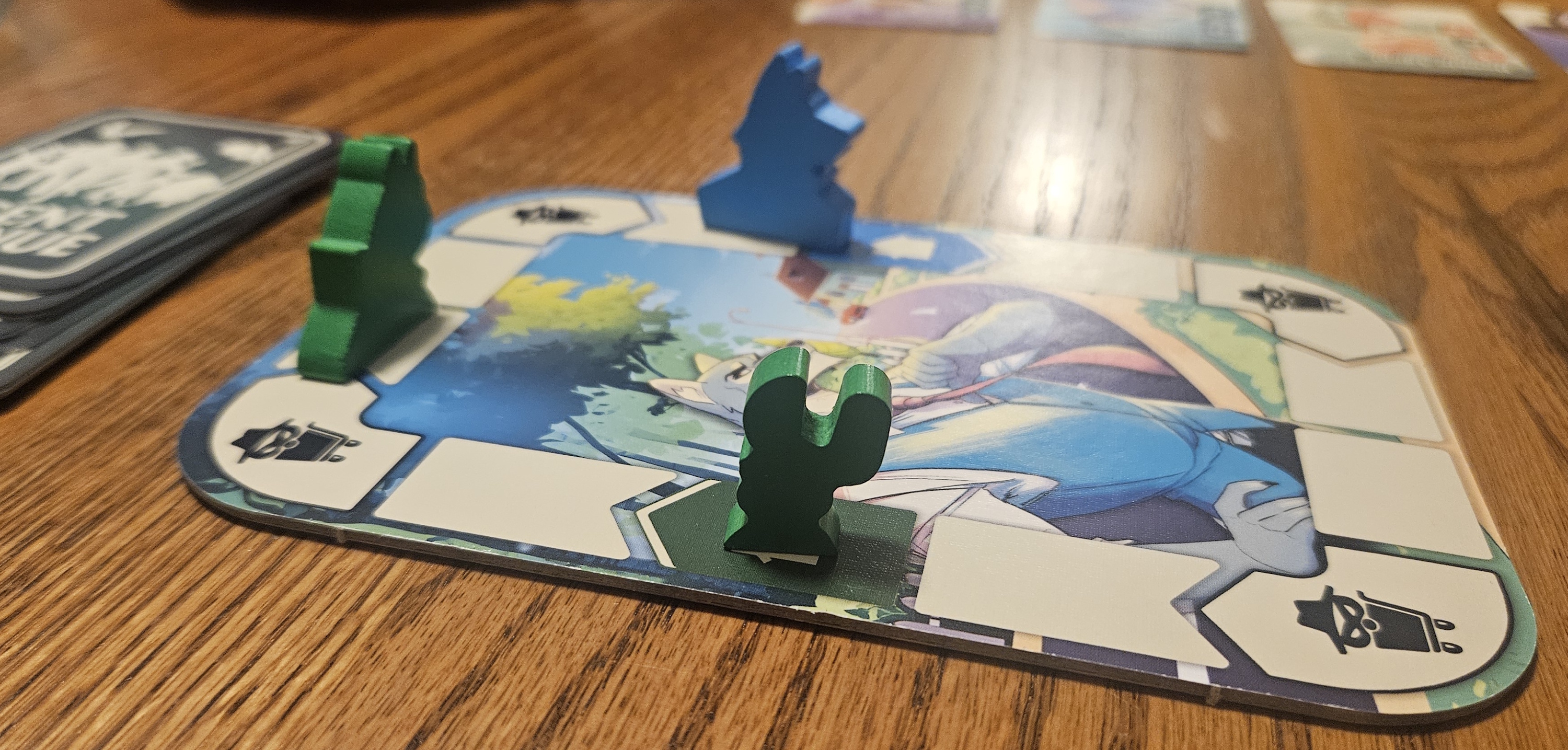
But where the base game’s cards fell into two broad categories — those that moved pawns and those that could, once enough copies were gathered, win or lose the game outright — Division M’s addition makes everything else more fraught. It’s an assassin. A mouse assassin. When first played, this adds an extra pawn to the board. As further copies are acquired, that assassin shifts its position like a shadow version of your main agent. If ever your rival shares a space with the great mouse assassin, it’s lights out for them. And vice versa, of course. Because there are six copies of Division M in the deck, it’s entirely possible for both sides to chase their rival while also dodging pint-sized bullets.

assassino rodenta

Mouse assassins add some extra danger to the roundabout.

What this adds to Agent Avenue is an essential landmine. It has always been possible to “checkmate” one’s opponent, offering a pair of cards that will both cause them to lose, or, barring that, to weaken their position. With Division M in the mix, that’s a little more likely, but in both directions. It isn’t uncommon, for instance, to see a Division M card put up for offer right as you approach your rival’s side of the board. By claiming the concealed card, you might move right into the freshly-spawned rodent killer. Or is that what your opponent wants you to think? And so forth.

This makes matches punchier, which is exactly what I wanted. Despite my affection for the base game, I’ve suffered through the occasional match that ran a little too long for its own good, both agents circling again and again until one of them lost out of exhaustion more than maneuvering. Those days are over.

It helps, too, that the new black market cards are stellar. Nothing has changed in the advanced mode, rules-wise. Landing on a corner space still lets you select one of three offerings, and those cards are still nasty little things. It’s just that they’re a little more barbed than before. There’s the Turncoat, which lets you recruit a card from your opponent’s hand at random. Will you get something they’ve been hoarding for the right moment? Or maybe an ill-timed saboteur? Some of the new options even manipulate your new pawn, like Call Backup, which lets you move your mouse up to three spaces. That one’s counterpart is Secret Passage, which gives you a one-time dodge when your diminutive killer would put you on ice. Those fifteen extra cards double the size of the black market deck, ensuring that each session now has its own set of considerations.

In less interesting news, Double Agent is still OP.

Just that one extra card adds a lot to consider.

Still, the real draw is the Division M card. The short version — short, geddit? — is that I already liked Agent Avenue, but Division M shapes it into an all-timer. It’s a perfect game for filling ten minutes, which includes when the kiddos want to play something quick before bed or we’d like to cap off an evening with something that’s still pleasantly thinky. I can’t foresee a time when I won’t want it on my forever shelf.


A complimentary copy of Agent Avenue: Division M was provided by the publisher.

(If what I’m doing at Space-Biff! is valuable to you in some way, please consider dropping by my Patreon campaign or Ko-fi.)

Yub Nub

07. Januar 2026 um 20:22

YUI3II3O is my bank password

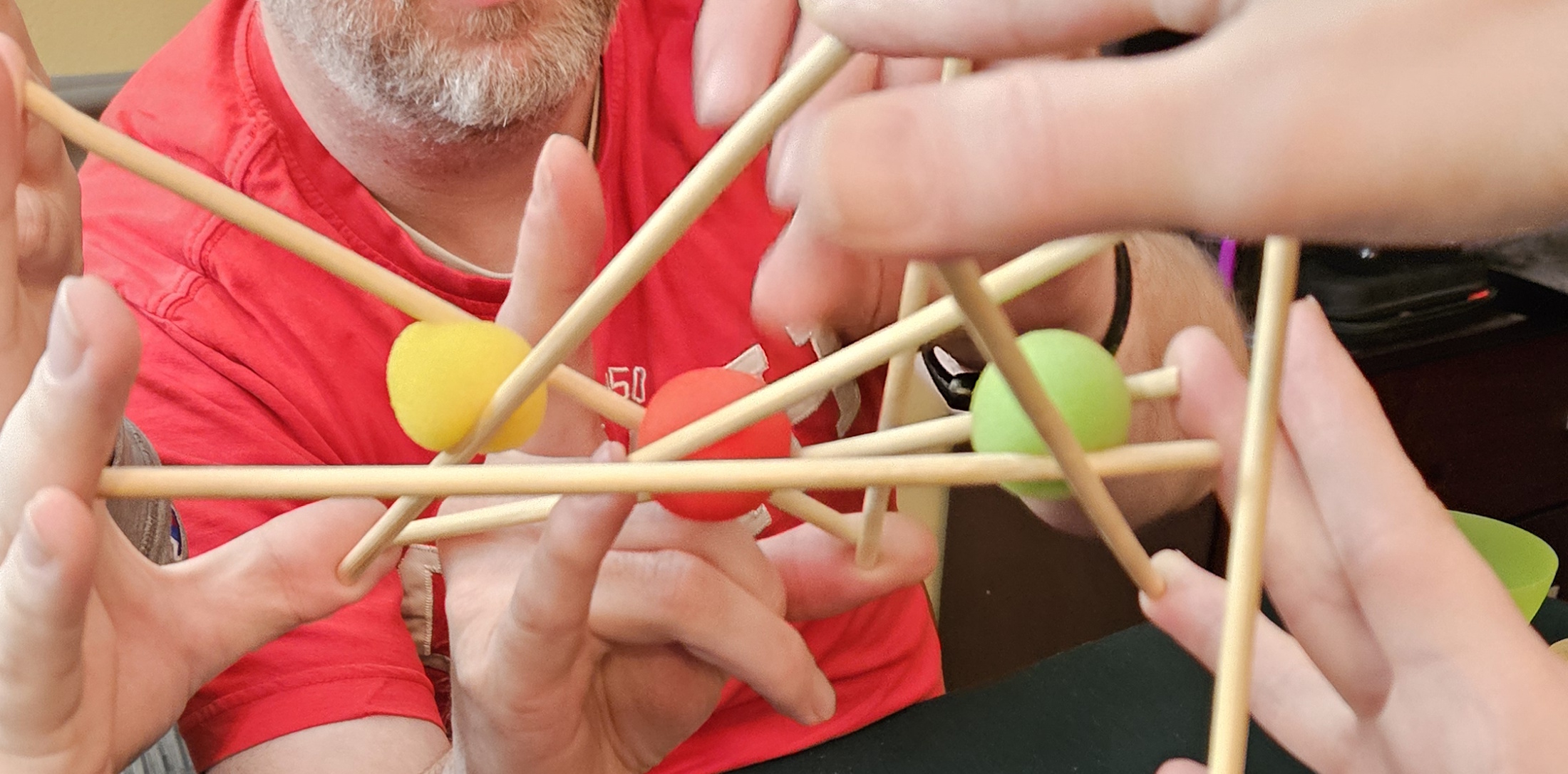
Yubibo exists to reveal which member of your group has selfish proprioception, a sentence I never could have conceptualized until I experienced a friend, with a dozen sticks poised between his fingers and those of four peers, suddenly rotating his wrist all the way around to arrive at a more comfortable position. Six other players were sent lurching in response, doing everything in their power to maintain the pressure on those sticks. It didn’t work. Foam balls and wooden sticks clattered to the table. Everyone laughed.

growing the beard while doing it? insane mode

Balancing the balls is technically the advanced mode. Usually the sticks are hard enough.

Yubibo feels like a game invented, playtested, and marketed in a dumpling restaurant. The gist couldn’t be simpler. You draw a card — very quickly itself a feat of balance — to reveal which player you must balance a stick with. Which player and which finger. Your brother-in-law’s ring finger. Your daughter’s thumb. Your own birdie finger, which means anybody’s birdie finger of your choosing.

Early on, this is a simple ask. Two people can hold a stick between them. No problemo. Kein problem. Mondainai. Another stick? Sure. How about a third. What is this, a game for children?

I’ve tried Yubibo with children, and let me tell you, it takes some willpower to keep more than a couple sticks above the table. My older daughter can manage alright, although her wrist gets tired after a while. My six-year-old? Forget it. She has the greediest proprioception I’ve ever seen. This isn’t something I could have known about her until she tossed an entire handful of sticks onto the table, noping out of the game after three minutes. Was her hand hurting? “I just don’t like this game,” she insisted.

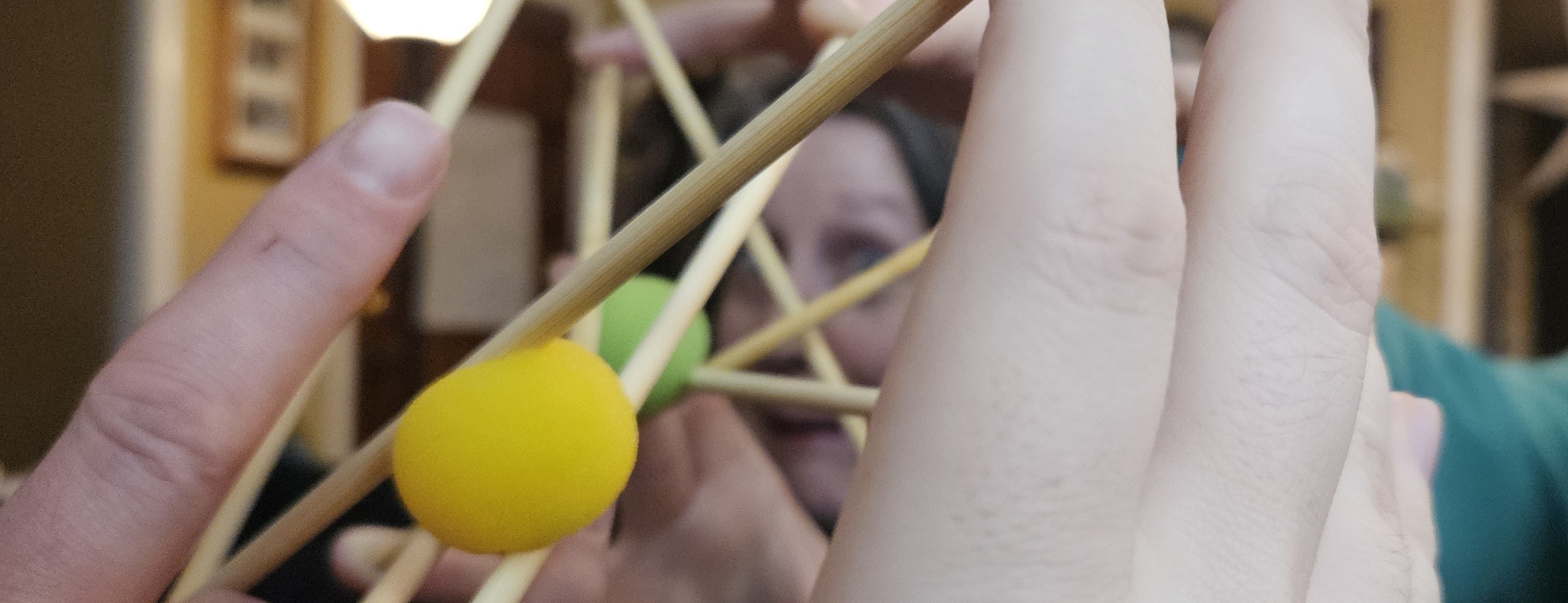
Even with adults, it only takes one go around the table, maybe two with a smaller group, before you start to feel it. Not only the burn, although Yubibo excels at finding the muscle groups that have atrophied from disuse. No, it’s the sheer jittery tension that comes from coordinating with other human beings, but not quite touching them. The sticks become power cables. Tension bridges. Bonsai wires. When someone in the group shifts — even when it isn’t someone you’re holding a stick with — you feel every movement, transmitted like a message through multiple intermediaries. Someone rolls their finger to accommodate a second stick and the entire collective vibrates.

"my hand isn't meant to bend like this!"

Terror.

At its easiest, Yubibo is just about balancing sticks. In case you’d like to try out for your country’s gymnastics team, you can also try to stuff foam balls in between the sticks. Why would you do this? Because it transforms you into Mr. Miyagi trying to honk a clown nose. A hivemind Mr. Miyagi who, if you’re anything like us, lacks basic coordination and couldn’t beat up a gang of skeletons if his life depended on it.

I think strange thoughts while playing Yubibo, which is undoubtedly bad practice when it comes to focusing on all those sticks. I look at that shifting forest and wonder if this is what the connections in our brain are like, tensing and flexing as they produce consciousness. I see human society, this magnificent construct barely held aloft through faith and determination. I see a family. Then I lock eyes with someone across the table and the spell breaks, and more often than not I feel the tremor in my knuckles and the whole thing begins to come apart.

Yubibo is a quick game. It’s an easy game to teach. Unlike some balancing games, I have my doubts that it’s quite winnable. Oh, the rules provide a metric. A certain number of sticks. In my experience, those are best ignored. The game shines when you play it with all the stuff. When there’s no purpose but the cascade at the end. Not every game needs to end in victory. Sometimes, just holding it together for one more go-round the table is enough.

basically the Ring girl

The most cursed image ever featured on Space-Biff!

There isn’t much more to say about Yubibo. This once, that strikes me as a good thing. Ten minutes, lots of laughter, lots of failure. The sticks clatter, the foam balls bounce away. So, too, goes whatever was cluttering my headspace only a few moments ago.


A complimentary copy of Yubibo was provided by the publisher.

(If what I’m doing at Space-Biff! is valuable to you in some way, please consider dropping by my Patreon campaign or Ko-fi.)

Movin’ Up an’ Down Again

07. Januar 2026 um 04:43

Oaf?

For all that board games thrive on taking us to new places, exploration is surprisingly hard to do well. Explorers of Navoria, designed by Meng Chunlin, is a prime example. Set in a colorful world redolent of Root’s woodland or Oath’s turbulent empire, and populated by critters who wouldn’t draw much side-eye in either setting, Explorers of Navoria is nominally about pushing the frontier ever outward, but more accurately about shifting one’s position on a number of slightly differentiated tracks. In the proper mode — a persnickety combination of player count, expansion, and headspace — it’s a tasty and visually appealing course that feels good going down even as it leaves the stomach rumbling minutes later.

Just maybe not here on this particular board.

There’s lots to explore out there.

To describe Explorers of Navoria is to divvy it into two halves. Think of them as expansion and contraction. In the first phase, players are asked to push outward, assigning discs to various decks to acquire cards in the market; later, they will reassign those discs back into the heartland that birthed them, earning resources and other sundries.

Each of these phases has its own appeal. The exploration phase is immediately rewarding. Either you draw a pair of those discs from a bag and select one, or else claim one of the previous discards. Either way, your… troupe? guild? I’m not sure, but whatever their role, they’ll nab a card from the market and put it into practice.

These cards, in addition to being easy on the eyes, are simple little things. Some move your explorers along tracks, one for each of the desert, jungle, and mountain, in order to plant flags and earn farthest-place bonuses. Others build outposts along those same tracks, pushing your starting space outward for future rounds. Those are the most dynamic; others are more straight-laced, earning resources that can be distributed across your player board’s three spaces to be cashed in for bonuses and points later, or perhaps building combos for later. There are suits to consider for end-game scoring, various species to monopolize for the same function, and the not-occasional coin or three. Coins are victory points, by the way, so don’t go expecting something more engaging.

And then, once the exploration is complete, Explorers of Navoria transforms into an ultra-light worker-placement shindig. Those same tokens return home, only this time the earnings are less tableau-ish. You earn a few more resources, a few more coins, and maybe turn in some of those resources for an extra few bonuses.

In between the cards and the player board, you can see the drafted faction powers that are only included in the expansion. If you must play this game, I recommend the extras.

I do appreciate a vibrant tableau.

The secret to the game’s success isn’t really much of a secret. Everything is rewarding. Everything feels good. It’s like a casino where every slot machine is guaranteed to dump cherries and coins and colorful bits of ribbon in your lap. Never mind that the cherries are plastic and the coins hold no value. Explorers of Navoria is a masterwork at saying something loudly and often, but with very little meaning.

To be fair, that isn’t such a bad thing. At its best, Explorers of Navoria could hardly be described as a poor hang. It feels good to move up those tracks. It feels great to build an outpost and start a little farther out than last time. It feels nice to bring home a wagon full of crystals and swords, and even better to trade them in for some extra coins-slash-VPs.

Little by little, though, the sameness of the linoleum starts to show through. There’s the way every card sticks more or less to the same formula, maybe plus or minus a point, but never coughing up anything all that exciting. Or the way every combo looks like every other combo; there are those that reward coins for particular races, or those that trigger only at the end of the game for outposts, with very little room in between. This isn’t exactly a game that allows the player to discover something new, let alone forge their own way in the world. At least there’s some frisson of randomness there, courtesy of the draw-bag and the way the market populates with cards. It isn’t much. It isn’t enough. I’d call it a gesture in the right direction. But two plays is enough to realize you’ve already seen what Explorers of Navoria has to offer.

This isn't even the correct metaphor. Explorers of Navoria could afford to be MORE tipsy. Instead, it's a little too stable. Still, the fact that the turn markers can't stay standing for more than a moment is an interesting detail.

The turn markers are a microcosm of the game at large: pretty but tipsy.

It doesn’t help that some of the game’s best ideas are hidden away behind the expansion. Like actual rewards for moving along those tracks. Actual rewards apart from coins, I mean, such as bonuses for collecting the previously underwhelming warfare cards. Or like the faction draft that sees each player building their own opening combo, with starting cards and little abilities, complete with an extra resource that can be gathered on the map and churned into a new approach to the gameplay. Or like the addition of a sixth deck of cards in the market. This makes it possible to play with five players, but more importantly it allows the game to actually function at four.

Okay, I’ll back up. With the base game, each round sees players gathering four cards. Unless you have four people at the table. Then you only gather three. That’s the difference between nine and twelve cards at the end of the game. Playing with four means everybody is too pinched. It’s hard to move along any of those exploration tracks, let alone build a functional combo. With the expansion, however, now there’s enough to go around. Unless you bump the count to five players. Then you’re stuck gathering those three cards per round again.

It’s a weird way to gate a package’s content. Urp. Content. I hate thinking about board games like that. But in this case, it’s hard not to default to that way of thinking. The base game works well enough, but it works less well without the expansion. Despite all the color and the fanciful characters and the moment-to-moment lizard-brained pleasure of accumulation, it feels thin, like the precise number of cards were doled out to make the game playable but also a bit lean, just enough to leave everyone hungry for more.

Which leaves Explorers of Navoria in an odd space. Like I said earlier, it feels good to play. It’s tight. Players will likely wind up with comparable scores, borne of fifty trickles that sometimes contained a drop more or less than the others. But it’s still the equivalent of licking a damp cave wall for nourishment. It’s just that there are pretty pictures to look at and some technically serviceable levers to pull while your tongue laps at that smoothness.

I was originally going to sneak a card from Oath in there just to see if anyone would notice, but their title banners gave them away too readily. Oh well.

The lion guy is a good hang.

What’s left is a board game that looks nice and feels nice, but never really does anything more. Which, look, is sometimes precisely what I want. This is an easy game to converse over, even if the variable turn order makes it a little more hostile to beer-and-pretzels than it might have otherwise been. But there are other options out there. Some of them feel less like hamster wheels. You’ve got better things to do with your time than march up and down the same featureless tracks.


A complimentary copy of Explorers of Navoria was provided by the publisher.

(If what I’m doing at Space-Biff! is valuable to you in some way, please consider dropping by my Patreon campaign or Ko-fi.)

Best Week 2025! The Index!

31. Dezember 2025 um 17:42

Another turn of the Wheel. 2025 was a banner year for board games, which by extension means it was a banner year for Best Week. Down below, you’ll find an index of the year’s picks. Click on any of the images to be whisked to the corresponding article. To the old year! To the new year!

Day One! Picture Perfect!

Day Two! Heart of Darkness!

Day Three! Beatrixmania!

Day Four! The D.T.R.!

Day Five! All My Children!


(If what I’m doing at Space-Biff! is valuable to you in some way, please consider dropping by my Patreon campaign or Ko-fi.)

Best Week 2025! All My Children!

30. Dezember 2025 um 17:04

In those now-unreachable years before my daughters came along, I remember balking at certain statements. “Some things you simply can’t understand until you have children,” someone would say. Now that I’ve had kids, I’m adult enough to admit they were right… but still juvenile enough to believe they were drafting their offspring into props to prove a point.

And what, exactly, have my daughters taught me? The unnamed emotion of putting an infant to sleep on my stomach. The mind-blanking terror of sitting beside a hospital bed. The way even the simplest of board games can become profound shared experiences. What follows is a list I never thought I would write: the games that transformed my year not because they were innovative or philosophical, but rather because they let me pass a few meaningful minutes with my girls.

#6. Tic Tac Trek

Designed by Trevor Benjamin and Brett J. Gilbert. Published by Alley Cat Games.

The third in Alley Cat’s line of mint-tin games, Tic Tac Trek initially seemed like the afterthought of the group. For one thing, unlike its predecessors Tinderblox and Barbecubes, it isn’t a stacking game. For another, it’s a riff on Tic Tac Toe, the worst way to pass time in church. (Besides actually listening to the sermon, obviously.)

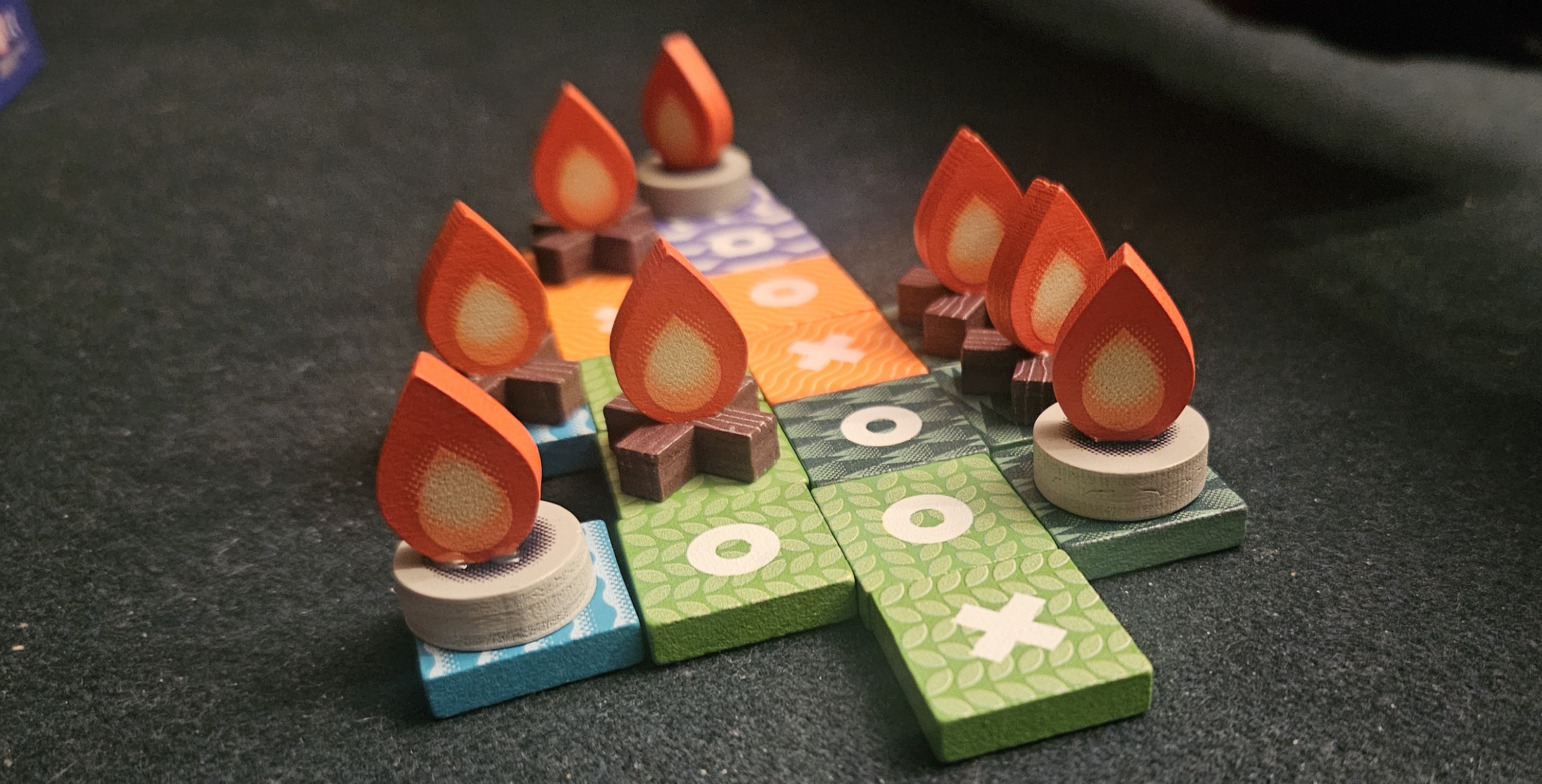
I should have known better than to doubt Trevor Benjamin and Brett J. Gilbert. Tic Tac Trek is as smart as they come. Your goal is indeed to make three in a row, but here your marks are tiles drawn from a bag, injecting tension and doubt into every move. What’s more, you hope to ignite your campfires on the edges of the play space, earning points for every uncharted territory around them, but risking subtractions as the game progresses. It’s a masterclass in shared incentives and painstaking blocking — but on a more relevant level, you should have seen me beam when my elder daughter absolutely swept my dad with a series of clever placements.

Review: Fire Hazards

#5. Ichor

Designed by Reiner Knizia. Published by Bitewing Games.

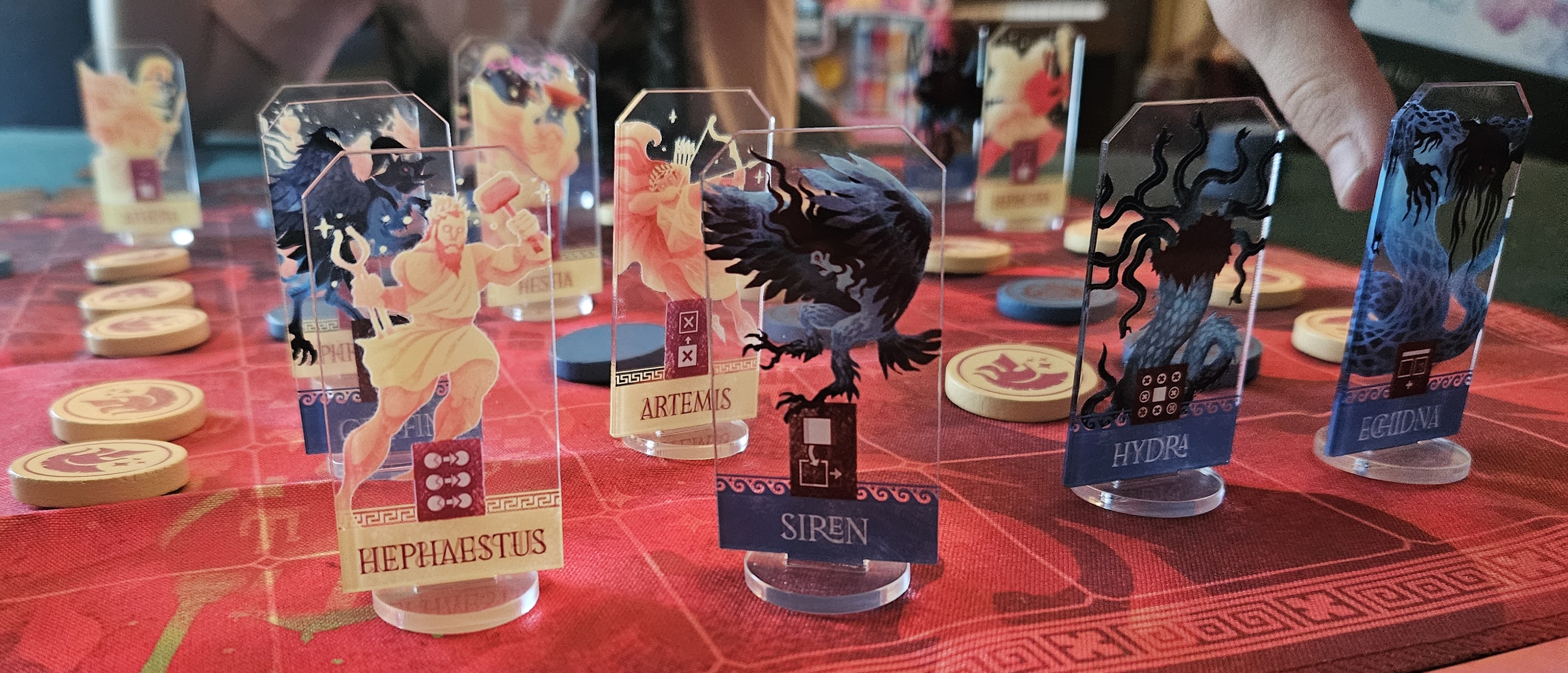
Look, I agree that Iliad, Ichor’s companion title, is the stronger of these Knizias. But Ichor is the one my elder daughter fell in love with, and by extension the one we played time and time again, her monsters sweeping across the foothills of Mount Olympus. As a game, Ichor feels tailor-made to appeal to chess-loving children. It’s basically the answer to the question, “What if every piece could move like a rook?” The answer is silly at times, especially when somebody leaves a lane unattended.

Of course, Reiner Knizia knows better than to let one of his games fall apart just for the sake of some silliness. Ichor stands apart because its objective isn’t to capture opposing pieces. Indeed, most pieces can’t capture at all. Instead, you’re here to scatter all your tokens across the board, a task made all the harder because your opponent also has a stable of their own rooks for replacing your tokens with their own. It’s only through careful play, including cautious use of your team’s special abilities, that you can get ahead. My daughter can beat me over half the time now. I couldn’t be prouder.

Review: She’s a Grisly Monster, I Assure You

#4. Magical Athlete

Designed by Takashi Ishida and Richard Garfield. Published by CMYK.

The surest sign of a board game’s success comes when my parents, relative agnostics for the form, ask excitedly if I brought it to Christmas brunch. Magical Athlete is one of the best board games ever designed, and I say that without reservation. Low player agency? Fart noiseWho cares. This is one of those rare games that can be played by four-year-olds and octogenarians with equal delight.

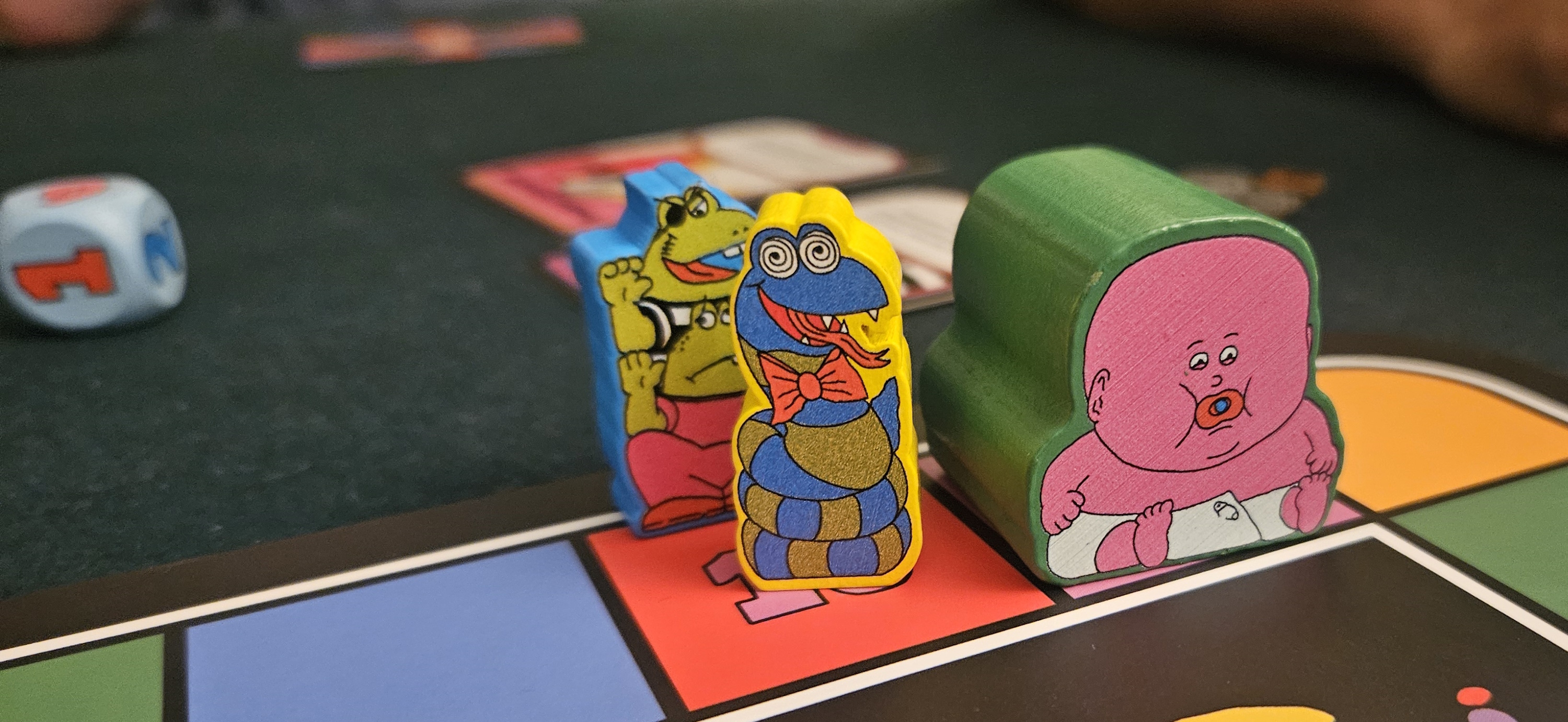
And the recent CMYK edition is more or less the game’s platonic ideal. Everything has been touched up: the character abilities, the extra racing circuit, the way racers are drafted, even the wooden miniatures. Ever seen a giant baby take up an entire space? The game is packed with little jokes, some ludic and others visual. I have yet to encounter a bad play of this thing. Or, crud, even an average play. My kids now insist we pack this thing to any sufficiently large family gathering. It’s that good.

Review: Chariots of Frickin’ Fire

#3. A Gentle Rain

Designed by Kevin Wilson. Published by Incredible Dream Studios.

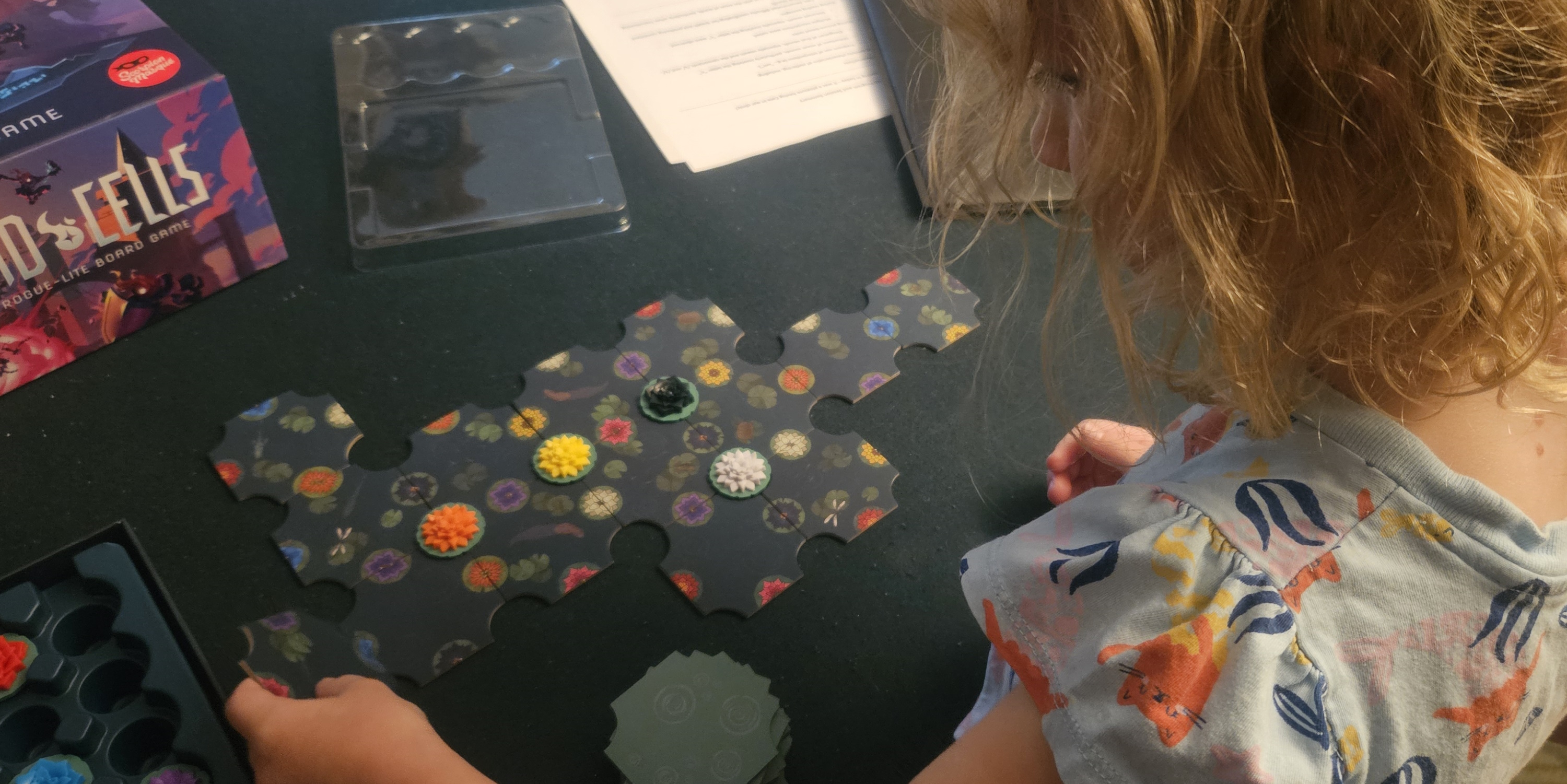
Designed during the doldrums of a global plague, A Gentle Rain technically released in 2021. But in a testament to the format’s timelessness, it emerged as a household regular only this year. As a game, I was initially reluctant. The play consists of matching tile edges to create blossoms. Not much to it. There’s a win condition, but it’s squishy. To be frank, the entire project initially struck me as indulgent and patronizing.

I was wrong. Oh, so wrong. My younger daughter has always struggled with the largeness of her emotions. Being able to sit and undertake simple, soothing, repetitive actions has been a blessing. She cheats at the game; since it’s cooperative, nobody cares, and she also insists I cheat as well. It’s short enough that we can squeeze it in before school. And it’s calming enough that it has been become a reliable staple for helping her gain some space from an overwhelming task. As an exercise in mindfulness, A Gentle Rain exemplifies the strengths of tabletop games.

Review: A Mindful Rain

#2. Tidal Blades 2: Rise of the Unfolders

Designed by Tim and Ben Eisner. Published by Druid City Games.

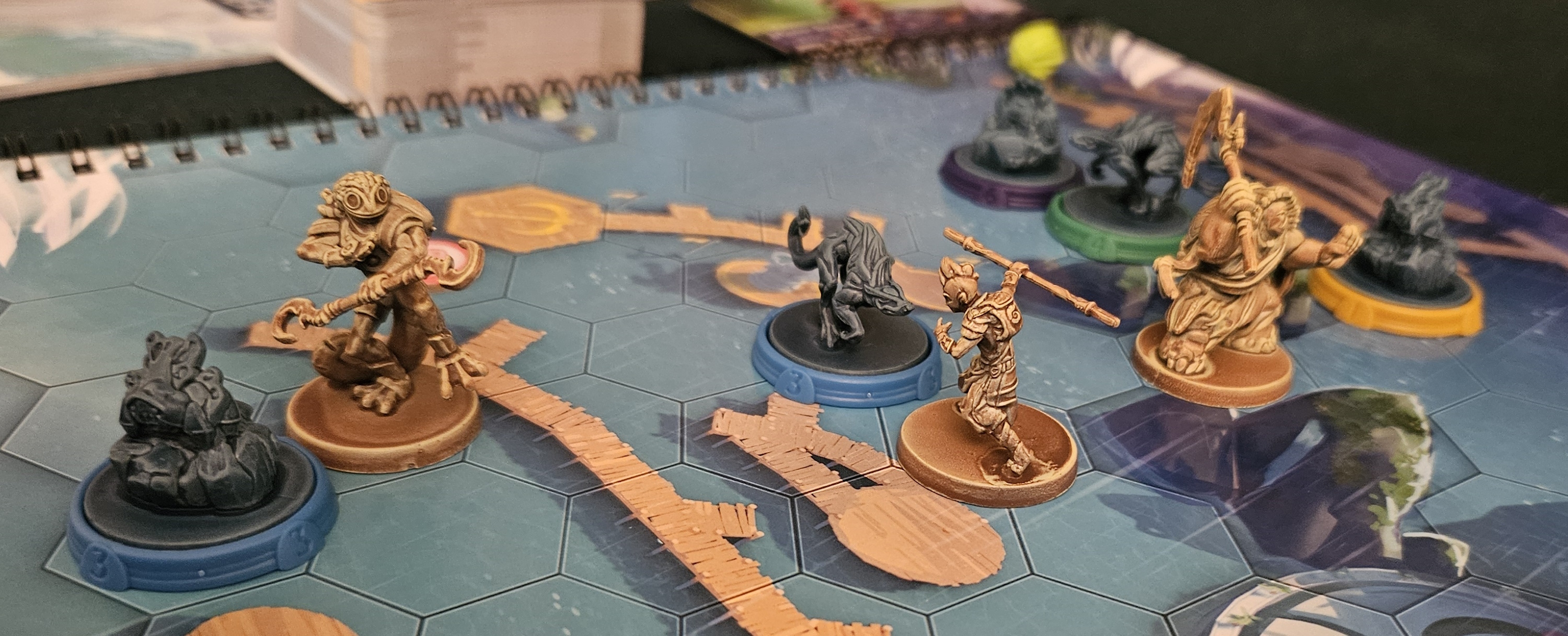
Over the past year, we’ve tackled a number of campaign games. Most of them have quickly proved tiring. I won’t list examples; Best Week isn’t for downers. But the one title that consistently brought us back to the table, charmed us with its bright palette and upbeat characters, and kept us turning pages despite some rather, ah, expressive writing, was Tidal Blades 2: Rise of the Unfolders.

What are Unfolders? I could tell you, but it wouldn’t make any sense. Like most board game adventures, Tidal Blades 2 is a bit of a mush. But it’s a lovely mush. Even the monsters are worth seeing. We spent many nights poring over the game’s scenarios, my older kid tinkering with her character while my younger one perched on my lap for a side battle between her own hero and some spare creatures. This is the first board game that my kids could tell you about the lore. It helps, too, that I was also invested, not only because of the kiddos, but because the game’s world is so vibrant that even this weathered sack of bones found something worth defending.

Review: Wet Behind the Gills

#1. Hot Streak

Designed by Jon Perry. Published by CMYK.

It’s unthinkable that two goofball racing games came out this year, both with limited player agency, wacky characters, and broad appeal, and that the best of them wasn’t Magical Athlete. In our house, we were already Jon Perry fans. Between Spots for the kids and Scape Goat for the bigguns, there’s no denying his range and talent. Hot Streak bridges the gap with a Golden Gate of remarkable craftsmanship. Also, it’s a useful inroad to the topic of gambling. Look at what DraftKings did to these poor addicts, now reduced to wagering on the outcome of underground mascot races. Is this the future you want for yourselves, kids? Betting your life savings that a hot dog will eat asphalt?

Maaaybe. Above all else, Hot Streak is a scream. It captures the thrill of spectation, breaking down the barrier between play and passive observance. But, look, that’s grown-up talk. The real takeaway is that this is a perfect game because you can bet big on an angler fish running backwards across the finish line. We love it.

Review: Ready Set Brat

There you have it! Don’t hesitate to go all mushy on me. What were your favorite family/kid/dog games of the year? Share them below.


(If what I’m doing at Space-Biff! is valuable to you in some way, please consider dropping by my Patreon campaign or Ko-fi.)

❌