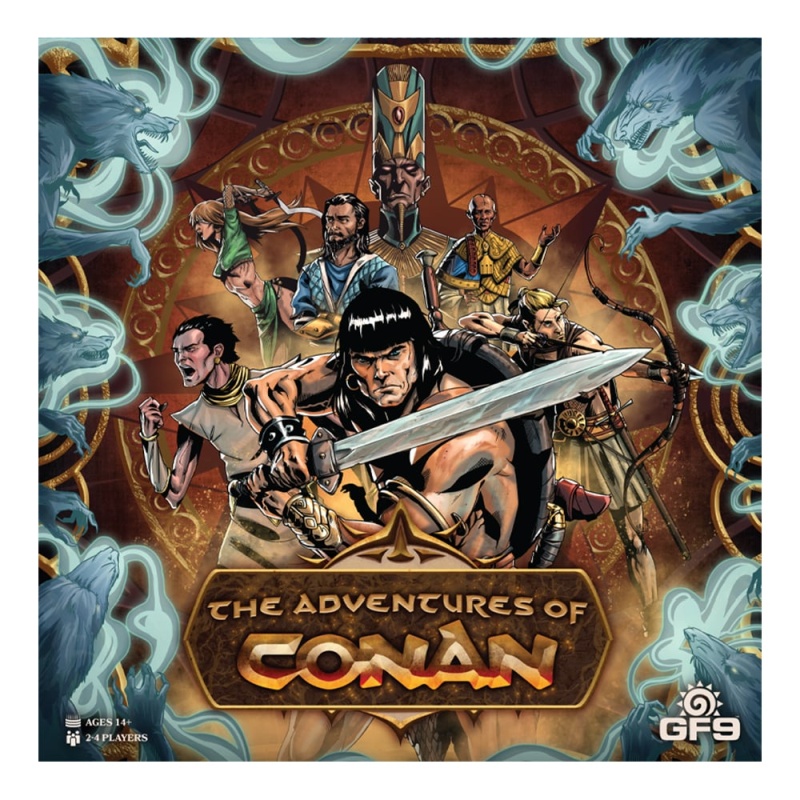
The Adventures of Conan expansions pack contains two expansions Queen of the Black Coast and Nemedian Chronicles
Queen of the Black Coast.
In this expansion there is so much added for your fun that will just lift your gaming experience hugely. In this expansion is added The Black Coast map for your game and five new realms, It also adds more allies, foes and another version of Conan to spice up your game even more. There is also added even more events, plots and scenarios.
This will open so much more to your gaming fun as you can now play as a new character while exploring new places and opening new plots and scenarios.
This expansion adds so much more playability for future games as well as so much more to do in the now.
Nemedian Chronicles
This expansion adds new scenarios with new ways to play, special encounter cards even more plots, you get Crom a new character this means he can take over and control Conan during the game, there is a set of characters put aside and if someone else takes over Conan that player must choose onr of the rogue characters and take that over with all the benefits that comes with that character. You also have new event cards that play slightly differently so that will also shake up your game a lot.
There is also now a bazar to buy special effects to add to your character and this will change how they interact with each other.
Another great expansion. At this moment both of these expansion are in one amazing box. A highly recommended expansion which will add so much to your game!
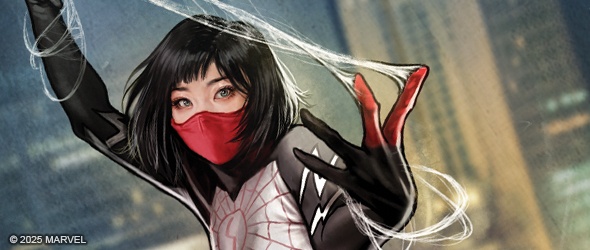
First a bit of background on Silk, she is quite a new Superhero as she first appeared on 1st April 2014 in the amazing Spiderman. She is of Korean American descent and was a love interest of Spider-Mans, her full name is Cindy Moon and she was bitten by the same Spider that had bitten Peter Parker. Her abilities are Superhuman strength, Speed, Agility, Equilibrium, Reflexes. Stamina and Durability. She also has the ability o stick to solid surfaces, she has organic web generation, precog silk-sense, she is an expert in hand to hand combat and has an Eidetic memory.She was a member of Spider-Army, Web-Warriors and the Agents of Atlas. She briefly took on the name Spider-Woman during the spider verse story line of 2022-2023.
So how does she play in the game? Her best ability is her tuck mechanic that lets her defuse dangeours encounter cards allowing her to turn them into a future card draw in her alter ego, this gives better control of the encounter deck espeically in a solo game. She has a strong defense allowing her to take damage which is useful whether playing solo or multiplayer where someone needs to take the hits. In a multi player deck with other web warriors she can share the benefit of those cards like Web of Life and Destiny. Her main disadvantage is her low damage output which especially in solo can mean she struggles against bosses.
This is a game where each player has a sheet which says how they can win. The first player play as Conan. The next player chooses a foe to play, the next player chooses an ally to play and if you have a fourth player they choose another Foe to play. Each player has their own aims and objectives for the game which makes for an interesting time. Each round plays with small combats and other exciting parts of the exploring then we see if there is a bigger fight to happen between Conan and the board and maybe a second fight as well. If Conan does not loses one or both of his fights then the third player has a chance to save the day, depending on the results bonus points go out to the players and you go on to round two.
As you go through each of the rounds the game opens up and you get more and more fun from the playing of it. On your sheet for your player it tells you what you need to achieve to win the game for your character, so good luck and enjoy yourselves! This is a complex yet fun game that is not going to be every-ones cup of tea, (I recommend giving it a go) yet it if you like this sort of game then you will love the complexities that come with exploring this realm adds to your life. I would highly recommend this great game! Espeically if you enjoyed the Dark Horse Comics line of Conan titles where the characters, adventures and art are taken from.
It’s that time of year again – time for the des Jahres awards! These are a set of awards given to the German game of the year. The Spiel des Jahres (family game of the year) has been around since 1978, with the Kinderspiel (childrens game) being officially added as an award in 2001, and the Kennerspiel (connoisseur’s game) being introduced in 2011. Despite being only one of a myriad of awards out there, these tend to be the most like the Oscars and get the most scrutiny from the hobby game community. Every year since this blog started, I’ve done an annual rundown of the titles nominated and given my predictions, and I’m 22-16 overall with my picks. Last year, I broke my three year streak of getting all three winners correct as I only got the Kinderspiel right, so let’s see if we can get back on track this year.
I’m 6-4 overall with my Kinderpiel picks, which I only started picking in 2015. And here is how I’ve done over the years:
2015: Spinderella (correct)
2016: My First Stone Age (I picked Leo)
2017: Ice Cool (correct)
2018: Dragon’s Breath (I picked Panic Mansion)
2019: Valley of the Vikings (I picked Go Gecko Go)
2020: Hedgehog Roll (I picked Foto Fish)
2021: Dragomino (correct)
2022: Magic Mountain (correct)
2023: Mysterium Kids (correct)
2024: Magic Keys (correct)
You’ll notice that I have gotten the Kinderspiel winner correct the last four years in a row. We’ll see if we can keep that streak up this year. Without further ado, here are the nominees!
image by BGG user Purple
Cascadia Junior (Fertessa Alysse/Randy Flynn, Flatout/AEG) is a kids version of 2022 Spiel des Jahres winner Cascadia. In the game, you’ll be drawing double hex tiles and adding them to your habitat. If you ever create a group of three animal icons, you’ll cover them up and draw a matching animal token, placing it on a panorama board (but not looking at it). Once everyone has placed 10 tiles, the game ends, and you collect habitat tokens for having groups of 3-5 and 6+ identical terrain groupings. You’ll then reveal all your tokens, add up the scores, and see who won.
It’s certainly not unheard of for the kids version of a game to win Kinderspiel – My First Stone Age and Mysterium Kids have both done it. And plenty have also gotten nominations – Taco Kitten Pizza got a nod last year. This one looks like an interesting distillation of the Cascadia rules, though I’m really not a fan of the hidden-from-everyone-including-the-player scoring. Still, it doesn’t look bad.
image by BGG user KushTheGoddess
Le Clan des Souris (aka Die Mäusebande, Christoph Lauras, Débacle Jeux/Game Factory) is a game about collecting teeth, because apparently other cultures use a Tooth Mouse instead of a Tooth Fairy. A 3×3 (or, in a more advanced game, 4×4) grid is laid out, and players have to find animals on the tiles to collect their teeth. Before time runs out, as tracked by moons, players need to find different sizes of animals to collect their teeth. In the advanced game, there are monsters to be beaten, stuff to beat those monsters, and other bonuses/obstacles to discover.
This game is only available in French and German, but it seems like a fairly simple memory game. Memory games don’t tend to do well in Kinderspiel voting, but I have enjoyed seeing the different ways the mechanism is explored over the years. The three sizes of animals look like it really throws a wrench in just straight memorization. It looks fun.
image by BGG user W Eric Martin
Topp die Torte! (Wolfgang Warsch, Schmidt Spiele) is a game about building cakes. Each player starts the game with a unique base layer with a number of colored bars. You’ll also get a stack of 7 layers from which you’ll draw two. From those two, you’ll choose one to add to your cake, and you’ll pass the other. If the colored bars line between the tile you placed and the tile below it, you gain gems of those colors based on symbols present on the bars. Gems are placed in jars, which (when full) get you coins with points on them. After everyone has placed seven layers on their cake, the game ends, and the player with the most points wins.
This is a spatial game, where players really have to visualize where the layers will line up so they can get maximum gems. There is some luck in what you draw, as well as points from the coins. But the draft becomes the most important, as you have to pick both what you’re going to keep as well as what your neighbor will get. It looks like a pretty cool game.
My predictions for the winners are at the bottom of the post, but for now, let’s get to the granddaddy of them all, the Spiel des Jahres.
I’m 8-6 Spiel in my predictions for the Spiel des Jahres. Here’s how I’ve done over the years.
2011: Qwirkle (I picked Forbidden Island)
2012: Kingdom Builder (I picked Eselsbrücke)
2013: Hanabi (correct)
2014: Camel Up (I picked Splendor)
2015: Colt Express (correct)
2016: Codenames (I picked Imhotep)
2017: Kingdomino (correct)
2018: Azul (correct)
2019: Just One (correct)
2020: Pictures (I picked My City)
2021: MicroMacro Crime City (correct)
2022: Cascadia (correct)
2023: Dorfromantik (correct)
2024: Sky Team (I picked Captain Flip)
Captain Flip was the one pick I made last year where I was pretty certain I was correct, and then the jury went against tradition and picked the heaviest game nominated. I haven’t gotten to play Sky Team yet, and while I do think it looks very good, it’s still a surprise that a two-player game got picked for family game of the year. Anyway, I’m going to try to get back on the horse this year with my pick. Here are the nominees.
image by BGG user Quokkova
Bomb Busters (Hisashi Hayashi, Pegasus Spiele) is a cooperative game about being part of a bomb disposal squad. Each player has a rack of wires, and other players have to logically figure out what you have. On your turn, you can either do a solo cut, where you reveal two of your wires that have the same number, or a dual cut, where you ask another player if a particular wire is a number that matches one of yours. If they do, you both reveal. If not, you’re one step closer to blowing up. There’s equipment you can use to make your life easier, but the main goal is to find all the wire pairs before the bomb detonates.
This game kind of gives me Hanabi vibes as players are trying to logically figure out which stuff to reveal without having it all blow up in their faces. It also gives me a little bit of The Crew, as there are a ton of missions in the box to keep things interesting. And it looks like a pretty good logic puzzle style game with a slightly more intense theme than the cover art would suggest.
image by BGG user Mrmarshmallow
Flip 7 (Eric Olsen, KOSMOS/The Op) is a push-your-luck card game where you’re trying to score points by taking unique cards. In a round, players will take turns deciding if they want to hit and take another card, or if they want to stop and just take their points. If they hit and get a number (0-12) that they do not have, they are safe. If they get a repeat number, they bust and are out of the round. There are also special action and modifier cards that could come up. When someone gets to 200 points, the player with the most points at the end of that round wins.
This is a pretty light card game that seems like a lot of fun. I thoroughly enjoy light push-your-luck games, and this looks like a good one. It bills itself as “THE GREATEST CARD GAME OF ALL TIME” right on the cover, which is kind of off-putting to me, even if it is just a joke. However, the game does look fun and it’s one I’d like to try.
image by BGG user frechverlag
Krakel Orakel (Die 7 Bazis, frechverlag) is a party style drawing game where players are trying to get their fellow players to guess a drawing. The trick is, you’re drawing on a board that has a bunch of scribbles already printed on it, and you have to use those lines. Each player gets a word, then has two minutes to make their drawing on their board. Once everyone is done, the words get mixed with some dummies from the deck, and each player gets to vote on one word they think was not drawn by another player. If players can survive four rounds without losing too many points, they win.
I’m not a party game fan, and I don’t think this one would make a convert of me. I think it has a clever twist with the preprinted lines, but at the same time, I can see that being really frustrating and limiting for some people. Sculptors like to talk about seeing their sculpture in the medium before they start, and that’s something I think you’d have to do here. It looks like an interesting twist on drawing games, but it’s not one that I’m personally interested in trying out.
Before we get to my pick, let’s look at the Kennerspiel des Jahres.
I’m 8-6 in my picks for the Kennerspiel, which is awarded to a slightly heavier game each year. It’s typically not a heavy game, more like a next step up from the SdJ. Here’s how I’ve done:
2011: 7 Wonders (correct)
2012: Village (correct)
2013: Legend of Andor (I picked Bruges)
2014: Istanbul (I picked Rococo)
2015: Broom Service (correct)
2016: Isle of Skye (I picked Pandemic Legacy)
2017: EXIT: The Game (I picked Raiders of the North Sea)
2018: The Quacks of Quedlinburg (I picked Heaven & Ale)
2019: Wingspan (correct)
2020: The Crew (correct)
2021: Paleo (correct)
2022: Living Forest (correct)
2023: Challengers (correct)
2024: Daybreak (I picked Guild of Merchant Explorers)
I had gotten five in a row correct before I talked myself out of picking Daybreak last year. I have played both that and Guild of Merchant Explorers this year, and like them both. But it was indeed a case of the jury defying tradition again and picking a heavier game than they usually do. Still, I’m going to try to get to 6 out of the last 7 with this year’s pick. Here are the nominees.
image by BGG user DWPtoronto
Endeavor: Deep Sea (Carl de Visser/Jarratt Gray, Burnt Island Games/Grand Gamers Guild) is the latest game in the Endeavor line. The original Endeavor came out in 2009, and was a game of exploration and economics. The 2018 reprint (subtitled Age of Sail) updated the game and brought a whole new set of fans to the system. This sequel is about underwater exploration, and while it has similar mechanisms, it is a different game. Players will be performing actions on different tiles that will make up the modular board. These include diving, traveling, using sonar, and research. The game has a conservationist bent to it, and the goal is to score the most points as you explore and understand the deep sea better.
I’m not getting into all the mechanisms of the game because there are a lot of moving parts, and I’m trying to keep this at least relatively brief. But, it looks like a good sequel to Endeavor (I’ve played the original, but not the reprint) that takes the system in a different direction. I’d imagine that the third game might head to outer space, but who knows. I think this looks like a lot of fun, with my only hesitation being that I think it might have just a few too many moving parts for the Kennerspiel this year.
image by BGG user Mattintheweb
Faraway (Johannes Goupy/Corentin Lebrat, KOSMOS) is a game about taking a journey and completing quests. In each round, players will simultaneously add a card to their journey rows. Starting with the player who played the lowest number, they will then draft a new card to their hand. After eight rounds, players will score their journey. This is done by flipping all the cards face down, then revealing them one by one, starting from the end (i.e. the last card they played). Cards have different scoring conditions, including different symbols to collect and colors needed, and you can only score cards that have been revealed. So the first card you play won’t get scored until the end, while the last card you played will score before anything else has been flipped. The player with the highest score wins.
Faraway is the only nominee from any of the categories that I have played. It’s a very interesting game that takes a little thinking to get your head around the concept. There’s a lot of thinking in the game, especially at the start as you figure out your strategy going forward. It can run long with higher player counts (my first game was with six players who kept getting very distracted), but it shouldn’t take too long once people understand the flow. I like it, and I think it’s a good nominee for this award.
image by BGG user GigamicTeam
Looot (Charles Chevallier/Laurent Escoffier, Gigamic/Game Factory) is a Viking themed game where you’re pillaging the land to build up your own community. Players are placing Vikings on a shared board to collect resources and building to put on their own board. The different buildings have different rules for capture. There are also different Longships you can get that will give you more points, and these have resource requirements to make them operational, and will lose you points if not completed. In the end, when all Vikings have been placed, the player who has the most points wins.
Looot seems like a pretty interesting puzzly game, as you’re trying to figure out the best way to get resources and buildings. That you’re picking up stuff from a shared board is interesting, especially that your Vikings don’t have to be adjacent to your own Vikings, which means you need to b mindful of what others need and try not to make it too easy for them. It seems like a pretty good game that, due to the title, I might have skipped over looking at had it not been for the nomination.
OK, it’s time for my picks. For the Kinderspiel, I’ve been waffling between two choices. My general guiding principle is to pick the one with the dexterity element, but none of these have one. Memory games don’t tend to do well in voting, so I’m not going with Les Clans des Souris. That leaves Cascadia Jr and and Topp die Torte. After much deliberation, I’m going with…
This is a weird pick for me because I think it’s the game that I personally would be least interested in. However, at the same time, it’s the one that feels the most like a Kinderspiel winner. Topp die Torte looks really cool and interesting, but I can also see it being super frustrating for kids. I mentioned that memory games don’t tend to do well in KidJ voting, but Les Clans des Souris does have a great concept and looks like a pretty solid game. Cascadia Jr, despite having more randomness in the scoring than I would like, does have that light puzzle feel, nice art, and a panorama where you can build your own nature scenes. Also, it’s based on a popular board game IP, and those games do have a history of doing well (just since I’ve been doing my predictions, My First Stone Age, Dragomino, and Mysterium Kids have all won). So, I think it’ll be Cascadia Jr, though I’d be happy seeing either of the other two win.
On to my Spiel des Jahres prediction, and this is another one where I went back and forth between my choices. Ultimately, I think I’m going with
It was between this and Bomb Busters for me. Krakel Orakel seems like this year’s weird pick – the one that is interesting because it’s so quirky, but ultimately doesn’t have a shot. I ended up going with Flip 7 because I think it’s an easily accessible game that will really reach a lot of people who might not be that into gaming. While I think Bomb Busters looks great, I think the theme is probably going to turn a lot of people off. It coming the year after “avoiding a plane crash” was the theme probably doesn’t help. While Flip 7 does seem very small and simple for an SdJ winner, that’s my choice, and I’m sticking with it.
Time for the Kennerspiel prediction, and while I’m not 100% confident in my pick, I arrived at this decision quicker than the others. I’m going with
Faraway seems like the kind of game the jury will go for. Simple rules, the twist on scoring, and a fairly compact game make it seem like the clear frontrunner. Endeavor: Deep Sea and Looot seem like very good games, but just with a lot of moving pieces that might be kind of intimidating. I have played Faraway and haven’t played the other two, so maybe that’s my bias showing, but I’ll go with Faraway as this year’s Kennerspiel winner. If it doesn’t win, I think Looot would be my second choice, but I’m sticking with Faraway.
So, there’s my predictions. The award winners will be announced on Sunday at 6pm German time (GMT+2), so we’ll see if I managed to get it right this year. Thanks for reading!
EDIT: Well, that didn’t go well. For the first time since 2016, I’m 0-3. Topp die Torte won the Kinderspiel, giving Wolfgang Warsch his second dJ award – he’s now one step closer to the career Grand Slam, just need an SdJ. Bomb Busters won the SdJ, meaning that a cooperative game has now won 5 of the last 7 years. Endeavor: Deep Sea won the Kennerspiel, which was a surprise for me because I thought it would be a little too heavy. Between that and Daybreak last year, it seems the jury might be moving in a little bit of a heavier direction with these picks. Anyway, not a good year for me, so we’ll see if I can do better next time.
It’s that time of year again – time for the des Jahres awards! These are a set of awards given to the German game of the year. The Spiel des Jahres (family game of the year) has been around since 1978, with the Kinderspiel (childrens game) being officially added as an award in 2001, and the Kennerspiel (connoisseur’s game) being introduced in 2011. Despite being only one of a myriad of awards out there, these tend to be the most like the Oscars and get the most scrutiny from the hobby game community. Every year since this blog started, I’ve done an annual rundown of the titles nominated and given my predictions, and I’m 22-16 overall with my picks. Last year, I broke my three year streak of getting all three winners correct as I only got the Kinderspiel right, so let’s see if we can get back on track this year.
I’m 6-4 overall with my Kinderpiel picks, which I only started picking in 2015. And here is how I’ve done over the years:
2015: Spinderella (correct)
2016: My First Stone Age (I picked Leo)
2017: Ice Cool (correct)
2018: Dragon’s Breath (I picked Panic Mansion)
2019: Valley of the Vikings (I picked Go Gecko Go)
2020: Hedgehog Roll (I picked Foto Fish)
2021: Dragomino (correct)
2022: Magic Mountain (correct)
2023: Mysterium Kids (correct)
2024: Magic Keys (correct)
You’ll notice that I have gotten the Kinderspiel winner correct the last four years in a row. We’ll see if we can keep that streak up this year. Without further ado, here are the nominees!
image by BGG user Purple
Cascadia Junior (Fertessa Alysse/Randy Flynn, Flatout/AEG) is a kids version of 2022 Spiel des Jahres winner Cascadia. In the game, you’ll be drawing double hex tiles and adding them to your habitat. If you ever create a group of three animal icons, you’ll cover them up and draw a matching animal token, placing it on a panorama board (but not looking at it). Once everyone has placed 10 tiles, the game ends, and you collect habitat tokens for having groups of 3-5 and 6+ identical terrain groupings. You’ll then reveal all your tokens, add up the scores, and see who won.
It’s certainly not unheard of for the kids version of a game to win Kinderspiel – My First Stone Age and Mysterium Kids have both done it. And plenty have also gotten nominations – Taco Kitten Pizza got a nod last year. This one looks like an interesting distillation of the Cascadia rules, though I’m really not a fan of the hidden-from-everyone-including-the-player scoring. Still, it doesn’t look bad.
image by BGG user KushTheGoddess
Le Clan des Souris (aka Die Mäusebande, Christoph Lauras, Débacle Jeux/Game Factory) is a game about collecting teeth, because apparently other cultures use a Tooth Mouse instead of a Tooth Fairy. A 3×3 (or, in a more advanced game, 4×4) grid is laid out, and players have to find animals on the tiles to collect their teeth. Before time runs out, as tracked by moons, players need to find different sizes of animals to collect their teeth. In the advanced game, there are monsters to be beaten, stuff to beat those monsters, and other bonuses/obstacles to discover.
This game is only available in French and German, but it seems like a fairly simple memory game. Memory games don’t tend to do well in Kinderspiel voting, but I have enjoyed seeing the different ways the mechanism is explored over the years. The three sizes of animals look like it really throws a wrench in just straight memorization. It looks fun.
image by BGG user W Eric Martin
Topp die Torte! (Wolfgang Warsch, Schmidt Spiele) is a game about building cakes. Each player starts the game with a unique base layer with a number of colored bars. You’ll also get a stack of 7 layers from which you’ll draw two. From those two, you’ll choose one to add to your cake, and you’ll pass the other. If the colored bars line between the tile you placed and the tile below it, you gain gems of those colors based on symbols present on the bars. Gems are placed in jars, which (when full) get you coins with points on them. After everyone has placed seven layers on their cake, the game ends, and the player with the most points wins.
This is a spatial game, where players really have to visualize where the layers will line up so they can get maximum gems. There is some luck in what you draw, as well as points from the coins. But the draft becomes the most important, as you have to pick both what you’re going to keep as well as what your neighbor will get. It looks like a pretty cool game.
My predictions for the winners are at the bottom of the post, but for now, let’s get to the granddaddy of them all, the Spiel des Jahres.
I’m 8-6 Spiel in my predictions for the Spiel des Jahres. Here’s how I’ve done over the years.
2011: Qwirkle (I picked Forbidden Island)
2012: Kingdom Builder (I picked Eselsbrücke)
2013: Hanabi (correct)
2014: Camel Up (I picked Splendor)
2015: Colt Express (correct)
2016: Codenames (I picked Imhotep)
2017: Kingdomino (correct)
2018: Azul (correct)
2019: Just One (correct)
2020: Pictures (I picked My City)
2021: MicroMacro Crime City (correct)
2022: Cascadia (correct)
2023: Dorfromantik (correct)
2024: Sky Team (I picked Captain Flip)
Captain Flip was the one pick I made last year where I was pretty certain I was correct, and then the jury went against tradition and picked the heaviest game nominated. I haven’t gotten to play Sky Team yet, and while I do think it looks very good, it’s still a surprise that a two-player game got picked for family game of the year. Anyway, I’m going to try to get back on the horse this year with my pick. Here are the nominees.
image by BGG user Quokkova
Bomb Busters (Hisashi Hayashi, Pegasus Spiele) is a cooperative game about being part of a bomb disposal squad. Each player has a rack of wires, and other players have to logically figure out what you have. On your turn, you can either do a solo cut, where you reveal two of your wires that have the same number, or a dual cut, where you ask another player if a particular wire is a number that matches one of yours. If they do, you both reveal. If not, you’re one step closer to blowing up. There’s equipment you can use to make your life easier, but the main goal is to find all the wire pairs before the bomb detonates.
This game kind of gives me Hanabi vibes as players are trying to logically figure out which stuff to reveal without having it all blow up in their faces. It also gives me a little bit of The Crew, as there are a ton of missions in the box to keep things interesting. And it looks like a pretty good logic puzzle style game with a slightly more intense theme than the cover art would suggest.
image by BGG user Mrmarshmallow
Flip 7 (Eric Olsen, KOSMOS/The Op) is a push-your-luck card game where you’re trying to score points by taking unique cards. In a round, players will take turns deciding if they want to hit and take another card, or if they want to stop and just take their points. If they hit and get a number (0-12) that they do not have, they are safe. If they get a repeat number, they bust and are out of the round. There are also special action and modifier cards that could come up. When someone gets to 200 points, the player with the most points at the end of that round wins.
This is a pretty light card game that seems like a lot of fun. I thoroughly enjoy light push-your-luck games, and this looks like a good one. It bills itself as “THE GREATEST CARD GAME OF ALL TIME” right on the cover, which is kind of off-putting to me, even if it is just a joke. However, the game does look fun and it’s one I’d like to try.
image by BGG user frechverlag
Krakel Orakel (Die 7 Bazis, frechverlag) is a party style drawing game where players are trying to get their fellow players to guess a drawing. The trick is, you’re drawing on a board that has a bunch of scribbles already printed on it, and you have to use those lines. Each player gets a word, then has two minutes to make their drawing on their board. Once everyone is done, the words get mixed with some dummies from the deck, and each player gets to vote on one word they think was not drawn by another player. If players can survive four rounds without losing too many points, they win.
I’m not a party game fan, and I don’t think this one would make a convert of me. I think it has a clever twist with the preprinted lines, but at the same time, I can see that being really frustrating and limiting for some people. Sculptors like to talk about seeing their sculpture in the medium before they start, and that’s something I think you’d have to do here. It looks like an interesting twist on drawing games, but it’s not one that I’m personally interested in trying out.
Before we get to my pick, let’s look at the Kennerspiel des Jahres.
I’m 8-6 in my picks for the Kennerspiel, which is awarded to a slightly heavier game each year. It’s typically not a heavy game, more like a next step up from the SdJ. Here’s how I’ve done:
2011: 7 Wonders (correct)
2012: Village (correct)
2013: Legend of Andor (I picked Bruges)
2014: Istanbul (I picked Rococo)
2015: Broom Service (correct)
2016: Isle of Skye (I picked Pandemic Legacy)
2017: EXIT: The Game (I picked Raiders of the North Sea)
2018: The Quacks of Quedlinburg (I picked Heaven & Ale)
2019: Wingspan (correct)
2020: The Crew (correct)
2021: Paleo (correct)
2022: Living Forest (correct)
2023: Challengers (correct)
2024: Daybreak (I picked Guild of Merchant Explorers)
I had gotten five in a row correct before I talked myself out of picking Daybreak last year. I have played both that and Guild of Merchant Explorers this year, and like them both. But it was indeed a case of the jury defying tradition again and picking a heavier game than they usually do. Still, I’m going to try to get to 6 out of the last 7 with this year’s pick. Here are the nominees.
image by BGG user DWPtoronto
Endeavor: Deep Sea (Carl de Visser/Jarratt Gray, Burnt Island Games/Grand Gamers Guild) is the latest game in the Endeavor line. The original Endeavor came out in 2009, and was a game of exploration and economics. The 2018 reprint (subtitled Age of Sail) updated the game and brought a whole new set of fans to the system. This sequel is about underwater exploration, and while it has similar mechanisms, it is a different game. Players will be performing actions on different tiles that will make up the modular board. These include diving, traveling, using sonar, and research. The game has a conservationist bent to it, and the goal is to score the most points as you explore and understand the deep sea better.
I’m not getting into all the mechanisms of the game because there are a lot of moving parts, and I’m trying to keep this at least relatively brief. But, it looks like a good sequel to Endeavor (I’ve played the original, but not the reprint) that takes the system in a different direction. I’d imagine that the third game might head to outer space, but who knows. I think this looks like a lot of fun, with my only hesitation being that I think it might have just a few too many moving parts for the Kennerspiel this year.
image by BGG user Mattintheweb
Faraway (Johannes Goupy/Corentin Lebrat, KOSMOS) is a game about taking a journey and completing quests. In each round, players will simultaneously add a card to their journey rows. Starting with the player who played the lowest number, they will then draft a new card to their hand. After eight rounds, players will score their journey. This is done by flipping all the cards face down, then revealing them one by one, starting from the end (i.e. the last card they played). Cards have different scoring conditions, including different symbols to collect and colors needed, and you can only score cards that have been revealed. So the first card you play won’t get scored until the end, while the last card you played will score before anything else has been flipped. The player with the highest score wins.
Faraway is the only nominee from any of the categories that I have played. It’s a very interesting game that takes a little thinking to get your head around the concept. There’s a lot of thinking in the game, especially at the start as you figure out your strategy going forward. It can run long with higher player counts (my first game was with six players who kept getting very distracted), but it shouldn’t take too long once people understand the flow. I like it, and I think it’s a good nominee for this award.
image by BGG user GigamicTeam
Looot (Charles Chevallier/Laurent Escoffier, Gigamic/Game Factory) is a Viking themed game where you’re pillaging the land to build up your own community. Players are placing Vikings on a shared board to collect resources and building to put on their own board. The different buildings have different rules for capture. There are also different Longships you can get that will give you more points, and these have resource requirements to make them operational, and will lose you points if not completed. In the end, when all Vikings have been placed, the player who has the most points wins.
Looot seems like a pretty interesting puzzly game, as you’re trying to figure out the best way to get resources and buildings. That you’re picking up stuff from a shared board is interesting, especially that your Vikings don’t have to be adjacent to your own Vikings, which means you need to b mindful of what others need and try not to make it too easy for them. It seems like a pretty good game that, due to the title, I might have skipped over looking at had it not been for the nomination.
OK, it’s time for my picks. For the Kinderspiel, I’ve been waffling between two choices. My general guiding principle is to pick the one with the dexterity element, but none of these have one. Memory games don’t tend to do well in voting, so I’m not going with Les Clans des Souris. That leaves Cascadia Jr and and Topp die Torte. After much deliberation, I’m going with…
This is a weird pick for me because I think it’s the game that I personally would be least interested in. However, at the same time, it’s the one that feels the most like a Kinderspiel winner. Topp die Torte looks really cool and interesting, but I can also see it being super frustrating for kids. I mentioned that memory games don’t tend to do well in KidJ voting, but Les Clans des Souris does have a great concept and looks like a pretty solid game. Cascadia Jr, despite having more randomness in the scoring than I would like, does have that light puzzle feel, nice art, and a panorama where you can build your own nature scenes. Also, it’s based on a popular board game IP, and those games do have a history of doing well (just since I’ve been doing my predictions, My First Stone Age, Dragomino, and Mysterium Kids have all won). So, I think it’ll be Cascadia Jr, though I’d be happy seeing either of the other two win.
On to my Spiel des Jahres prediction, and this is another one where I went back and forth between my choices. Ultimately, I think I’m going with
It was between this and Bomb Busters for me. Krakel Orakel seems like this year’s weird pick – the one that is interesting because it’s so quirky, but ultimately doesn’t have a shot. I ended up going with Flip 7 because I think it’s an easily accessible game that will really reach a lot of people who might not be that into gaming. While I think Bomb Busters looks great, I think the theme is probably going to turn a lot of people off. It coming the year after “avoiding a plane crash” was the theme probably doesn’t help. While Flip 7 does seem very small and simple for an SdJ winner, that’s my choice, and I’m sticking with it.
Time for the Kennerspiel prediction, and while I’m not 100% confident in my pick, I arrived at this decision quicker than the others. I’m going with
Faraway seems like the kind of game the jury will go for. Simple rules, the twist on scoring, and a fairly compact game make it seem like the clear frontrunner. Endeavor: Deep Sea and Looot seem like very good games, but just with a lot of moving pieces that might be kind of intimidating. I have played Faraway and haven’t played the other two, so maybe that’s my bias showing, but I’ll go with Faraway as this year’s Kennerspiel winner. If it doesn’t win, I think Looot would be my second choice, but I’m sticking with Faraway.
So, there’s my predictions. The award winners will be announced on Sunday at 6pm German time (GMT+2), so we’ll see if I managed to get it right this year. Thanks for reading!
EDIT: Well, that didn’t go well. For the first time since 2016, I’m 0-3. Topp die Torte won the Kinderspiel, giving Wolfgang Warsch his second dJ award – he’s now one step closer to the career Grand Slam, just need an SdJ. Bomb Busters won the SdJ, meaning that a cooperative game has now won 5 of the last 7 years. Endeavor: Deep Sea won the Kennerspiel, which was a surprise for me because I thought it would be a little too heavy. Between that and Daybreak last year, it seems the jury might be moving in a little bit of a heavier direction with these picks. Anyway, not a good year for me, so we’ll see if I can do better next time.
We are really excited to introduce Avatars in BG Stats!
Avatars offer a way, in just three steps, to easily and quickly create a beautiful picture to use as your player icon.
Multiple talented artists created sets of illustrations you can use together with a background colour and a shape to create a unique Avatar for you and other Players in the app.
The Illustrations you can choose from are created by the following 5 talented artists:
Select your own Avatar, (optionally) receive your friends Avatars when they share plays, or create sets of Avatars with the same background colour or shape for different game groups!
With 50 illustrations, 450+ colours and more than 25 shapes you can make each players avatar unique!
Select illustration
Select background colour
Select shape
Receiving Avatars
On the Matching screen, when you import a play file / QR code, you can choose which avatars to import, so you can use a players own chosen avatar in your app. Or you can keep the avatar you’ve chosen for that player yourself!
Avatars on the Plays list
On the plays list there is an option to show avatars for all players, or just the winner(s).
Plays list
Plays list: options to show Board/variants
On the Plays list it is now possible to show board/variants for plays. Just like expansions, you can now toggle “Display board/variants” in the gear menu at the top right of the list.
Hungarian
We are very proud that thanks to the hard work of our wonderful volunteers Hungarian becomes the 16th language in BG Stats!
Languages already available are: Chinese (simplified), Czech, Dutch, English, Finnish, French, German, Icelandic, Italian, Korean, Polish, Portuguese, Spanish, Swedish and Ukrainian!
Activating a different language in the app Go to Settings –> App Settings –> Language
We are very grateful for all our translators for not only translating the app, but also for their continued support with translating new features!
This edition of Off the Shelf is going to look at an odd little game called
image by BGG user ashpyne
oddball Äeronauts is a 2014 two-player game designed by Nigel Pyne, and published by maverick muse. It’s an in-hand game, where you are playing cards in an attempt to get your opponent to discard all of theirs. It has a steampunk theme to it, with two different factions included in the box. The game first caught my attention when it was on Kickstarter, and I got my copy shortly after it actually released. The game is no longer in print – I don’t think the publisher ever put anything else out, other than a sequel in 2015, and they aren’t in operation now.
Each player gets a deck of cards specific to their faction (Pirates or Pendragons). They also get a mercenary and two event cards. The decks are then traded, shuffled, and returned to their original owner. Players hold their deck in hand face up, and flip the bottom three cards face down. The deck is held with the top three cards splayed out as these are the cards available to be played.
image by BGG user tpgrove
In each round, one player is designated as the Leader. That player will choose a suit to lead – Sailing, Guns, or Boarding. These are listed in the upper left corner of the card. The opponent will then choose a suit, which can be the same or different. Players will then choose how many cards they want to play (1-3), and reveal this information simultaneously. Players will then add the main value from the suit they chose (the larger number) and add it to the support value from other cards they played (the smaller number with a +). The higher value wins. The winning suit gives a bonus – Sailing allows a player to recover two cards, which means they flip their first two facedown cards so that they are face up; Guns forces their opponent to discard two additional cards, meaning they are flipped facedown and moved to the bottom of the deck; and Boarding allows the player to recover one while the opponent discards one.
In addition to the Sailing, Guns, and Boarding values, each card has a trick. You can use the trick on your top card, which may give you a bonus for winning, increase the value of certain suits, or other benefits.
When one player has no face up cards remaining in their deck, their opponent wins.
image by BGG user The Innocent
What really makes this game stand apart is that it’s a game you don’t need a table for. It’s just cards, they’re all held in-hand, and this means it’s a game that you can play anywhere. Which is pretty cool. Each player’s deck consists of 29 cards – 26 faction cards, one mercenary, and two events – so they fit pretty well in-hand. The art is all steampunkily stylized, and it’s a good looking game.
The game boils down, basically, to War meets Rock-Paper-Scissors. Even that’s not entirely accurate as it only really bears a passing resemblance to RPS – there are three categories you can choose to fight in, and rather than one always beats another, it’s a case where you just have to compare strengths at that particular time. But still, this means that there is a lot of luck in the game. You can only play with your top three cards, your top card is always your main card, and the next two are always supports. There’s some tactics you can employ, such as trying to manipulate it so a certain card comes on top next, but you’re still at the whim of that initial shuffle. (Incidentally, I do really like how the game instructs you to have the other person shuffle your deck.) The manipulation becomes harder if your opponent is choosing a suit that will cause you to discard if you lose.
I like the flow of the game, where one person leads with a suit, then the other player chooses their response. Especially since the leader is the person who won the last hand, it gives the second player a chance to react to what they’re doing. Maybe tricks could be in play. The use of the term “trick” in the game always makes me think that this is some kind of trick-taking game. It’s not, the tricks are just little rule-breakers you can use to enhance your game. Their inclusion is pretty nice – it gives you something to consider other than just the numbers on your card.
I like the portability of the game, and the fact that it can be played all in your hand. However, in the end, there’s not a lot of strategy. Don’t get me wrong, there is some, but the choices are usually based on how you think you can get the highest score based on what’s in front of you. The game doesn’t require a lot of brain power, which is good, but at the same time, I feel like it should require a bit more than I get. That’s why I’m ranking this fairly low, currently at #43 on my Off the Shelf rankings.
I know I’ve kind of had some radio silence lately, but there’s been a lot going on with work and things. The next post I do will likely be my annual X des Jahres rundown. Thanks for reading!
This edition of Off the Shelf is going to look at an odd little game called
image by BGG user ashpyne
oddball Äeronauts is a 2014 two-player game designed by Nigel Pyne, and published by maverick muse. It’s an in-hand game, where you are playing cards in an attempt to get your opponent to discard all of theirs. It has a steampunk theme to it, with two different factions included in the box. The game first caught my attention when it was on Kickstarter, and I got my copy shortly after it actually released. The game is no longer in print – I don’t think the publisher ever put anything else out, other than a sequel in 2015, and they aren’t in operation now.
Each player gets a deck of cards specific to their faction (Pirates or Pendragons). They also get a mercenary and two event cards. The decks are then traded, shuffled, and returned to their original owner. Players hold their deck in hand face up, and flip the bottom three cards face down. The deck is held with the top three cards splayed out as these are the cards available to be played.
image by BGG user tpgrove
In each round, one player is designated as the Leader. That player will choose a suit to lead – Sailing, Guns, or Boarding. These are listed in the upper left corner of the card. The opponent will then choose a suit, which can be the same or different. Players will then choose how many cards they want to play (1-3), and reveal this information simultaneously. Players will then add the main value from the suit they chose (the larger number) and add it to the support value from other cards they played (the smaller number with a +). The higher value wins. The winning suit gives a bonus – Sailing allows a player to recover two cards, which means they flip their first two facedown cards so that they are face up; Guns forces their opponent to discard two additional cards, meaning they are flipped facedown and moved to the bottom of the deck; and Boarding allows the player to recover one while the opponent discards one.
In addition to the Sailing, Guns, and Boarding values, each card has a trick. You can use the trick on your top card, which may give you a bonus for winning, increase the value of certain suits, or other benefits.
When one player has no face up cards remaining in their deck, their opponent wins.
image by BGG user The Innocent
What really makes this game stand apart is that it’s a game you don’t need a table for. It’s just cards, they’re all held in-hand, and this means it’s a game that you can play anywhere. Which is pretty cool. Each player’s deck consists of 29 cards – 26 faction cards, one mercenary, and two events – so they fit pretty well in-hand. The art is all steampunkily stylized, and it’s a good looking game.
The game boils down, basically, to War meets Rock-Paper-Scissors. Even that’s not entirely accurate as it only really bears a passing resemblance to RPS – there are three categories you can choose to fight in, and rather than one always beats another, it’s a case where you just have to compare strengths at that particular time. But still, this means that there is a lot of luck in the game. You can only play with your top three cards, your top card is always your main card, and the next two are always supports. There’s some tactics you can employ, such as trying to manipulate it so a certain card comes on top next, but you’re still at the whim of that initial shuffle. (Incidentally, I do really like how the game instructs you to have the other person shuffle your deck.) The manipulation becomes harder if your opponent is choosing a suit that will cause you to discard if you lose.
I like the flow of the game, where one person leads with a suit, then the other player chooses their response. Especially since the leader is the person who won the last hand, it gives the second player a chance to react to what they’re doing. Maybe tricks could be in play. The use of the term “trick” in the game always makes me think that this is some kind of trick-taking game. It’s not, the tricks are just little rule-breakers you can use to enhance your game. Their inclusion is pretty nice – it gives you something to consider other than just the numbers on your card.
I like the portability of the game, and the fact that it can be played all in your hand. However, in the end, there’s not a lot of strategy. Don’t get me wrong, there is some, but the choices are usually based on how you think you can get the highest score based on what’s in front of you. The game doesn’t require a lot of brain power, which is good, but at the same time, I feel like it should require a bit more than I get. That’s why I’m ranking this fairly low, currently at #43 on my Off the Shelf rankings.
I know I’ve kind of had some radio silence lately, but there’s been a lot going on with work and things. The next post I do will likely be my annual X des Jahres rundown. Thanks for reading!
The video game just moderates the board game. The graphics are the image of the board and counters. (I’m fine with that). Dialogs present your options (and the DRMs). There are certainly rules behind the surface, but it was enough to at least go through the motions and play. I assume its just as overwhelming as the board game. It did make me at least go the GMT page for the game and download the how to play booklet and governing manual and start reading them. I probably should make either the board game or videogame an auto-buy … much cheaper than bowling … but I’m torn on which, because:
There is more than a whiff of Magic Realm’s complexity; but Mr. President’s complexity is more opaque and hidden … once you know the Realm’s combat system you can look at your character and the monster’s counter and decide if the battle is automatic (either way) or how much luck it will take. To analyze (say) China’s position means having an idea of what the various charts in China’s booklet are, as well as the deck of event cards, etc.
I would love — love — more games that emulated Magic Realm’s entangled systems (but with understandable rules). Mr. President’s theme deserves it; this tries to deliver, but I feel that the volume of details buried in those 8 pamphlets means the systems won’t feel connected: that is difficult to tell from the demo.
More details of the demo:
It plays part of a year, but does appear random as to what rolls/events are made (I played the demo and then redid it, and different crisis events showed up).
Entire subsystems are marked as “Not yet available” so it’s tough to judge those. The demo mostly shows you how to use the main “You get X actions of these types” and “Now stuff happens.” It is certainly enough to grok the basics.
The UI is reasonable in showing the actions and then letting you pop one open and it will tell you the restrictions, Die Roll Modifiers (based on your current game state), and results, along with the “Take Action” button (or “Take action and buy a DRM.”)
The UI is a not great at showing the results, simply moving the counter and not really highlighting it. I mean, it shows it, but if you aren’t looking at the right part of the screen it can be hard to miss. I’ve submitted some feedback to the designers.
I’d like the ability to examine a detailed log that explains step-by-step every decision, die roll, modifier, etc.1
Amusingly (to me), the game uses the unreal engine when — as near as I can tell — the entire graphics are just the board, the counters, and a few die rolls and “flashing highlight” gifs.2
What themes deserve a MagicRealm type “highly entangled” system?
I’ve actually been thinking about this for a few years, but Mr. President re-ignited the concern.
I personally think a Jane Austen “The family wants to marry off their daughter” game would work well. (What is more complex than human relations?) Combining it with a ridiculously complex rule-set is probably not a best-seller. (Imagine that “The Daughter” wants to marry for love, “The Father” wants a wealthy son, “The bitter aunt” wants to thwart a happy marriage, etc….)
Various employees of a corporation both running it and trying to ascend. (John Company already does this).
Italy City/States Communi period.
Taking a page from Mr. President, various congressional factions trying to produce legislation (while of course maintaining/consolidating power).
I’m sure there are plenty more.
Ideally configurable to things like ‘Show DRMs’ or ‘Not’ but even the everything log would be appreciated. ︎
I’m assuming there’s some reason I don’t know about, like handling a bunch of details automatically (just like a JVM lets you mostly ignore the system you are on). ︎

 Anmelden