Normale Ansicht

Forget the Flippers

01. Juni 2026 um 22:00

I love the art style, at least.

It wouldn’t be an exaggeration to call Steven Aramini one of our hobby’s finest designers of small-format board games. Whether we’re talking about microgames like Sprawlopolis and Ancient Realm, or Fliptown, still perhaps the finest flip-and-write game ever designed, Aramini has a keen talent for compressing big ideas into small packages.

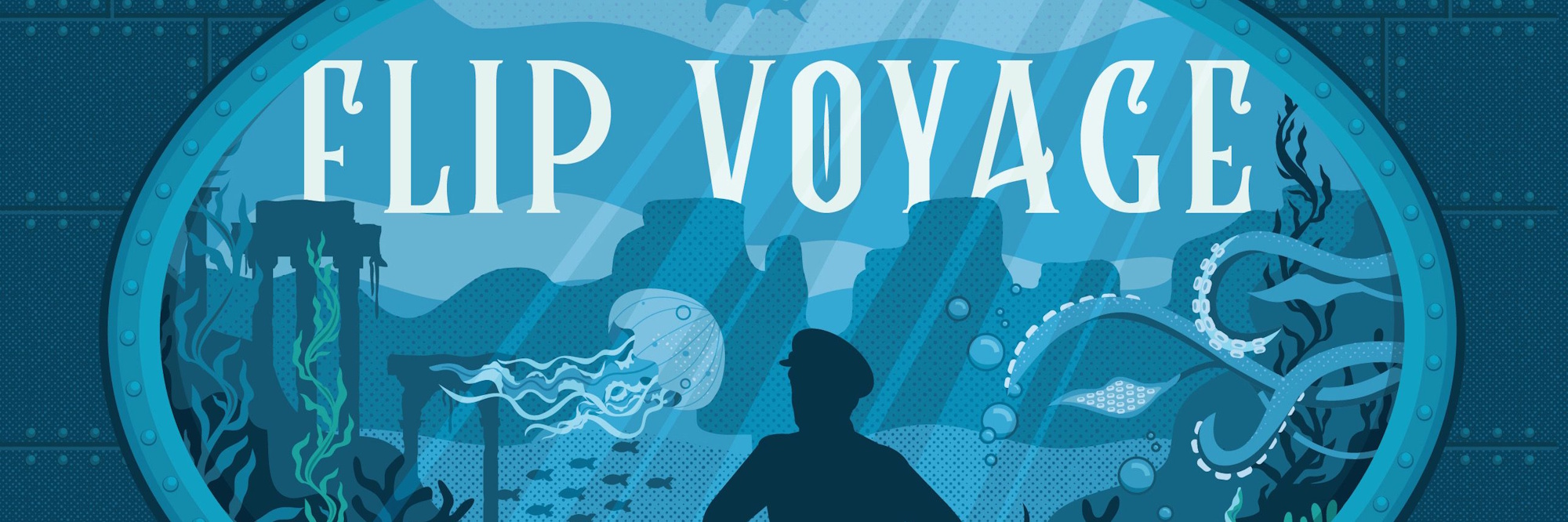
Flip Voyage, then, is his followup to Fliptown by way of Nemo’s War — although in a rare Aramini miss, this one surfaced too quickly and contracted the bends.
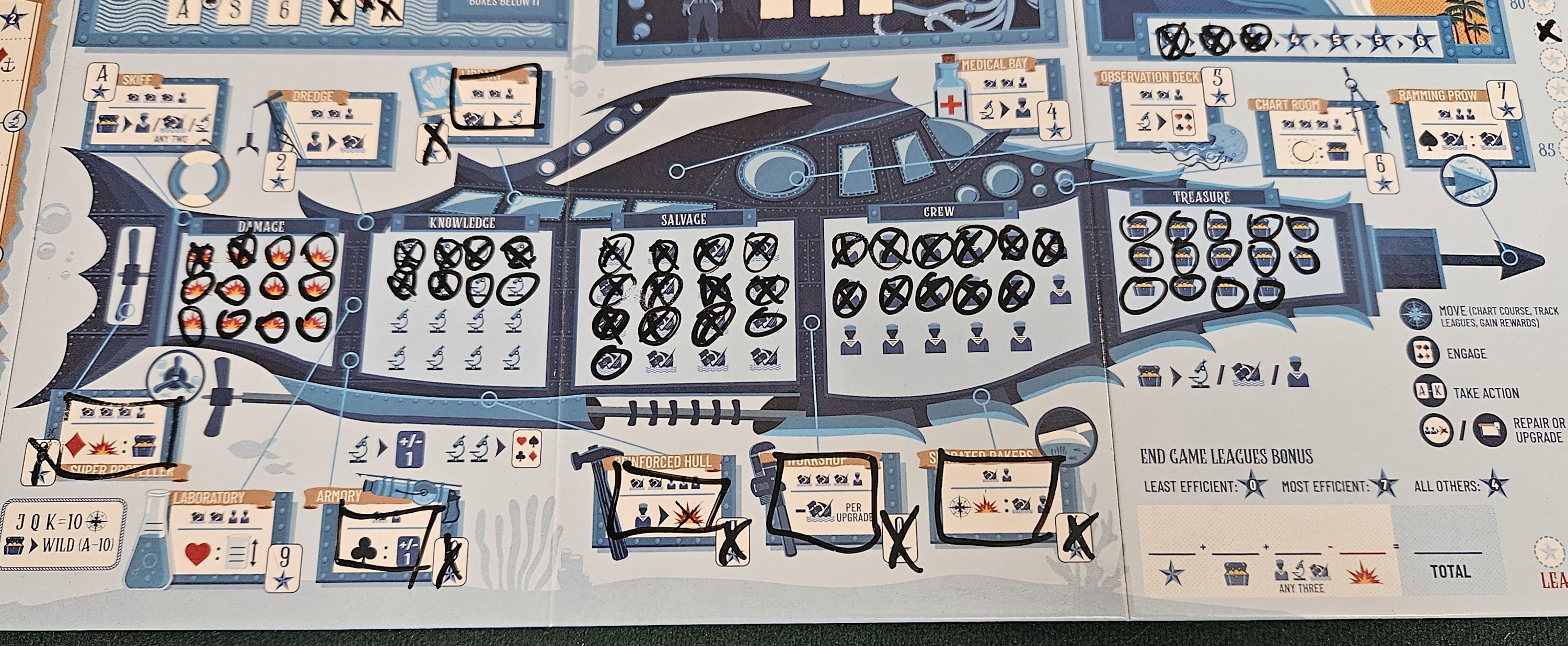
I have been led to understand that living on a submarine is a clammy, cramped experience, devoid of the wide-open viewing ports, expansive libraries, and world-class luxuries that such a fantastical vessel should offer. Sounds like a skill issue. Get on it, submarine designers.

We all live on an ordinary blue submarine.

If you’ve played Fliptown, the basic conceit behind Flip Voyage will be familiar, if perhaps also baffling in its pared-down nature. Like that game, Flip Voyage is a combo-heavy flip-and-write that sees everybody at the table — whether one player or fifty, with the box providing enough dry-erase boards for four — turning three cards at a time from an ordinary deck of playing cards. Everyone uses that trio according to their own individual goals and position, and then, after awkwardly signaling to one another that they’re done, moves onto the next set. For our signal, my group has taken to sticking up a thumb. That or asking Geoff whether he’s wrapped up his turn, because eighty percent of the time he’s the last one anyway.

In Fliptown, the template was straightforward enough, while still offering a range of options. You would choose one card for its suit, to indicate which of four activities your cowboy would undertake that turn. Another card offered up its rank, setting the strength and/or destination for that activity. The final card became part of a poker hand, an ongoing bid to earn extra points and cash at the conclusion of five flips. Since everybody knows poker hands, from movies if not from personal experience, the relative value of each splay was given an intuitive value.
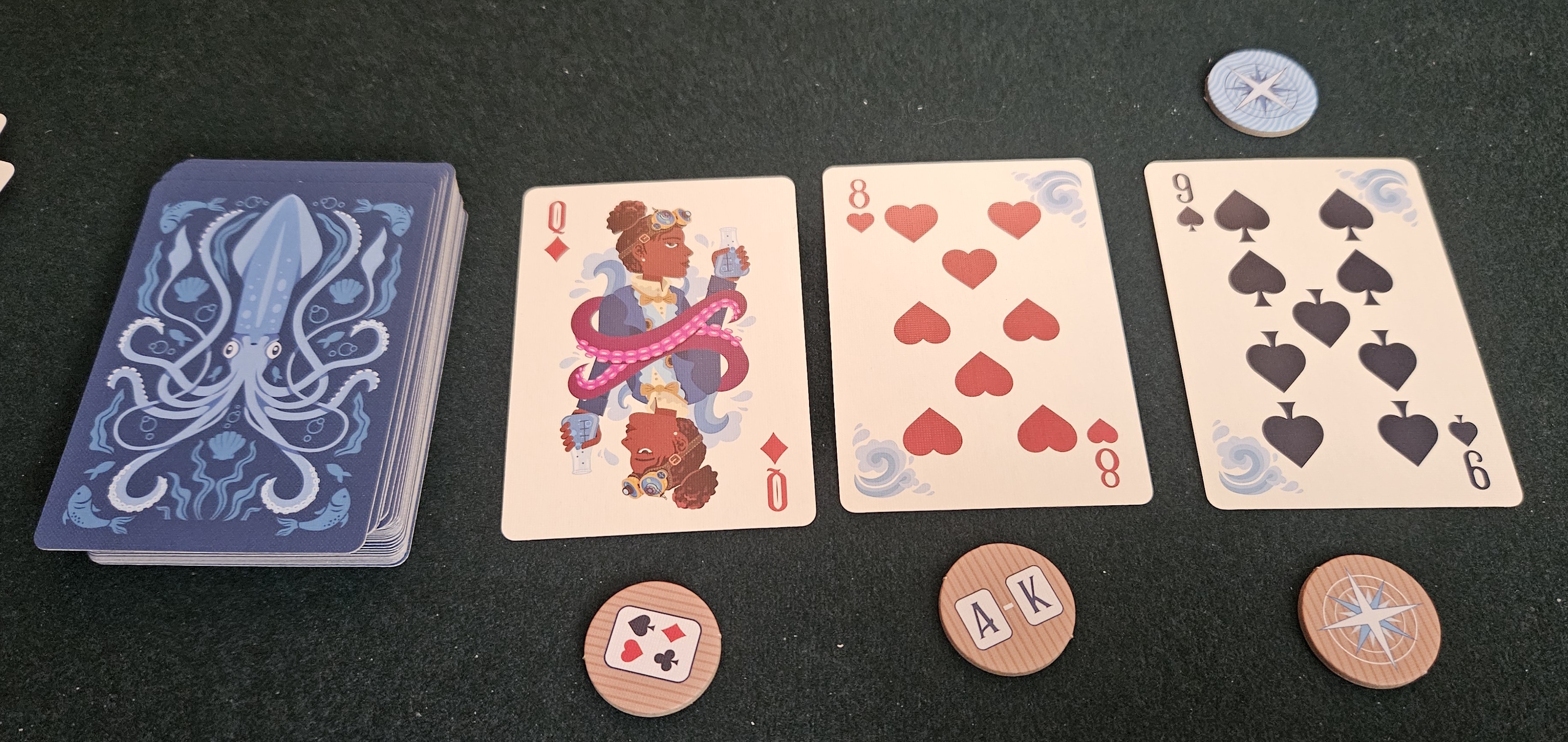
There are no giant squids in this game. Pity.

Three cards are revealed at a time. How will you use them?

This time around, the value of any given card is more wishy-washy.

For one thing, there are no poker hands. That’s fine. Fliptown was a cowboy game. Per contractual obligation, every cowboy game must feature poker. Flip Voyage, though, is about journeying under the sea in a submarine based on Captain Nemo’s / Jules Verne’s Nautilus, undertaking such anti-colonial activities as sinking imperial vessels and liberating captives from slaver camps.

As such, while two of each round’s three cards are spent undertaking those activities, that final card is instead used to travel across a simple grid map. These journeys are both critical, setting the tone for each trio of cards, and somewhat disappointing in their straightforwardness. Certain spaces award stars — points, basically, here called “notoriety” — while others incur damage to your vessel. Various lines can be crossed to earn resources, and there are ports where weighing anchor earns you a free action in one of the game’s four suits.

The gist is that you take your chosen card’s rank and travel that many spaces, generally steering across stars, avoiding damage, and ensuring you halt in a spot that will permit one of those free actions. Meanwhile, criss-crossing the map is a surefire way to earn extra resources, but you’re also lightly incentivized to keep your journey pacey thanks to a “most efficient” award doled out at the end of the session. Coal is expensive, I suppose.
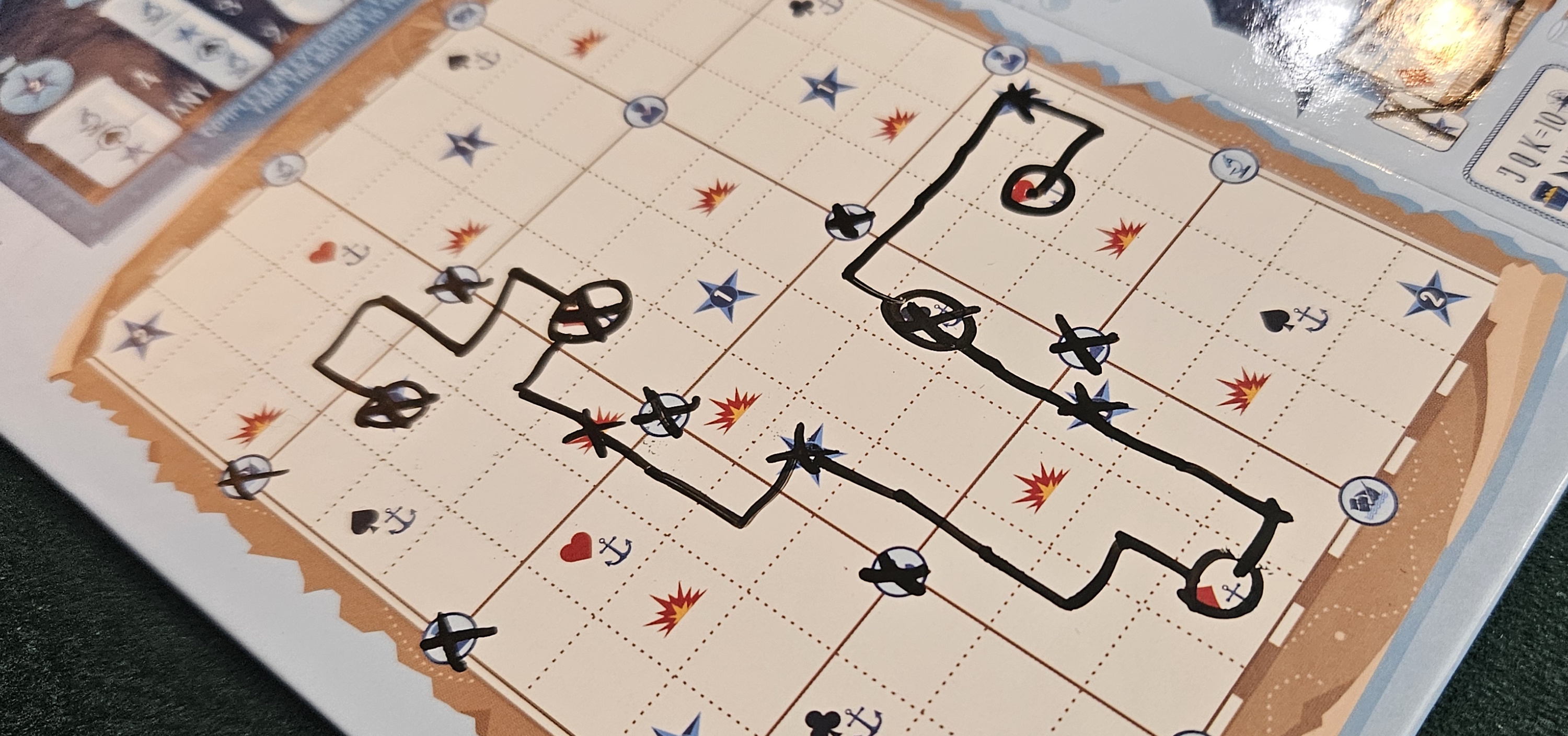
Meanderin' around.

Charting your course.

Perhaps I would have felt more kindly toward Flip Voyage’s voyaging had I not recently played three different titles that handled navigation so much more cleverly, but the map is never as interesting as it could have been. Damage is easily avoided, while the ease of pulling U-turns and adjusting your current range with a spent resource both serve to eliminate any hard decisions. For the most part, the toughest part of navigation is remembering to tally how far you moved on the score track.

The activities, meanwhile, are considerably easier than those found in Fliptown. There’s a tonal quality to the distinction. In Aramini’s former game, each activity was pitched as a wager, requiring players to decide how far they wanted to press themselves in an attempt to secure greater rewards. By contrast, the activities in Flip Voyage are considerably blander.

As before, there are four, each corresponding to the deck’s French suits. Using a heart takes you to the science lab, where you must fill beakers in rank order. Next door is the warfare track, where spending cards will punch holes in imperial warships, either earning salvage or damage. Diamonds are for adventure on the ocean floor to retrieve treasure or damage. And clubs are for raiding slaver camps, liberating new crewmates or, again, taking damage.
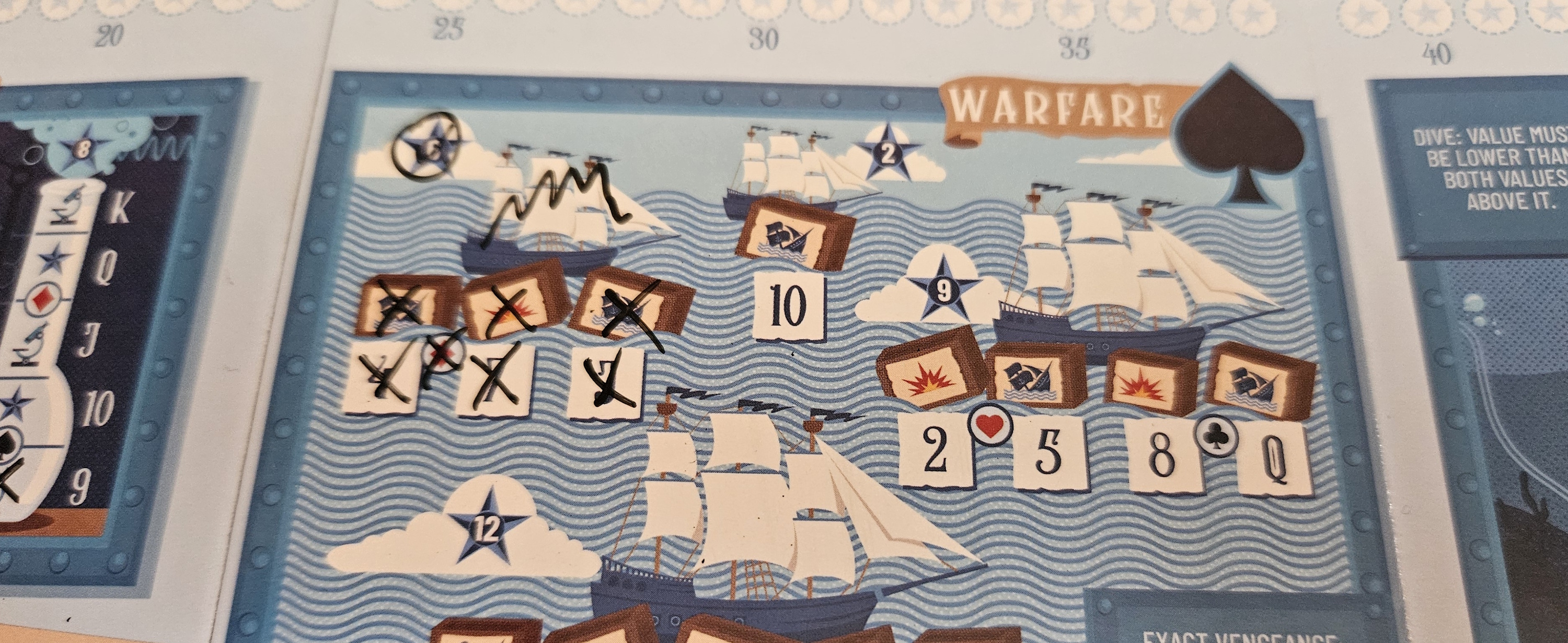
Against all odds, Flip Voyage makes sinking a wooden warship dull.

Sink to the bottom… without me.

If you couldn’t tell, there’s a lot of taking damage in Flip Voyage. Three of four activities will ding your Nautilus Jr. in some way or another, and there’s no skipping a turn to loot graves like in Fliptown. This has a flattening effect on the game. There are fewer peaks and troughs than before. Instead, you’re usually guaranteed some upside to go with your downside, or vice versa. A resource here, a scratch there, bit by bit, until the game concludes and everyone tallies their score.

There are upgrades to consider, little perks that adjust your activities. Some are formidable, like the serrated rakers that encourage you to steer into damaging spaces on the map or the super propeller and ramming prow that earn extra resources from their related activities. But a number of upgrades are surprisingly dull. Oh, the dredge lets me turn crew into salvage? The library turns salvage into research? Sorry, I nodded off. I hate to keep resorting to contrast, but these are a far cry from the shops and hotels of Fliptown’s tumbleweed town.

It’s possible to consider these alterations in a generous light. Fliptown had moments of profound chance, especially when two players attempted to, say, rob a stagecoach on the same turn, an endeavor that required both highwaymen to draw their own card to determine their success. Flip Voyage is less beholden to Lady Luck. Apart from the trio that opens the turn, there are no flipped cards here. I’m sure there are those who prefer their flip-and-writes to limit their luck to inputs rather than outputs, to borrow Geoff Engelstein’s delineation between flavors of chance.

I’m not one of those people. The beauty of Fliptown was its willingness to allow both modes. You could push your cash into the center of the table by sticking up trains, speculating on land, and chasing bounties. Or you could keep to safer trails by mining gold, riding duster, or robbing corpses. Even without the inclusion of random outcomes, there was so much to do that every session felt like a fresh adventure. After about one and a half plays, Flip Voyage has shown all it has to offer.
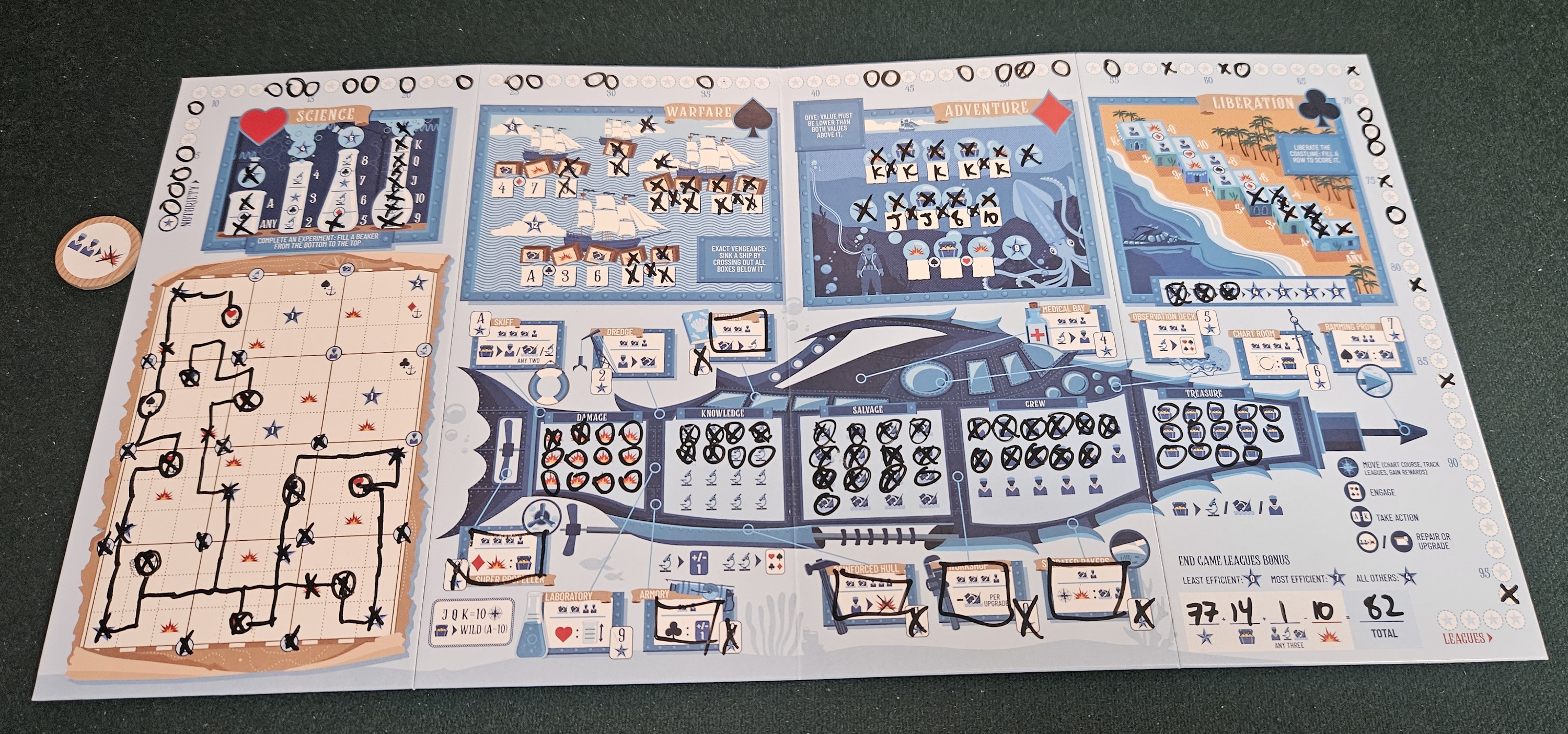
I also have the Fliptown expansion ready to go. Hopefully it's better than this one.

Ahh, a marked-up board.

Still, the process of filling in the board is enjoyable enough. That’s some faint praise, I know, but it would be a lie to say that this game is devoid of its pleasures. Figuring out how to put those cards to use is still a strong core for such a game.

But twenty thousand leagues is a great distance to cover under such pressure, and this hull has sprung more than a few leaks. There are plenty of better options, including many designed by Aramini. To quote Captain Nemo, “Oh Almighty God! Enough! Enough!”


A complimentary copy of Flip Voyage was provided by the publisher/designer.

(If what I’m doing at Space-Biff! is valuable to you in some way, please consider dropping by my Patreon campaign or Ko-fi. Right now, supporters can read my first-quarter update of 2026: the best board games, movies, books, and more!)

Combat Results Postcard

26. Mai 2026 um 03:52

Battle (underline) Card

Battle Card is as apt as descriptions get. Designed by David Thompson and Nils Johansson, this is the fourth project in the Postmark Games lineup. Like its earlier peers — Voyages, Aquamarine, and Waypoints — this is a print-and-play title that can be produced with functionally zero budget. Unlike those projects, however, Battle Card is billed as a wargame on a single postcard-sized sheet.

That’s true enough. With a few dice and a smidgen of experience to help interpret the rules, Battle Card covers six engagements from the Second World War. And their format is indeed very small, highlighting some real resourcefulness on their designers’ part in compressing battles and even campaigns into ten-minute experiences.

But unlike those other titles, Battle Card is a mixed bag. I’ll give an example.

Their national anthem, I believe.

Rock on, Canada.

The second of Battle Card’s six scenarios sees Commonwealth forces waging a fighting retreat against Imperial Japanese troops shortly after the attack on Pearl Harbor. Over the course of two months, these forces staggered their positions along the Malay Peninsula, gradually ceding ground in an attempt to withdraw a portion of their forces. Historically, the campaign was catastrophic for the Allies, revealing Japanese air superiority and rapid infantry. (Mounted on bicycles!)

In Battle Card, the situation isn’t much better. Dice represent the armies on both sides, with their pips indicating their current strength. These armies engage in battle — determined by the roll of another die — and shift positions along the twin roads along the peninsula.

Here, the situation is relatively static. As the leader of the Commonwealth forces, your options mostly revolve around when to retreat, whether to defend your position or mount a counterattack, and which units to gradually pull back toward Singapore. No matter the outcome of any individual roll, the game has been fixed, much as it was historically. It isn’t a question of whether the Japanese will overtake your position, but how swiftly.

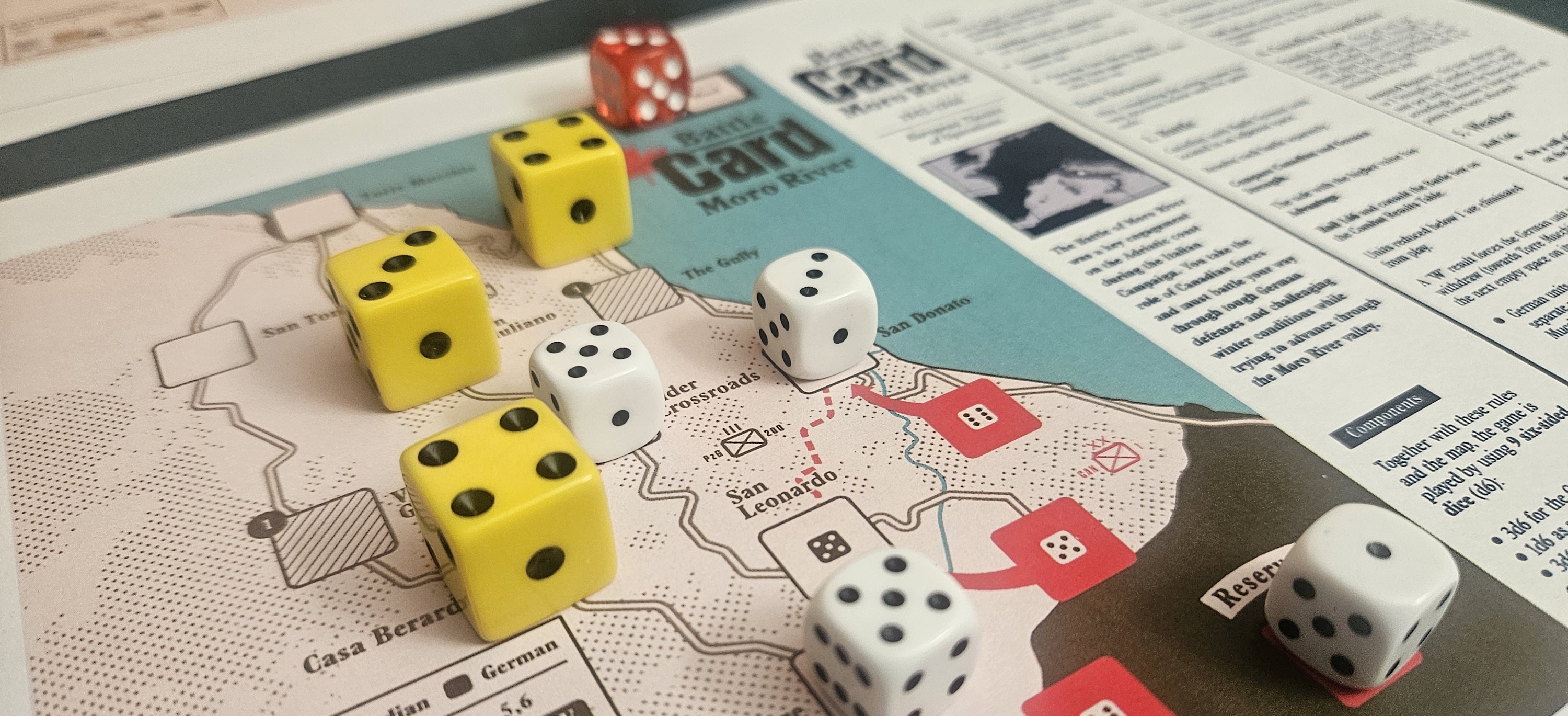
The smaller dice designate control. None of the other scenarios bother. This was a wise omission.

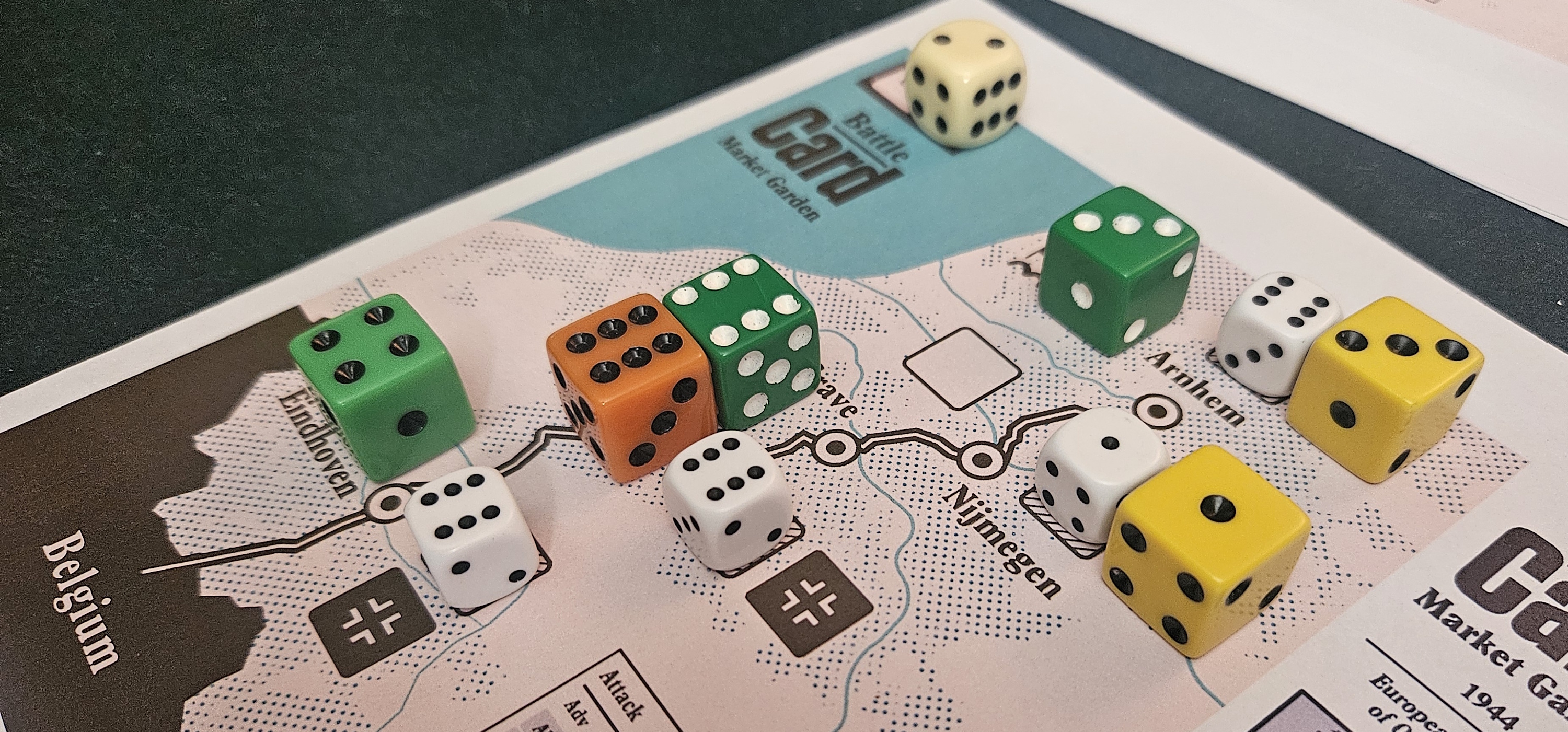
The Market Garden scenario is ostensibly a demo, but it’s fiddlier than those that come afterward.

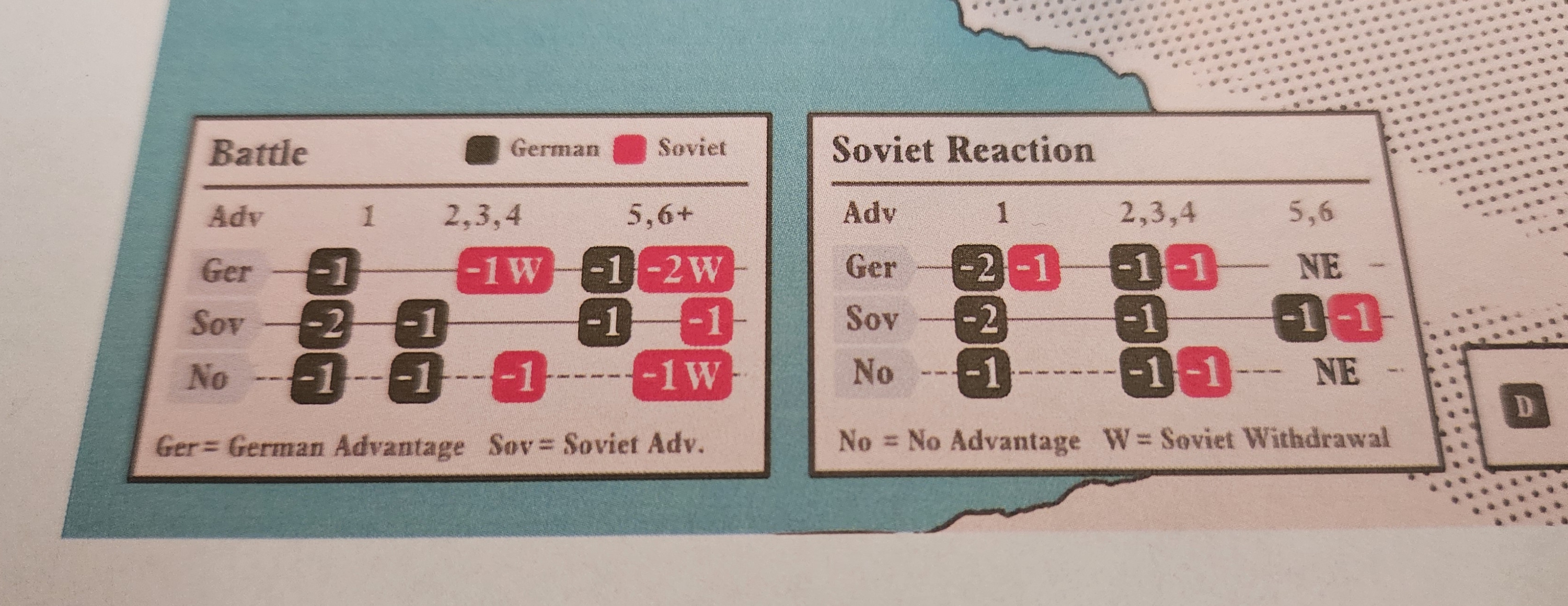
What follows is a strong indication of both the system’s strengths and weaknesses. Your choices, such as they are, are as bite-sized as the game’s footprint. Retreat or hold; defend or attack; withdraw a die along a road. The roll-offs are governed by small combat results tables that factor in whether one side has an advantage — meaning one side’s die has more pips than that of their enemy. As advertised, it’s fast. And, to its credit, the minimalist design does lend some sense of the geography and the central conundrums of the conflict.

In this case, your objective is to withdraw three pips to Singapore, and the way to accomplish this goal is closer to a puzzle than anything offering operational flexibility. Either you stick your troops behind the right line in the sand or you don’t. Either you withdraw in time or you don’t. Either you make high enough rolls or you don’t. No matter the scenario, this is more or less how Battle Card functions. There’s a solution here. That solution still requires the bulk of the rolls to go your way, but that’s the solution, and there’s no deviating from it. Perhaps most damningly, once you’ve uncovered that solution, there’s really nothing else to see.

Yes, yes, I’m the guy who wrote that replayability is overrated. But there are slender games and then there are slender games. Battle Card is the latter. Each play lasts between five and ten minutes. Scenarios are also compact, as befits a game called Battle Card, meaning there aren’t many subtleties to any given fight. If you don’t figure out the trick on your first play, you’re bound to have a strong suspicion heading into your second. After that, it’s really a matter of getting the right rolls.

Magnifying glass not included.

Combat results tables! We got ’em!

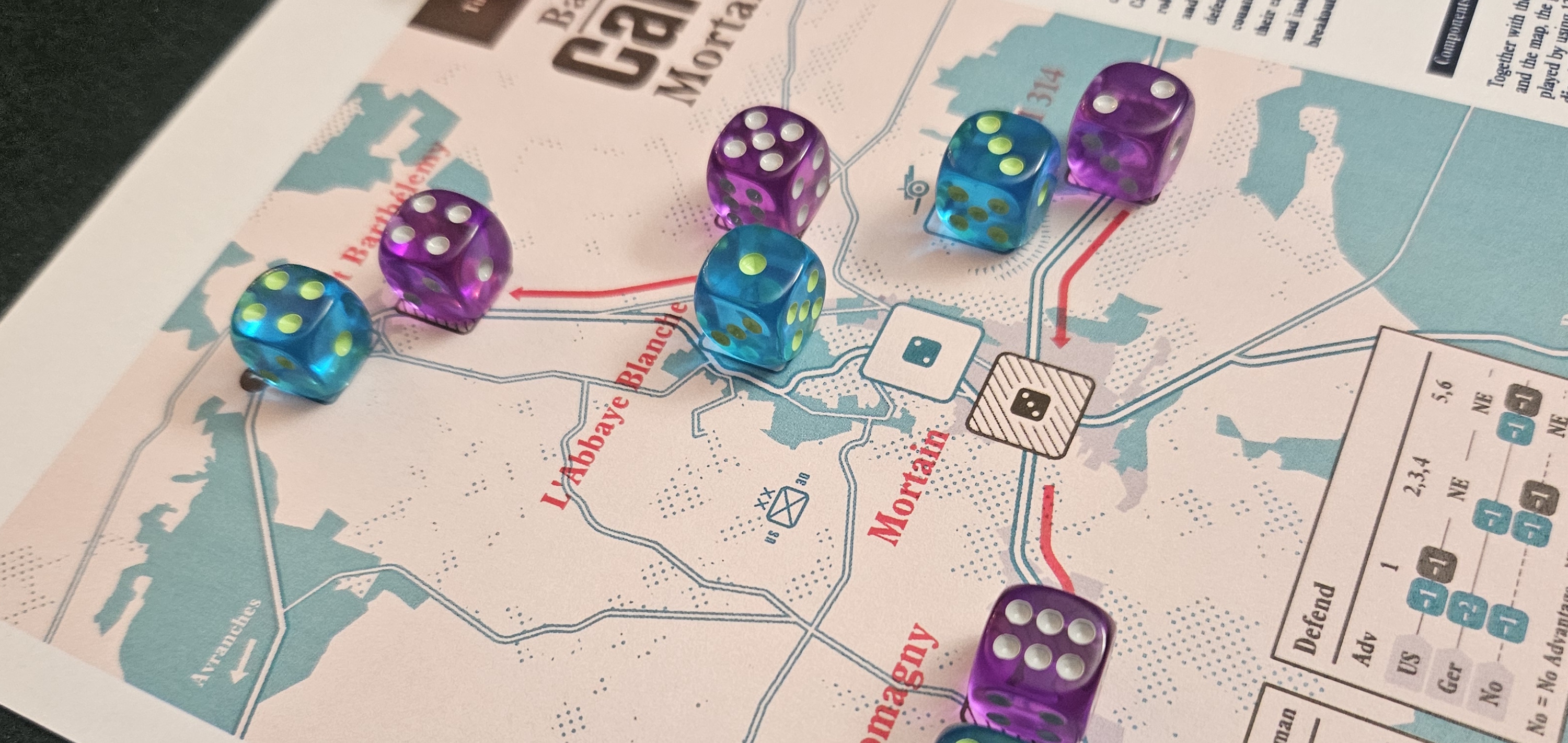
This isn’t to say the whole enterprise is doomed. The best scenarios offer some wiggle room between maneuver and chance. As the Canadians make a three-pronged drive up the Italian boot in the Moro River scenario, they must pause to reinforce any divisions that took a beating. As the Germans plunge toward the Caucasus oil fields, they need to decide when to split their forces into smaller but more vulnerable columns. Choosing where to fire your artillery at Mortain is… well, it isn’t the most complicated decision, but it would also be inaccurate to call it straightforward.

Again, though, that’s about as much mileage as anyone will get out of these print-and-plays. I’ve run through the entire series twice now, and the second time I found myself growing weary. This stands in strong contrast to those other Postmark titles. As score-chasers, there was always a reason to return for another attempt. Here, the entire format feels too compressed, like a States of Siege game without the chrome-laden considerations that made that series so interesting. Mostly, it was a nice way to organize my dice by color and size.

Step one: fire arty at bad guys threatening arty. Step two: fire arty at other bad guys.

Firing the arty.

In a way, Battle Card isn’t that far off from looking at an animated battle map. All those little arrows and company designators. The towns changing hands. The roads, the weather. The relative strength of any given column. Battle Card is that with some marginal interactivity. As a middle-aged white guy, that’s my ken. But the joke’s on Battle Card. I already own a book of WWII battle maps. This is one instance where pushing the pieces across the board — sorry, the card — isn’t enough of an improvement.


Access to the files to print Battle Card was provided by the publisher.

(If what I’m doing at Space-Biff! is valuable to you in some way, please consider dropping by my Patreon campaign or Ko-fi. Right now, supporters can read my first-quarter update of 2026: the best board games, movies, books, and more!)
Touch Grass (Metaphorical)

19. Mai 2026 um 01:00

at last, a use for this darn orienteering merit badge

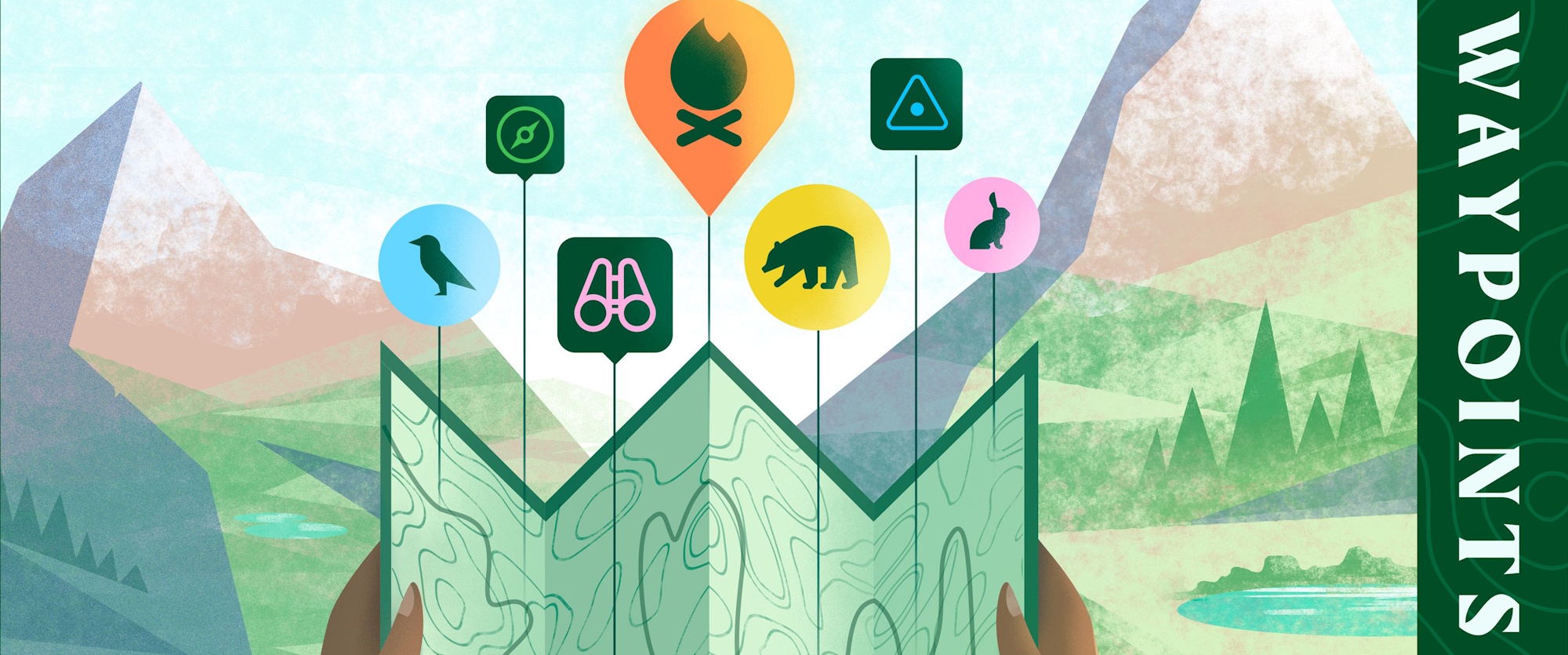
Voyages, the first of Matthew Dunstan and Rory Muldoon’s single-sheet print-and-play roll-and-write games, used three dice. Aquamarine used two. Waypoints continues the trend by using a single die.

That’s cool in its own right. But that isn’t what makes Waypoints special. What makes Waypoints special is the way it handles the movements generated by its rolls. Where those other titles — and let’s face it, most board games — featured straight movements, point to point, A to B, nearly every move in Waypoints is the sort of move you might actually make while traversing an open space.

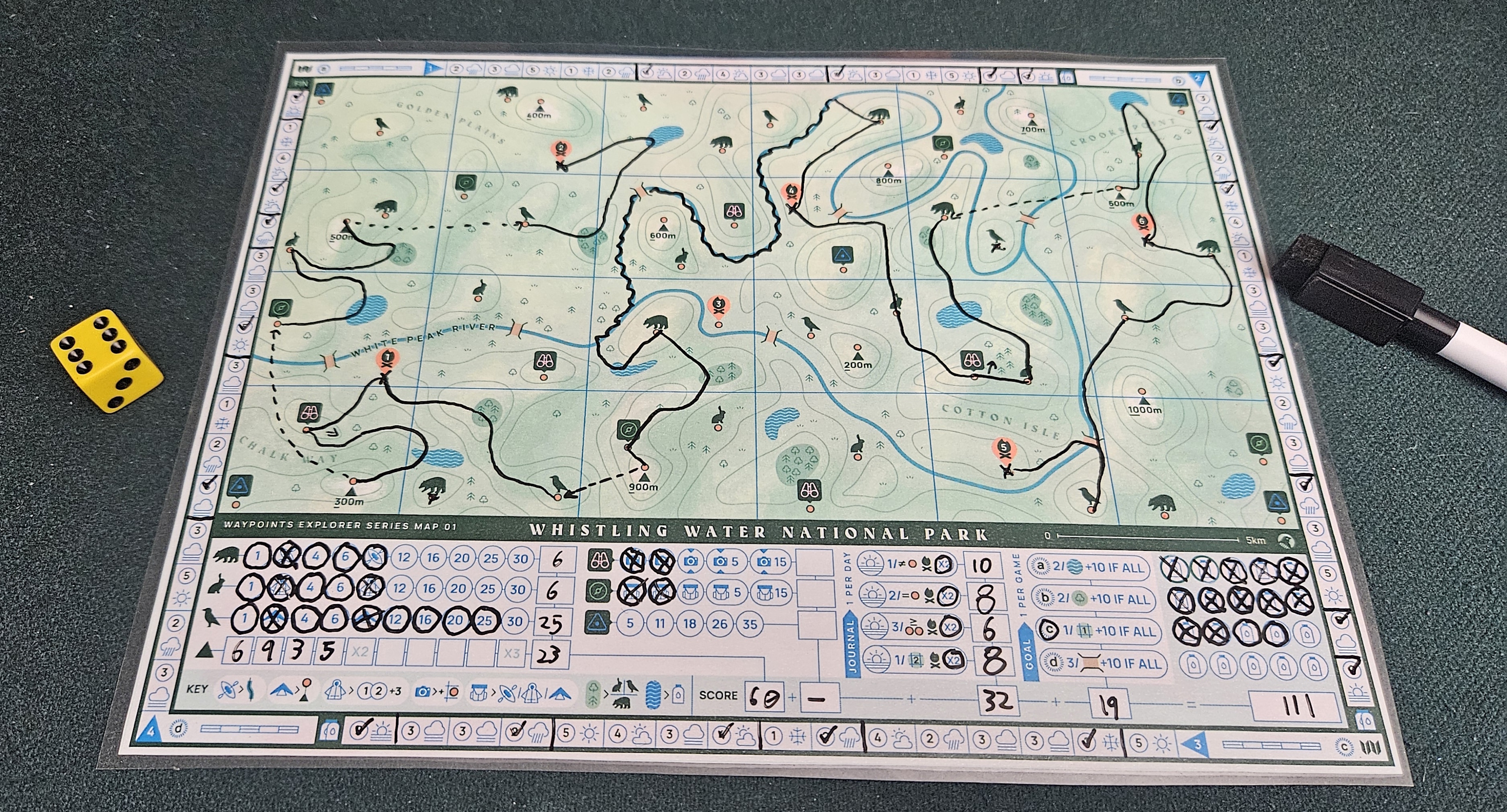
Here, I’ll show you.

I attempted to draw my route in the spirit of Fabio Bracht on BoardGameGeek. His penmanship (squigglemanship?) in this game is super impressive.

A glimpse of the first map and the many places it might take you.

You’ve taken the Internet’s advice to touch grass. And with gusto, because rather than go to the park or something, you’re opting for a four-day wilderness expedition. Hopefully you aren’t prone to hay fever.

The gist behind Waypoints is that every turn you’re allotted some number of movement points. The number itself depends on the weather, and isn’t as simple as rolling the die and moving as far as it indicates. Instead, your roll shifts you forward along a track and reveals the current turn’s weather for everybody at the table. Inclement showers or storms might confer only a single pip of movement, while sunny afternoons offer a full five points. You also have a limited supply of water, which can be spent to stretch yourself to greater distances.

Every move begins and ends at a waypoint. When the game opens, that’s a campsite. Turn by turn, that might mean a wildlife site, a peak, a hot spring, a scenic overlook, or any number of other destinations. There are plenty to discover, and across the game’s five scenarios there’s a fair bit of variety. Along the way, you might swing by special features, like water sources or forests, but these aren’t waypoints, just side destinations on your way to the main thing. If you can’t reach another waypoint, that’s fine, but it means you’ll be stuck at your starting point pumping some extra water instead of moving anywhere at all.

As for those movement points, they’re spent by crossing lines. Latitude and longitude? That’s a point. Elevation? Another point. A long-distance trek involving multiple map segments and lots of hiking up and down ravines? That’s possible, but you’ll probably need a decent stretch of good weather. That or guzzle tons of water.

The skill here is avoiding goats.

Each map prioritizes a different skill.

Very quickly, these inbuilt limitations give your movements a certain naturalistic beauty. Rather than dealing in straight lines, as the crow flies, Waypoints challenges you to think like a gravity-bound creature. You’ll scurry along ridges, stick to gullies between rises, find open stretches of flat ground for traveling long distances, march up inclines in short spurts.

Of course, saving energy is only half the game. You’re here to see things. And the things most worth seeing outdoors are liable to be hard to reach. There’s a balance to be struck, then, between conserving your strength and pushing yourself to see the best sights.

But the result is a creativity of space, energy, and distance that’s rarely expressed in a medium as literalistic and rules-bound as board games. Often, the best route will be circuitous, the one that loops the long way around a peak. Or one that swings down a hill to collect some water, across a meadow to investigate a forest, and then around and up an incline where you’ll deploy a hang glider to soar to your next destination.

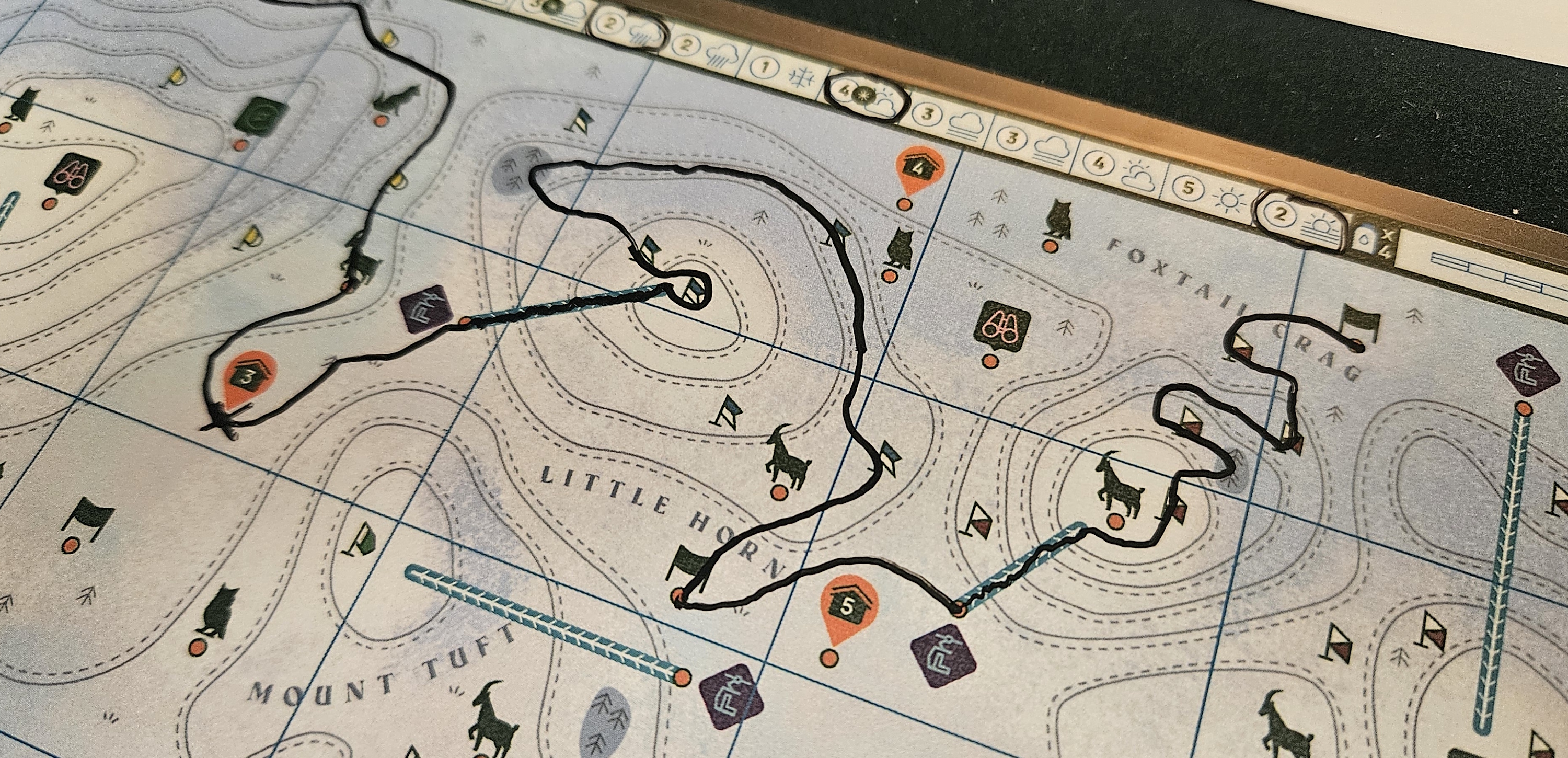
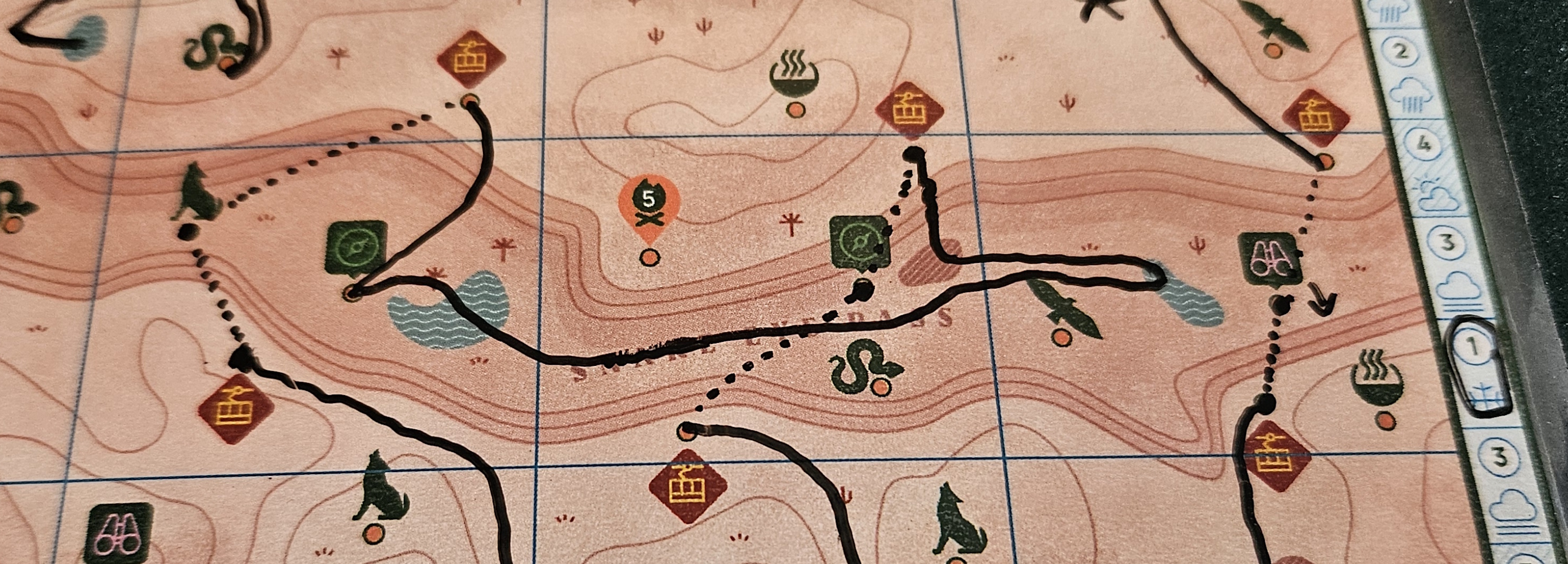
Because of course there are special abilities. In the first map, you quickly avail yourself of hang gliders and kayaks for covering great stretches of the outdoors. On other maps, your tools might include climbing ropes, cable cars, bicycles, snorkel gear, dinghies, ski lifts, or ferries. This produces fresh conundrums for each scenario. More impressively, these differences are also visible in the lines you draw on the map. In the desert, you tend to travel in spurts, sticking to shade or rationing your movement around the great canyon bisecting the map. On the ski slopes, shuffling upward is more difficult than gliding downhill, resulting in sharp rises followed by sweeping, switchbacked movements that visit feature after feature before arriving at the turn-concluding waypoint. In Waypoints, your mode of transportation is written directly onto the page, visible in the sweep of each route.

butterflies become granola... curious.

Meeting wild animals confers a wide range of benefits.

Like the previous entries in Dunstan and Muldoon’s movement trilogy, Waypoints is heavy with scoring opportunities. Fortunately, also like Voyages and Aquamarine, the scoring is interesting at all points.

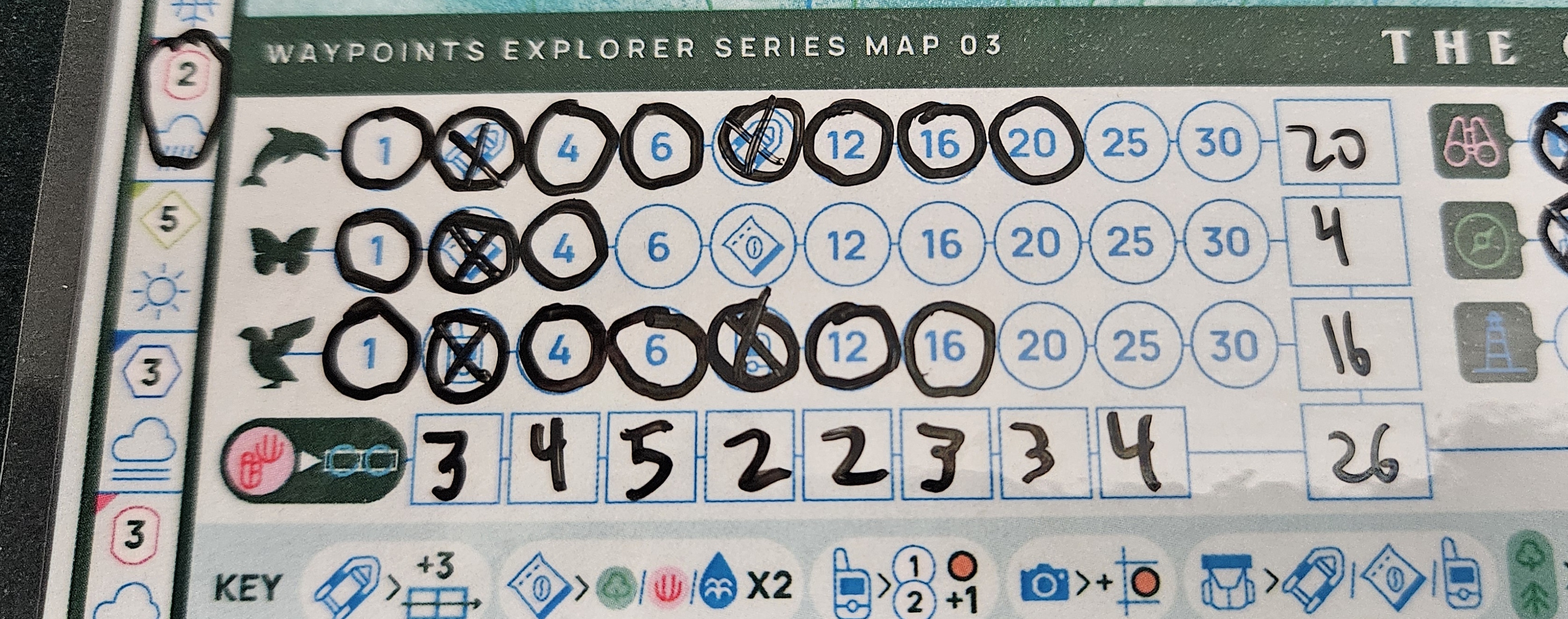
The main commonality between maps is wildlife. There are always three types to see, and apart from occasional oddities — on the coastal map, the majority of my dolphin sightings occur in forests — it’s rewarding to watch your appreciation tick upward, earning not only points but also additional tools to make traversal easier. Beyond that, maps grow more playful. In one, reefs earn additional points later in the day, creating a situation where you’re incentivized to visit them late, but not so late that you get stranded when the day unexpectedly comes to its end. In another, you parcel out slugs of whisky between visiting local breweries or slogging through lochs in search of monsters.

Perhaps the one sour note is yet another repeat: the solitaire mode is a letdown. As with Voyages and Aquamarine, this is one roll-and-write that’s far more interesting to experience with other human minds. The problem is that the solo objective is incredibly easy in a vacuum, asking you to ensure that you conclude each day at a campsite. When that’s your primary objective, it’s a thing easily accomplished.

With fellow trekkers, the real goal is to wring every last point out of an imperfect day. Some hikes will be cut short, the caprice of the dice only offering a small handful of turns before the sunset brings your trek to a close. Others might even go long, your hiker hovering around a natural concluding point, only to find themselves distracted by extra sights. Regardless, there’s something satisfying about facing challenge after challenge, feeling like everything is going wrong, only to look at a rival’s sheet to discover that, you know what, your journey was rather remarkable in the end.

And scored forty-something points for it. Boom, baby. I still lost.

That time I scaled the Grand Canyon eight times in a day.

That’s the last great thing about Waypoints. In the minute between scoring and erasure, you get to look back on this thing, this little journey, and behold what you’ve accomplished. The strange loops, the reversals, that time you got stranded at a lighthouse for the night. The stories this game tells are small and gentle, but that’s also what makes them worth tracing one last time. This is no battle. There are no foes to vanquish. Only you, a fellow player or ten, and the routes you penned onto a map.

It’s a rare game that lets its players be so expressive. That Waypoints does so much with a sheet, a pen, and a die is nothing short of wonderful. I liked both Voyages and Aquamarine; against all odds, this one outdoes both of them at their best.


Access to the files to print Waypoints was provided by the publisher/designer.

(If what I’m doing at Space-Biff! is valuable to you in some way, please consider dropping by my Patreon campaign or Ko-fi. Right now, supporters can read my first-quarter update of 2026: the best board games, movies, books, and more!)
❌