Join us as we discuss and review Decko, Tembo: Survival on the Savannah, Star Wars Unlimited: A Lawless Time, First Giants, Twilight Imperium 4, and Yonder, all of which are terrific games
Duel of Meloch is a standalone game that combines mechanisms from two existing games, Scythe and Expeditions, into a 45-minute head-to-head clash. One player uses the Scythe rules and components (including a new faction and player mat); the other player uses the Expedition rules and components (including a new mech, character, and companion). As long as you know one of those games and your opponent knows the other, you can play Duel of Meloch, and you don’t need anything other than Duel of Meloch to play this game.
Set during the Edo Period of Japan, play as a daimyo - or feudal lord - overseeing a personal province board that begins as a wild, old growth forest. Over the course of five rounds, each player will determine the path of their own province by simultaneously placing skilled forestry samurai workers at key intersections to perform actions. These decisions could include the harvesting of trees to construct farms and castles, the planting and study of trees for future knowledge, establishing a new agricultural presence to sustain the region’s population, the building of castle structures for both immediate rewards and eventual honor, or even mustering a military force to help support the efforts of the Shogun in Ed
Wingspan Pocket distills the Wingspan experience down to a lighter, shorter, card-driven game that has each player activate a single row of cards on each of their turns. The cards are all double sided: a food side and a bird side. Bird powers are primarily indicated by icons instead of text, and they include a new type of power, ongoing (green) benefits.
0:00 - Intro
0:43 - Brief Overview
3:10 - Review
Card storage box and sleeves are from Crimitidex. If you order their products, use the code below for a discount!
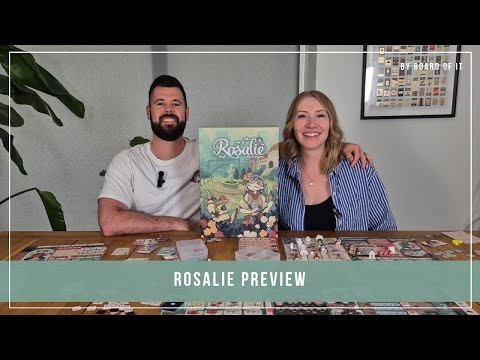
In Rosalie, players are aspiring rose breeders competing to build the most magnificent rose garden and earn renown as the finest nursery grower in town.
Each player begins with a small plot of land and a dream. Over the course of the game, players plant roses, crossbreed new varieties, cultivate their soil, and adorn their gardens with fountains and windmills. New and exotic roses are temperamental — neglect their care, and they will wither. To help tend the garden, players can recruit caretaker robots, powering them with electricity to keep their precious roses alive and thriving.
We were lucky enough to have a 4 player game of this absolute epic yesterday! It took around 10 hours, and sadly we didn’t actually get to finish to 14 points as it was close to midnight and we didn’t yet have dinner 🤣 so we called it with the winner on 11 points. Can’t wait to play again!
Join us as we cover Nucleum and it's expansions: Australia, Court of Progress, Gibraltar, and Energy Research Institute. We'll take you through what Nucleum is, how it plays, what the expansions add, and what we think about it all!
0:00 - Intro
1:29 - What Is Nucleum?
2:32 - How Do You Play?
5:00 - What Is Nucleum: Australia?
6:34 - What Is Nucleum: Court of Progress?
8:02 - What Is Nucleum: Energy Research Institute?
8:53 - What Is Nucleum: Gibraltar?
10:29 - How Does It All Fit Together
11:02 - What Do We Think - Nucleum Base Game
14:40 - What Do We Think - Australia
17:11 - What Do We Think - Court of Progress
20:22 - What Do We Think - Energy Research Institute
23:14 - What Do We Think - Gibraltar
Card storage box and sleeves are from Crimitidex. If you order their products, use the code below for a discount!
In the early 1900s, the Austrian neurologist Sigmund Freud established a revolutionary theory called psychoanalysis, related to the study of the unconscious mind. As his work took hold, supporters met at Freud's apartment every Wednesday to discuss psychology and dream symbolism. This group—the Wednesday Psychological Society—marked the beginning of the worldwide psychoanalytic movement. As a member of this society, you aim to formulate new therapeutic techniques, establish a practice, grow your clientele, and become Freud’s most distinguished contemporary. To best accomplish this, you’ll need to share insights, discuss ideas with peers, and publish theories. And to stay invigorated, you’ll likely need some coffee—lots of coffee.
0:00 - Intro
0:37 - Root
7:28 - Gingham
17:45 - Take Time
24:03 - A Feast For Odin + The Norwegians expansion
32:13 - Dune: Uprising
Card storage box, card stands, dice tower, component trays and sleeves are from Crimitidex. If you order their products, use the code below for a discount!
Got through a lot of games last week! Featuring some lighter card games as we were out with friends, and those types are super easy to play at a bar. Finished our Regicide Legacy campaign - feeling emotional! Had a crack at the mode you can play post-campaign and it’s decent!
Made our final conclusions on Forest Shuffle OG vs Dartmoor version after playing both this week 😬
The Hobbit: There & Back Again is a competitive adventure game in which players draft dice to make pathways, collect resources, and perform actions that help them to reach their chapter goal.
0:00 - Intro
0:39 - Brief Overview
2:34 - Review
Dice tower is from Crimitidex. If you order their products, use the code below for a discount!
What a variety last week! Continued to explore the Homeland expansion for Root, taught Dune: Imperium - Uprising to a friend who wanted to play since he likes the Dune universe, and also had some great co-op experiences with Bomb Busters and Regicide Legacy.
Take Time is a cooperative game where players either win or lose together.
To succeed, you must strategically play 12 cards facedown around a Clock, following specific rules for each Test. You can work together through a series of games to pass all 40 Tests available in the game.
0:00 - Intro
0:54 - Brief Overview
2:56 - Review
Sleeves are from Crimitidex. If you order their products, use the code below for a discount!
In Gazebo, players take turns placing dominos on the shared garden map to establish nooks — that is, two or more contiguous terrain spaces of the same type: flower, foliage, or water. When a player creates a nook, they place one of their gazebos on top of it, and by connecting their nook to a patio, they can claim the patio and place a gazebo on it.
But not all is peaceful in this game of garden landscaping. Larger nooks can absorb smaller nooks, and patios can be stolen by cunning rivals. The first player to place all of their gazebos on the board wins!

 Anmelden