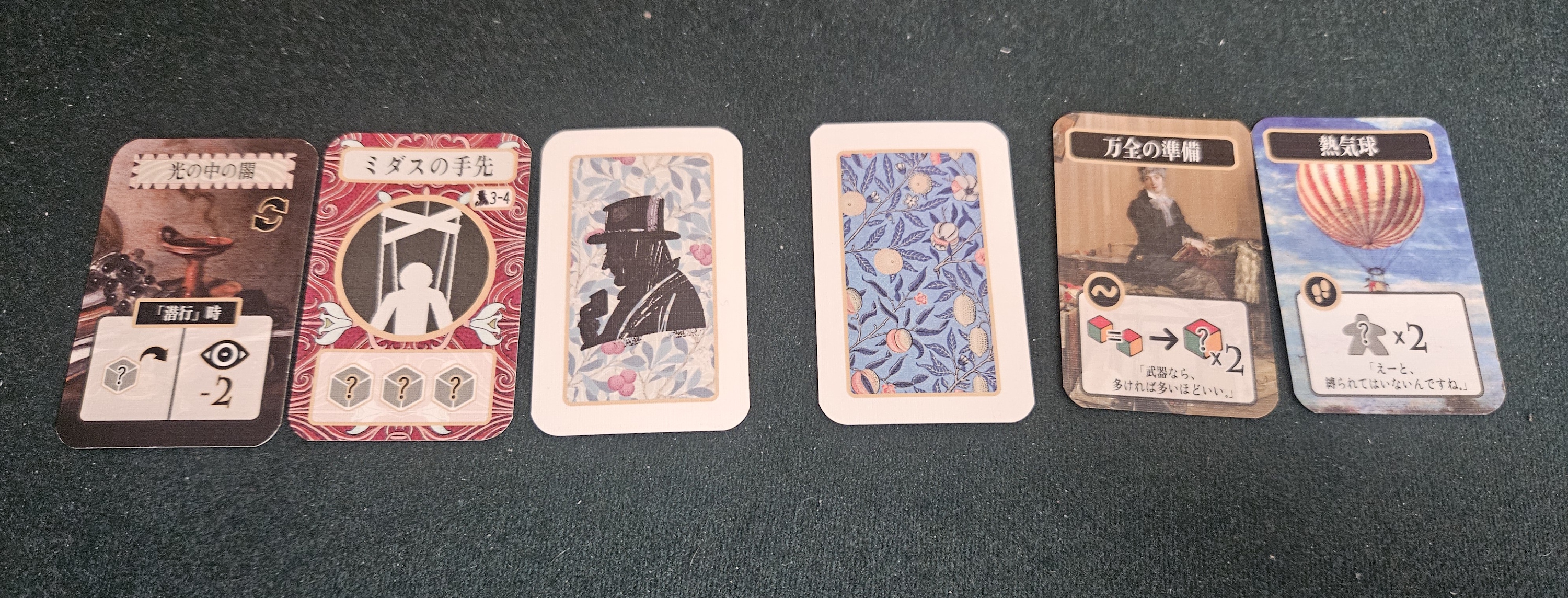
I wouldn’t go as far as to say that G.K. Chesterton’s The Man Who Was Thursday saved my life. Probably it would be more accurate to say it built my life. The novel arrived at a pivotal moment in my adolescence. I was seventeen. Dumb with hormones, dumb with culture, just plain dumb. Still deciding who I was. Who I was going to be. I found it through the unlikeliest of sources, snippets of text in the video game Deus Ex, and felt like an investigative researcher when I obtained a copy from the bookstore I haunted like a ghost that summer.
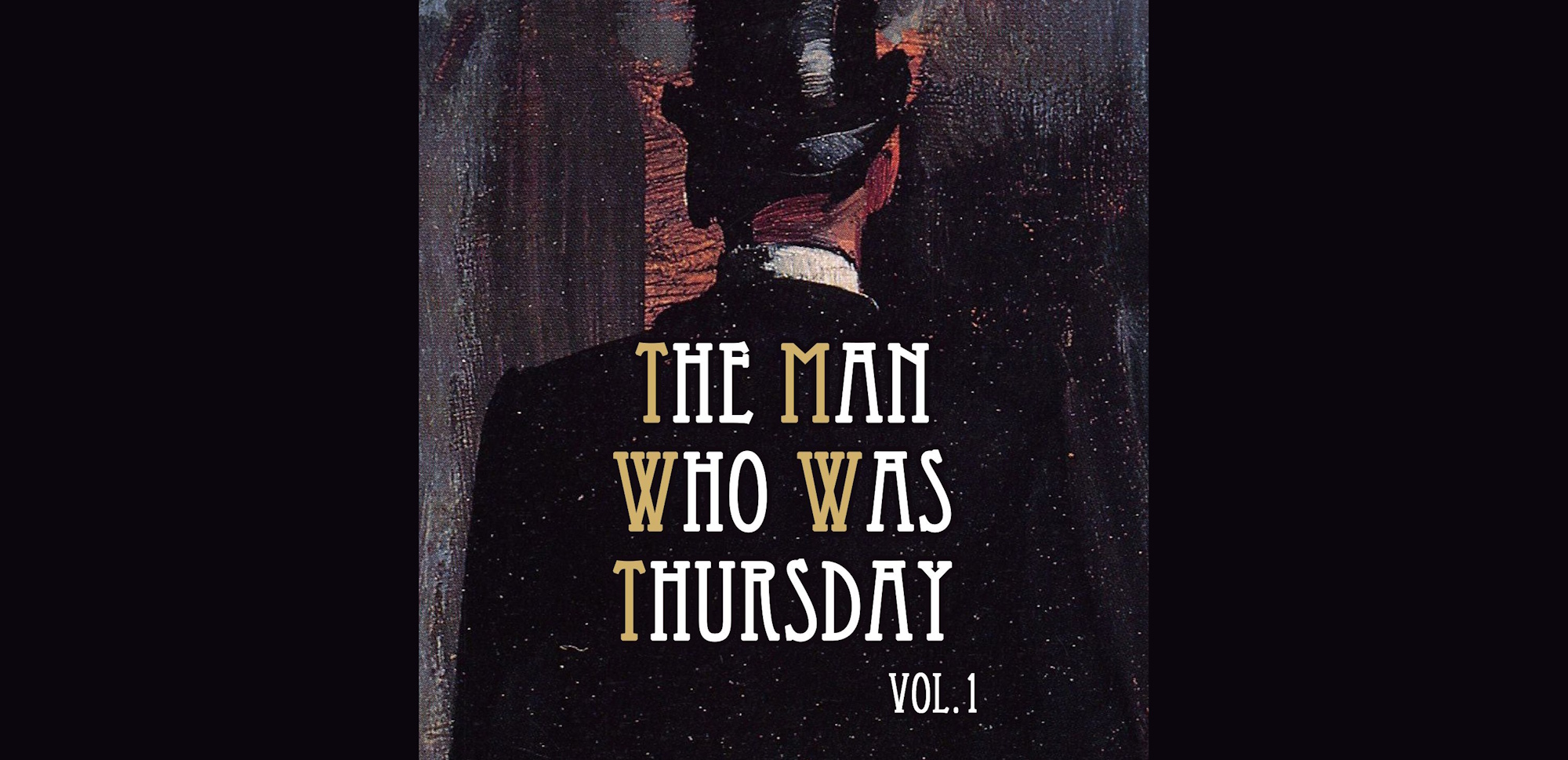
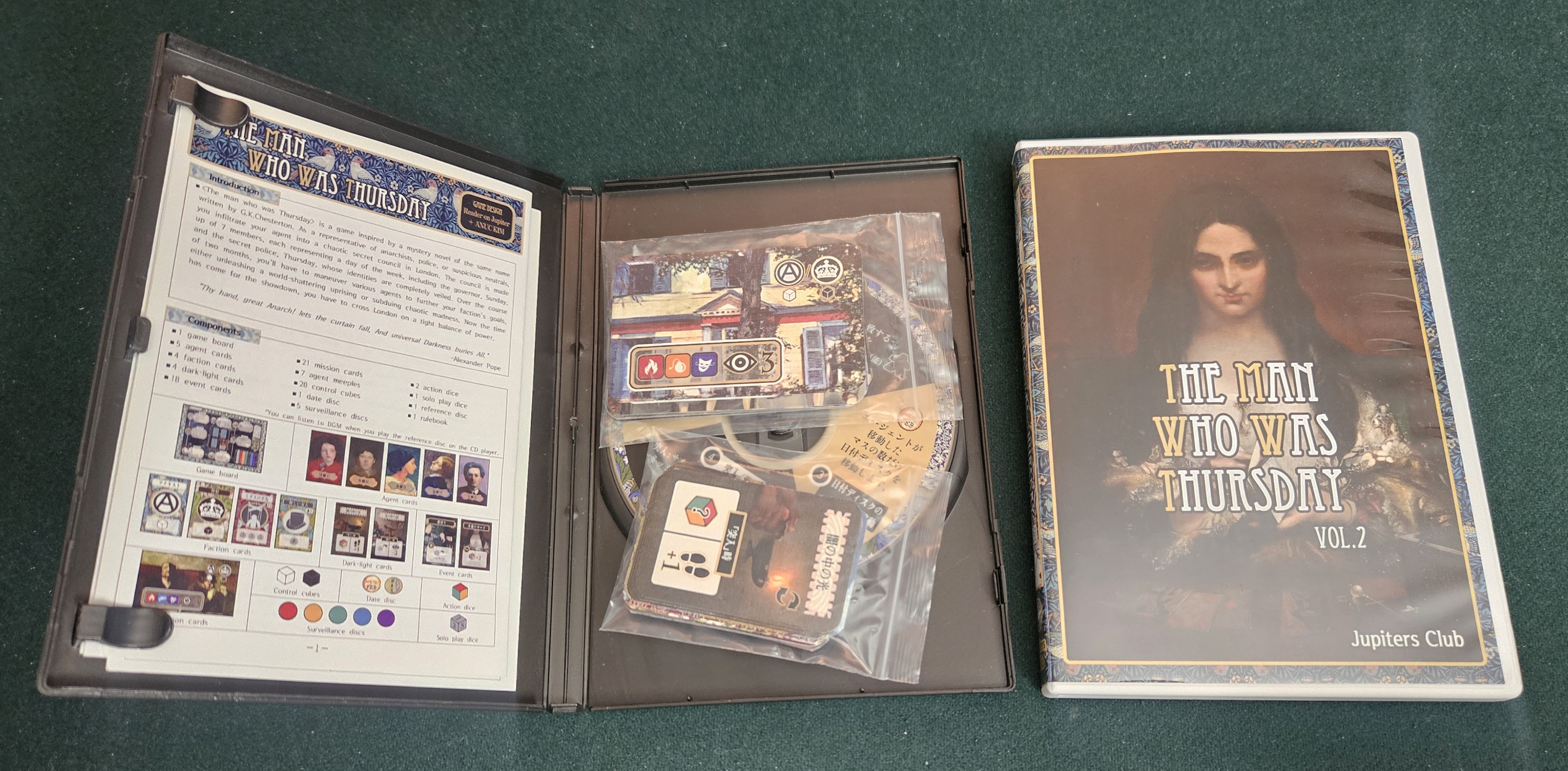
The Man Who Was Thursday is also a board game. A very unlikely board game. Created by a designer from South Korea who goes by the nom de ludens Reader on Jupiter, it arrives folded within twin DVD cases. Arrived. Past tense. It’s profoundly out of print, although its author claims there will be another use for the system sometime in the future.
Honestly, it isn’t the system I’m interested in. It’s the adaptation. This is the board game version of a book that was one of the cornerstones in building who I am today. I cannot see it impartially. Only intimately, like an old friend straining to express something important. Straining to express a revelation.
The perilous streets of Europe.
It begins with the conspiracy.
Written in 1908, when Chesterton was yet a Protestant, and in the period when anarchists and nationalists alike flung bombs at monarchs, a vocation that would soon spark the War to Begin All Wars, The Man Who Was Thursday opens with an undercover policeman, Gabriel Syme, on a quest to stop a council of bomb-throwers from completing their most daring, most damaging undertaking yet.
He is elected to the position of Thursday. That is, one of seven members of the anarchist committee. The committee is headed by Sunday, a monstrous, massive presence who seems unbeatable at every turn. Syme is initially shown as dashing and clever, worming his way into the anarchist committee through poetic debates, mistimed oaths of secrecy, and inflamed speeches. Seated before Sunday, he is transformed into a sweating plaything, certain that the anarchist of anarchists sees straight through him.
It’s a tale of isolation, at least in part. Thursday is one of those stories that reflects the eye of the reader. Some have argued that it’s the antecedent for the coming storm of espionage thrillers. The critic Adam Gopnik argued that it was the turning point between the earlier nonsense fantasies of Lewis Carroll and Edwin Lear and the latter horror fantasies of Franz Kafka and Jorge Luis Borges, the moment when the fever dream grew truly nightmarish. More than one theological treatise has argued that it’s a retelling of the Book of Job, with its senseless morality. It’s easy to see why. The world of Thursday is broken, pessimistic, heavy with suffering.
And at its heart is a man who doesn’t see a path through to the end. Or, in my case, its heart is a teenager on the verge of adulthood, flirtatious with fascism but honestly too sensitive for jackboots, with an ear for the numinous but too questing to be considered faithful, and only barely smart enough to know he doesn’t know a single damn thing worth knowing.
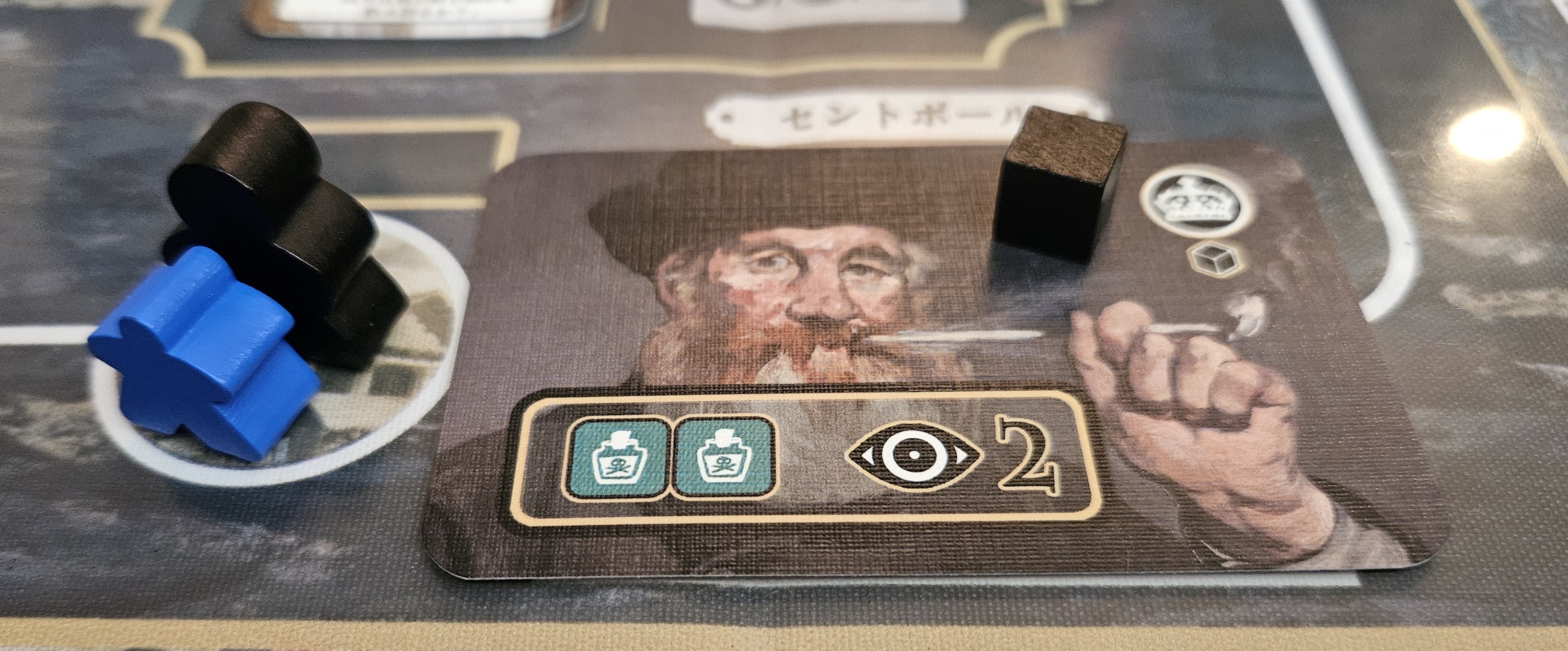
For the good of humankind, we’re gonna poison this guy.
Adaptation is one the most difficult arts of all. Partly because, when done well, it will be invisible.
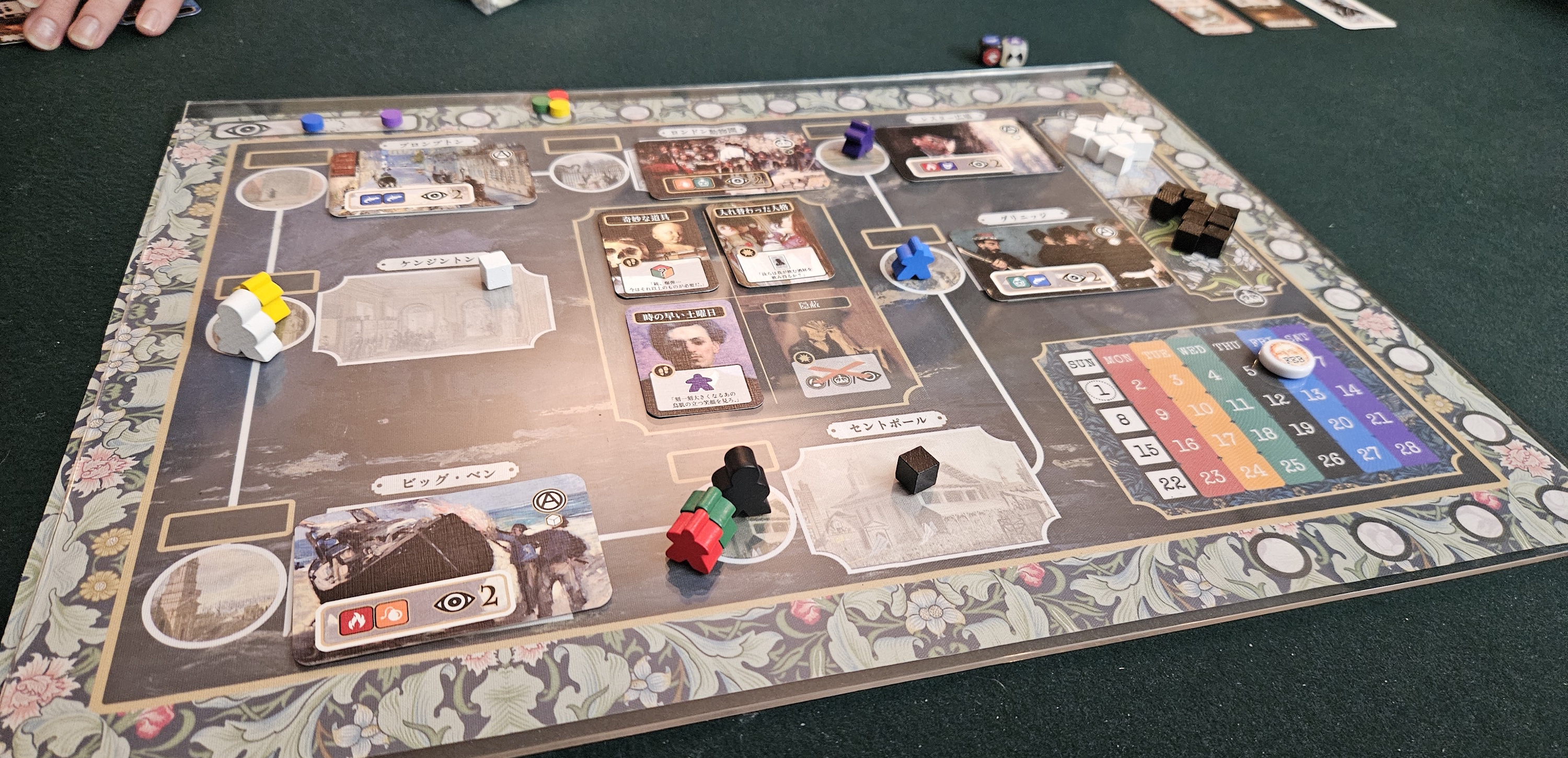
Thursday the board game adapts Thursday the novel by thrusting players into a tangle that they can only vaguely see the outlines of. Everyone is a member of the Council of Days with a double identity. The first of those identities is visible, an objective to fill the spaces of the board with some number or color of cubes. Perhaps you’ll be tasked with placing a bunch of anarchist cubes, or entrusted to make sure there are more police cubes than anarchists in as many spaces as possible, or even instructed to sow chaos by commingling white and black across the entire board.
Your second identity, however, is concealed. This is your position on the Council of Days. Perhaps you’ll be purple, Saturday, or red, Monday. The only options barred to you are Sunday, the avatar of anarchy, and Thursday, representing the police.
These dual identities are never far from mind, tied as they are to the game’s victory conditions. Your first goal is accomplished by undertaking missions that add cubes to the board. But your second, that of your hidden identity, requires you to steer clear of those same missions lest you fall under suspicion. This functions as a tiebreaker, but ties are common enough that your relative standing can never be neglected, causing players to go out of their way to keep their player token clear of any major plots.
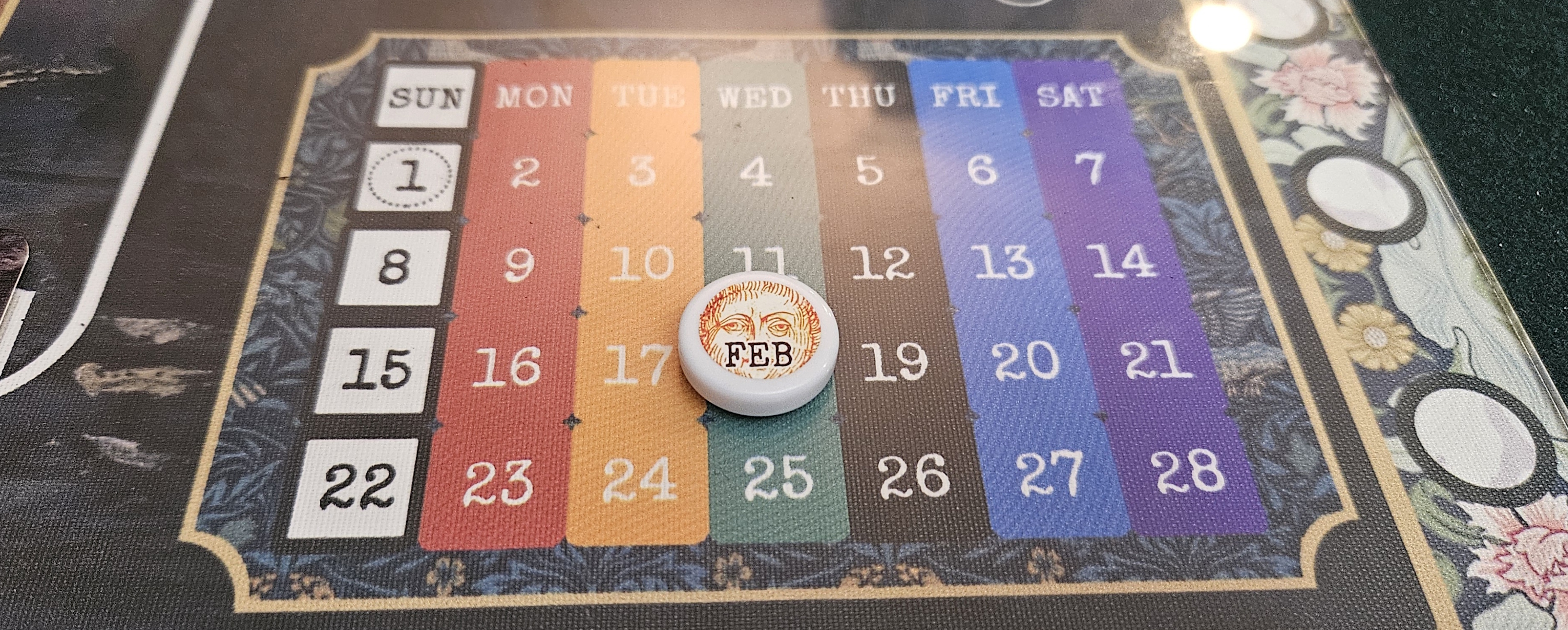
This is made doubly challenging by the fact that you never command your avatar directly. Instead, your current token is determined by a calendar that shifts forward in response to everybody’s moves. You’re Monday, but today is Wednesday, so rather than moving your red piece, you’re given control of green. Along the way, you pick up Friday (blue) to fling a bomb at some minister, causing green and blue to gain suspicion, but also leading everybody at the table to suspect that your real identity is tied to neither of those colors. The calendar ticks forward three days because you moved three spaces. The next player glares at you because it seems like they’re always moving Saturday.
The timekeeping calendar is lovely.
Out of the corner of my eye, I can regard the game with some sliver of critical impartiality. There are flaws here. Missions are accomplished through a combination of dice faces and token colors. Theoretically, this forces players to make do with what they’re given, some combination of whichever color the calendar has assigned them this turn, the colleague they pick up en route to their mission, and any dice results and/or bonuses they have handy. But missions are too easy to complete, rendering entire portions of the design vestigial. There’s an option, for instance, to lay low rather than to complete a mission, cooling off some suspicion or tweaking the position of previously placed cubes. But this is rare, an outside exception, especially the first few times the game hits the table.
Similarly, the objectives struggle to find their balance. Some, like the one that sees you filling spaces with the maximum three cubes, are far easier than those that pit anarchy and the police against one another. With some experience, the gameplay opens up. You learn how to speed up the calendar when you’re ahead, or use the bigger Sunday and Thursday tokens to alter the outcome of a mission, or take advantage of the game’s many special abilities to alter the game from its icon-matching core into more of an area control contest. The Man Who Was Thursday can be played well, can overcome certain of its limitations. But even at its best, it remains a flawed system.
As an adaptation, it fares better. There’s still an incompleteness to the presentation here, as one might expect of a board game, which by its nature presents a snapshot rather than a definite narrative arc. This is, in a sense, the middle act of Thursday, the conspiracy of isolated individuals, after Syme’s infiltration but before the absurdities begin to overwhelm the tale. I’m reluctant to spoil any details, itself something of an absurdity for a novel that’s nearly 120 years old, but… well, that’s on you. Sorry. You’ve had your entire life to read it.
The question of your identity is always under investigation.
The novel gradually transforms, shedding its guise as a political spy thriller. For a time it becomes a meditation on isolation and the power of companionship, with Syme discovering that the various members of the Council of Days are all undercover policemen like himself who have been set against one another. In its final chapters, it shifts into the cosmic realm of Job’s behemoth and whirlwind, Sunday fleeing atop an elephant, then via hot air balloon. When the conspirators at last corner the anarchist of anarchists — a state of affairs that sees him at the height of his power, not laid low as one might presume — they grill him. Why have they suffered so much? Why must everything on earth contend against every other thing? Why does even God hide His face?
This is when Syme, at the moment of theophany, understands. The suffering is also the justification for its own existence. If only the wicked suffered, then their complaint against God would be correct in labeling Him a tyrant. It’s only in the wildness of suffering, in its untamed nature, in the way the lion might gaze lazily at you or consume you, in how every living thing is pressed into service as an anarchist, that true goodness becomes possible.
Do I buy it? Eh. About as much as I buy any explanation for why we suffer. Okay, that isn’t true. I buy it more than any prosperity gospel. But I bought it as a teenager. I bought it, and decided that we were indeed heroes disguised as anarchists, everyone alone, everybody hurting, and that, as Chesterton wrote, the best we could do was to try to find the people who were hidden like us and make allies of them. In his words, “There are no words to express the abyss between isolation and having one ally. It may be conceded to the mathematician that four is twice two. But two is not twice one; two is two thousand times one.”
What a strange, wonderful artifact this is.
This version of Thursday doesn’t arrive at that final confrontation. It remains quagmired in the issue of concealed identity. It’s entirely possible, even likely, that players won’t know one another’s color until they arrive at the game’s conclusion.
But it succeeds in its own confrontation, that moment when everyone’s identity is revealed and any ties are broken. This parting of the curtain is a delight, all the preceding machinations suddenly laid bare. And, by extension, it succeeds in the small moments of relief it provides. When someone at the table eases the suspicion cast on your pawn. When a fellow trailing player collaborates to break someone’s winning state. When at last the game is tallied and packed away and we return again to the table, free of the magic circle, no longer strangers, once again friends.
A complimentary copy of The Man Who Was Thursday was provided by the designer/publisher.
(If what I’m doing at Space-Biff! is valuable to you in some way, please consider dropping by my Patreon campaign or Ko-fi. Right now, supporters can read the next installment in my series Talking About Games, this time tackling the topic of what makes a good list! Naturally, the piece includes a list.)
Every so often, I’ll write something that receives a weird amount of hostility. The most emblematic example is Foucault in the Woodland, my series examining Cole Wehrle’s Root through the lens of Michel Foucault. This is especially weird because Wehrle has been rather open with his design intentions there, including his desire to wrap some philosophical talking points in the garb of fable. In other words, some of the points I’ve written about Root aren’t even subtext; they’re explicit rhetoric spelled out by the game’s author.
But this raises a tangential (and frankly more interesting) question than whether I’m stretching when I insert theories about biopower, state surveillance, and sexual deviancy into the factions of Root. How much should it matter whether Wehrle has left his imprimatur on Root as a game that could be read through a Foucauldian perspective? Thanks the Death of the Author, shouldn’t we be free to talk about any game through any lens that occurs to us, as readers and/or players of that game? Or, as Roland Barthes might put it, as conversants in the same language the designer used to create it in the first place? In playing these things, aren’t we creating their meaning as resolutely as their designers did in the first place?
Today I want to talk about the Death of the Author, Roland Barthes, and the tension that exists between two halves of the way I evaluate games. But in order to do that, first we need to talk about the Bible. That’s right, the Holy one. I’m so sorry.
This one. And no other.
I. Originalism and Reception
As some of my long-time readers may know, I have a background in Bible. My education is primarily in Christian history, which necessarily touches on a pretty wide range of topics, if only because Christianity has been with us for a couple thousand years now. There’s the usual stuff, patristics and theology and orthodoxy and schisms and bad popes and whatnot. But there’s also the stuff that students are surprised to discover. Like the changing Christian treatment of women over the centuries, or the involvement of priests in both colonialism and revolution alike, or how certain brands of literary theory simply wouldn’t exist without bored dudes (they’re almost always dudes) sitting around and thinking about how to critically read a text.
The dominant strain of critical reading is what we call originalism. This is the study of what meaning an author intended to convey when they first (originally) jotted down their words and thoughts and sermons and prayers and personal correspondences. It probably won’t surprise you to discover that this more or less grows out of Bible studies, specifically when it comes to figures like Jesus or Paul.
Especially Paul! Because that dude was all over the map. He’s the one who says that women shouldn’t lead in church, that they should cover their heads, that they’re meant to submit to their husbands, all those zingers. But he’s also the one who praises women as leaders and missionaries and, in one glaring case that was gendered out of the New Testament for a long time, as an apostle.
A few hundred years back, a few of those bored dudes recognized that some of what Paul was laying down didn’t line up with itself. So they began asking questions and coming up with different theories to square the circle that was Paul. This resulted in a range of answers. Some bored dudes decided that maybe Paul was calling on women to thread a particular needle; that they needed to be leaders and submissive and missionaries and that’s a lot of work for women, but tough. Other bored dudes recognized that sometimes Paul’s language changed, so maybe some of his statements on women had been inserted into the original text to alter its meaning (fancy word: interpolated), or maybe even entire epistles were forged by later authors (fancy word: pseudepigrapha). Cluttering this even further, other bored dudes decided to lean into Paul’s most hostile utterances about women, while women scholars rehabilitated Paul as a proto-feminist who was working within the rather strict gender format of Ancient Roman times. Sometimes multiple of these theories coexisted within the same headspace.
In each of these cases, however our bored dudes (and eventually bored women) were deciding to interpret Paul, their intent was generally to arrive at what this ancient Christian originally meant to say. This tendency to assess the Bible as a bundle of original meanings that could be deciphered eventually noodled its way from the religion department to the literature department, where classicists and historians and theater nerds started to subject their own subject matter to the same treatment. The rest is history, right up to our current predicament where Dan McClellan and TikTok theobros spend their every waking moment debunking each other.
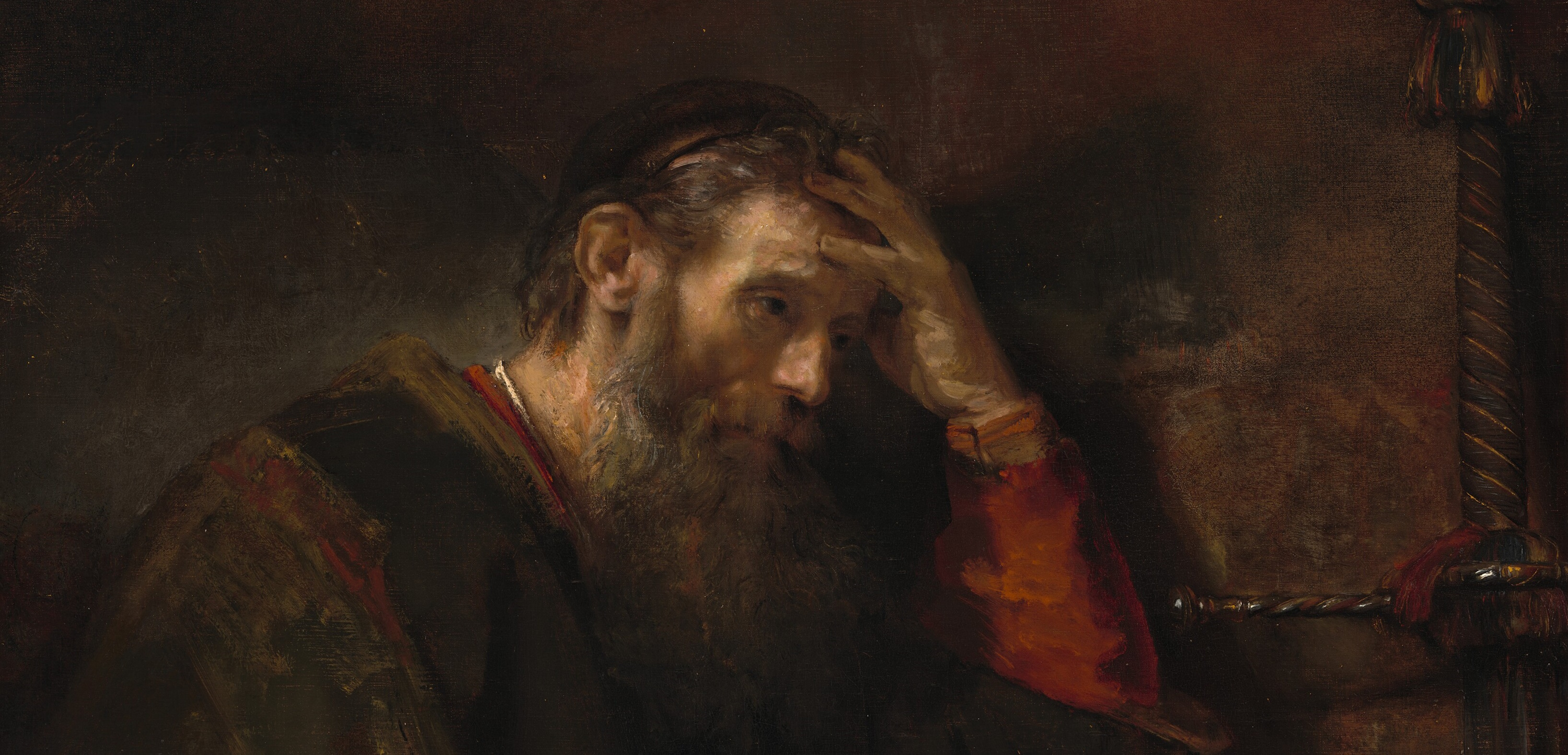
Dan McClellan in an earlier incarnation. Ha ha, it’s actually Paul via Rembrandt.
Only there was a problem. A big one. A lead stinker of a problem. And it went like this:
So what?
Why should we care what Paul said about women? He lived in olden times. They argued about dietary restrictions and whether Jesus was an alien hologram. They also cooked everything over open fires and died young when their teeth wore out. Maybe, these new bored dudes (and bored women) argued, maybe we should care less about what people like Paul originally said and more about what religion can do for us right now.
To be clear, not all of these statements were wholly conscious. Most of the people making these arguments were believers themselves, so they weren’t trying to throw out the entire Bible. It’s just that original meaning isn’t the only meaning. Maybe Jesus and Paul and all these other Bible authors were pointing toward a deeper truth.
Here’s one place where the issue came to a head: slavery. Paul talked about slavery. There’s an entire epistle (his shortest) devoted to the issue. But that text, a letter to the master of an escaped slave, isn’t really about slavery so much as it is about Christian fellowship. Basically, Paul asks Philemon, the master, to accept Onesimus, his escaped slave, back into his household, but to treat him as a brother. It’s a beautiful piece of work, expressing Paul’s hope that Christian identity will override any other.
The problem, though, is that Paul doesn’t exactly liberate Onesimus. He’s still sending the guy back to his master. So we get these bored dudes debating the meaning of this epistle. Is Paul saying that slavery ought to be ended? Or is Paul saying that slavery is good, but that slaves should be treated well? And what exactly does “treated well” mean? Like a brother? Like a pet? Like a child who doesn’t know what’s best for them?
Or is it possible that abolition isn’t something that could occur to a first-century thinker in the first place?
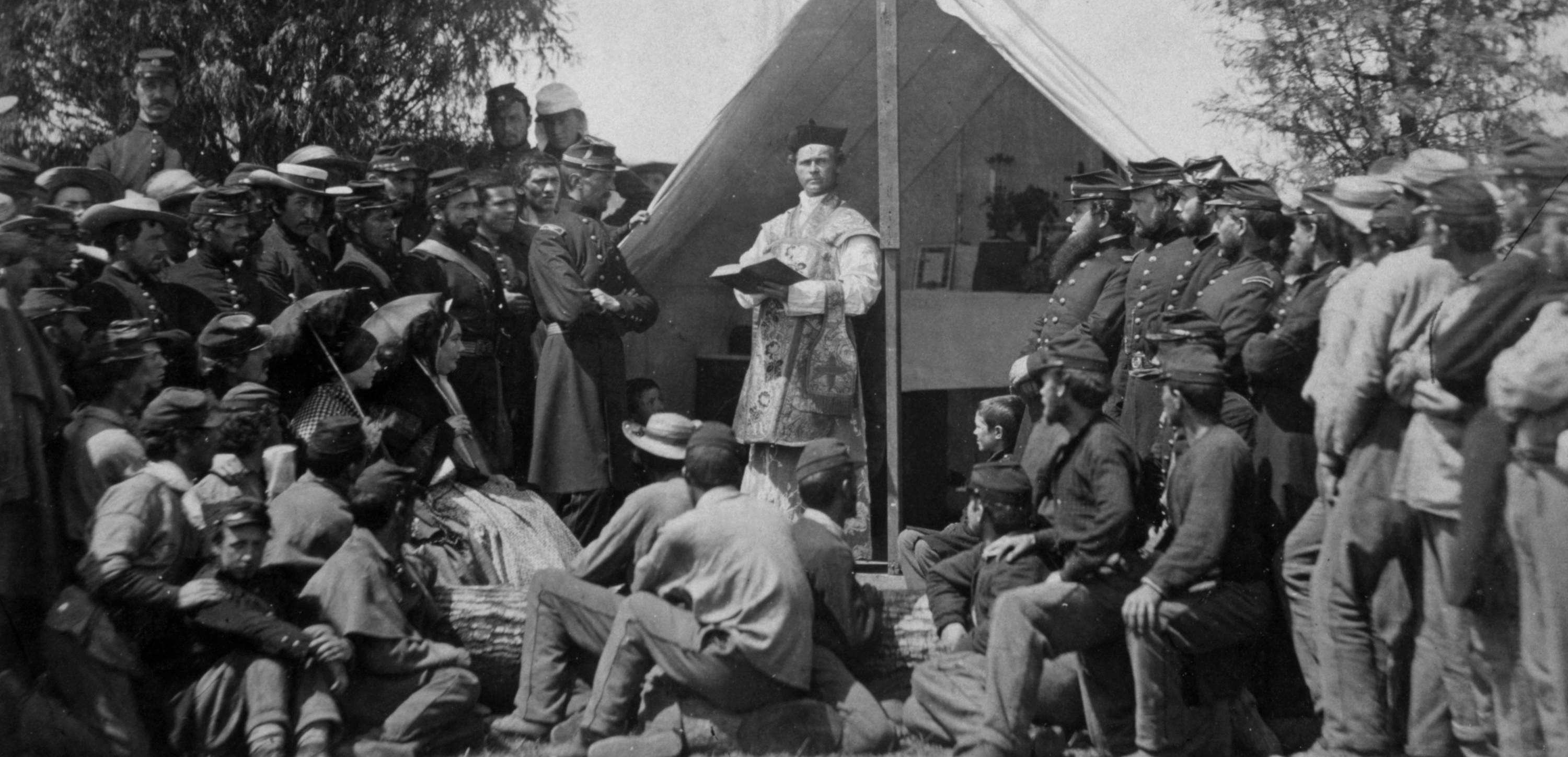
Catholic Mass during the American Civil War.
So our bored dudes started debating what Paul means by this epistle. And their underlying disagreement wasn’t solely over what he originally meant. It was over the meaning behind the meaning. Paul never saw the cotton gin. He never saw industrial slavery. He never saw slave ships packed with human meat. This isn’t to say that Roman slavery was super fun. It sucked. But it was the background noise of Paul’s day. Maybe, if this long-dead authority figure could be whisked into an 18th-century context, he would see the factories and the cane fields and free-market capitalism and agree that slavery had run its course and ought to be done away with. Maybe he’d become a Marxist. Maybe he’d die of future shock. It all depends on who you ask.
(Meanwhile, of course, a few people were beginning to point out that maybe we shouldn’t rely on long-dead authority figures. But that’s a tangent we shan’t explore today.)
This is where we get a very different strand of understanding texts. These people start to realize that some things, including a lot of things that a lot of Christians care a lot about, aren’t a function of those original meanings. They’re new. And these new things are maybe just as important as the original stuff.
Like, for example, abolition. Or the creole blending of Christianity with native faiths. Or how women might participate in a modern church. Or how to handle texts that clash with archaeological discoveries and scientific theories. Or the role of priests in resisting authoritarian governments. Or the role of priests in supporting authoritarian governments — because, look, these innovations weren’t always positive.
The need to adapt to changing circumstances prompts a very different method for reading texts. This is called reception. The idea is that the reader’s context is every bit as important as the original context. Maybe even more so. After all, Paul has been dead for a while. Let the dead bury the dead, someone once said.
Like originalism, this new idea of reception trickled from the religion department over to its neighbors, spurring disagreement even between critical theorists. The question looks like this:
Which matters more: the original meaning or the new meaning?
Roland Barthes, looking very sexable today.
II. The Life-Death of the Author
According to French philosopher, critic, and semiotician Roland Barthes, the thing that matters most is the new meaning. The reception of the work by its readers, not the original meaning intended by the author. Although in his case, he would probably label it the old meaning.
Ask your average lit-kid to sum up Barthes’ seminal essay “The Death of the Author” in one sentence and, first of all, they’ll insist it can’t be done in fewer than a few paragraphs. But stand firm and you’ll probably get something like this: “The author’s intentions and biography aren’t what matters when it comes to interpreting a work of art.” Easy, right?
Not quite. For one thing, it’s useful to actually read the essay in question. I know, it’s super long. 2200 words! That’s a little bit longer than this piece up to this point!
But the Barthes who argues for the death of the author is speaking in stronger terms still. To him, the author is a new concept entirely. “The author is a modern figure,” he writes, “no doubt produced by our society as it emerged from the Middle Ages, inflected by English empiricism, French rationalism, and the personal faith of the Reformation, thereby discovering the prestige of the individual, or, to put it more nobly, of the ‘human person.’ Hence it is logical that in literary matters it should be positivism, that crown and conclusion of capitalist ideology, which has accorded the greatest importance to the author’s ‘person.’”
Now, you might note an irony here. When Barthes attributes the birth of the author in part to the “personal faith of the Reformation,” isn’t he talking about the same bored dudes who developed the idea that reception matters more than originalism? The answer is… kinda-sorta. Remember, our bored dudes were so bored that they spent all their mental energy arguing with other bored dudes. Pinning them down to a single consistent perspective is tough. Even more importantly, we’re entering a dissimilar realm of thought. Barthes is not a historian. He’s a philosopher. And while there’s quite a bit of overlap between our history and philosophy departments, they’re different enough that the rubric that applies to one might not easily fit into the other.
For one thing, Barthes seems blind to at least two possibilities. First, that it isn’t only the Author who has been created by modern society, but Readers as well. And two, that our art has always been subject to some degree of authorial shenaniganry. In Barthes’ quasi-historical telling, art was previously relayed by mediators — shamans, orators, village elders — who were effectively putting on performances rather than functioning as a tale’s sole arbiter of meaning. But it doesn’t take much effort to observe that there have been plenty of shamans, orators, and polemicists throughout history who have gladly declared what any given work of art really means. And this isn’t limited to tradency, in the sense that orators will sometimes leave their own stamp on a story. Biblical authors and editors went of their way to establish their biographies or clarify a text’s original intentions, sometimes overwriting poetry or inserting themselves under someone else’s name. (Remember our fancy words from earlier!) It’s as natural as storytelling to re-imprint oneself on the text. To edit or translate, even to relay, is to author.
Which, it should be noted, draws these two disparate threads closer to fashioning an actual knot. Because if editing, translating, and relaying make authors of readers, then so too does the mere act of reading. When you read a text, you mediate its meaning by reinterpreting it within your own context. This transforms you into an author. A very different type of author from the Author that Barthes intends to throw down from his pillar. But an author all the same.
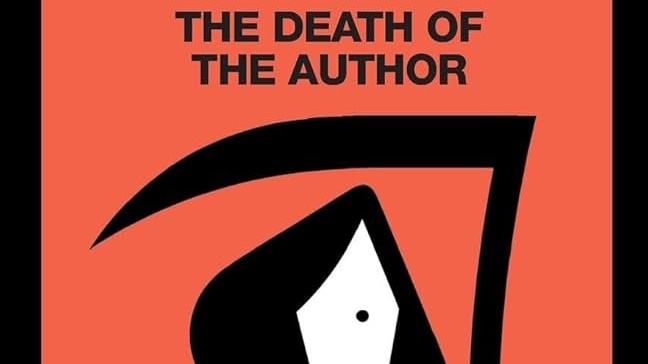
Oh! This jacket designer thought Barthes meant it literally.
Okay, we’re all authors, lower-case rather than capital-letter god figures. Great. We get it. But what’s so bad about the original Author’s intentions and context anyway?
To understand that, we need to investigate the context that Barthes was operating in. Which is at least ironic, maybe even something of a trap, since we’re now trying to strike at the man’s original meaning as opposed to its received understanding. And, oh, I ought to note that some literary theorists have indeed argued that Barthes was imposing an irony-trap by crafting a theory that would force its adherents to strive to understand his original meaning and thus paradox themselves to death. This strikes me as the sort of prank Jacques Derrida was more prone to, but consider yourself informed. Let’s spring the trap, if only to investigate its hinges and springs.
To begin with, Barthes argues that the Author isn’t quite as much of an author as they would like to think. He writes, “We know now that a text consists not of a line of words, releasing a single ‘theological’ meaning — the message of the Author-God — but rather a multidimensional space in which several meanings are married and contested, none of which is original. The text is a fabric of quotations, resulting from a thousand sources of culture.”
Whoa, cool it, Roland! In simpler terms, language and culture are so potent that the Author is passing along meaning more than they are inventing it. While the Author might want to claim ownership of their ideas, they’re merely handling it. They’re closer to those shamans and orators, tradents of ideas rather than originators of them.
Even Barthes was swimming in his own culture. As plenty of commentators have pointed out, other critics were beginning to argue something similar to what Barthes argued in “The Death of the Author.” Short version, nobody is as original as they would prefer to think.
But there’s another element of culture at play, one that goes a long way toward explaining the strength of Barthes’ language. The dominant strain of literary criticism of his day was downright obsessed with originalism. According to prevailing wisdom, critics were intended to decipher art’s original meaning, usually by studying an author’s biography or, when possible, by simply having the author clarify a work’s intended meaning. It’s time to drop an over-long quote on you, but I’ll put it in a breakout box to add some visual flair:
The author still reigns in manuals of literary history, in biographies of writers, magazine interviews, and in the very consciousness of litterateurs eager to unite, by means of private journals, their person and their work. The image of literature found in contemporary culture is tyrannically centered on the author, his person, his history, his tastes, his passions. Criticism still largely consists in saying that Baudelaire’s oeuvre is the failure of the man Baudelaire, Van Gogh’s his madness, Tchaikovsky’s his vice. Explanation of the work is still sought in the person of its producer, as if, through the more or less transparent allegory of fiction, it was always, ultimately, the voice of one and the same person, the author, which was transmitting his confidences.
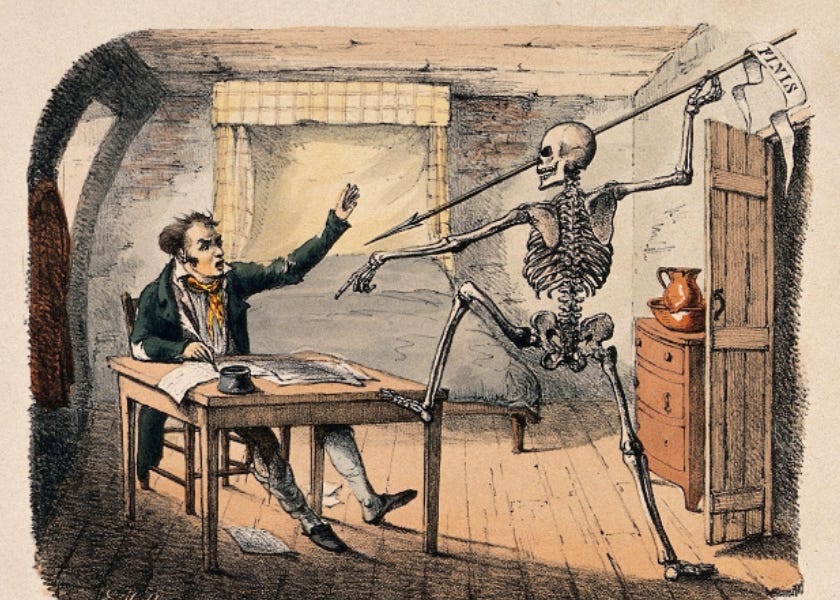
An author being kill’t.
Whoa, cool it, Roland! What’s the problem, anyway? To Barthes, a man who cares very much about art and about the meanings it transmits, the problem is that it makes art perishable. It puts a period on a single examination of the work. The task of criticism becomes that of a codebreaker. You look at art and you say, “What is the one singular meaning that this work of art must have?”
Once that has been done, any other meaning is rendered meaningless. Barthes is offering a critique of his day’s critical apparatus. And in suitable unoriginal fashion (which, remember, Barthes is defending!), his critique stems from the Marxist argument that capital has transformed art into one more product to be extracted and expended. There’s no reason to dwell on a painting for one’s entire life. Once the painting has been understood, it can be fed to the bonfire so you can purchase another. There’s no need to reread a book at different stages of your life to witness how its meaning transforms because you have transformed. The only meaning that matters is the one passed down by the Author. There’s no need for a song to blossom from springtime excitement to nostalgia. There are other albums for that.
By killing the Author, by permitting every reader to be as much an author as those who put pen to paper, Barthes argues that art becomes freer, greater, more open to all. “To assign an Author to a text is to impose a brake on it, to furnish it with a final signification, to close the writing,” he notes. “Once the Author is distanced, the claim to ‘decipher’ a text becomes entirely futile.”
It’s revolutionary. In the literal, rhetorical sense. Barthes isn’t just declaring that the Author is dead. He’s rolling the guillotine over to traditional literary criticism and laying out the head-basket.
Vive la revolution.
Review this soap, if you would.
III. Shrödinger’s Historio-Critic
But there’s a quandary to be had, because in contravention to how the Death of the Author has been received by some adherents, Barthes isn’t arguing for the death of context. The death of the Author as tyrant, yes. The death of art as a perishable grocery, yes. The death of context, research, or external meaning, not so much.
Here’s some context of our own. In the 1950s, Barthes made an early name for himself by writing essays for Les Lettres Nouvelles that assessed objects of popular culture — wine, professional wrestling, soap detergent, Einstein’s brain, Charlie Chaplin — as modern mythmaking. Eventually compiled into a single book, Mythologies, these essays were short, fewer than a thousand words a pop, but they sought to cut to the heart of the ways even seemingly innocuous cultural productions like advertisements were in fact engaged in cultural storytelling. (Usually, it turns out, bourgeoisie storytelling.) This requires a great deal of context on Barthes’ part. When he examines how the Romans are depicted in film, it requires him to stay grounded in contemporary cinema to note how every Roman’s hair is fringed, but also to venture into actual Ancient Roman imagery, where plenty of people were bald. He sidesteps any reliance on authorial authority — yes, those words have the same root, the Latin auctor for “originator” — but spends quite a number of his limited word count on contextualizing the meaning of these new myths.
In one essay, he also derides critics who “proclaim their helplessness” when it comes to understanding meaning. “Critics often use two rather singular arguments,” he writes. “The first consists in deciding that the true subject of criticism is ineffable, and that criticism, as a consequence, is unnecessary. The other, which also appears periodically, consists in confessing that one is too stupid, too unenlightened, to understand a book reputedly philosophical.” He mock-quotes such a perspective with a poisoned barb: “I don’t understand, therefore you are idiots.”
What does this have to do with authorship? First of all, if I had a nickel for every time somebody told me that their perspective is as good as any other because the Author is Dead, I would have at least three dollars. Such a degree of solipsism is very much in line with the “blind and dumb criticism” that Barthes cannot stand. He asks of the critic, “To understand, to enlighten, that is your profession, isn’t it?” Not every meaning is equivalent. There are better and worse interpretations, low-effort and try-hard interpretations, and everything in between. The Death of the Author isn’t raw solipsism. It still demands context. It’s just that it wants that context to be far-ranging, not limited to the author’s interpretation.
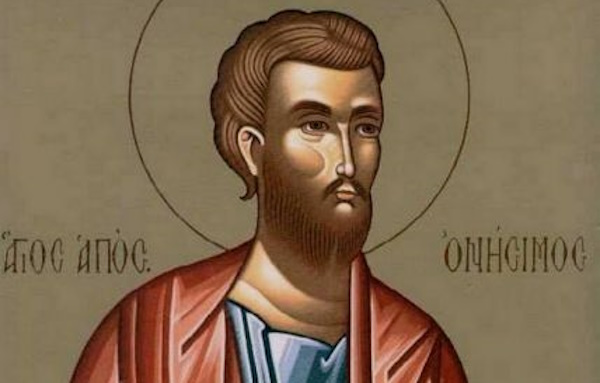
Onesimus, a slave, and in some traditions the Bishop of Byzantium.
If that isn’t enough, we can ask the more probing question. This is, incidentally, the same question raised by the bored dudes who questioned their predecessors’ assumptions:
So what?
So what if Barthes prefers that I don’t pay any mind to the author? I’m a critic, sure, but I’m also a historian. While the former role does well to disentangle itself from total authorial control over a text, the latter is still interested in documentation, attribution, and preservation.
One component of that preservation is the utterances of the designer. Most board games throughout the centuries have been anonymously designed. But it’s a very silly perspective indeed to think of this as a positive state of affairs. We may not know who first pushed cowrie shells around in the sand, but it enriches our understanding of mancala to learn that its popularity can be mapped to the bellies of slave ships and displaced populations, that one of its most crucial components is its absence of formal components. We may not be speaking about a singular author, but this is still a question of authorship-as-transmission. Of course, this isn’t to say that every design that uses mancala as an underlying system needs to pay homage to that. But as critics, the more context we glean, the better our understanding and therefore the better our critique. Because, as with those Bible scholars and the many victims of Barthes’ Mythologies, many of these stories are passed along through the cultural subconscious rather than stated outright. When a designer engages with a tradition, they may pass along fragments of that tradition if only by accident or assumption. They are authors, but lower-case authors, an authority on their work, if never its final authority.
Which is to say, there’s a very real tension in my work between Critic and Historian. Navigating that tension isn’t always easy. At any given time, I’m trying to assess board games as artifacts that exist independently of their creators, while also trying to preserve their authorial voices. There isn’t a single easy solution to that tension.
Oh, Roland. I asked you to stop making bedroom eyes at me.
But I do think it’s possible for these errant stands to be drawn into a knot. In his time, Barthes offered the Death of the Author as a corrective to an overly straitjacketed and commercial critical apparatus. In the decades since, the Death of the Author has become an axiom in its own right — a terrible irony, but not one that’s surprising to any student of history. Today’s heterodoxy becomes tomorrow’s orthodoxy. So it goes.
The irony brings along a great opportunity for the ride. This is the great but under-served task of modern criticism. Not merely to say “Here is my interpretation of this game, and it is as good and precious as any other.” That way lies a new incarnation of Barthes’ “blind and dumb” criticism.
Rather, the task is to develop an individual perspective that’s literate in where our tabletop games come from, which wider conversations they engage with, what their authors intended and how they succeed or fail, and where they engage with the wider culture at play. Criticism begins as a buyer’s guide, transforms into personal expression, but may, with practice and a radical engagement in the medium, transform yet again into true cultural critique, one that is simultaneously subjective and universal, that speaks about truth without surrendering to the notion that there can only be One True Thing. Such a process is fraught, but I believe it’s the next essential step in realizing a medium that has only recently stepped out of its infancy.
Vive la revolution, baby. Sorry. Vive la revolution, adolescent.
(If what I’m doing at Space-Biff! is valuable to you in some way, please consider dropping by my Patreon campaign or Ko-fi. Right now, supporters can read the next installment in my series Talking About Games, this time tackling the topic of what makes a good list! Naturally, the piece includes a list.)

 Anmelden