Normale Ansicht

Flippin’ Mickey

14. April 2026 um 21:30

this is not an ambigram

FlipToons was designed by Renato Simões and Jordy Adan, the latter of whom gave us Stonespine Architects and Cartographers, but the real star of the show is Diego Sá, whose animated characters make me want to rate the game significantly higher than I would otherwise. Just look at those little dudes! The camel is two seconds away from winding up a punch. The rabbit wouldn’t feel out of place leaning in for a kiss, only to be rebuffed when the ostrich hides her head in the sand. The sheep is just is out there boppin’ to her tunes.

As a game? Oh, it’s pretty good. Clever at points, nice to play, the usual. My larger reservation is the way it makes me feel during and after a play.
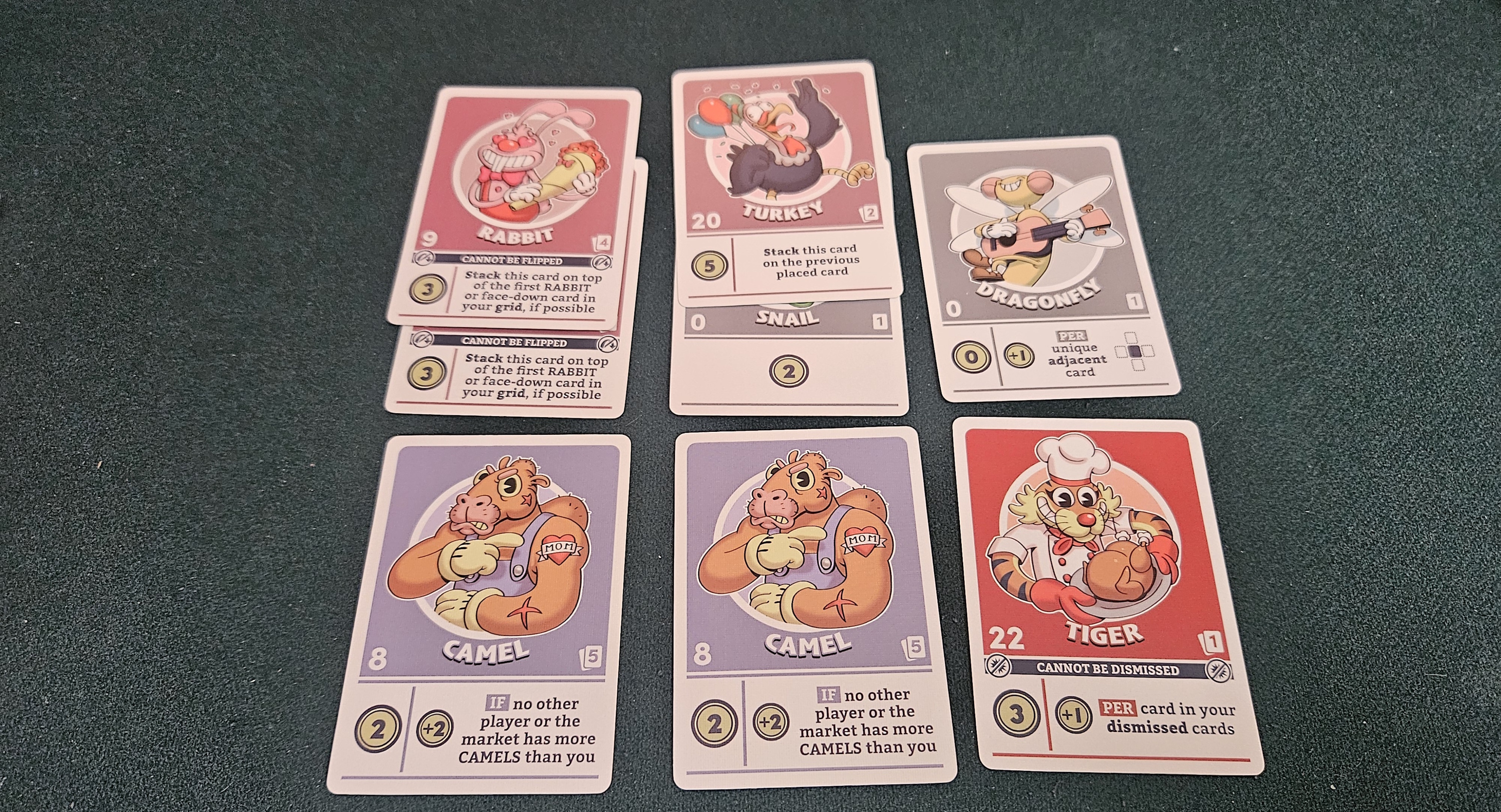
The other day my children were counting a bee's legs and getting mightily confused because it would not stop moving. That's me checking that I have six cards in FlipToons.

Six cards. In theory.

FlipToons is a game of two halves. Two halves which, when hinged like an aquatic bivalve, form into a united whole that conceals an unexpectedly tasty muscle within. Okay, so I skipped breakfast. Point is, FlipToons is hard to discuss holistically without first establishing how its components function apart from one another.

The first part is the deck. When the game begins, you have six cards in total. Two caterpillars, each worth bupkis, but easily dismissed. One skunk, a utility card for winnowing your deck. One bee, worth a single pip of purchasing power. One snail, worth double the bee’s value, making it the single most precious card in your starting lineup. And one dragonfly. Ah, the dragonfly. This guy gives you one point for every unique adjacent card.

What this means requires some explanation. Every round opens with you shuffling your deck and then dealing cards onto the table in front of you to create a three-by-two grid. If you have extra cards, too bad, they remain in your hand. If you have too few cards… well, don’t do that.

Some cards may stack. Rabbits, ostriches, turkeys, these are your chance to get more than six cards into your grid at a time. Others, like sheep or monkeys, trigger benefits if they occupy a particular row or column. Some cards flip, others compare values against other players or the market, and a few, like the pig, are traps that can be gifted to rivals to subtract from their tally.

That tally, then, is taken to the market to shape your deck. Since you’ll only use six-ish cards at a time, keeping your cast trim is a good idea. Fortunately, unlike most deck-builders, the ability to dismiss toons is inbuilt in FlipToons, always available for the low cost of five points.

The toons on display, meanwhile, adjust in cost according to their relative ranking. This ensures that something is always available, and if you’re lucky it’s possible for something unusually precious to slip down in cost. Of course, the opposite often also proves true, with low-value cruft sometimes overwhelming the market.

Regardless, you take your purchases and/or dismissals, shuffle your grid back into your hand, and begin all over again. Bit by bit, your cast improves. That measly starting five to six points becomes twelve, then sixteen, then you break twenty and flip your little tally card to its opposite side. The goal is to score thirty.
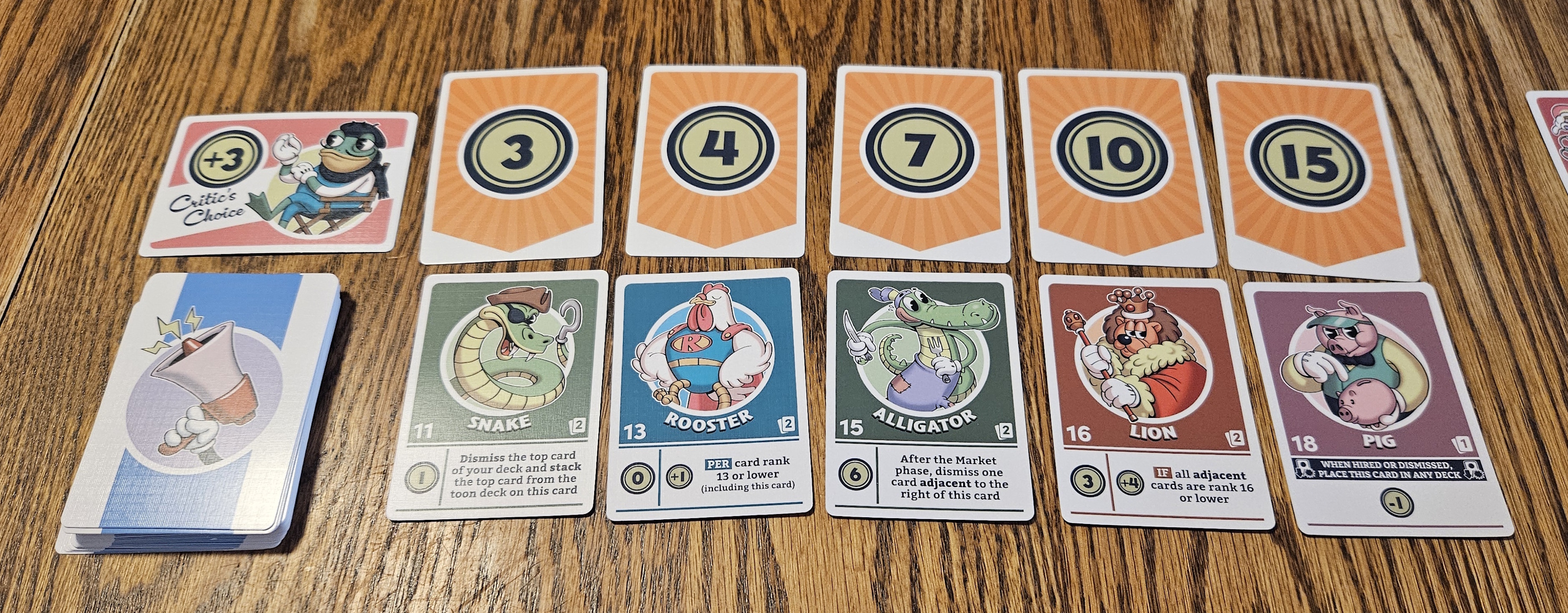
I'm not sure the snake and the alligator can be played well... then again, they're just gambling outright, which is at least fitting.

Costs are adjusted dynamically, which can result in little surprises.

Okay, not quite. Your actual goal is to score the most on the final round. Hitting a tally of thirty is how you trigger the endgame, and there’s a small plus-three advantage if you’re the one to bring it about, but that’s no guarantee luck will be on your side for the last flip. So, then: hit thirty to lock the game into one final pull of the lever, then hit the jackpot.

The slot-machine analogy is apt here. FlipToons is to deck-building what Balatro was to poker. The titular flip of FlipToons is devoid of decision points. You turn cards in order, left to right and top to bottom, until you’ve produced that three-by-two grid.

There’s more going on in the market portion, but these are minor choices rather than a vast menu. There are five cards available at any given moment, and even when you’re flush with cash in the late-game, you’re limited to two purchases. (And dismissing a card from your deck qualifies, so no double-dipping.) This keeps everyone at the table more or less bungee-corded at the hip, which is probably the right decision for such a light game, but also prevents the table from launching the exponential bottle rockets that were Balatro’s core pleasure.

But about those pleasures…

I have my reservations about these sorts of games. The art and market purchases, while pleasant, aren’t far removed from the lights, illusory choices, and “theming” of a slot machine. I remember as a kid on a trip to Vegas, walking past a slot machine that leaped out of the crowd. I think it was based on Aliens, with those sleek oily monsters I had yet to witness on the screen for myself, but which my friends with the cool parents, the ones who let their kids watch R-rated movies in elementary school, spoke of as the scariest things they’d ever seen. My Dad traced the object of my interest and leaned down to whisper, “That’s how they get you.” It was like somebody had roused me from hypnosis. In that moment, my Dad — who suddenly struck me as cooler than those other dads, or at least cannier — had broken through the social programming of that cigarette-reeking hellhole.

And, look, I don’t think FlipToons is some sort of evil artifact. It isn’t the equivalent of a casino, with its fine-tuned odds to ensure the house always wins and your kid’s college fund becomes another rounding error in a billionaire’s high score. But it produces a similar daze, all submersion and dulled perception. It’s a far cry, too, from some of the sharper auto-battler board games, titles like Tag Team, with its emphasis on attention and preemption, or One-Hit Heroes, which requires constant input from its players. Here, the gameplay comes pre-loaded. All you have to do is pull the lever.
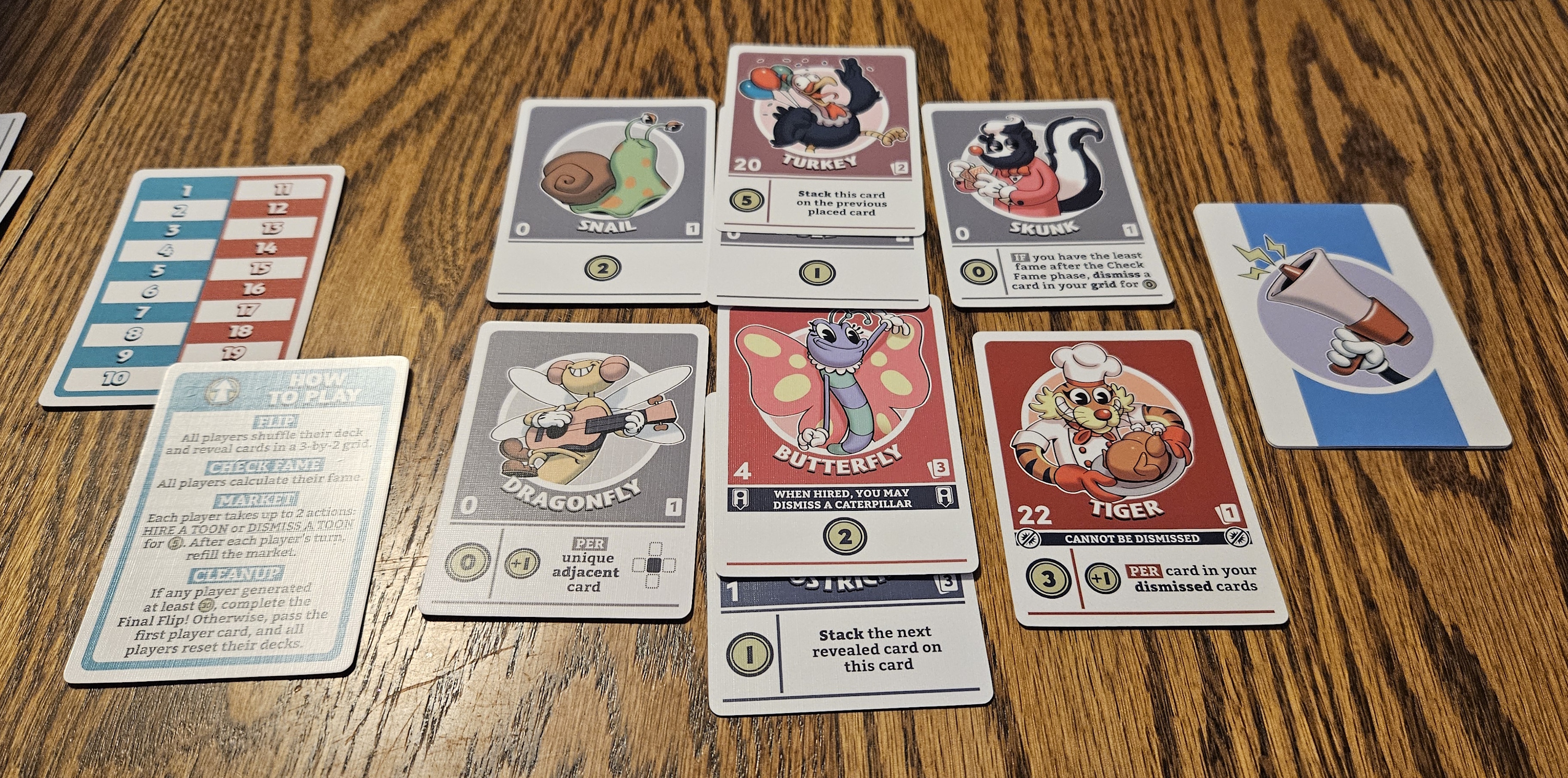
The solo mode is basically a race to hit 30 points while the game discards cards from the market. It's blindingly easy.

It doesn’t always take much effort to reach those 30 points.

I mean, there’s more to it than that. Just not by as much as I would prefer. Certainly not by enough to make me want to play it more.

Because in the end, FlipToons is a pleasant enough diversion. It’s well-crafted, pretty to look at, and feels good to play. When it hits the table, the fugue it offers is dreamy and warm. But when it’s done, I feel like I binged on steakhouse butter in place of an actual filet. It lacks what brought me to the table in the first place. It doesn’t spark my imagination or help me appreciate my friends. It doesn’t teach me anything. It barely even makes a win feel different from a loss. Most of the time, I hardly remember how I spent the past twenty minutes.

But yeah, the art is lovely. Those lovable goofballs. Those scamps. That’s how they get you.


A complimentary copy of FlipToons was provided by the publisher.

(If what I’m doing at Space-Biff! is valuable to you in some way, please consider dropping by my Patreon campaign or Ko-fi. Right now, supporters can read my first-quarter update of 2026: the best board games, movies, books, and more!)

Brine & Origami

14. April 2026 um 00:52

Make an origami of those sticky sea-things that lie on the beach, their sacs bloated and pulsing.

Sea Salt & Paper sure was hot a couple years back, huh? I didn’t think much of this thing the first time I encountered it, perhaps a symptom of having only played it with a single partner; in contrast to some, I find it needs room to stretch out. Perhaps it helps, too, that the expansions, More Salt and More Pepper, both give the game a small kick in its folded shorts.

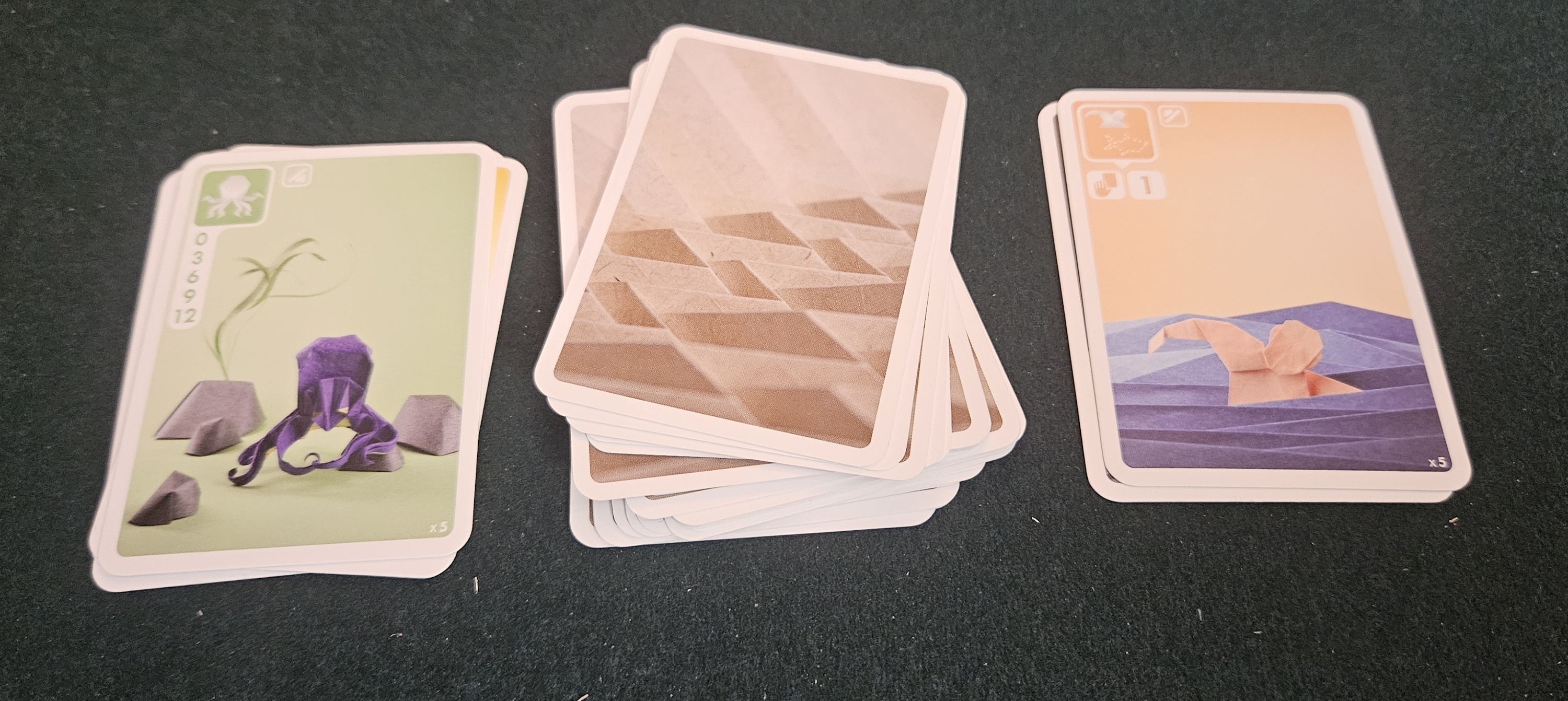
I could have tidied the piles, but this isn't that sort of game.

The basic choice: from where does one draw?

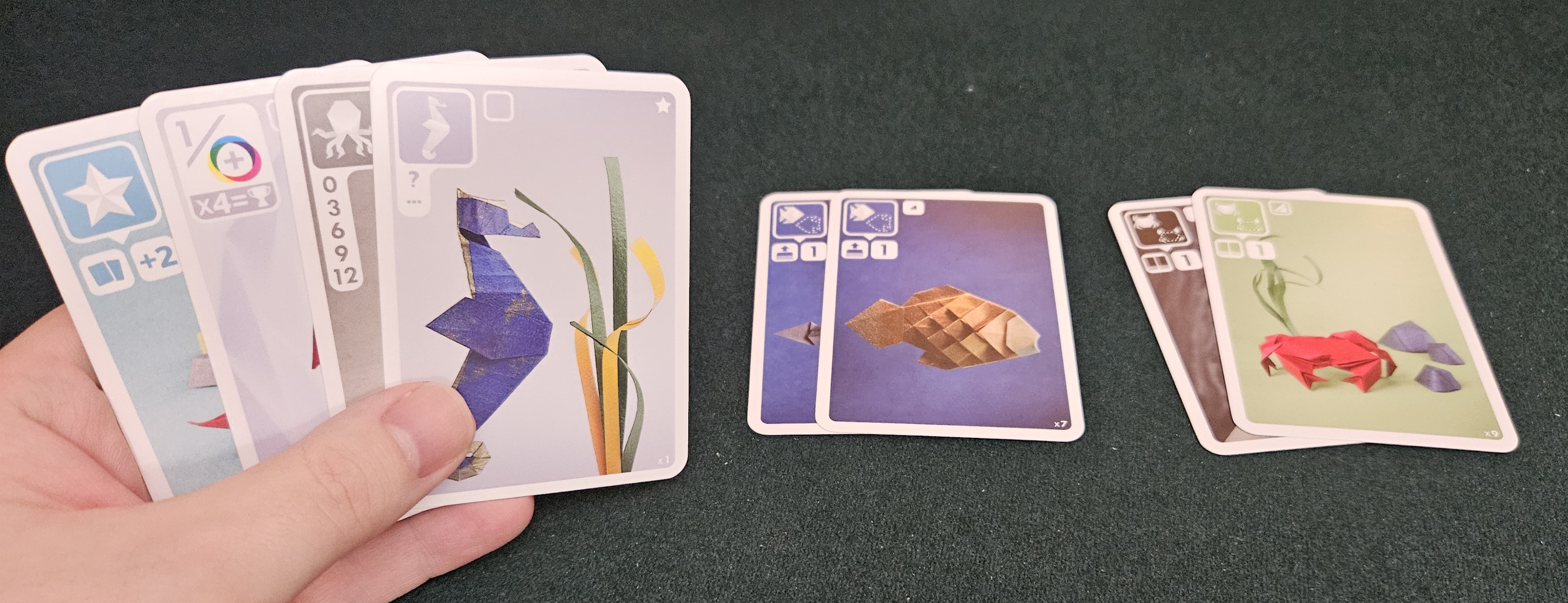
For those who haven’t played Bruno Cathala and Théo Rivière’s small-box card game, Sea Salt & Paper opens with the gentlest of all possible choices: from where to draw? Your options, in this case, are either the deck proper — in which case you’ll draw a pair, keep one, and toss the reminder into either of two discards — or the top offering from one of those castoff piles. Either way, you gain a single card.

Over the course of multiple turns and multiple sessions, however, this choice begins to take on some depth. First, there’s the possibility of playing a duo. Some cards, when paired with a mate, can be deployed to the table. The pair is worth a point either way, but their coming-out provides some small benefit: crabs that let you dig through a discard pile for something previously buried, boats that start your turn anew, a shark and swimmer that swipe something precious from a rival’s hand.

But while duos are potent, there’s more to your picks than pairing cards. There’s the color of the card, entirely separate from its icon, which can amass points as you gain more of a particular hue. Or there are offerings that pose a risk, like octopuses and penguins, worth nothing at first but gradually accumulating points as you build sets — while, of course, signaling to your opponents that you’re angling for something.

Or there’s the risk of throwing away something worthwhile to the others at the table. More than once, I’ve had to take a worthless shell because Adam, who tends to sit to my left, hoards shells by default. If I throw one out, he’ll nab it for certain. And fortune favoring him, he probably already has three in hand.

This is all to say that Sea Salt & Paper is an unassuming little thing. Its choices are diminutive, but no less crucial for their stature.

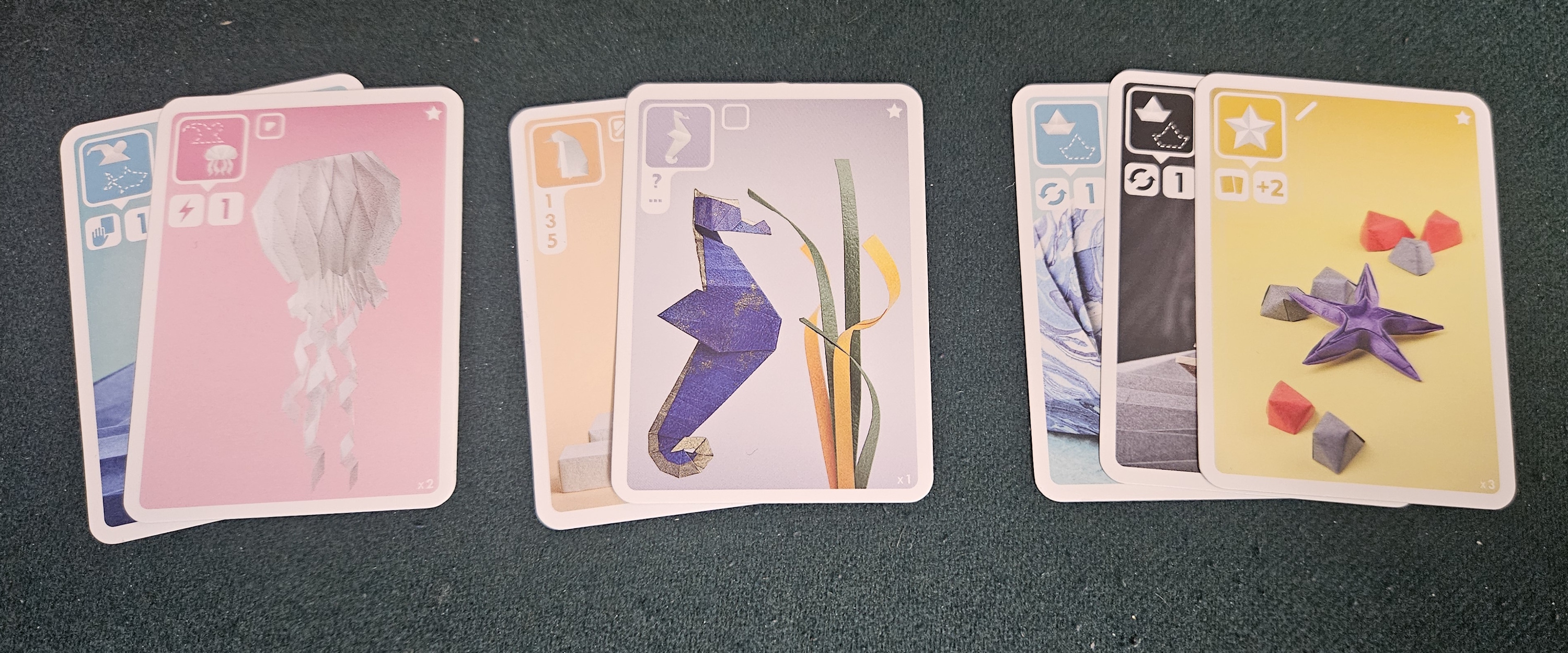
Oops, I showed the seahorse twice. You'll see.

Cards in hand are hidden, but vulnerable.

Where the game gets interesting, though, is in its scoring. Played over multiple hands, the objective is to accumulate some number of points. Say, thirty points with four players. But rather than ending any given hand at a certain threshold, here players are allowed to keep playing until somebody elects to go out. And then they’re offered another little choice that bends the proceedings. They can declare the hand is over, at which point everybody scores according to what they’re holding and/or the duos they’ve revealed. Or the goer-outer can announce that they have the high score at the table and nobody can match them.

Aha! The contest is on. And the stakes are high. If the player who went out has the highest score, they earn all their points plus a color bonus, points worth the sum of their highest-held suit. That might be a lot or a little, depending on their priorities that round. Everyone else, meanwhile, earns only a color bonus. Again, that might be a tidy sum, but it will almost certainly be less than their normal score. But if the opposite holds true, the pendulum swings the other way. Everybody else scores their hand points, while the shouty player earns nothing but the color bonus.

Like everything else in Sea Salt & Paper, this decision is understated. But it represents a potentially major swing. I say “potentially” because, well, this is a game of subtle wagers and sudden swings, and it’s entirely possible for somebody to quietly amass a solid bar of colors and come out ahead either way.

This gives it a sleepy atmosphere. I might even call it boring, in a largely pleasant way, the sort of game you play with your grandmother while sharing some light chit-chat. In that regard, it reminds me of something like Mexican Train or countless trick-takers played with a regular deck. It doesn’t exactly knock me out of my socks, but it was never meant for sock-rocking. It’s there for quiet evenings on the seaside, the air heavy with the inrush of atmosphere, a storm coming but still out on the horizon. It’s a bedtime game.

There it is. These pictures weren't even taken on the same night. I guess I just love seahorses. (True.)

Extra Salt adds a few cards.

The expansions give it some much-needed kick. The first, Extra Salt, adds only a few cards, not enough to upset the delicate ecosystem of the original game, but sufficient to add at least a few decisions. Extras like a lobster or a jellyfish pair with previously-obvious offerings to produce new effects, while a seahorse makes certain sets more worthwhile and starfish can be added to a duo to drop their ability in exchange for some extra points. The game is still sleepy, but the decision-space is a little denser.

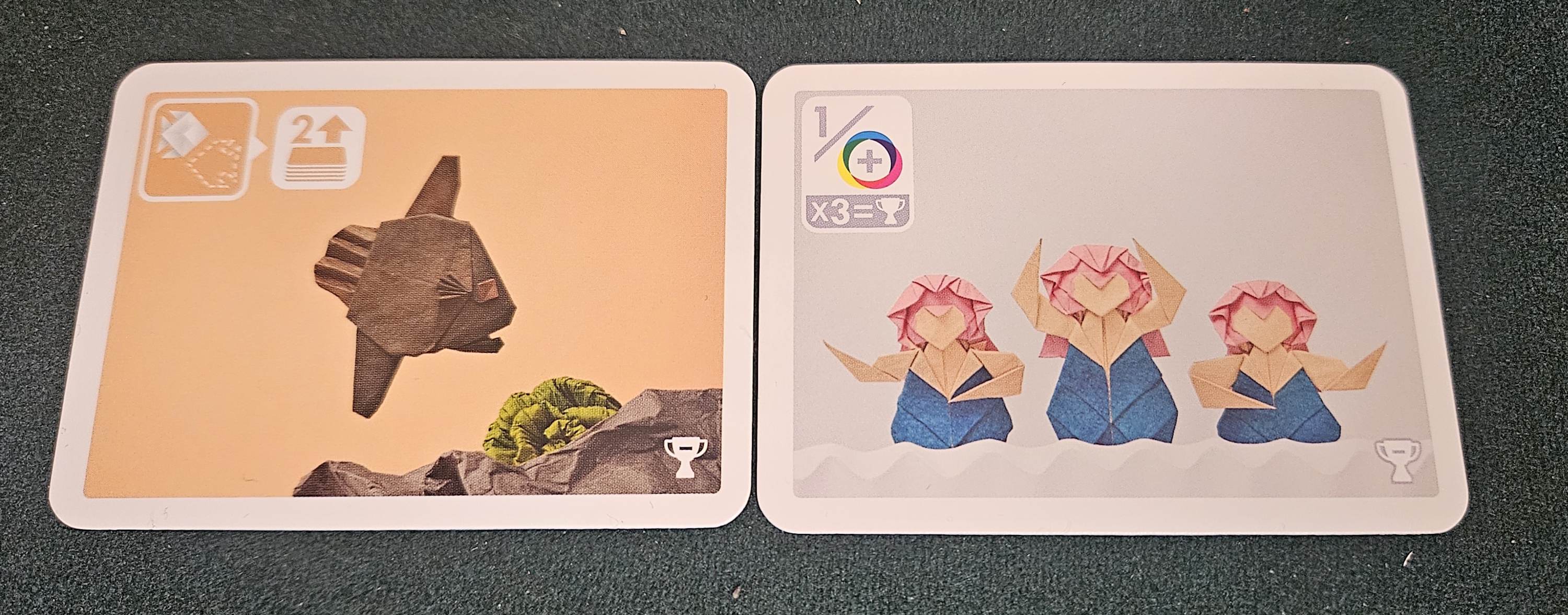
Next is Extra Pepper, the more interesting offering. Every round, an event card is drawn that alters the proceedings. A change to how a certain set is formed, a higher scoring threshold, only needing three mermaids to win outright rather than the usual four… that sort of thing. Everybody plays according to this altered rule, but then — and this is the smart bit — then the winning or losing player receives the event card as a permanent addition to their repertoire. This varies by card, with handicaps going to trailing players and hurdles to winners. Either way, the game receives a nudge that corrects toward the median ever so slightly. Or, better yet, allows somebody to manipulate the rules in their favor by tanking an early session to nab something ultra-potent.

In both cases, the expansions benefit the core game by adding a little more to the turn-by-turn proceedings. If I had to identify an issue with the game — which, again, I’m not sure this is the sort of game that bears a deep critique — it’s that the decision-making process is so muffled. There’s a gap between good and bad play, but good and great play? Eh. I’m not convinced. To their credit, the expansions offer a few more of those small decisions that make it such a pleasant, if still sleepy, game for late nights.

Assignment: Wee Aquinas origami.

Extra Pepper is more interesting.

On the whole, Sea Salt & Paper is a game that’s nice to play with family, as a filler, or when everybody’s too tired for anything heavier. That’s a crowded field, but, well, this just so happens to be one of the games that’s succeeded in that arena. Call it the king of the sleepers. I doubt Sea Salt & Paper would even take it as an insult.


A complimentary copy of Sea Salt & Paper was provided by the publisher.

(If what I’m doing at Space-Biff! is valuable to you in some way, please consider dropping by my Patreon campaign or Ko-fi. Right now, supporters can read my first-quarter update of 2026: the best board games, movies, books, and more!)
❌