Normale Ansicht

The Old King’s Annulment

03. März 2026 um 20:10

Want to dump your bride but don't want to ask the Pope? Annulet!

No need to bury the lede: as of this morning, The Old King’s Crown is now in funding for its second printing. If you haven’t read my review, the short version is that Pablo Clark’s debut design was a stunning achievement on every level.

Except, ambush!, there’s a second game afoot, and that’s the real target of my interest today. Included as an option for the crowdfunding campaign, Annulet is a card game that ostensibly exists within the broken realm of The Old King’s Crown. What is an annulet, you might ask? Short of being a legal way to divorce one’s spouse without God getting frumpy about it, an annulet is a little ring one might stick on a coat of arms or a pinkie toe. Exactly the sort of paraphernalia you might expect from the well-garbed folk of Clark’s faraway kingdom.

But is Annulet the sort of card game those selfsame weary warmongers would actually splay atop a knife-scored tavern slab? That’s the pressing question.
My kingdom is full of ghost animals.

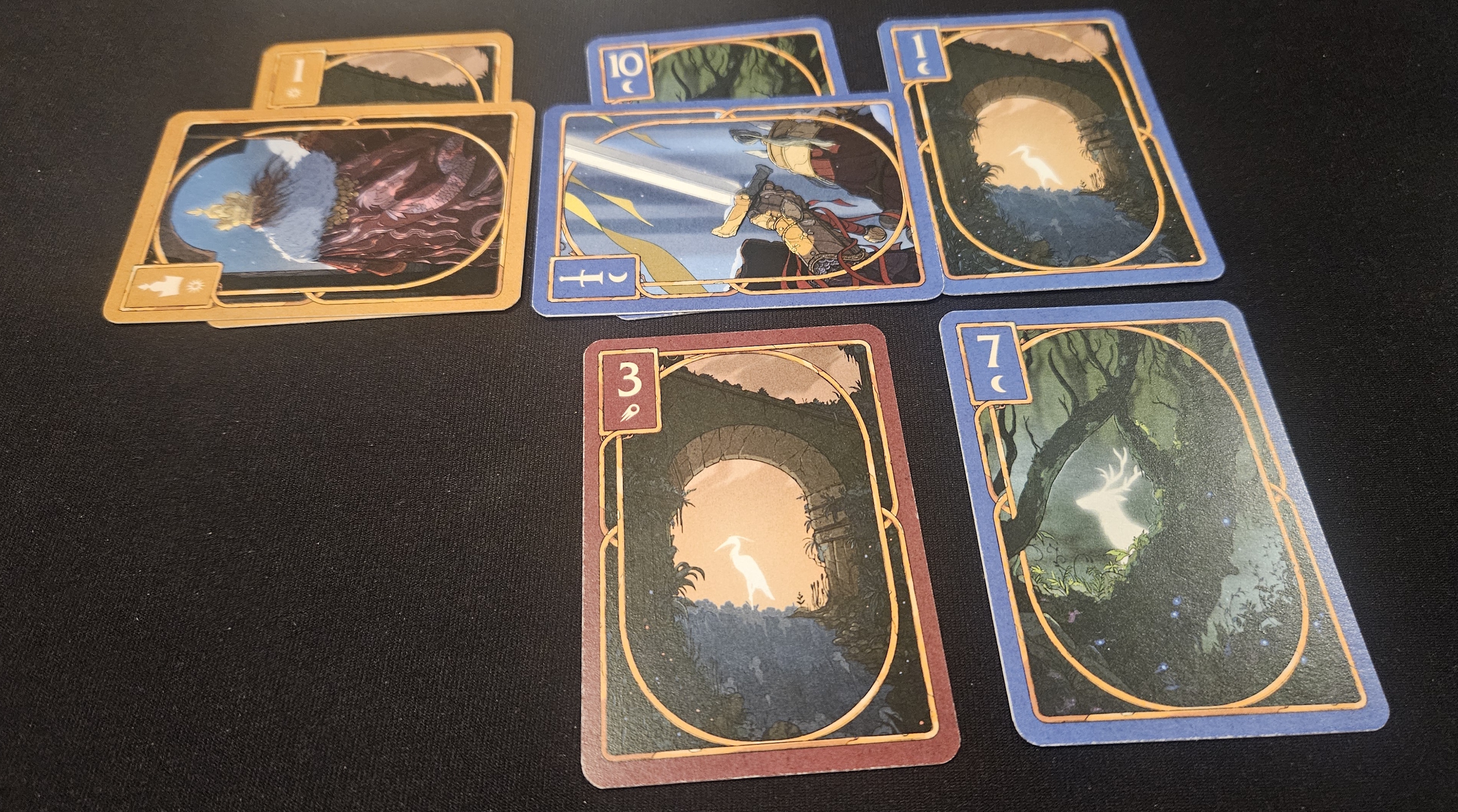
Cards are arranged on a three-by-three grid; score whenever you like!

At a glance, Annulet, like everything else in the world of The Old King’s Crown, is downright gorgeous. Also illustrated by Pablo Clark, even the prototype calls to mind a plate from a favorite childhood book of myths and tall tales, all enigmatic figures and crumbling aqueducts and mossy forests. Sure, it takes all of ten seconds to realize the game must have been designed with a regular deck of playing cards, given its four suits and face cards. So what? I can buy the notion that everything in Clark’s universe is just like ours but better illustrated.

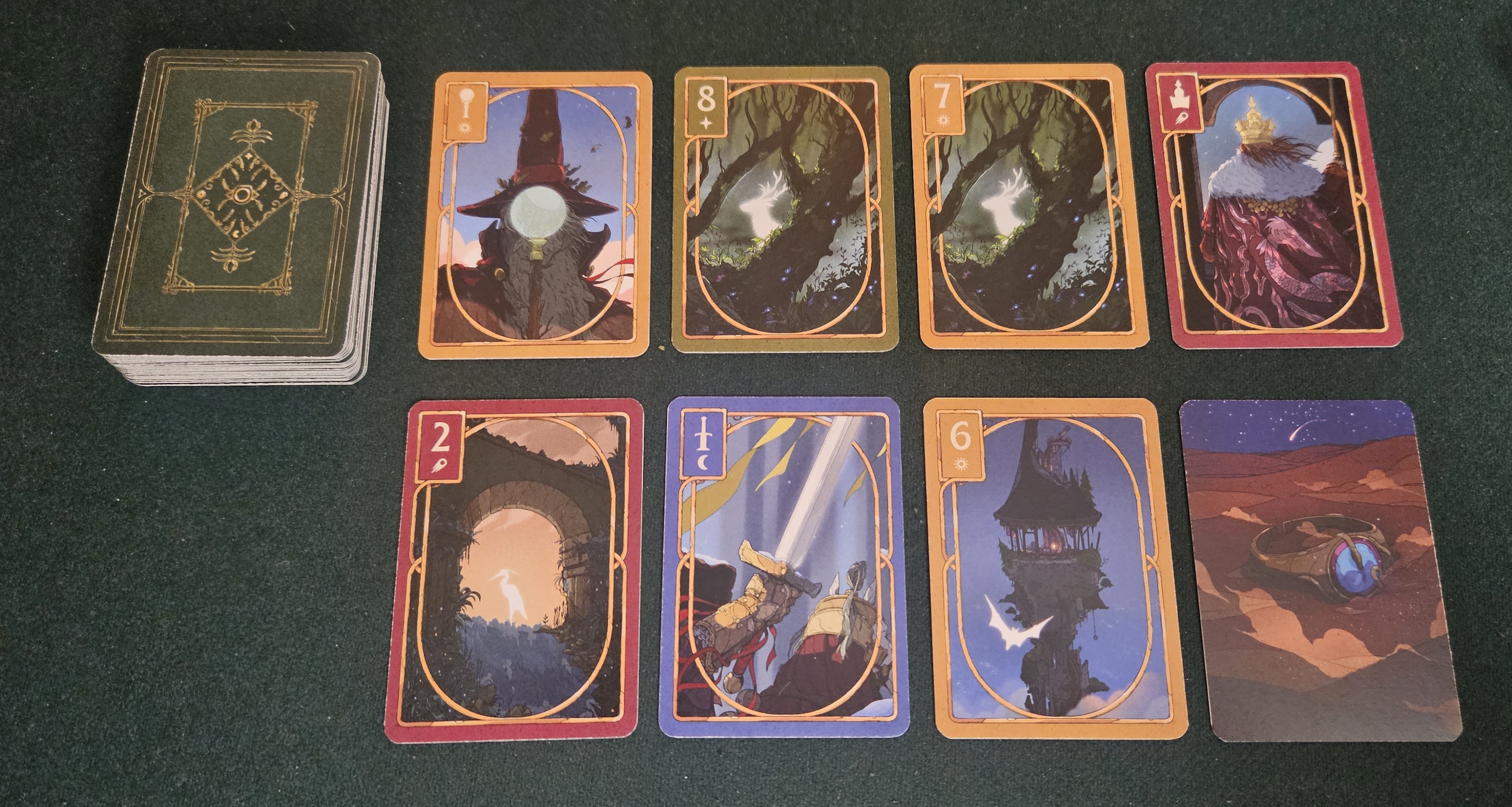
To Clark’s credit, Annulet doesn’t play quite like anything else out there. At core it’s a market selection game. Every round begins with a few cards on offer, from which the players will draft some number into their supply.

How many cards? That’s surprisingly hard to answer thanks to the way Annulet morphs according to player count. While the rules don’t undergo any substantive changes when swapping from two players to three or four, its underlying ethos is so transformed that it becomes something fundamentally different. We’ll circle back around to this question. For now, the answer is “two cards with two players, but only one with three or four players.”

All right. So you take either one or two cards. These are added to your supply. From there, cards can be installed in your kingdom, which swiftly shapes into a three-by-three grid of lands and characters. In the short-term, cards in your kingdom are secure. Unlike those still in your supply, they cannot be stolen by upstart rivals. Thinking ahead a bit, your kingdom is also the basis of your scoring. At some future moment of your choosing, every row, column, and diagonal may form points-earning sets. The rarer the better.
Secret Insider Info: originally the game was called Signet. I'm not sure if I'm allowed to say more than that.

The market shows which cards are available now and later.

As befits Annulet’s heritage, it manages to feel simultaneously old and new. Old because it doesn’t stray far from any number of card-gathering and set-forming games of yore. There’s a comforting familiarity to its percentages, that instinctual understanding that a straight flush is rarer and therefore deserves more coins than three-of-a-kind. Unlike The Old King’s Crown, which was sometimes burdened by keywords and concepts and special abilities, Annulet holds its cards closer to our shared cultural vest.

But it feels new, too, thanks to more modern flourishes that make its cardplay more dynamic and open-ended than most tavern games. There’s the game’s currency, river stones that must be spent and even exchanged between players in order to install additional cards into one’s kingdom or swipe juicy offerings from a rival’s supply. There’s the way face cards are arranged atop lands to alter their values. In the case of magicians and knights, this means adjusting their host land’s suit or rank. Monarchs are even more potent, increasing the scoring value of any set they’re part of, and all the better if you can score them in multiple directions at once. At absolute best, a single monarch in the middlemost space of a kingdom can score four times. That’s rare, but it’s hardly impossible.

Crucially, these flourishes tell something of a story, or at least they gesture at the outlines of Clark’s fantasy world. Just as different trick-takers might speak to the sensibilities of those who played them historically, whether as domestic parlor games or the pastimes of naval officers padding their peacetime income, Annulet speaks to a kingdom that’s always reshaping itself. Monarchs come and go. Treasures are gathered and plundered. Violence is so matter-of-course that the apex of a kingdom is also its dissolution.

The smartest of Clark’s inclusions are the tale cards. Each session opens with players selecting a pair, whether by choice or at random. At a gameplay level, these are modifiers. Textually, they’re regional variations. One session might feature “the People’s Game,” scoring extra points for sets that sum to a small number, while the next revolves around “Border Reaving” that adds junk cards to opposing kingdoms. The effect isn’t dissimilar from the many small variations in trick-taking or shedding games, leaving the core rules intact but tweaking the game’s breadth. The result is a title that feels as large as the world Clark penned to contain it.
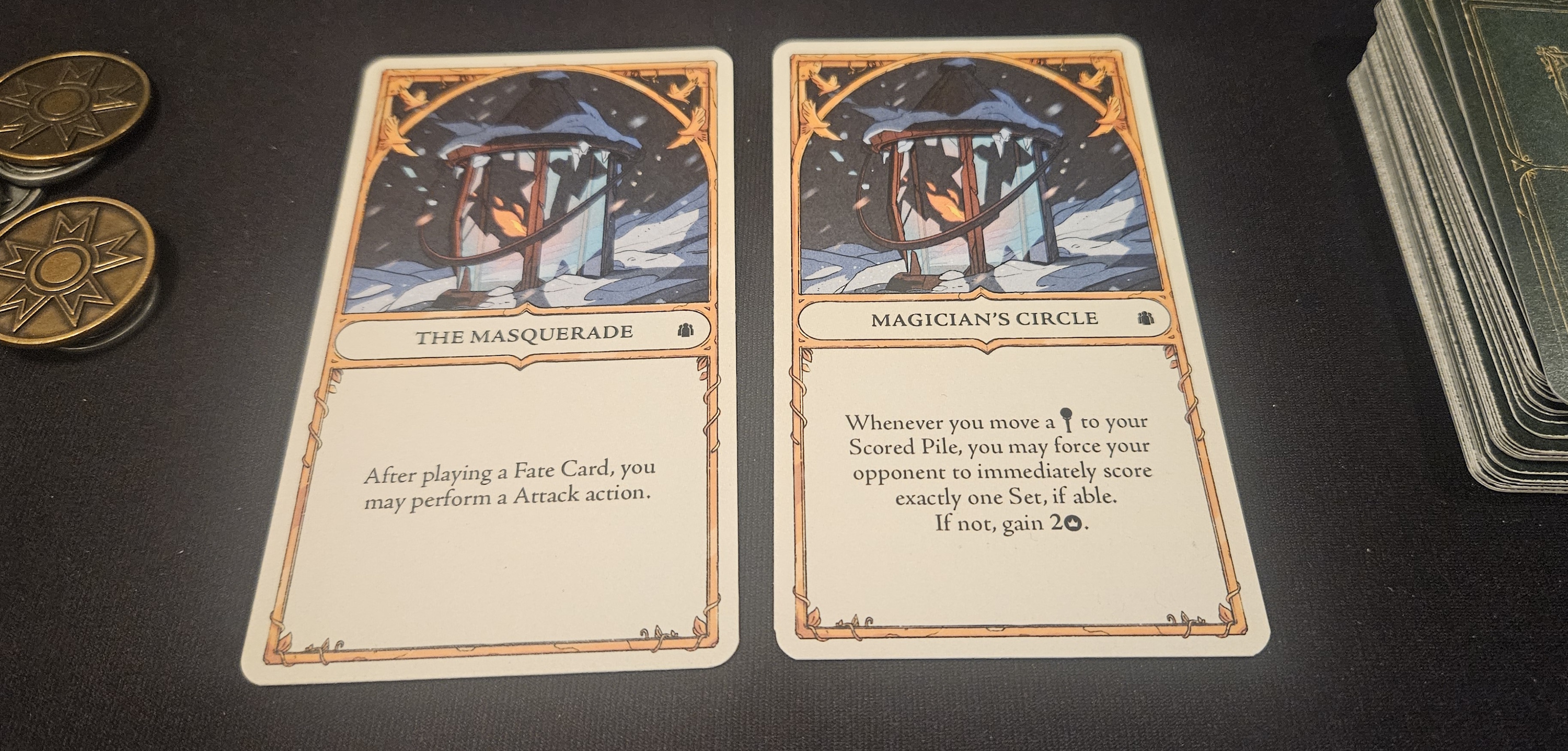
Will these all have original illustrations? That depends on how badly Pablo Clark wants to ruin his next few months.

Regional variations keep each session fresh.

This isn’t to say that Annulet escapes wholly unscathed, either as a plaything or within its internal fiction, and those scathings are largely interrelated. The short version is that the game is simply too permissive — in one sense, too modern — to pass muster as something that might appear in a military camp or dimly lit roadhouse.

First of all, the scoring is tremendously intrusive, often requiring an extended pause to sum up every one of a kingdom’s angles. On its own, this isn’t such a bad thing; we share a reality with Germans who play Schafkopf, so it isn’t as though real-world tavern games haven’t ever belabored their scoring to the point of madness. But where Annulet slips is through the inclusion of special cards called fates. Everybody begins with a few of these and can purchase more for a heap of river stones. From there, fates pull multiple duty. They potentially add to one’s score at the conclusion of the game, and can be spent to place trash into a rival’s kingdom, seize the all-important initiative marker for yourself, or enter your own kingdom as a wildcard.

It’s this latter function that gives Annulet its bagginess. A fate can function as anything: any card, whether land or nobility. But in scoring, it must adopt a single posture — not always the easiest thing to visualize when there are a full eight sets that might be assessed at any given moment — and the problem only compounds in kingdoms with multiple fate cards fulfilling many roles. Too often, Annulet hinges more on how permissively one employs their fates than how sharply they draft their kingdom.

This is a small complaint, but it’s small the way a pebble is small when caught inside one’s shoe. Annulet is too broad, failing to quite capture the sensation of playing and mastering a truly great tavern game, one defined as much by chance and limitation as by the range of things a player might accomplish on their turn. It’s like playing a trick-taker with a bunch of wilds; thrilling the first time you steal a trick, obnoxious when everybody’s doing it all the time.

Perhaps more pronounced, the game is a different beast depending on player count. It will probably surprise nobody to hear that it’s strongest at two players, which affords greater numbers of drafted cards and a tighter focus all around. Higher counts clutter the decision space a bit, especially where initiative and drafting are concerned, but three-player is charming in its own way. Annulet is at its strongest when it presents that razor-wire choice of which cards to draft and how to use them. With each additional player, that sharpness is blunted.
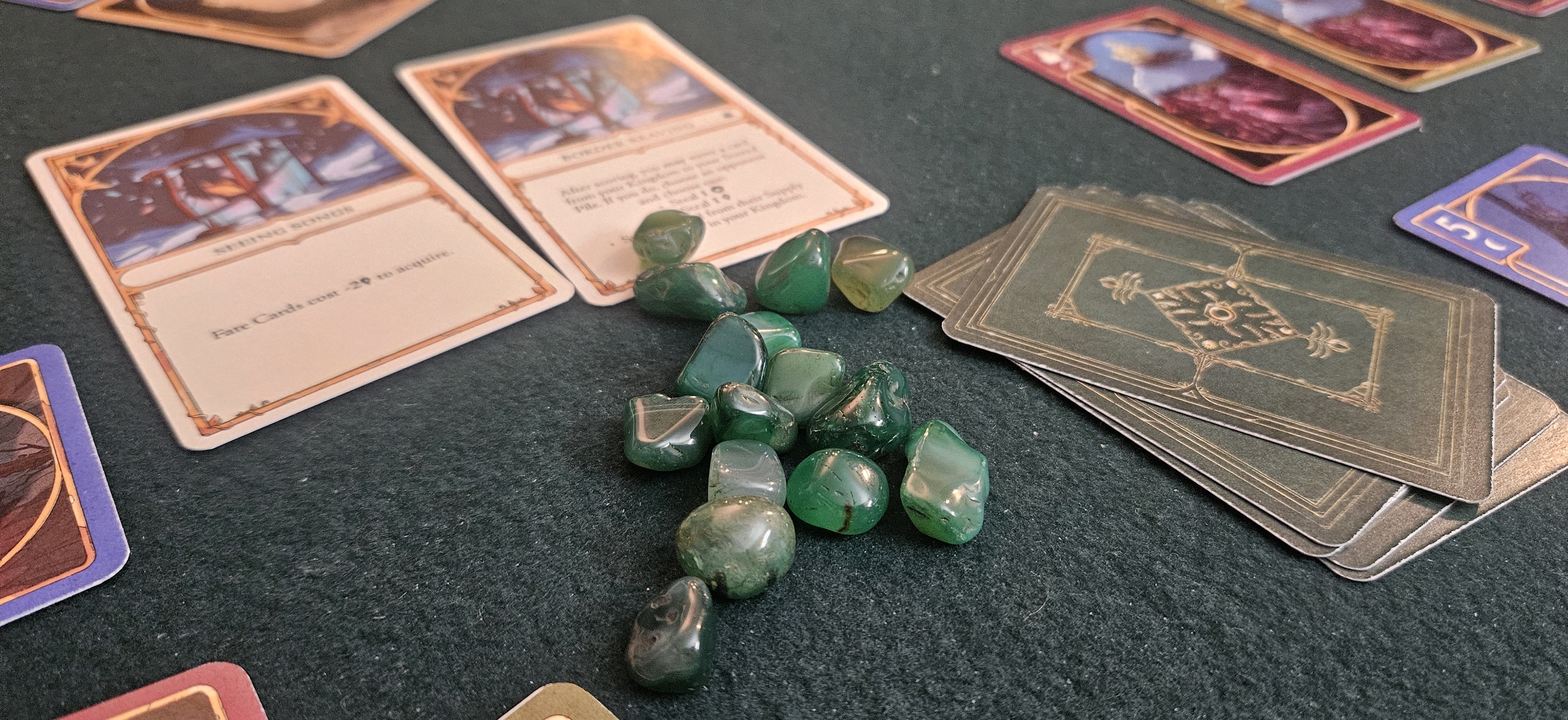
I once owned a very nice river stone. True story.

I’m a sucker for river stones. (Disclaimer: not real river stones.)

Apart from that, however, Annulet is quite the production. Even at its flimsiest, it’s lively and exciting. More importantly, as a diegetic artifact it speaks to the breadth of this place Pablo Clark has envisioned, something Baron Cuttlefish might splay atop the camp-table on the eve of crushing the Speakers of the Wood. With one finger he traces the rim of his goblet, heedless that the Vial Sect has already dusted the brass with their bitterest toxin. By the time the Ornithopter Club swoops down from the hills, his pulse will have already stilled.

Ahem. Look, it’s good stuff, even when it doesn’t hang together quite as tightly as I had hoped. For a follow-up to what was perhaps last year’s most exciting debut title, that’s no small thing. The result is an imperfect game, but a lovely and evocative experience nevertheless.


A prototype copy of Annulet was provided by the publisher.

(If what I’m doing at Space-Biff! is valuable to you in some way, please consider dropping by my Patreon campaign or Ko-fi. Right now, supporters can read about which films I watched in 2025, including some brief thoughts on each. That’s 44 movies! That’s a lot, unless you see, like, 45 or more movies in a year!)


Re;MATCH One, Two, or Four

03. März 2026 um 00:50

I like to play games where every character is ten times cooler than me. Scratch that — fifty times cooler.

It hasn’t been all that long since we took a look at Re;ACT: The Arts of War, an intriguing but imperfect game about various artists manifesting their crafts into the physical world in order to determine which medium is the most artsy of them all. It’s like Bloodsport but with calligraphy versus spray paint versus film stock.

MingYang Lu’s forthcoming followup, Re;MATCH, isn’t exactly a sequel, although its peculiar capitalization and errant semicolon might lend one that impression. Instead, it’s something even better: a match-three game in which one must never, ever match three.

Okay, it isn’t only that, although I’ll confess I find that part amusing.

Match three? Straight to jail.

Match some number of balls, so long as you don’t match three.

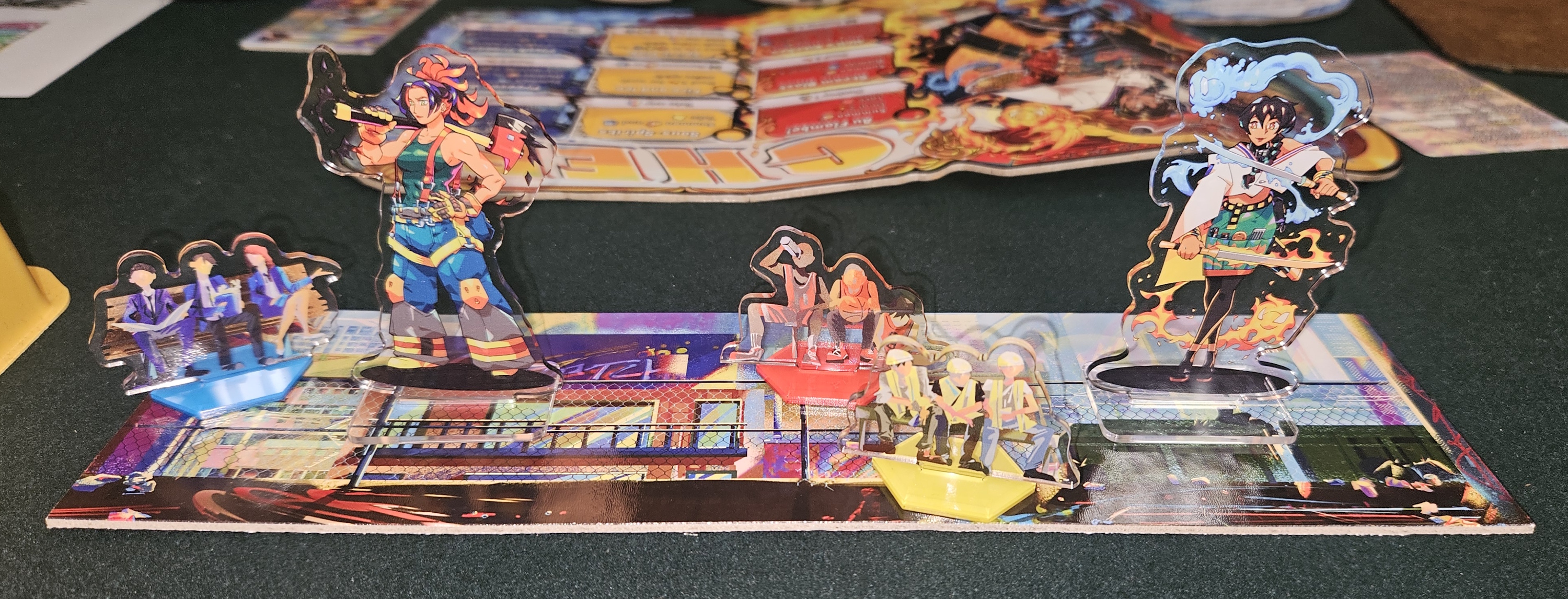
Like Re;ACT before it, Re;MATCH begins with a settling of accounts between two careers, although this time the jobs are even more disparate. That’s right, no more squabbles between artists. Instead, one match might see an axe-wielding firefighter squaring off against a disc jockey. Perhaps that seems one-sided, but no, this is a competition of the minds.

Still seems one-sided? Okay, let’s leave the minds in the drawer. How about a battle of marbles?

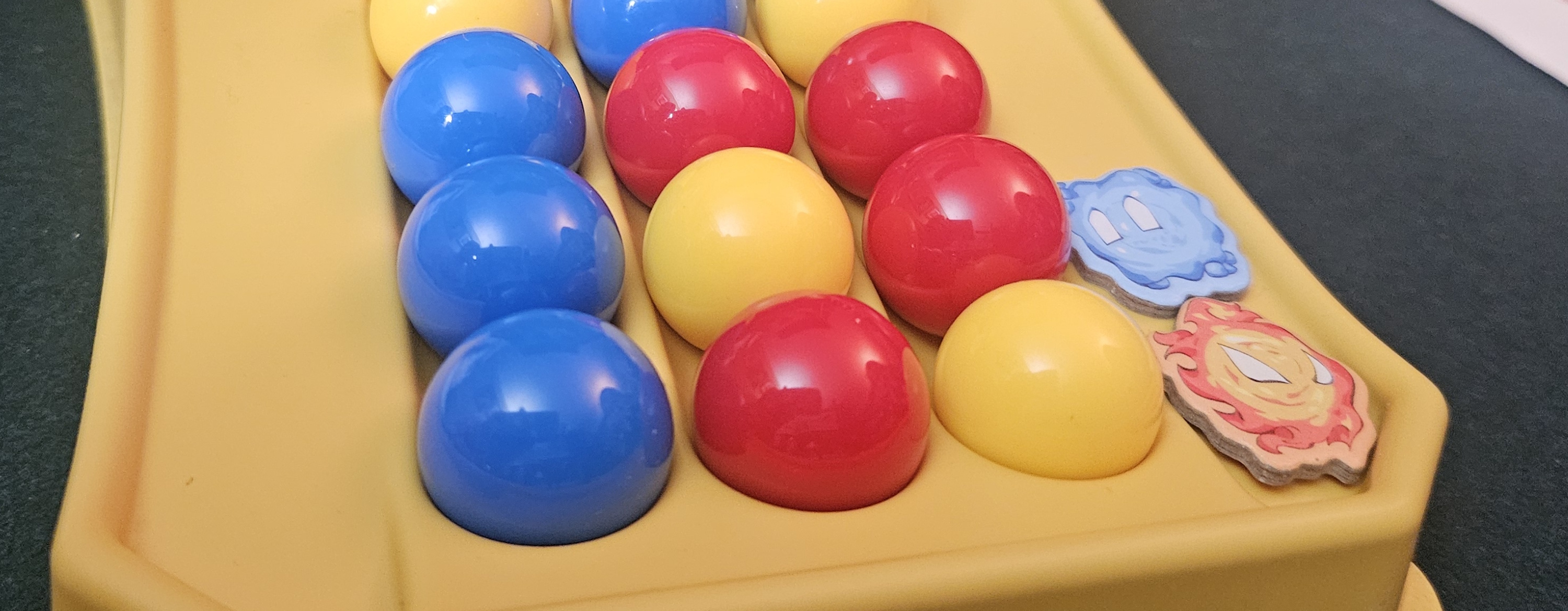
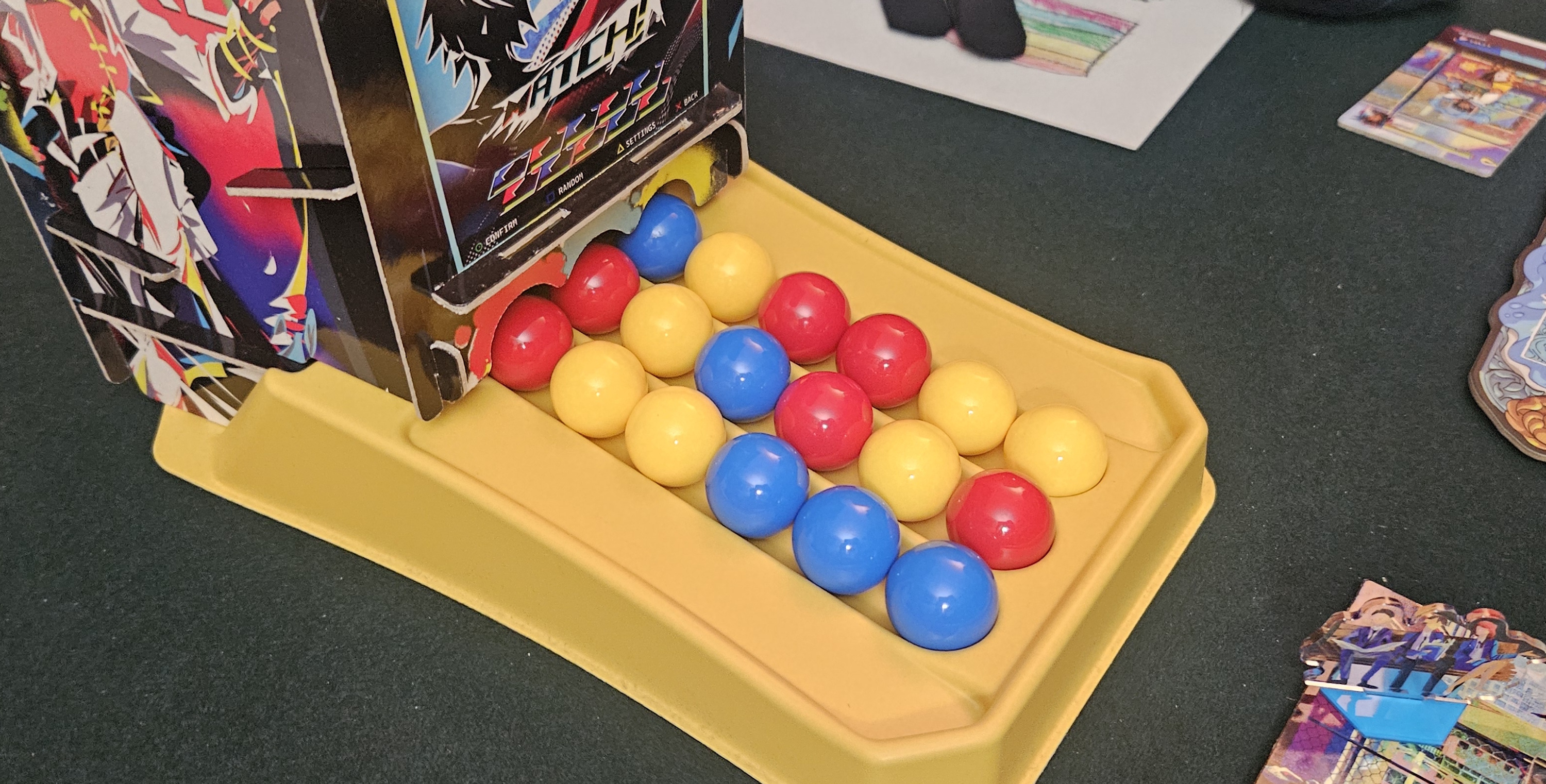
The big visual draw is the marble tower. The closest touchstone is the box from Potion Explosion, which, if you’re in the mood to suddenly feel old, came out a lengthy eleven years ago. The marble tower in Re;MATCH is even simpler than that game’s, producing three lanes of balls in three colors. It’s marble-matching so simple a baby could do it, right before trying to eat the marbles.

But the matching is simple for a reason. For one thing, you aren’t permitted to use all three of those lanes. Instead, you’re always limited to two: the one closest to you and the shared middle lane. The decision space is compressed, but in such a way that even a fourth color would cause no shortage of problems.

And then, of course, there are the fighters.

Nobody ever does, like, optometrist versus baggy college professor. But that's basically my marriage.

Whose career is better in a fight? Go!

The gist behind Re;MATCH is that every fighter comes with their own arcade cabinet, complete with a standee — whose function, it must be said, is principally aesthetic — a few special tokens, and a fold-out broad displaying a unique set of moves.

Those moves are the important part. By making color-coded matches in the marble tower, your fighter triggers various effects. Each color permits three levels, one that triggers when you utilize a single ball, another for two balls, and a third that skips over three balls to instead trigger when you manage to string together four marbles at a time. It’s simple, but not as much as it initially seems. Sometimes you’ll want to forego a powerful move for the sake of setting up an even more potent combo later — or because you desperately need to block a move coming down your rival’s lanes. It feels surprisingly close to the fighting cabinets it strives to evoke visually, despite the turn-based limitations of its medium.

Now comes the tricky part, because I can’t give examples without delving into the fighters themselves. This will come as no surprise to anybody who played or even glanced at Re;ACT. In that game, the duelists were so different that they often used entirely distinct mechanisms. Bag-building versus card management, for example. The contestants in Re;MATCH boast a more robust shared foundation, in that nobody leaps away from the marble tower to shuffle a private deck or anything like that. But the breadth of their personal expression is still quite the thing to behold.

Maybe I can limit myself to only one or two examples.

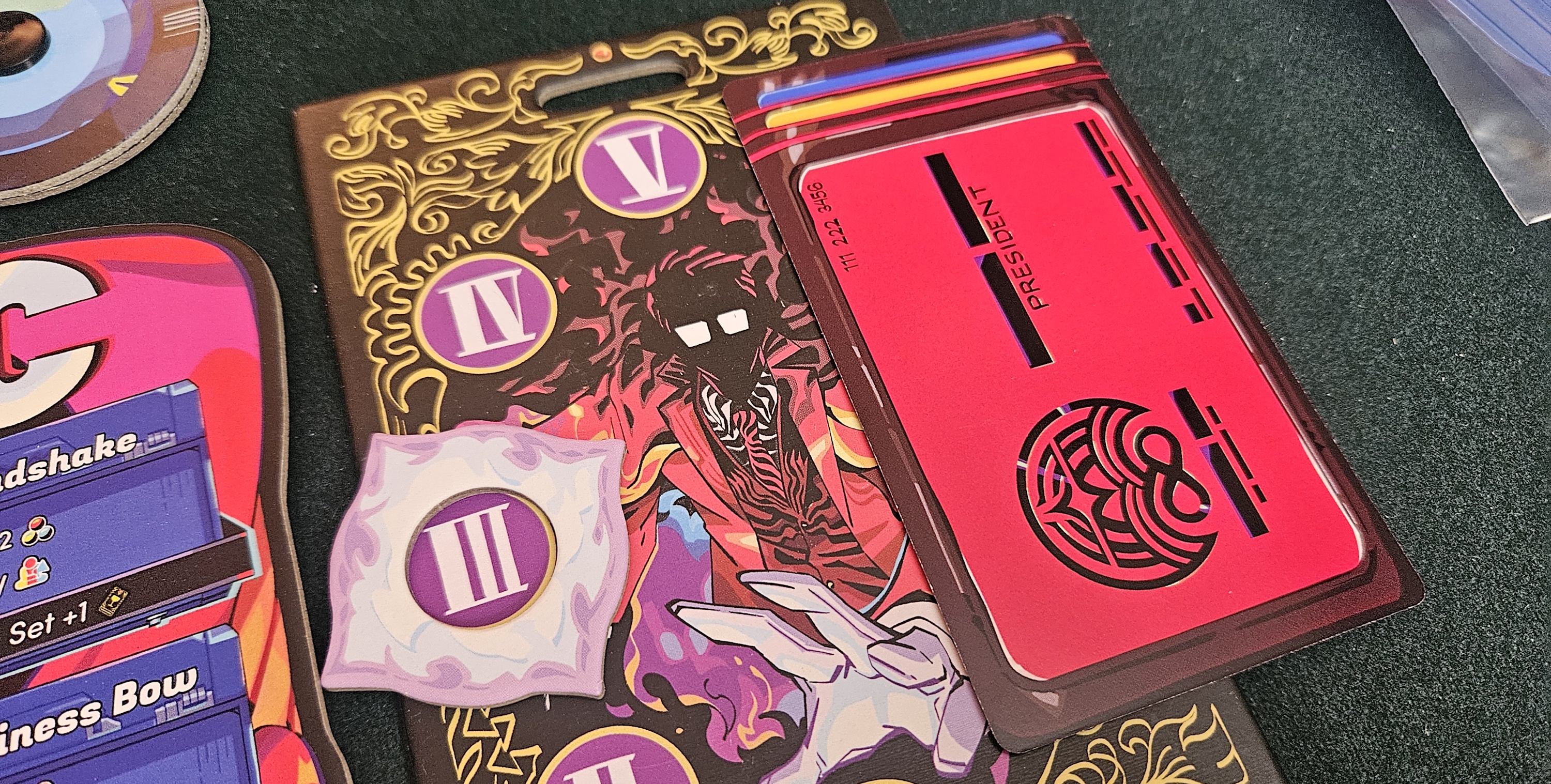
I wish I could wear spooky glowing glasses.

Predicting my opponent’s moves.

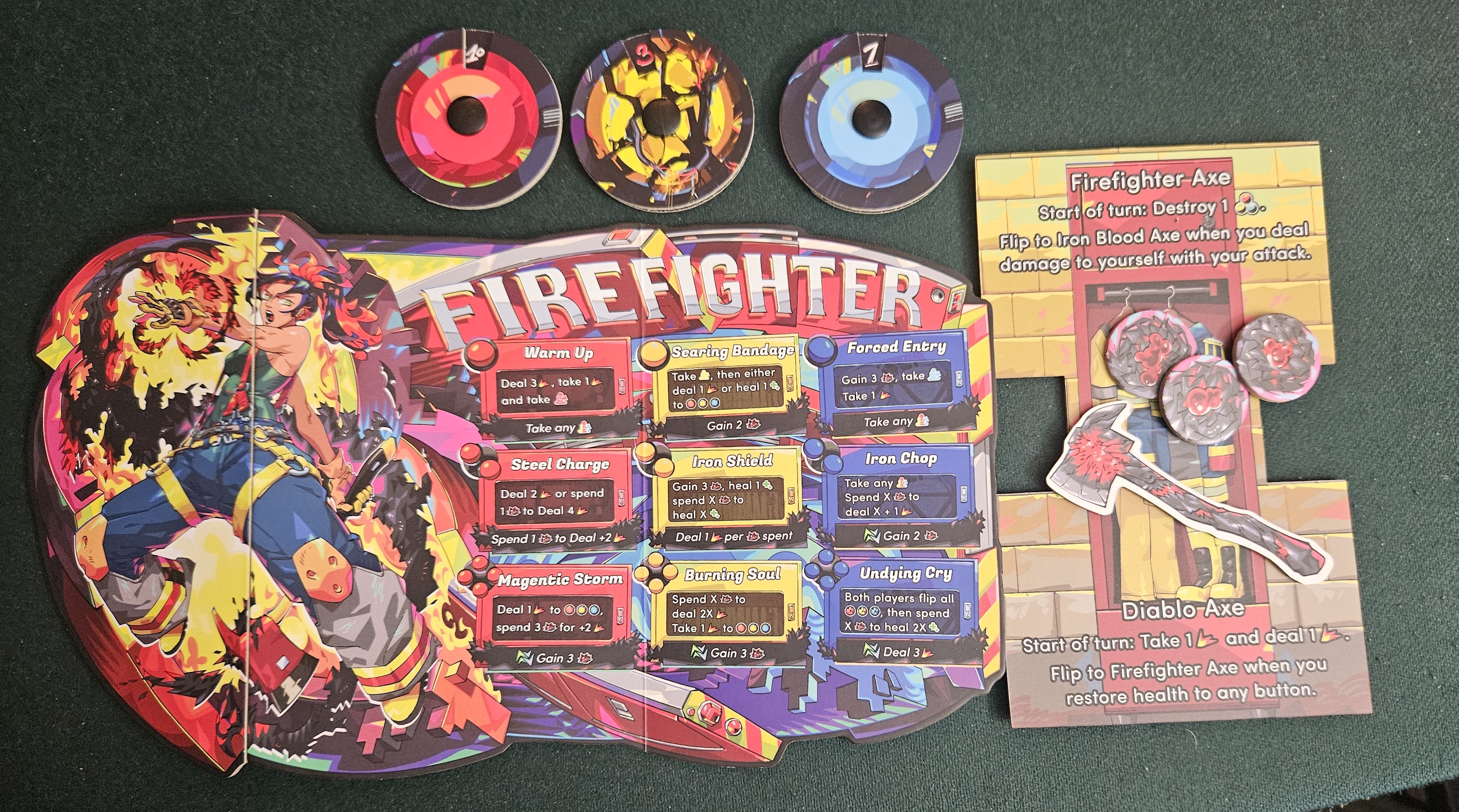
I wasn’t joking when I said there was a firefighter. That might sound silly. That’s because it is silly. But at the same time, this is a firefighter with a possessed axe that makes her take deadly risks, which pushes the character from silly to excellent. At various points, the firefighter’s moves might cause self-damage. This flips the axe to its other side, gains an “ironblood” token that can be spent to empower her moves, and changes how the firefighter operates in battle. Basically, she shifts between damage mode and defense mode, healing her injuries and destroying any combo-making balls in the marble tower before her opponent can pounce on them.

And this is reflected in those color-coded movesets. For instance, her red moves are all about dealing damage. One red marble deals three damage to her opponent and one to herself. Two marbles means she deals two damage, or else spends one of those ironblood tokens to deal twice as much. Four marbles deals only one damage, but does so to every color.

Did I mention that health is color-coded? It is. Both fighters have three health dials, one per color. Bottoming out a dial will “break” it, forcing its owner to spend a coin to stay in the game. This alters how the whole thing is played. Now the injured player can’t make matches with that color. Instead, it changes function for a bit. Instead of building matches, the broken color operates as a connector, letting its player trace through those busted marbles to connect other ones. This has the benefit of gradually ticking the broken dial upward, eventually restoring it to its healthy side.

In other words, as your moveset becomes more limited from suffering damage, your remaining colors grow even more formidable. At the same time, though, you’ll want to restore your broken dial as soon as possible, lest a second dial succumb. When that happens, it takes two coins to stay in the game. That’s bad. Coins are your “real” currency, you see. Lose all of them and it’s game over.

me: I don't think this is how firefighters— game: SHUT UP AND PUUUUUNCH

A closer look at the firefighter.

Okay, so the firefighter is all about tempo, switching between blasting both players and nursing her wounds. Let’s contrast that with another contestant, the D.J.

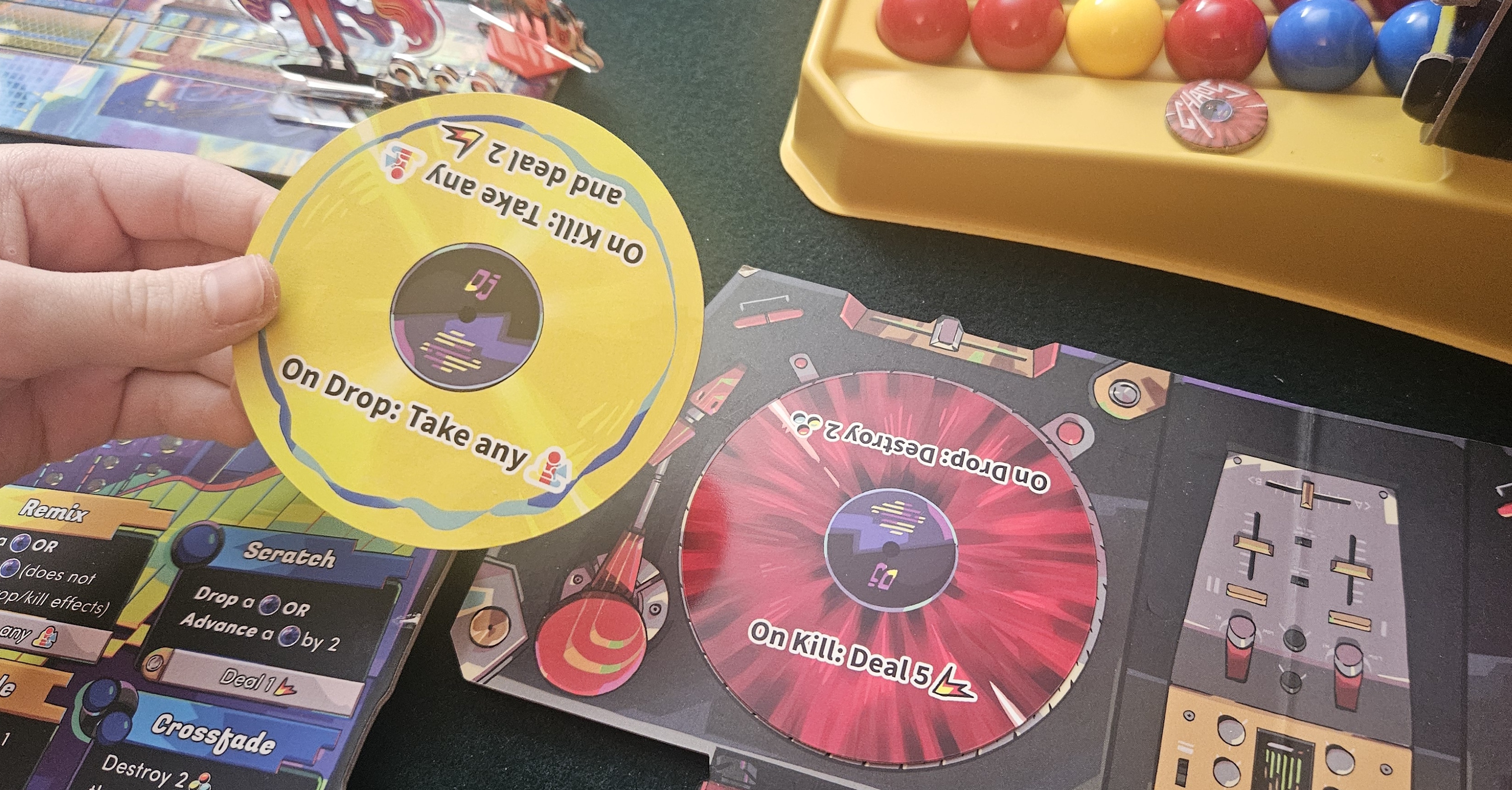
The D.J. loves to make noise. Her kit comes with a turntable and a selection of discs. Every so often, she’s allowed to drop a beat, physically taking one of those discs and placing it on the turntable. This might attract fans — a shared currency both players are grappling to control, and which increase the potency of every move in the game — or deal damage, or whatever. This also places a beat token on the marble tower. Row by row, the beat will advance. When it finally ends, another power triggers.

Naturally, the D.J.’s moveset includes normal stuff. She wins over fans. She deals damage. The usual. But her real abilities revolve around dropping, advancing, and killing beats. Her entire setup is one cacophonous wall of sound. Like the firefighter, she’s all about tempo. But the way those tempos function couldn’t be more different. The firefighter is all about managing two very different modes. The D.J. is the board game equivalent of a Shepard Tone, always ascending, always building momentum.

The other fighters tweak the formula in their own ways. Some, like the dancer and the chef, lay little traps on the marble tower, penalizing anyone who selects balls on the booby-trapped row. Others, such as the psychic and the trickster, are all about predicting and preempting their opponent’s moves. Like the firefighter and D.J., they share some similarities, but there’s an initial sense of discovery to seeing how they function, followed by the joy of figuring out how to leverage their strengths against an opponent with tricks and traps of their own.

I believe this turntable is incorrectly oriented, but neither I nor my 12yo actually know that much about turntables.

The D.J. battles via a turntable.

The effect isn’t all that dissimilar to something designed by Brad Talton, like some lighter marble-drop version of BattleCON or Exceed. Or, sure, Re;ACT, although Lu is in stronger form this time around. Unlike that earlier effort, which was full of sticky rules and questionable matchups, the fighters in Re;MATCH are sharply crafted — and I say this despite playing a prototype, with all the small tweaks and imbalances that always entails. Even so, my twelve-year-old was more than capable of figuring out the fighters’ intricacies. At the same time, they weren’t so breezy that she didn’t have to wrestle to overcome their various deficiencies, learning to mitigate a fighter’s shortage of healing or accurately predict my moves.

Are there depths here to plumb beyond the learning phase? I think so, although it’s hard to say after only a half-dozen matches with an in-progress prototype. I will say that I’m excited about the possibilities. Where Re;ACT was interesting to discover but also something of a chore, Re;MATCH doubles down on its strengths. Its systems are simpler, more tactile, and easier to master, but still reward clever combo-building. In the process, the randomization of the marble tower prevents it from feeling quite as process-bound as its predecessor. While some of the fighters still sport ambitious attacks, the game feels less like a race to trigger their two apparent combos.

Or maybe I just really enjoy fiddling with those balls. The game’s kineticism is admirable. Claiming marbles, studying your future options and those of your opponent, even jostling the prototype tower when the balls got caught within, everything about the production felt hefty and enjoyable. The game is pleasant in a way that Re;ACT only attempted.

And how one fondles them.

It’s about the balls.

But enough with the comparisons. Re;MATCH is one of those titles I’m excited to keep exploring. It’s colorful and diverse in its gameplay, fast-paced and hard-hitting, and above all, a pleasure to discover.

As a bonus, it made my kiddo go “wokka wokka.” I had no idea she’d ever seen a turntable. The more you know.

Re;MATCH launches on Kickstarter tomorrow.


A prototype copy of Re;MATCH was temporarily provided by the publisher.

(If what I’m doing at Space-Biff! is valuable to you in some way, please consider dropping by my Patreon campaign or Ko-fi. Right now, supporters can read about which films I watched in 2025, including some brief thoughts on each. That’s 44 movies! That’s a lot, unless you see, like, 45 or more movies in a year!)
Flip-and-Curse-That-Stupid-Dragon

27. Februar 2026 um 06:40

The two-tone color scheme is striking, but it also leads to a few problems. My friend Adam, for instance, cannot tell the difference between the gold coins and the gold magic beans.

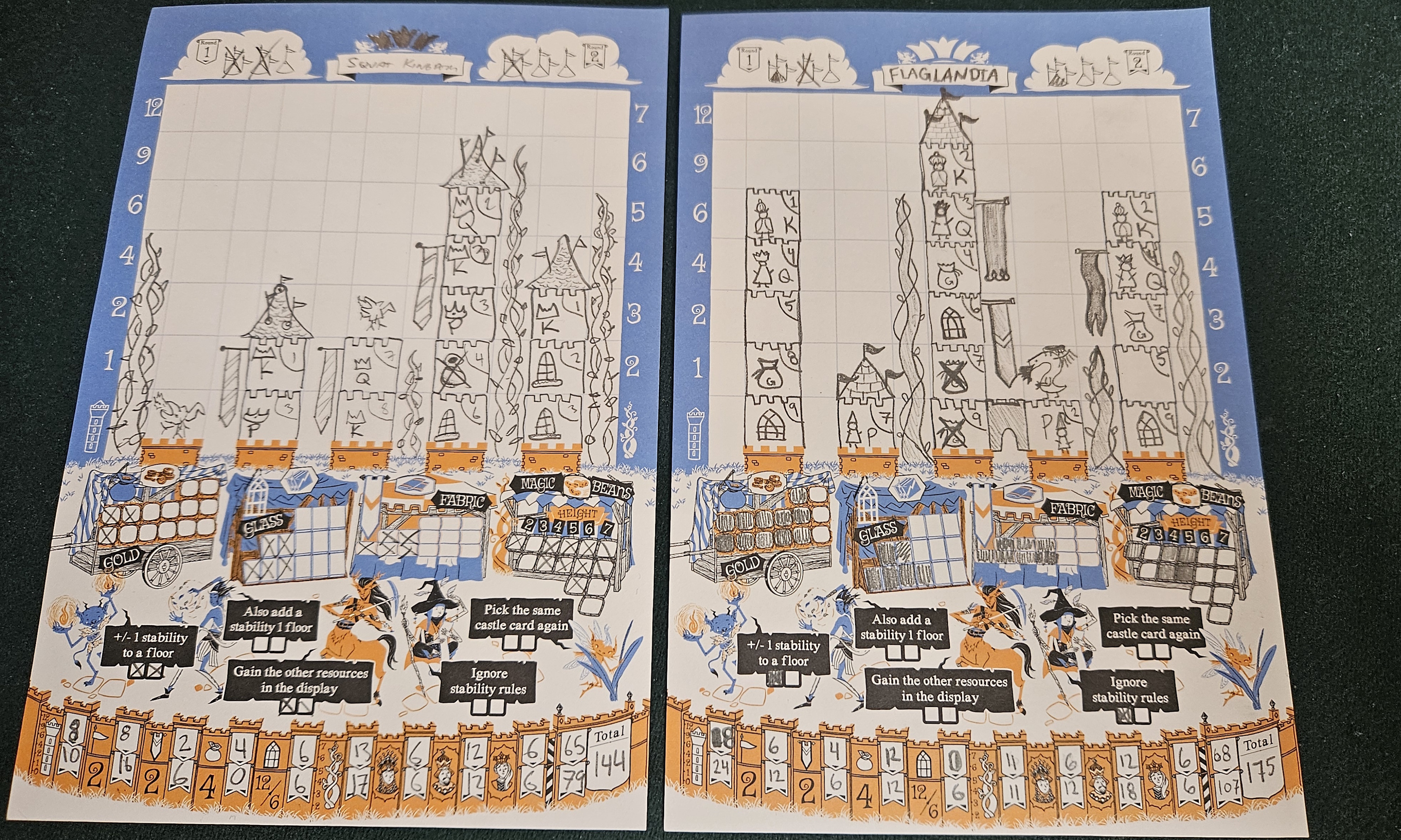
Remember when every other game was a roll-and-write? That was living proof that even golden ages come with cloudy linings. Flip Pick Towers, designed by Rob Fisher and Adam Porter, benefits from its release a few years after the slew of samey writing games. It’s an unrepentant flip-and-write, is what I’m saying, more in the vein of Cartographers than the form’s more mathy alternatives. Some artistic talent won’t go amiss.

For those of us who can’t even sketch a convincing stick figure, however, it’s still charming, albeit not perhaps as compelling as some of the options out there.

Nice ivies, dudes and dudettes!

Two very nice towers. (Not mine. Obviously.)

Stop me if you’ve heard this one before. Every round, three cards are flipped. Everybody at the table picks one — different ones, the same one, it doesn’t matter — and pens it onto their personal sheet of paper. Once the deck is out, it’s time to score.

There are a few little distinctions that set Flip Pick Towers apart from its peers, and no, I’m not talking about how the game’s title is a literal description of its phases. For one thing, the game cleverly triggers its scoring phase twice. This potentially pushes you through the deck twice, which is nice for those who are still learning its composition, but also encourages players to hustle toward scoring goals early rather than waiting for them to come together at the last moment. It helps, too, that it’s entirely possible for somebody’s failed castle to end the game a few rounds early. So much for that last tower you were hoping to stretch heavenward.

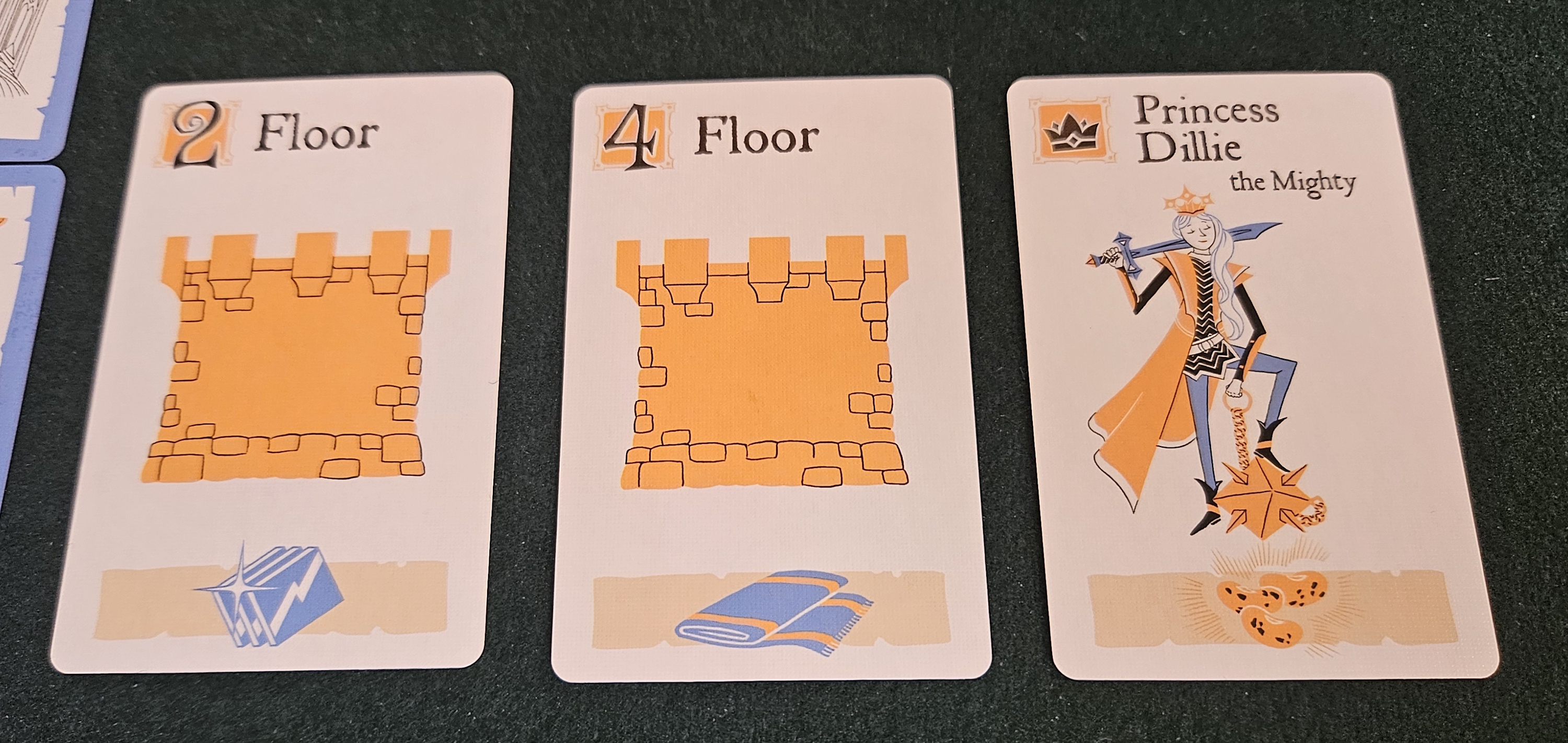
The constituent parts of your castle are simple enough. Most cards represent floors. These you stack like LEGO blocks, always keeping an eye on their stability number, which must tick downward with each successive level. Eventually bridges can span the gap between floors, providing foundations for further building and bypassing the usual stability rule for a moment. Look, it’s basic architecture. If you lean two crumbling minarets against one another, you can pile another few hundred tons of hewn blocks between them. Everybody knows that.

There are also magical creatures who provide special abilities — like, say, ignoring a floor’s stability, easily the most potent ability in the game — rooftops that can earn a few points but conclude a tower’s upward trajectory, and royalty who occupy all those empty rooms to score points. More on their majesties in a moment.

not shown: a good example of the game's diversity, but a great example of what most decisions actually look like

Every turn, you select from three cards.

Finally, every card also provides a material of one kind or another. The format for these is simple enough, adding new features to your castle whenever you complete a material’s column. Hence glass introduces windows to your castle, bags of gold eventually fill entire floors, and banners hang from on high while magic beanstalks creep up from below. In fine flip-and-write fashion, these soon jostle for space. There’s room for planning, but remaining inflexible is a surefire way to get nothing done at all.

The last type of card is a dragon. Argh, the dragon. There are two of these in the deck, meaning you might see four of the winged pests in a sitting, and they’re as unwelcome as it gets. Whenever one of the sky-rodents appears, you either place it atop one of your towers — blocking further construction, which can be a real nuisance if they appear in the game’s early stages — or scrawling out one of your hard-earned bags of gold to buy them off. Thankfully, they are not sexist dragons, and no sacrificial princesses are required.

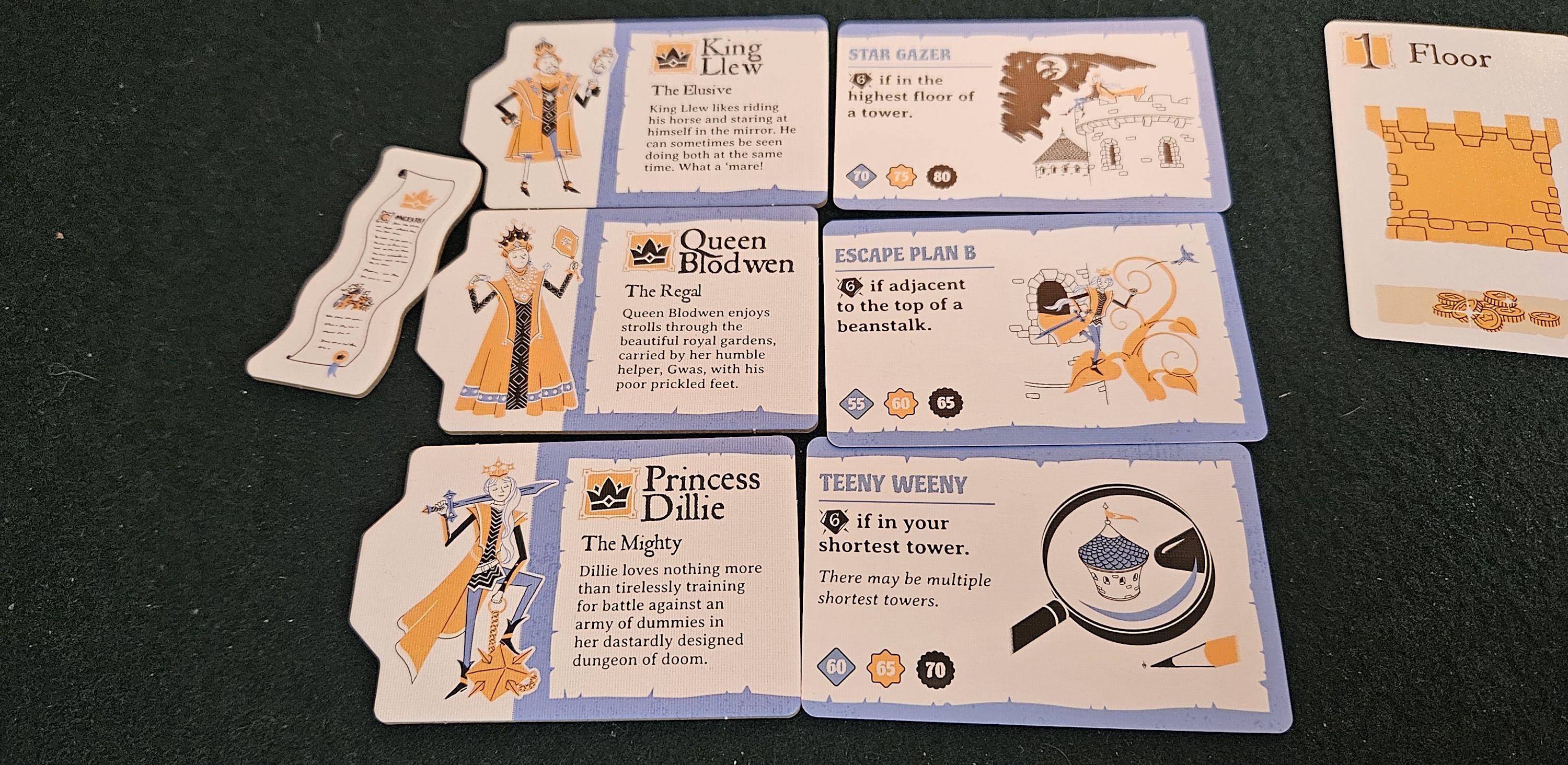
Speaking of princesses, the most interesting offering by far are the royalty cards. Each session assigns an objective to your queen, king, and princess. As their chambers are added to your towers, their points tend to compound. And compound. And compound. It isn’t uncommon for a single royal member to score as much in the endgame as a player earned at the midpoint tally.

King: "3 points per crushed orphan." Queen: "6 points for retracting privileges from the artisans." Princess: "8 points for telling them to eat cake."

The needs of your petty royalty.

In the best of instances, these transform the game’s sometimes obnoxious placements into significant opportunities. Remember those dragons? Well, if your king prefers occupying towers with dragons perched on them, now you can keep your gold and take care of the old man at the same time. All the better if you manage to erect a single tower with a single dragon atop it, then fill the place with four or five stacked kingly quarters. The same goes for the other elements. One session might feature a queen who yearns for escape, encouraging you to place those magical beanstalks next to her chambers rather than doing the normal thing by squirreling them off. Or, heck, a princess who just really likes living near bridges. Don’t we all appreciate a nice bridge?

Not every objective is similarly worthwhile. For every goal that enlivens the game’s placements, there’s another that’s plain uninteresting. After a couple plays, our group reached the point where we would keep drawing through the deck until we found something that felt sufficiently energetic.

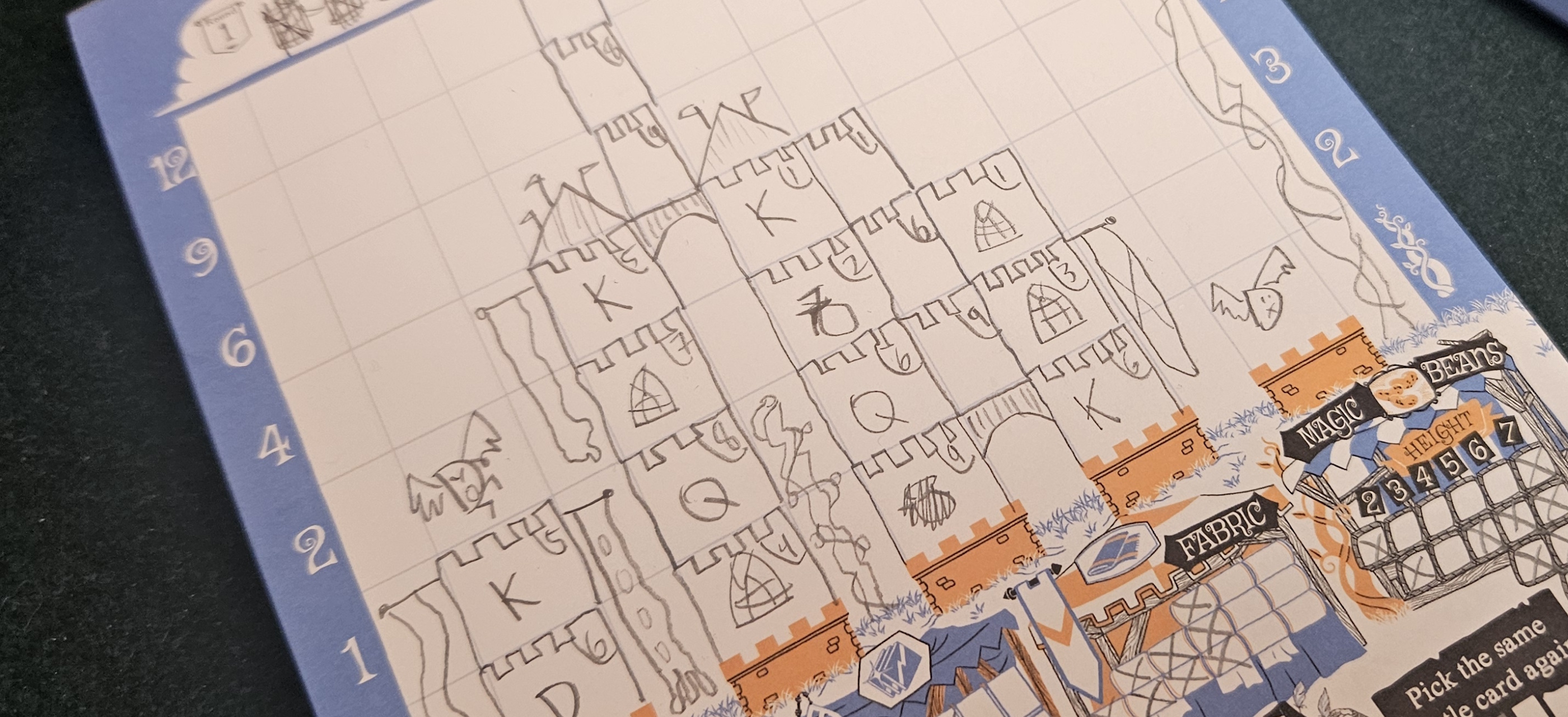
Even then, the overarching puzzle doesn’t change much from one session to the next. On the whole, there’s enough to keep everybody engaged, at least for a session or two. But the gameplay is simple enough that, barring the pleasure of scrawling a little castle, with little banners that look like banners and not whatever my castle’s banners look like, there probably isn’t much to keep anyone coming back time and time again.

It is, in other words, a flip-and-write. A very good flip-and-write, a charming flip-and-write, a flip-and-write with plenty of little considerations to account for. But it doesn’t stand up there with the finest of them.

Those are banners hanging from the side of my castle, not shed snake-skins and spent condoms.

Fine. Here’s my garbage tower.

Maybe it doesn’t need to. I’ll admit I’ve enjoyed looking at my friends’ creations, and even letting them laugh at mine. To go with my perfect face for radio and outstanding voice for text, I have excellent penmanship for a keyboard. Once, I wasn’t even sure whether a room’s occupant was a Q, for the queen, or a bag of gold with a little knot cinching it closed.

Anyway. Flip Pick Towers. It’s cute stuff. I’ve had a nice time with it. I suspect I’ll strain to remember it by year’s end.


A complimentary copy of Flip Pick Towers was provided by the publisher.

(If what I’m doing at Space-Biff! is valuable to you in some way, please consider dropping by my Patreon campaign or Ko-fi. Right now, supporters can read about which films I watched in 2025, including some brief thoughts on each. That’s 44 movies! That’s a lot, unless you see, like, 45 or more movies in a year!)
Walletbiters

25. Februar 2026 um 00:21

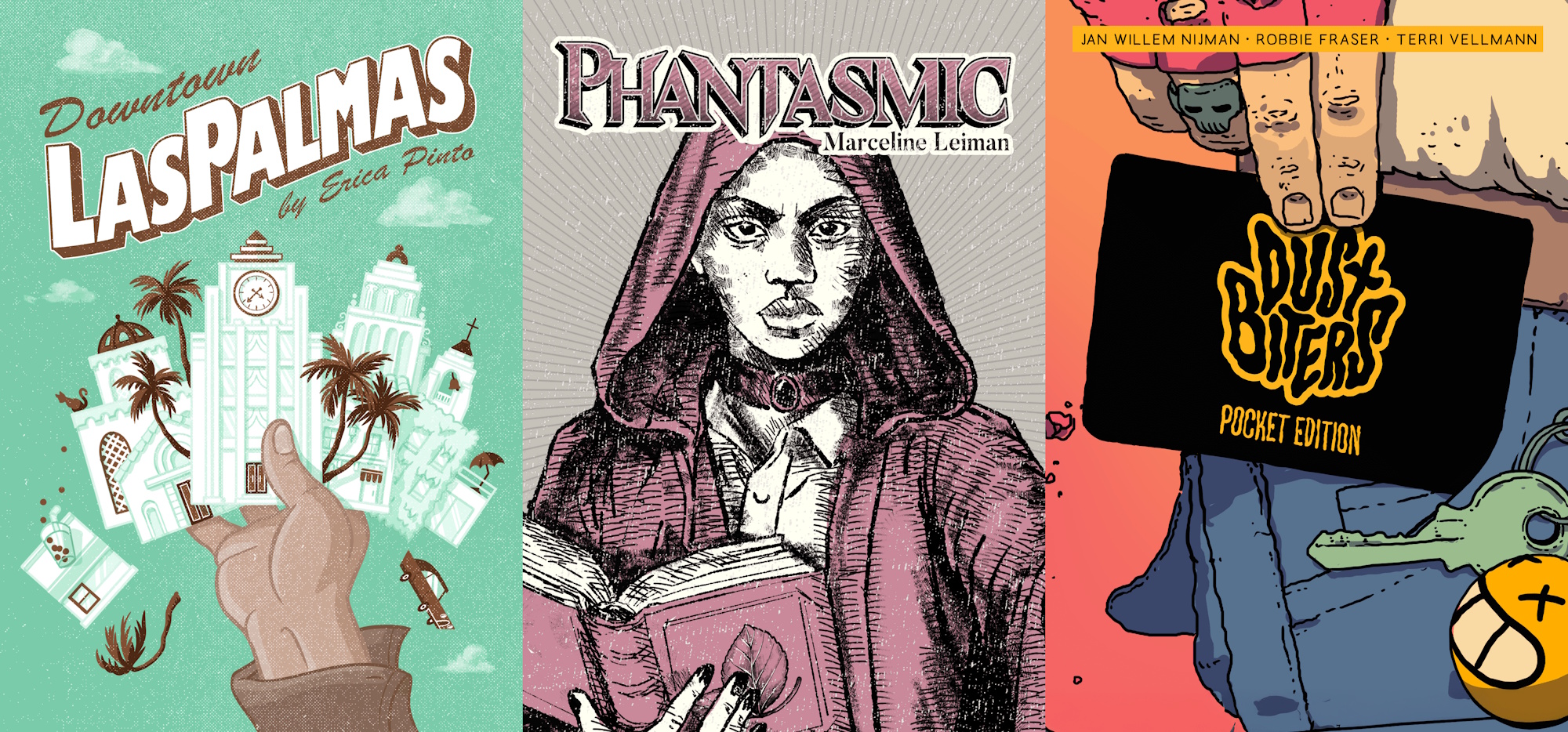
Gotta say, the art is excellent across the board.

It’s in my nature to appreciate wallets. I own a couple dozen of the things. One for carrying money and eleven-year-old gift cards to defunct smoothie chains, the rest for microgames from Button Shy.

This latest batch includes something experimental, something from a designer whose previous work I’ve loved, and something that’s really just a bigger board game compressed to fit into a wallet. That’s gotta be a home run, right?

Right?

now I want a banana

Downtown Las Palmas is the domain of “banana mitts.”

Downtown Las Palmas

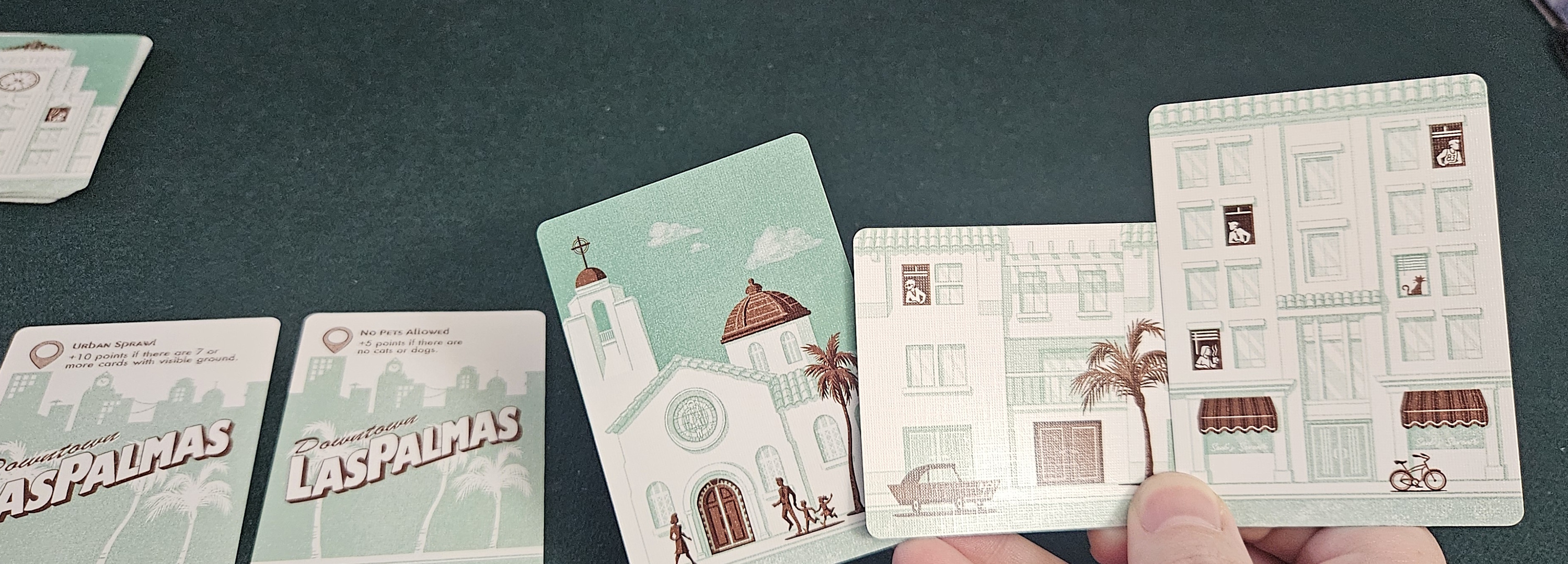
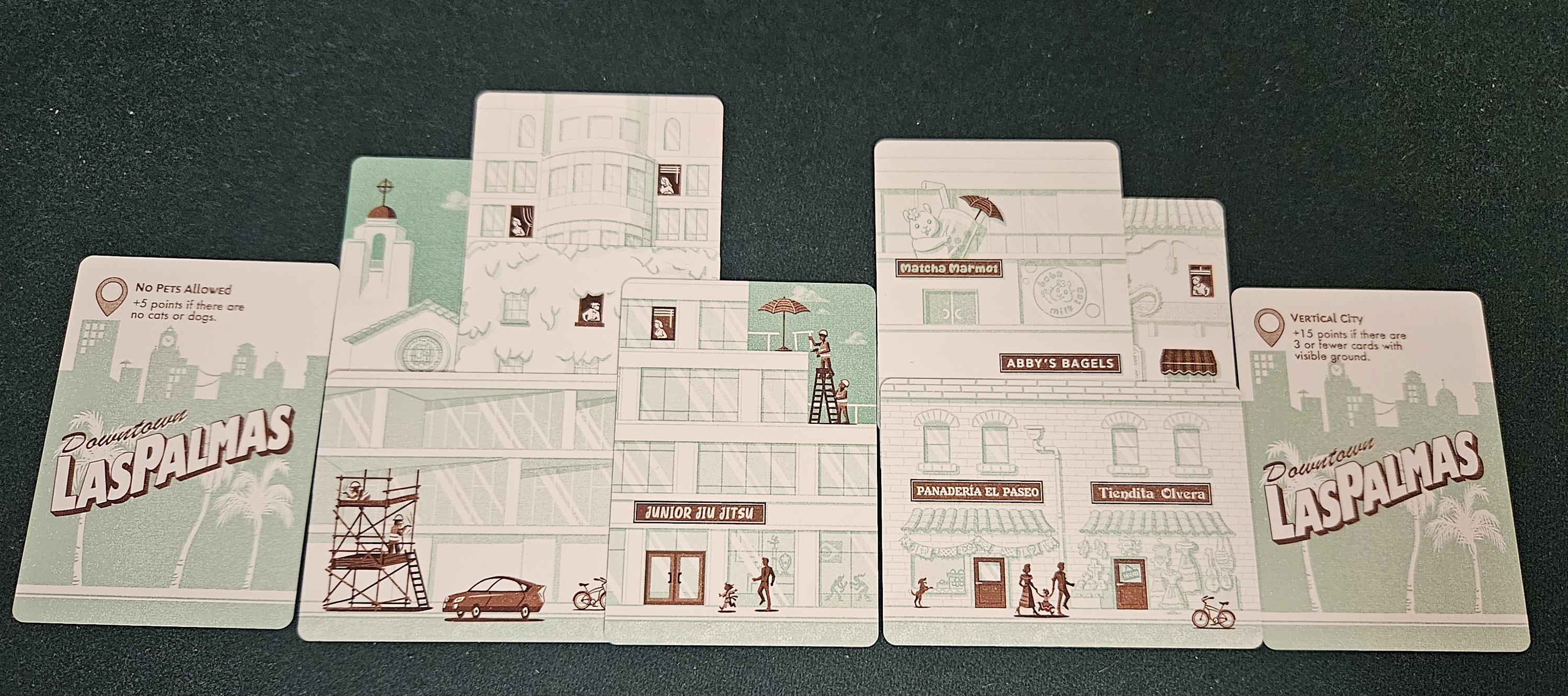
I appreciate a surfaceless game now and then, especially on long flights or while sitting in hotel rooms with tables that barely fit their obligatory lamp. In theory, Erica Pinto’s Downtown Las Palmas is one such game. You’re building a city in the palm of your hand, stretching those finger-webs to maximize real estate. The more cards you stuff into your mitts, the better, earning points not only for volume of cards, but also for every highlighted feature. Along the way, there’s some variability thanks to objectives printed on the back of every card. Stuff like “Traffic Jam: +2 points per vehicle” and “Urban Sprawl: +10 points if there are 7 or more cards with visible ground.”

Sadly, it doesn’t work.

I have wide hands. Not as wide as my friend Chris’s — everybody in our high school group called him “gorilla hands,” they were that massive — but big enough to comfortably reach an octave plus three on the piano. And I can barely hold these things. Maybe it’s the linen finish. Maybe it’s the game’s directives, which require ground-level streets to align and the sky to not intrude like some dimensional rift in front of another structure. These are necessary rules; to function as a society board game, you’ve gotta have rules. Or maybe it’s just my slippery fingers. But whatever it is, the entire thing slides to pieces the instant I’m holding more than four or five of the things.

Dang sky, always ruining my skyline.

The table version is functional, at least.

There’s an alternate way to play. Cards can be arranged on the table, spaced between your session’s chosen objectives. This allows some glimpse of how Downtown Las Palmas is meant to function. The buildings that sprout from the concrete jungle, punctuated by slants of blue sky. The signs over the signs, the awnings and cats perched in impossible places. It’s a lovely thing to see come together.

Playing this way, though, I can’t escape the notion that this isn’t how Downtown Las Palmas should work. Probably because it isn’t. Sure, this is an official variant. But there are other small games about overlapping cards, many of them also published by Button Shy.

In the end, the game remains a lovely concept. Maybe I’ll get to try something else from Pinto before too long.

I'm stronger than these cards. I will always win an arm wrestle, if only barely.

Stronger? Weaker? Who can say?

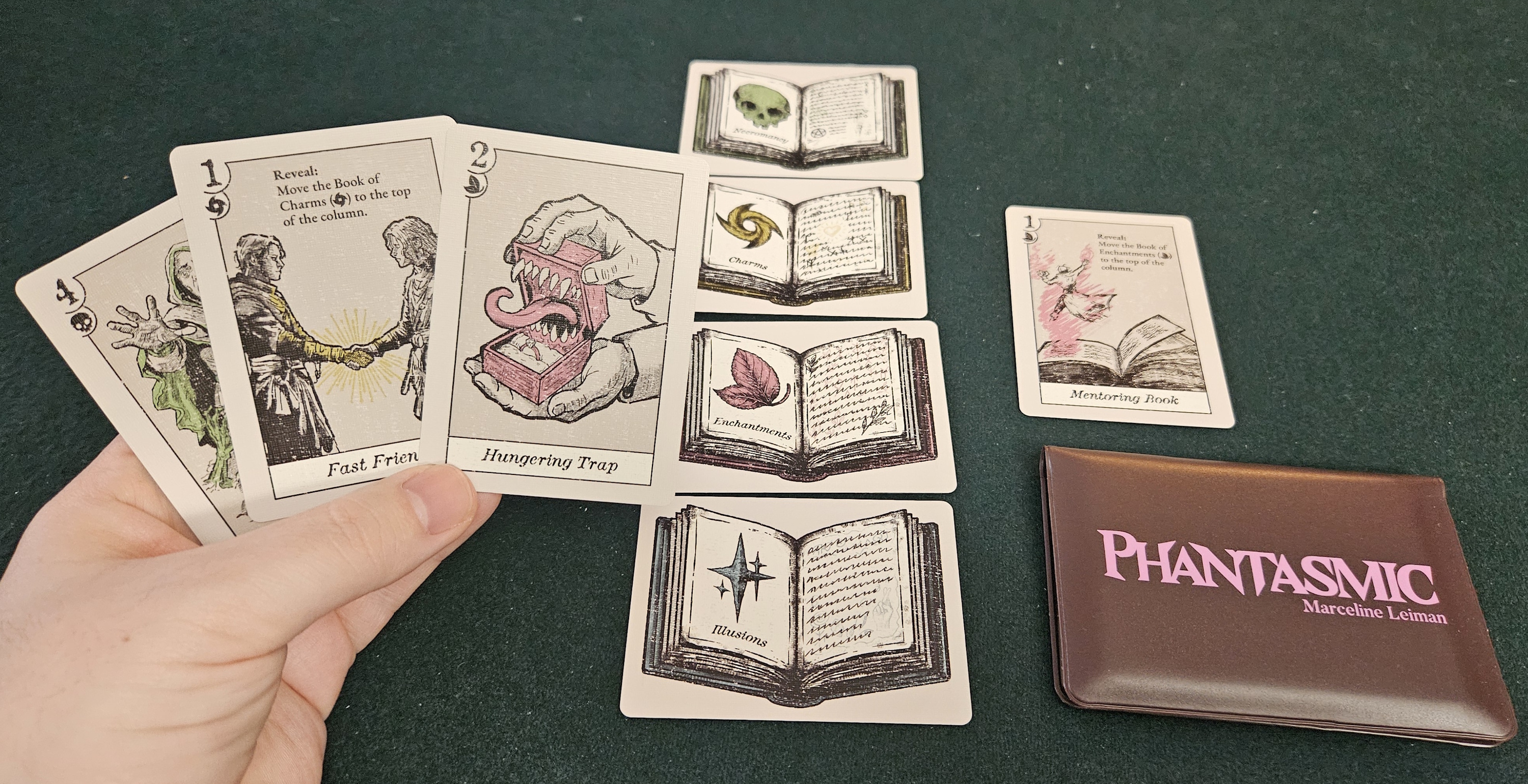
Phantasmic

Phantasmic is the smallest of Marceline Leiman’s games, which is saying something when the others are High Tide and Heavenly Bodies. It’s the smallest in terms of rules footprint as well. The game is dead simple.

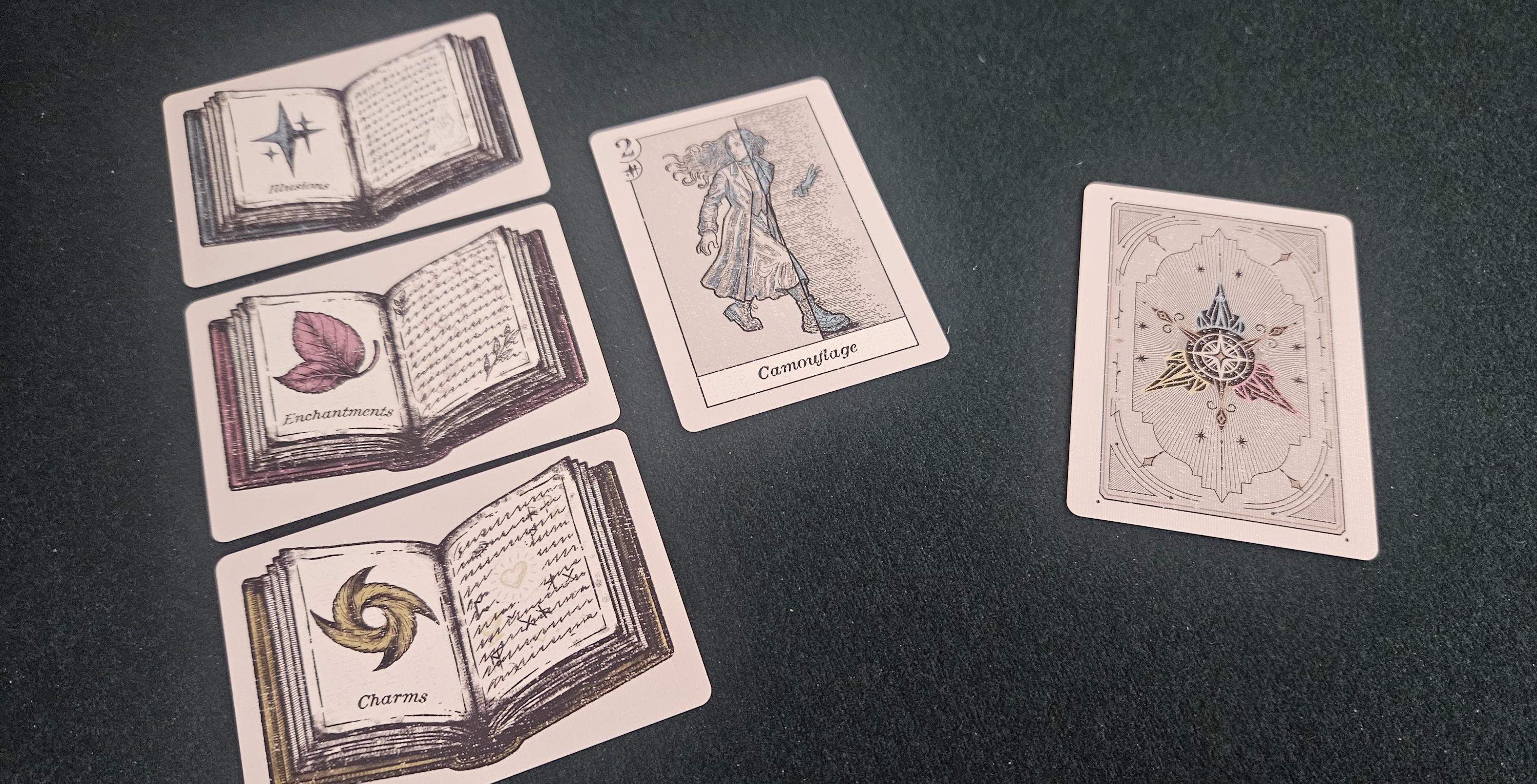
Picture a magical duel. That can’t be hard; heaven knows we’ve witnessed a bazillion of the things. One player is the Leader, a face-up spell before them on the table. The other is the Rival; their card goes face-down. At this point, the Rival announces whether their concealed spell is stronger or weaker than the Leader’s. A spell’s strength is a changeable quality, dependent on its rank and its spellbook’s position in relation to two others. The Leader declares whether they believe the Rival is lying or telling the truth. The hidden card is flipped. Everyone oohs and aahs.

Like I said, Phantasmic is simple. Perhaps too simple. At first brush, it feels almost like a coin flip. I say something, you determine whether I’m lying.

Then I could propose to Summer and have it bite her finger, haha! She would love that! (No, really, she would probably dig it.)

I want a ring box mimic.

But if Phantasmic is a coin flip, it’s a heavily loaded one. The placement of those spellbooks, the various rankings, even any previously played cards, all add to the game’s texture. A coin flip comes down to 50/50 odds; here, the likelihood that my spell is stronger than yours might be rather slender indeed. It helps that certain cards alter the outcome by swapping those spellbooks before the duel is decided.

So it’s a game of probabilities and bluffing in equal proportion. Given the game’s 18-card format, it helps that the card pool is knowable. Button Shy always offers little expansions, in this case a fourth set of spells; it isn’t enough to throw the calculations into disarray, but it does loosen up the probability a little bit.

Okay, so it isn’t quite as vacuous as a coin flip. But is it any good? Perhaps the best way to describe Phantasmic would be to say that I don’t mind it. I might almost use it as a five-minute tiebreaker, rather than a game’s default “whomever has the most leftover resources” or whatnot. But it’s so slight that I struggle to foresee any reason to nab it off the shelf rather than any number of other titles. Wallet games included.

After taking this picture, I chucked it disc-like toward the stack of coasters on the counter, only for it to knock over a pencil holder. So surely it could shred a repurposed school bus.

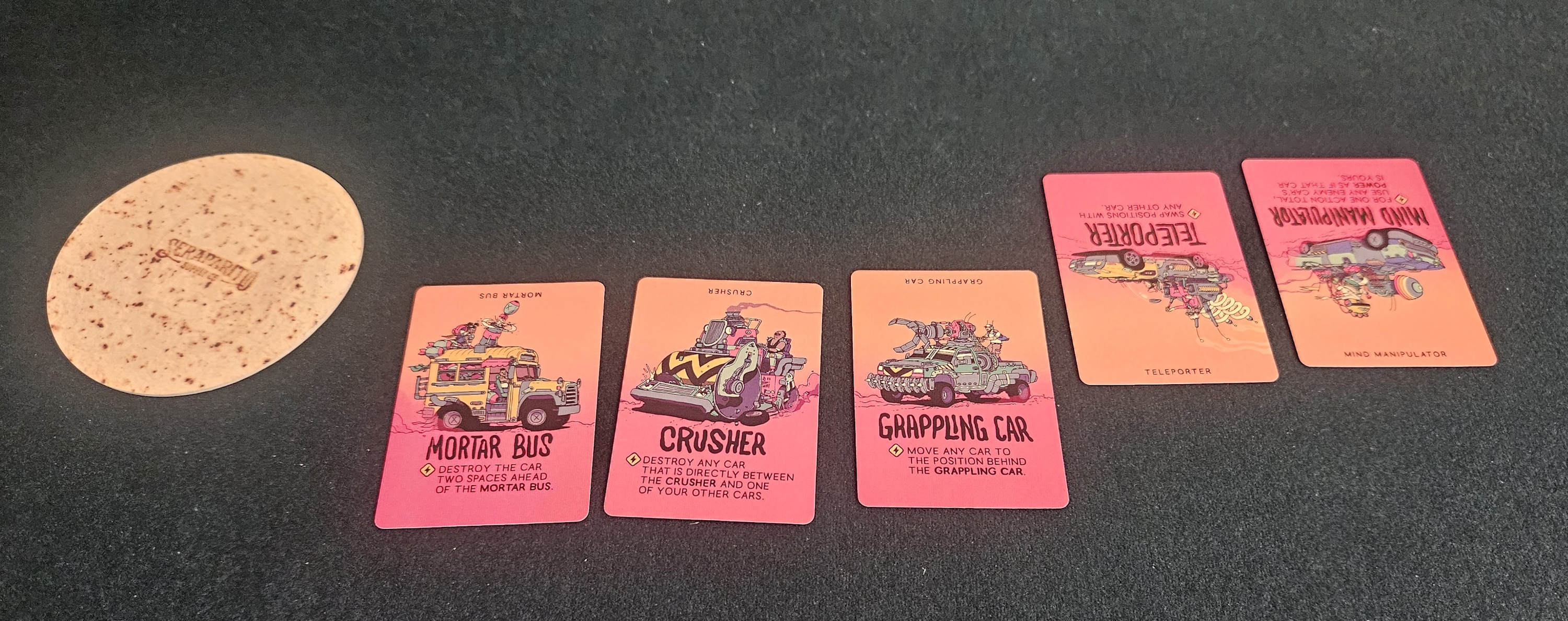
Pretend the tortilla coaster is a whirlwind.

Dustbiters: Pocket Edition

I remember being curious about Dustbiters a few years back, that collaborative design by Robbie Fraser, Jan Willem Nijman, and Terri Vellman, in no small part thanks to Vellman’s lovely pink-hued trashheap illustrations. It’s basically the sandstorm scene from Fury Road, all those cars gunning their engines and puffing propane-jelly, while being ripped apart by a duster wider than Texas.

To my delight, Button Shy’s Pocket Edition is Dustbiters, albeit in a smaller package and minus only a few cards that are immediately replaced by the expansion. When the original game hit the scene, I had no idea it was functionally a microgame itself, tallying a slender twenty-one cards. I might have even been irritated at seeing its contents floating inside a too-large box.

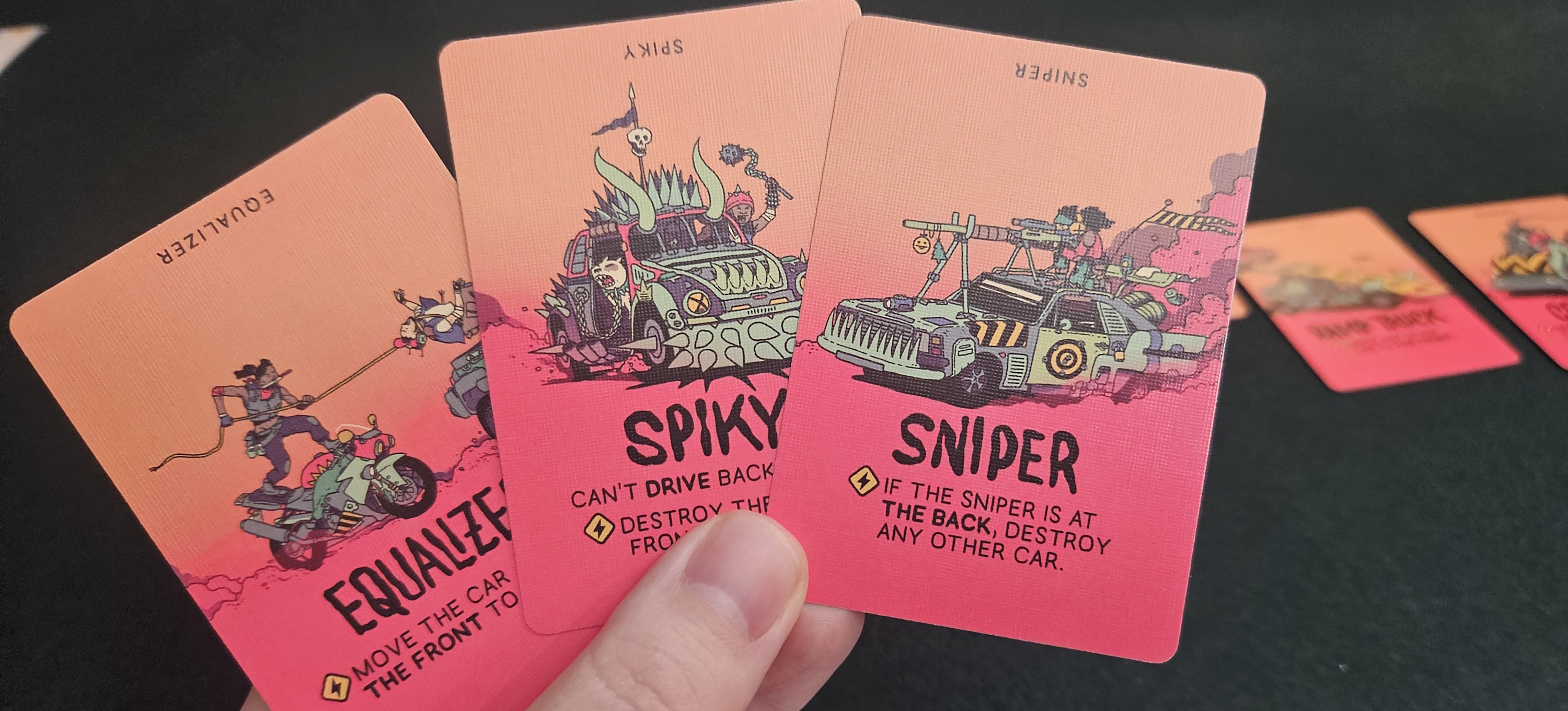
Right away, Dustbiters excels on multiple fronts. The artwork is perfect, of course, those little road-freaks guffawing as they tear across the wasteland. The gameplay is also no slouch. Six cards begin on the table, three oriented toward me and the rest facing you. Every turn offers three actions, whether spent moving vehicles up or down the line, triggering abilities, or deploying reinforcements to the melee.

From there, it’s a bloodbath. The goal is to be the last player with any cards on the table. Every turn will result in multiple casualties, and that’s if you’re shirking your homicidal duty. Thanks to the storm bearing down on your position, at least one car will be demolished at the conclusion of each turn. The only path to survival is sheer forward propulsion.

just good friends having a good time

A day out with the crew.

What a great little game. There’s some wonderful overlap between the vehicles’ appearance and their function, breeding a certain irradiated logic. There’s a Jammer with an old satellite dish wedged atop its minivan frame; it cancels the abilities of both adjacent cars. A repurposed steamroller can crush its neighbor, but only if its victim is sandwiched by another of your vehicles. A Ramp Truck lets you fling your car haphazardly to the front of the line. The blood-bag Max tethered to the front of the Martyr car may absorb any other hit.

Here’s something that tickles my fancy: quite often, designers stretch the microgame’s 18-card limit by pressing their cards into multiple duty. Each card has two sides and many orientations, after all. Dustbiters doesn’t need the help. All it takes is a conga line of murderous gas-guzzlers, some nasty time pressure, and a few simple rules. Five minutes is all it takes to play, but there’s more drama compressed into those five minutes than… well, than in certain nu-euros about flinging tourists into outer space.

Of the trio, Dustbiters is the clear frontrunner, which means it is the sole title to not be shredded by the wasteland storm of my judgement. Dustbiters, I verily witness thee.


Complimentary copies of Downtown Las Palmas, Phantasmic, and Dustbiters: Pocket Edition were provided by the designer.

(If what I’m doing at Space-Biff! is valuable to you in some way, please consider dropping by my Patreon campaign or Ko-fi. Right now, supporters can read about which films I watched in 2025, including some brief thoughts on each. That’s 44 movies! That’s a lot, unless you see, like, 45 or more movies in a year!)
Triple-Triple Omelette Burger w/o Cheese

24. Februar 2026 um 00:11

I'd eat there.

Sold initially at the Indie Games Night Market, Joseph Z. Chen’s Flip Stack Burger Shack has all the markings of an indie darling: its not-quite-smooth discs look great on the table, the gameplay is tactile and amusing, and it even comes in a bag. (All the best indies come in a bag.) But what I least expected from it was a cerebral puzzle that reduced my brain to onion jam.

Can you make my favorite burger? Nope. There aren't ingredients in the right colors.

Sandwich artistry.

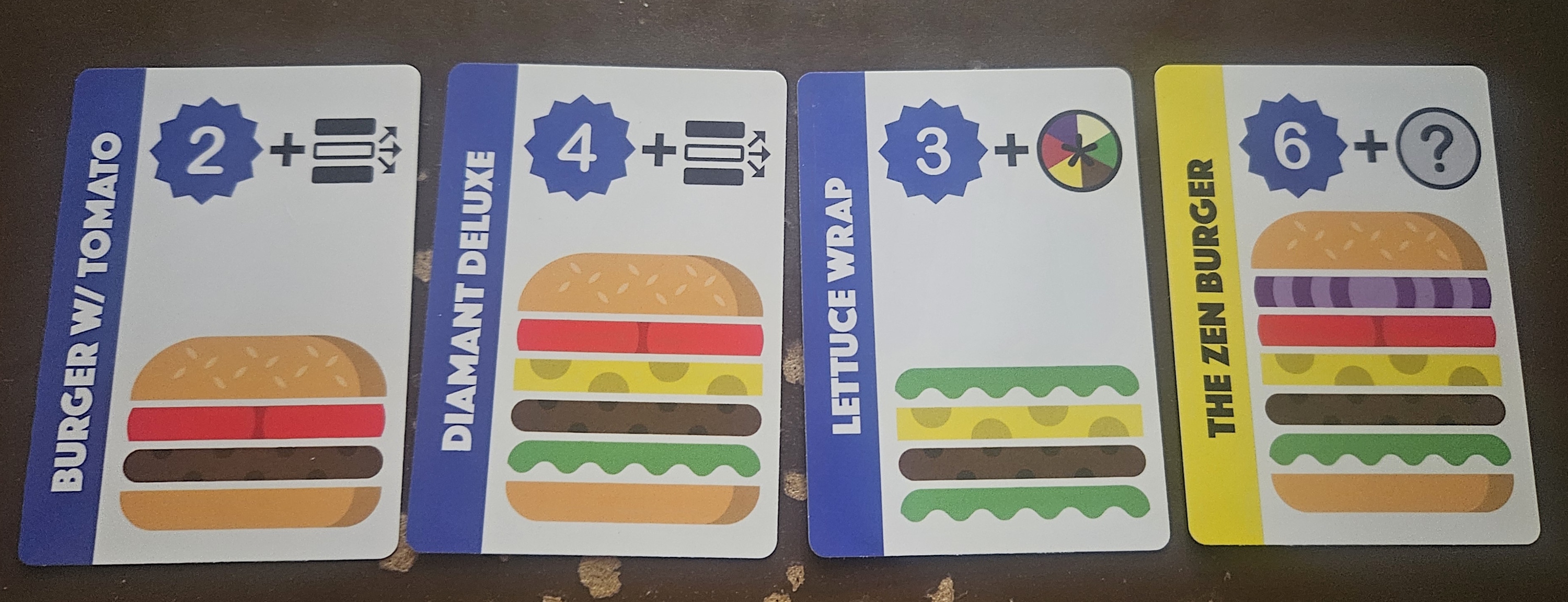
Picture this. It’s your first day on the job. The burger shack down at the beach is your haunt, and there are already people lining up at the window. The orders are coming fast and hot. Classic burger! Tomato grilled cheese! Diamant deluxe! Lavender burger! Your assistant begins flinging ingredients your way. It’s all you can do to flip the piles onto the proper buns.

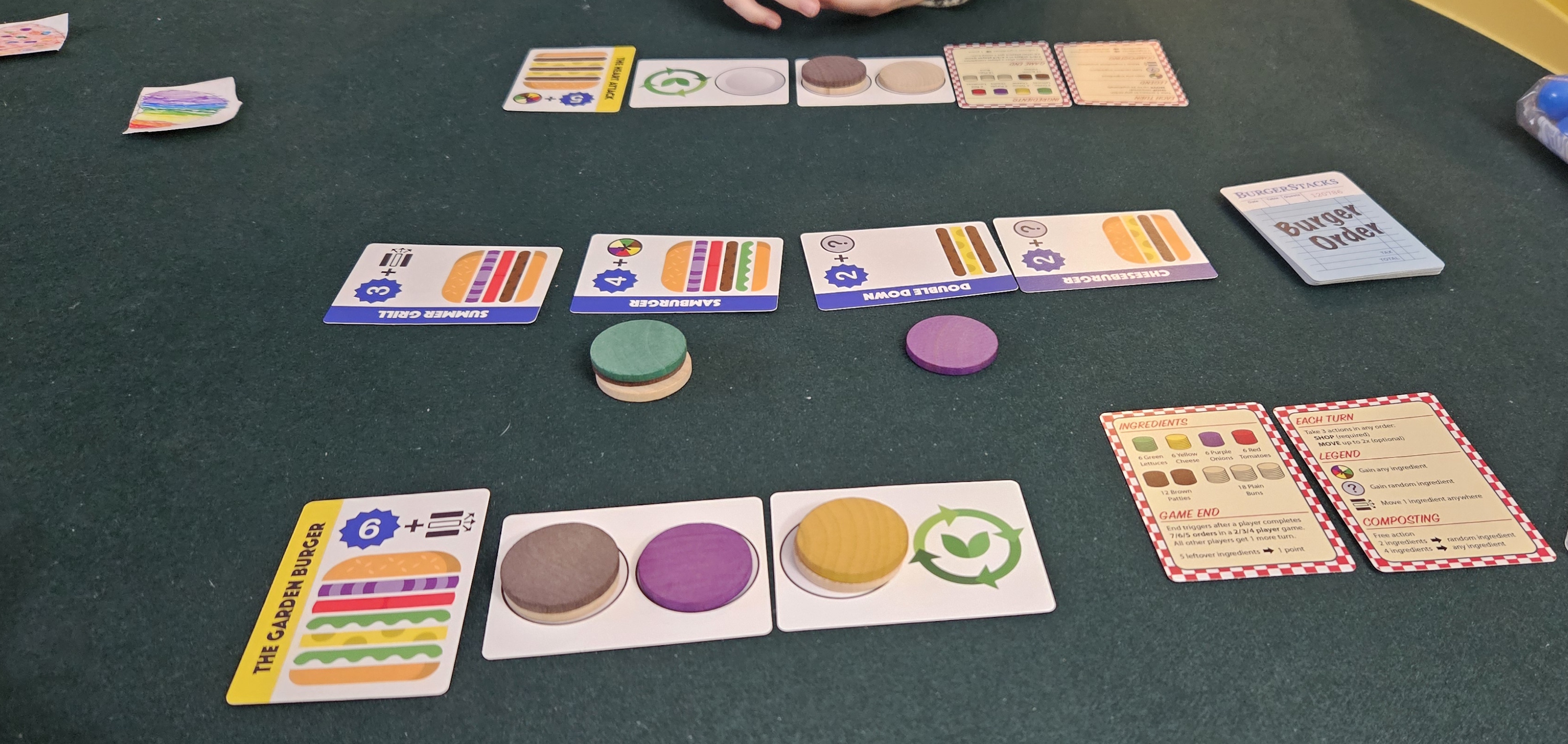
This isn’t quite how Flip Stack Burger Shack plays — nor does this particular shack deserve the highest food safety rating — but it’s close enough. Drafting from shared stacks, players take handfuls of ingredients, flip them this way and that, and slop them into something resembling an edible hamburger. Ideally before their coworkers can snipe the order out from under them.

Let’s get the quibbles out of the way. For a game about flipping burgers, Flip Stack Burger Shack is a strangely deliberate event. When you’re trying to assemble a particular sandwich — let’s say an Oklahoma — you’ll be staring at a diagram. In this case, a bun, patty, cheese, and onion, topped off with another bun. But building that burger is tougher than it looks, especially when the stacks begin to accumulate some elevation. At any given time, you might be staring at a single ingredient, some lettuce, the stack that was replenished right before your turn, but then ever-increasing stacks that might reach a half-dozen or more ingredients at the same time. Those slop piles can be useful, but they also tend to be tougher to use. This requires the titular flipping and stacking, often to separate out the necessary ingredients before they arrive atop the correct sandwich.

Or maybe you could chuck the whole thing into the composter and, via culinary magic, produce a more desirable ingredient from the bag. Sayonara, entire heads of wilted lettuce; say hello to a single sliced tomato.

Either way, this process is anything but rapid. More often, Flip Stack Burger Shack is thinky. Ponderous, even. With four players, the downtime between turns threatens to become bloated. Like unrinsed lettuce or a burger patty left too long in a surfer’s hatchback.

If you saw these hanging on the back wall of a Wendy's, would you find it endearing or distressing?

Handy burger diagrams.

But with the right crowd of players or the right player count, whichever lets you move at a steady clip, that same thinky edge makes Flip Stack Burger Shack an unexpected treat.

I’ll give an example. Most burgers need buns. Easy. Most burgers also need patties. As a result, it’s a relatively safe bet to nab extra buns and patties. But what happens when the easy pickings have been nabbed? Now the game shifts into riskier territory. With some clever acquisitions from the ingredient counter, not to mention a few timely flips, it’s possible to head off rival sandwich artists.

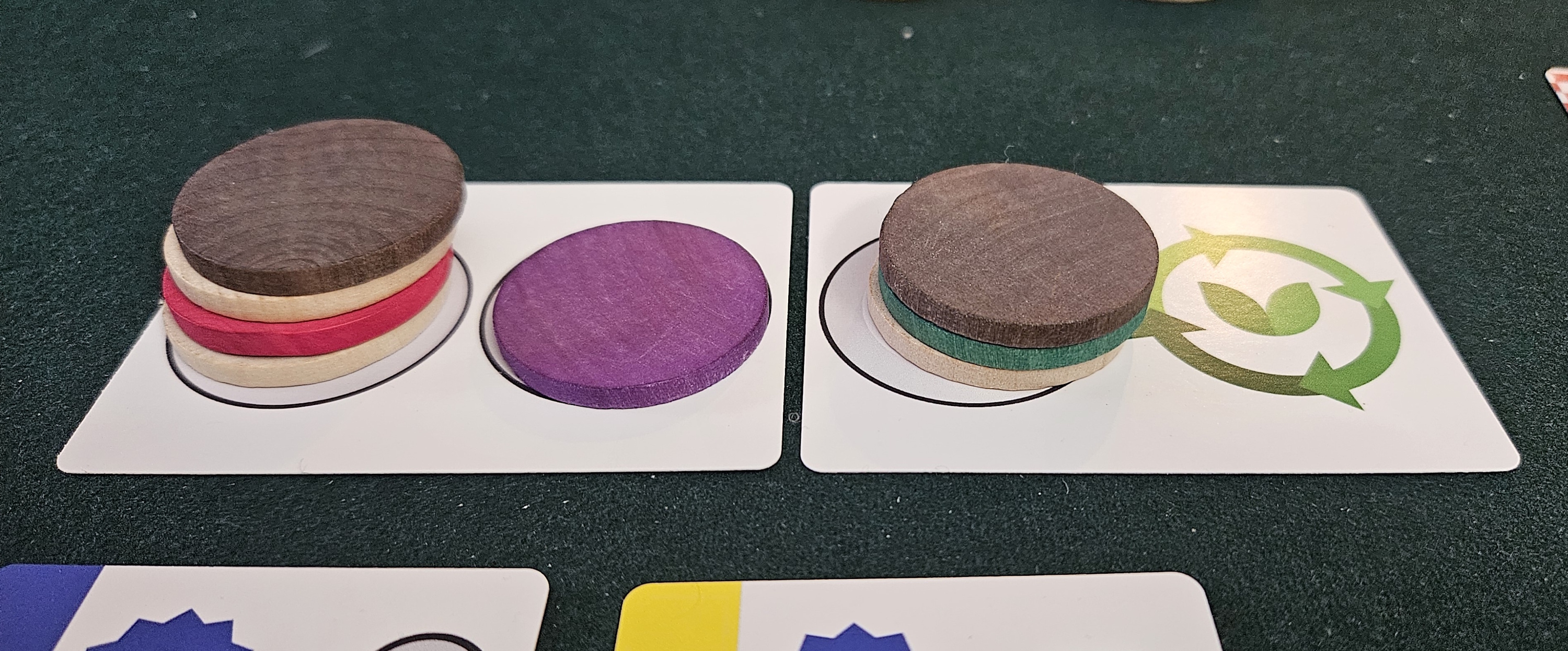
Those flips, by the way, are handled with perfect ease. Any time you pick up a stack, whether from the market or your own plates, you’re free to grab some or all of the tokens, and then you’re also free to flip them as you see fit. This doesn’t solve every problem; indeed, it’s surprising how often you’ll need multiple maneuvers just to lever a tomato out from under an ill-placed slice of cheese. But it provides some truly pleasant tactility. It helps that the tokens are wood. One of the benefits of being a small-batch production is that the whole thing’s aesthetic is perfectly minimalist, from the painted tokens to the receipt-book burger diagrams. Flip Stack Burger Shack isn’t the most innovative title in the world, but it feels lovely to handle.

That handling is the core of the entire experience. Some games are about big ideas. Others are about sequences, or engines, or fancy math. This one is about the joy of moving things, shifting and rotating them, feeling their grain on your fingertips, and doing your darnedest to keep the right stack in your mind’s eye.

mmm cheese

Even from a distance, these burgers are handsome.

And, well, that’s all there really is to it. Flip Stack Burger Shack is another indie market title that, like last week’s Imps, will hopefully draw enough attention that it gets picked up for wider publication. Just don’t report the shack to the food inspector’s office. I’m pretty sure none of these burgers are gluten, meat, or dairy free.


(If what I’m doing at Space-Biff! is valuable to you in some way, please consider dropping by my Patreon campaign or Ko-fi. Right now, supporters can read about which films I watched in 2025, including some brief thoughts on each. That’s 44 movies! That’s a lot, unless you see, like, 45 or more movies in a year!)
❌