Anmelden


Nepo Demibabies
Yesterday we looked at Pillars of Fate, a kinda-sorta remake of extended family reunion simulator Veiled Fate, and found it wanting for much the same reason as the original. The gods are capricious, everybody knows that, but their fickleness doesn’t exactly make them the most appealing playmates.
But here’s the thing. At the same time Austin Harrison, Max Anderson, and Zac Dixon were designing Pillars of Fate, another remake was, um, remade. On a superficial level, this one, Scales of Fate, resembles its namesakes. As in those other titles, dueling gods intend to deduce the identity of their rival’s offspring, minimize their impact on the world, and elevate their own bastards over everybody else. Basically, it’s a race to promote your nepo babies over everybody else’s at the family tire shop. And that tire shop happens to be the eternal mountain at the root of the world.
And it’s excellent. Scales of Fate just might be one of the tightest, nastiest deduction games out there. That it was built for two players only makes it the more impressive.
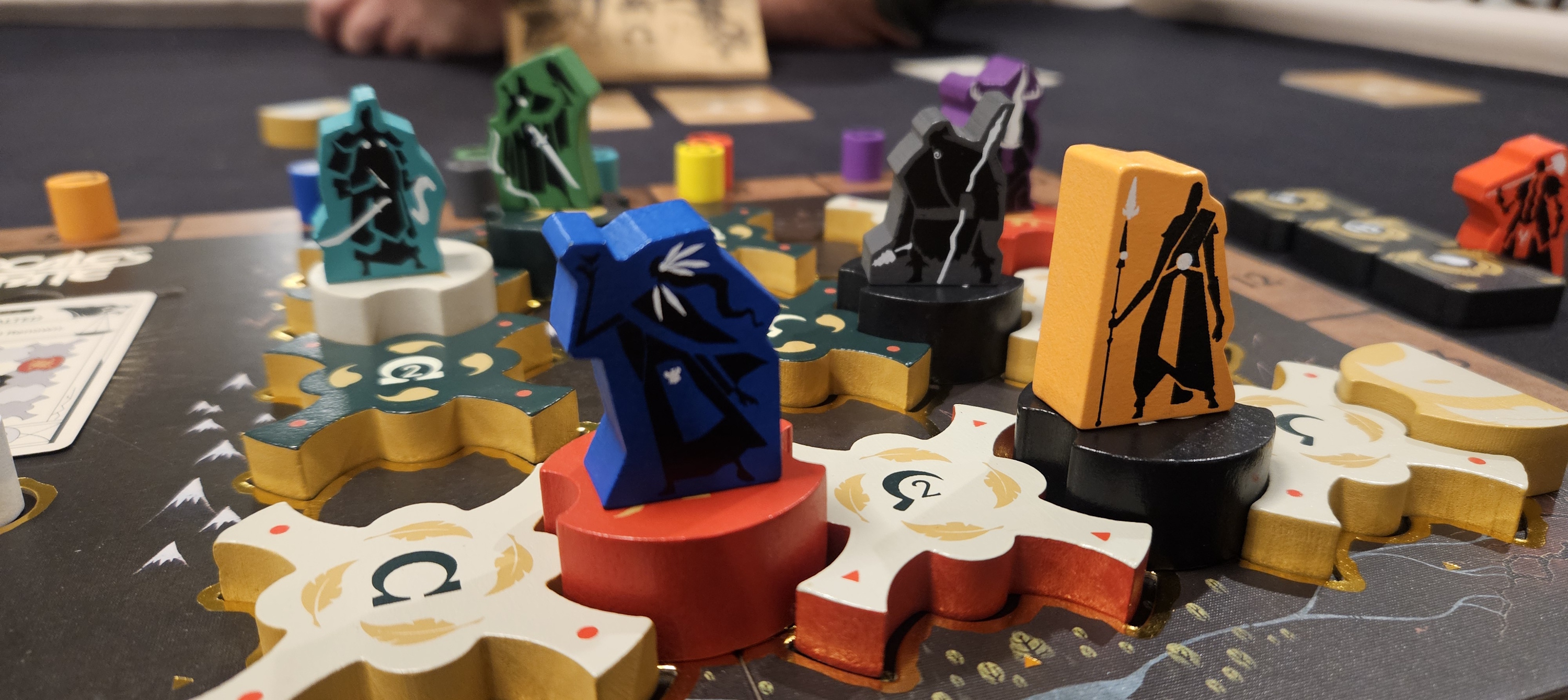
But these are the ones standing on pillars…
For first-timers, the board presented by Scales of Fate is wonderfully labyrinthine. I say “wonderfully” because just look at it. It’s colorful. The pieces slot together like joined fingers. There’s a topography to the whole thing. You can tell the elevated pieces will be more important than the pieces seated a few millimeters below them. Even when I had no idea what any of these components portended, I wanted to know. Needed to know. Were they gears? Would my demigods traverse them? Veiled Fate presented its map as a wheel. Pillars of Fate offered three lanes. Both are fine. Good, even. But I’ve seen wheels and lanes before. A series of interlocked cogs and risers is something new. That’s a metaphorical depiction of a landscape if ever there was one.
In practice, Scales of Fate is surprisingly easy to get a handle on. Turns consist of three possible actions. One of those, while important, functions more as an exception, an occasional bolt of lightning, than as business as usual.
The main two actions, meanwhile, immediately explain the function of those wonderful cogs and pillars. First, a demigod can be placed atop a pillar to trigger its ability. Whether it’s to smite another demigod down to the underworld to cool their heels, obtain the loyalty of a servant, or… well, that’s it. Rather than offering a wide menu of abilities, there are really only two to keep in mind. Sure, there’s some variety within those categories, but they fall into camps rather than cluttering the decision-space with branching paths.
The second action has to do with those servants. Placed along the edge of the board’s cogs, they trigger the quests that will increase or decrease each demigod’s renown. But to understand what that means, we need to back up a bit.
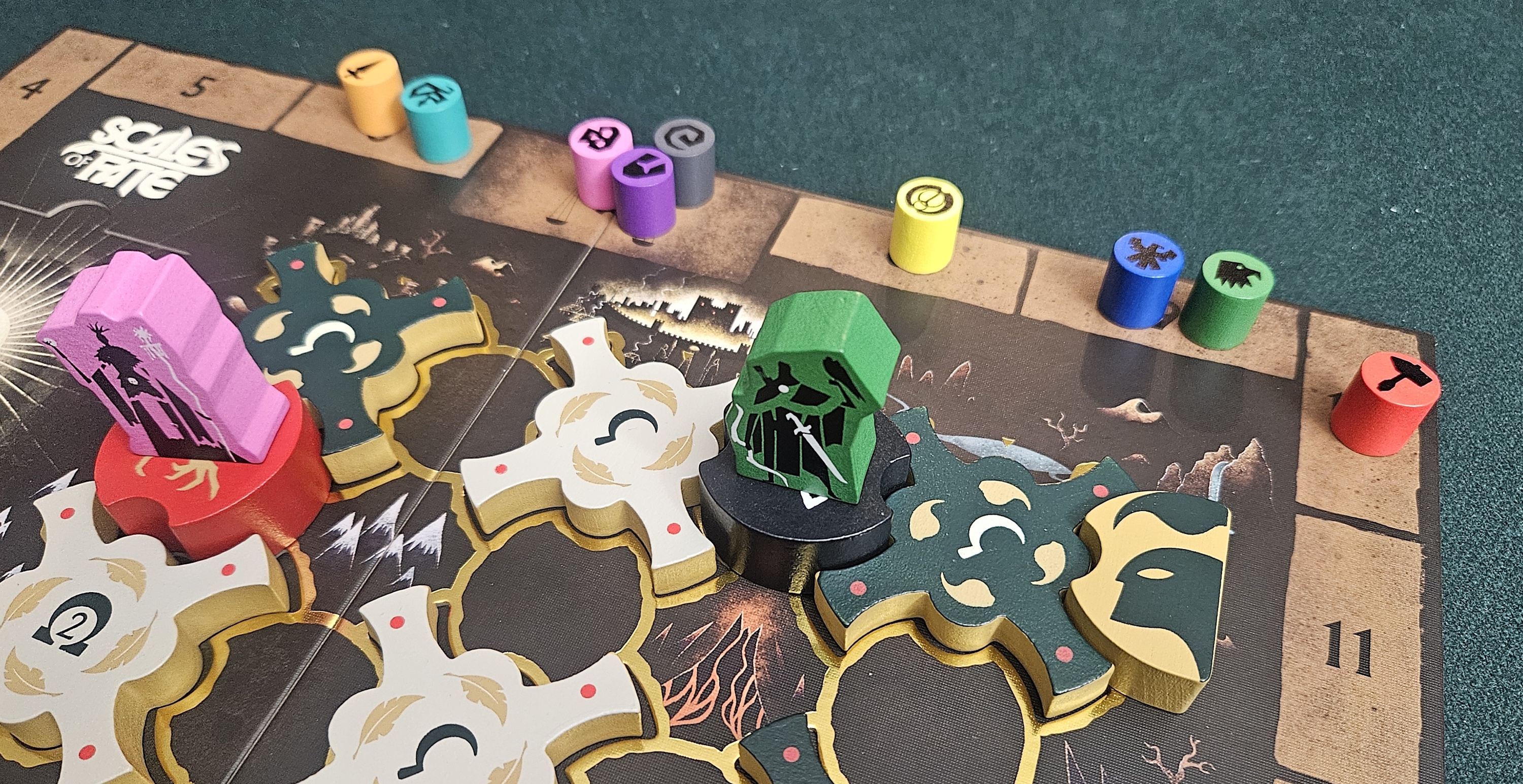
A servant sends two demigods on important quests.
Okay, so you’ve fathered/mothered/sea-foamed two half-divine offspring. Their identities are determined in secret at the beginning of the game. Put a pin in that. We’ll come back to it.
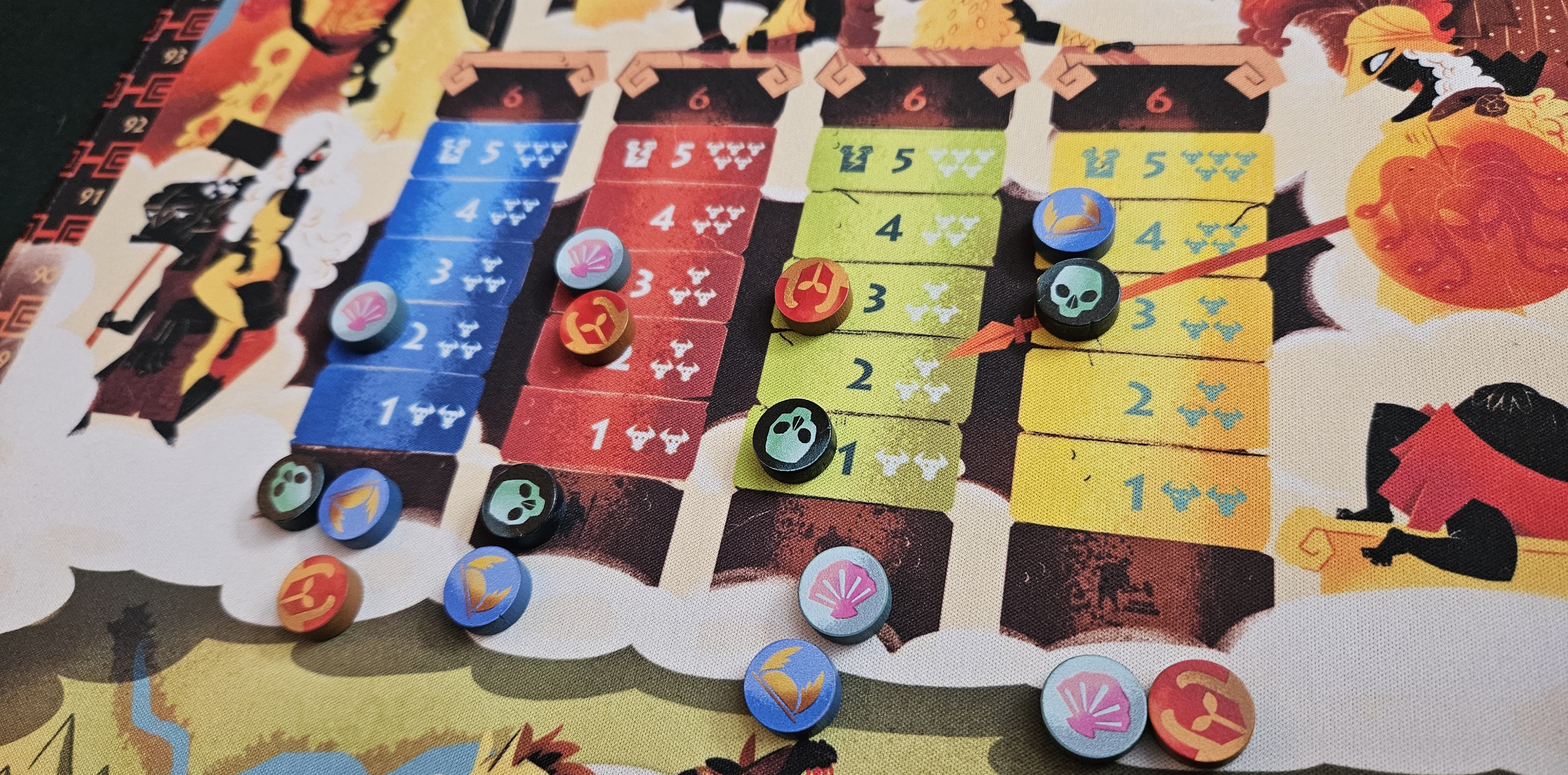
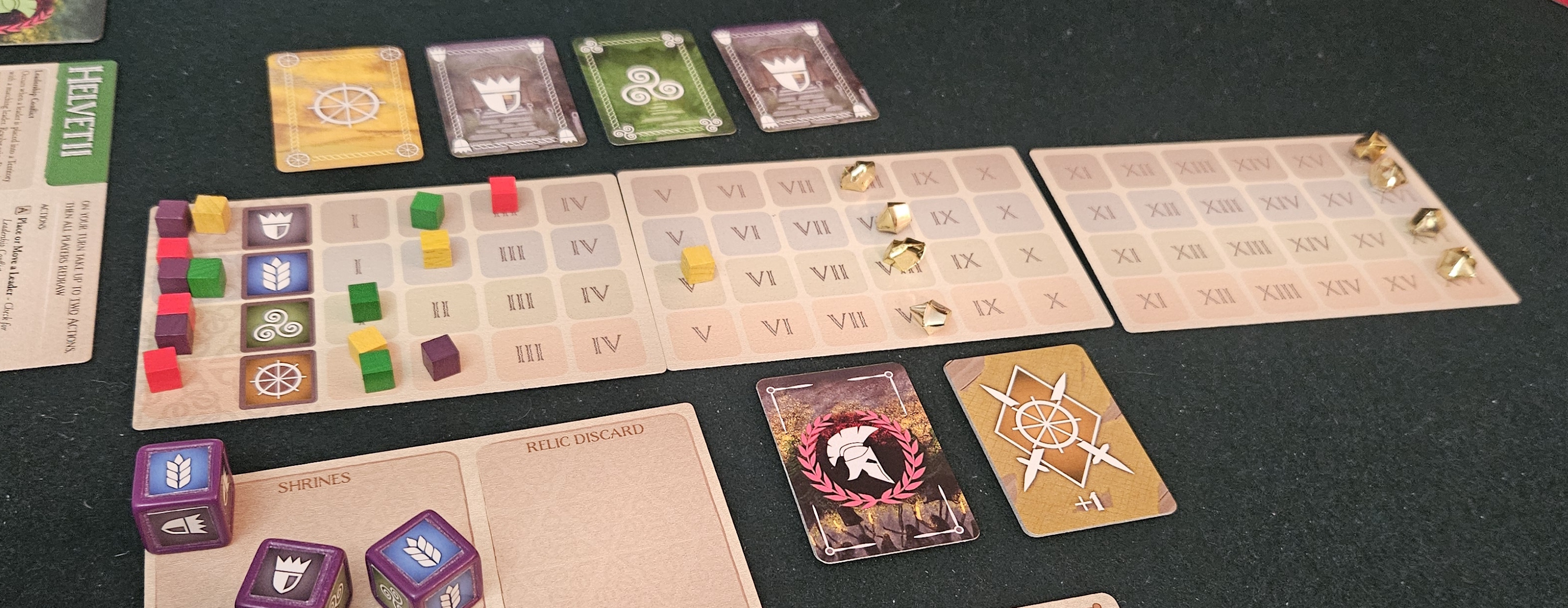
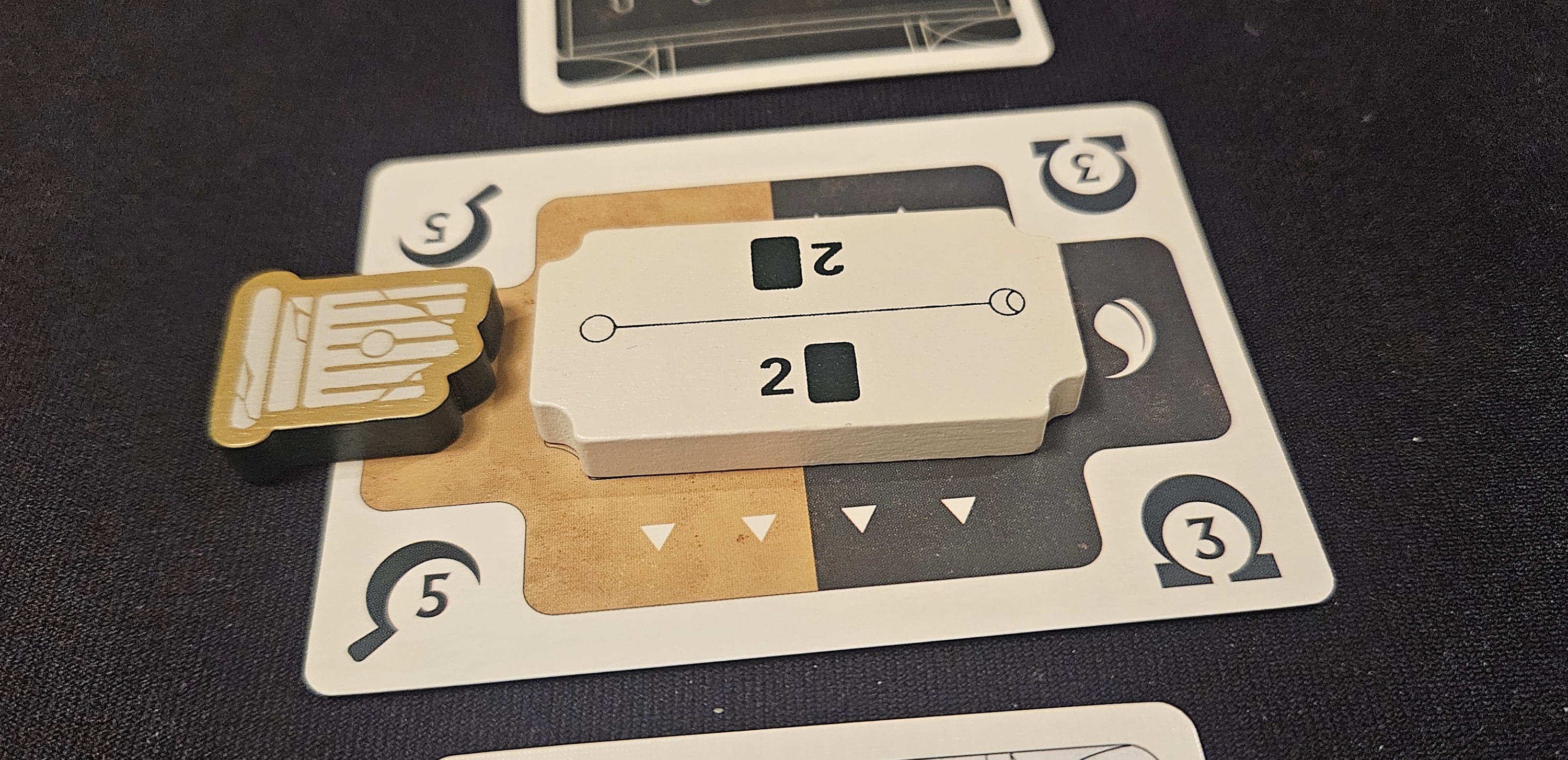
You want to elevate your children. Doing so openly is a surefire way to attract the wrath of your co-pantheonists. So you work in secret. The problem is that every demigod’s current standing is shown on the renown track, visible to both players. When the game begins, all nine demigods share the middle space. That’s seven renown. Even before they’ve done anything interesting, your offspring are worth something by means of their divine parentage.
What will they accomplish? Rather than doing the obvious thing — say, by asking you to push them up the renown track — Scales of Fate makes a tantalizing offer. Your children score points in one of two ways. If they occupy the same renown space when the game ends, they score its value. If both are seated on their starting space, having neither moved up nor down, that means they’ll be worth seven points. That’s respectable. Polite. Not a bad score. But if they move to different spaces on the track, now they score equal to the distance between them. Ticking one child up a single space means their combined value is one point. On the other hand, if your children should do the twin thing by embracing entirely opposite ends of the spectrum, they’ll be worth a whole lot more.
This introduces a wonderful sense of risk and reward to Scales of Fate, not to mention fixes my hangups with Veiled Fate. In that game, players earned points for ensuring their holy bastard earned the most renown. But that made their identity almost trivial. Once any one demigod got too hot for their britches, everyone would work together to take them down a peg. It was simple. Too simple.
Here, their relative standing makes the family tree more tangled. With nine demigods in the world, they’ll be all over the renown track. But what does that mean? Are those clusters on the track actually siblings working in tandem? Are those gods at the farthest edges secretly growing into a hero-villain rivalry that will shake the foundations of the earth?
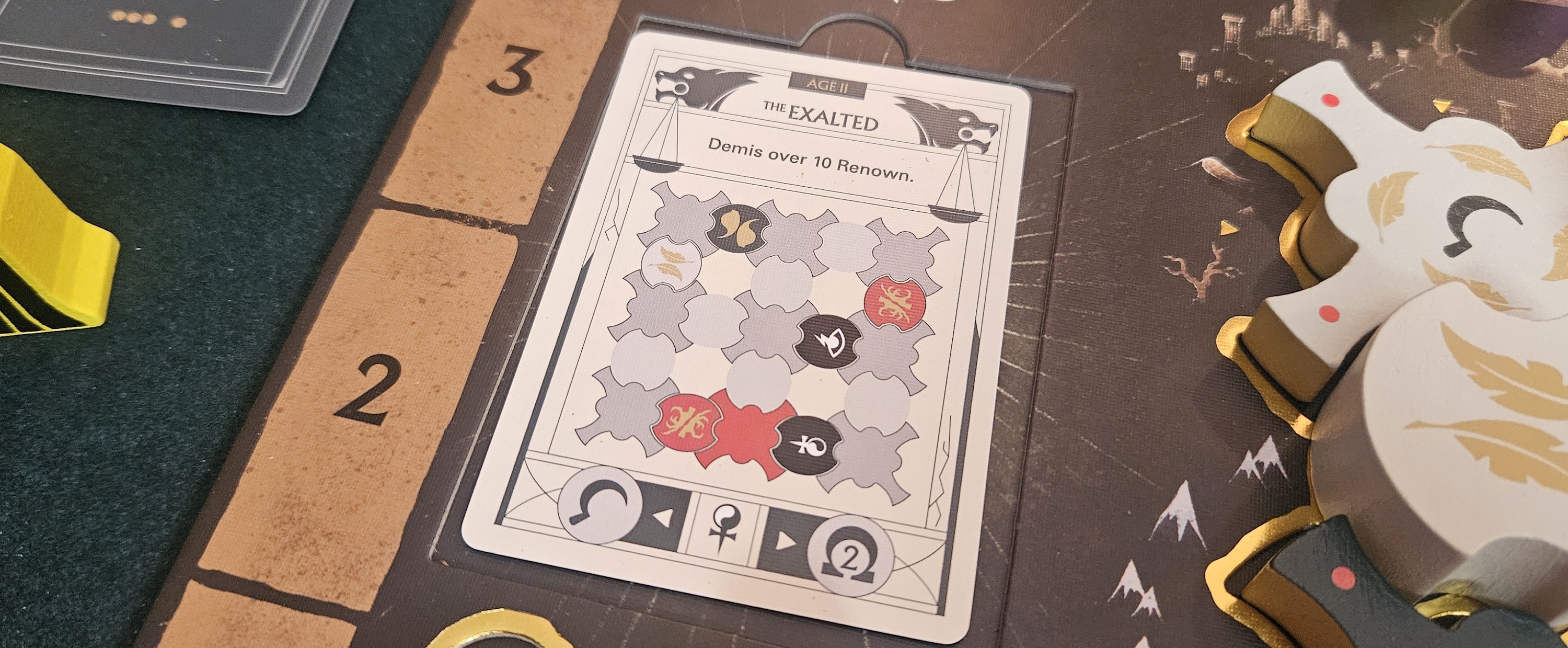
Each age provides new clues on your rival’s childrens’ identities.
Of course, this is a deduction game, which means there are tools for producing those deductions. Some of these tools are subtle. With experience, I’ve made a habit of watching my opponent like a hawk and marking whenever they idly touch a piece or linger too long over a move. More often than not, some correlation can be drawn over time, hinting at favoritism or resolute neglect. (Similarly, I’ve developed the habit of studiously avoiding my own offspring. This, I’m sure, is a tell in its own right. If I reach out to tentatively brush the pink demigod, Isabel, before pulling back like my fingers were singed by her presence, you can reliably infer that I have nothing to do with her.)
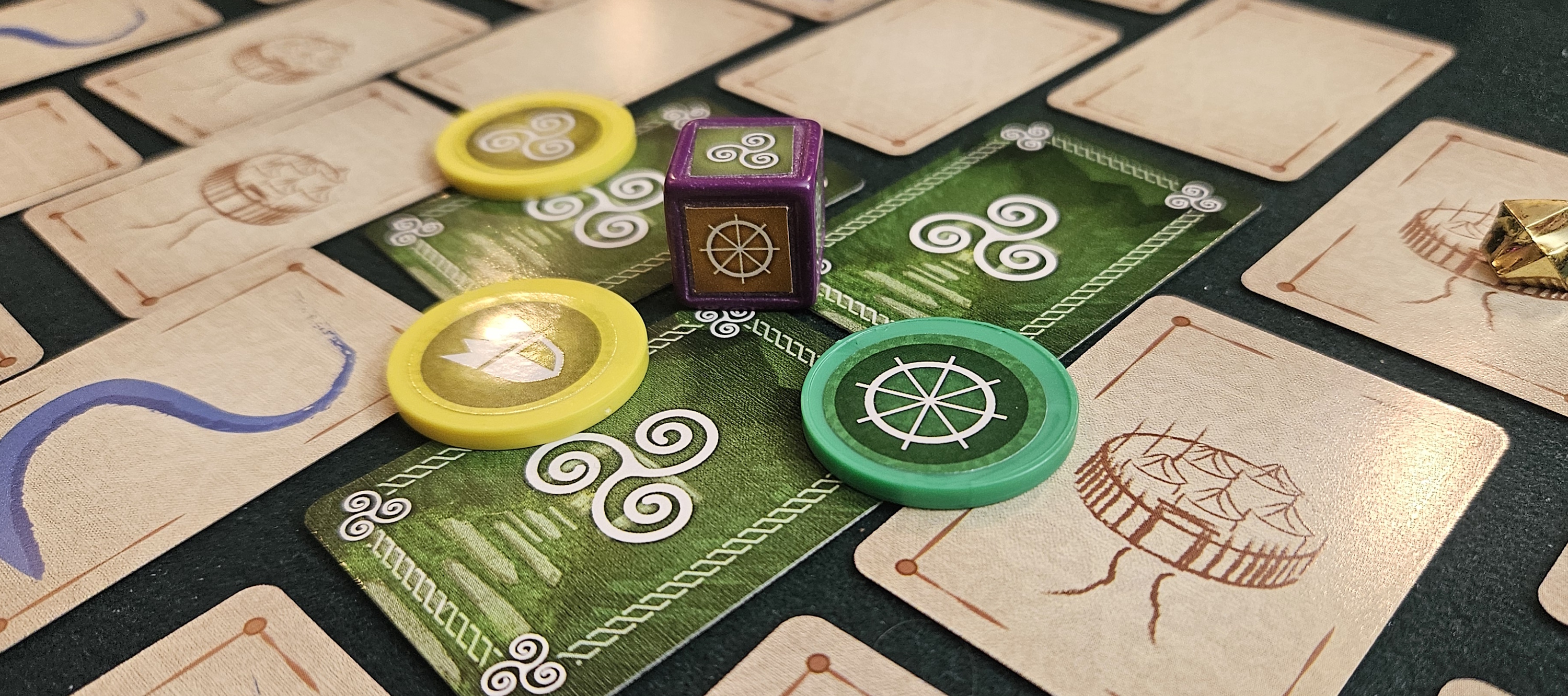
But the game’s more explicit tool is provided each age. Scales of Fate takes place over three rounds, each of which provides a different criterion that will be checked at the round’s end. Early on, for example, you might be required to inform your opponent whether you have any demigods out of play. That means they weren’t sent to the board, whether to trigger actions or because someone blasted them down to the underworld. Later, your suspicions might be confirmed by evidence of divine parentage for any demigod placed on a highlighted action pillar.
Crucially, these cards ask yes/no questions rather than demanding specifics. If you’re clever enough to ensure that only one of your two children meets the current age’s criterion, you can simply say “yes” to their presence without giving too much away. For example, one first-age card asks whether one of your children is still seated at four to six renown on the track. Saying yes is almost worse than saying no, especially if nearly all of the demigods have yet to make a name for themselves.
In the meantime, nearly everything adjusts their standing on the renown track. When servants trigger quests — the cogs that surround the action pillars — the surrounding demigods shift up or down. When sent to the underworld, another action will determine the place’s magma forecast, thus providing feats or humiliations that also adjust their standing. Every little detail matters.
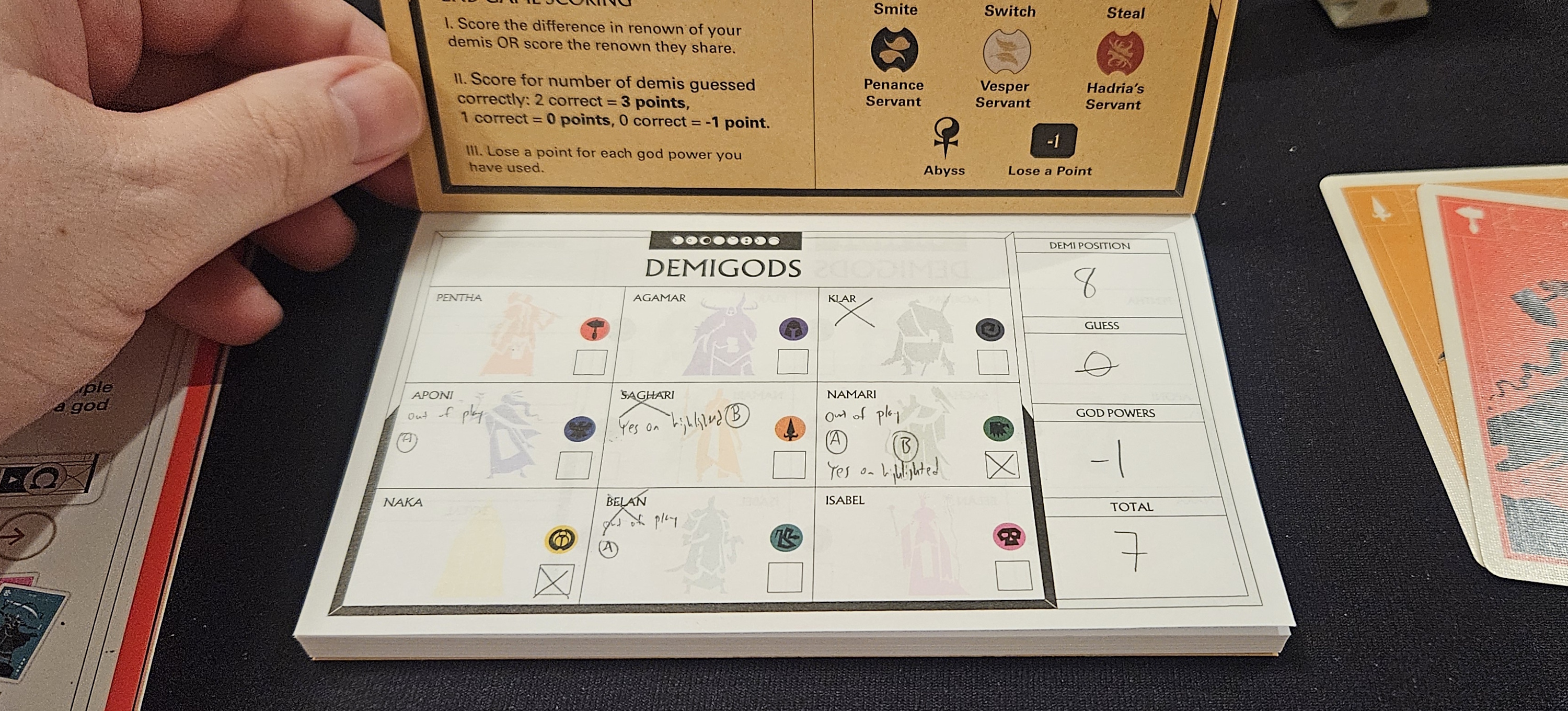
Now that’s nice.
And we still haven’t talked about the game’s cleverest touch. Remember when I mentioned we would return to the question of your children’s parentage? Turns out this pantheon is rocking one big orgy, with all the problems it poses for any paternity/maternity/sea-foam tests.
In most deduction games, including the basic rules for Veiled Fate, holding a card means nobody else is holding it. In Scales of Fate, both sides have their own duplicate deck. Just because your children are Agamar and Saghari doesn’t mean your rival won’t have some personal interest in one of them as well. Maybe even both of them, although that’s unlikely. This adds no small amount of static to the ongoing deductions. When one of your demigods gets bumped off their current space, is that because your rival has figured out that they’re your kid and is trying to mess with you, or are they chasing an ambition of their own? Some of my favorite matches have featured duplicate offspring, and while this calls into question what’s so demi- about these so-called demigods, it’s a brilliant addition to a shared-control deduction game.
That goes for the entire package. To some degree, I wish I could play a version of this game that featured more than two players. The idea behind Veiled Fate was always one that appealed to me, and while it finds its best expression here, there’s a slightness to Scales of Fate that I wish would be transposed into a more robust framework. Of course, it’s entirely possible that this game only functions because its manipulations are so laser-focused. It’s generally possible to figure out your rival’s progeny. At least one of them. I’m not sure that would be the case if we had to keep an eye on three other players rather than staring down only one person.
Along the way, there are other little touches that elevate the experience. Like the game-breaking powers that let you smite anyone or swap two demigods, but subtract points from your final tally. Or the way the end-game deduction rewards a correct genealogical discovery but only penalizes you for not uncovering at least one of your rival’s kids. Like the board’s cogs and pillars, everything locks together into one elegant whole, resulting in a crystallized experience where nothing is out of place.
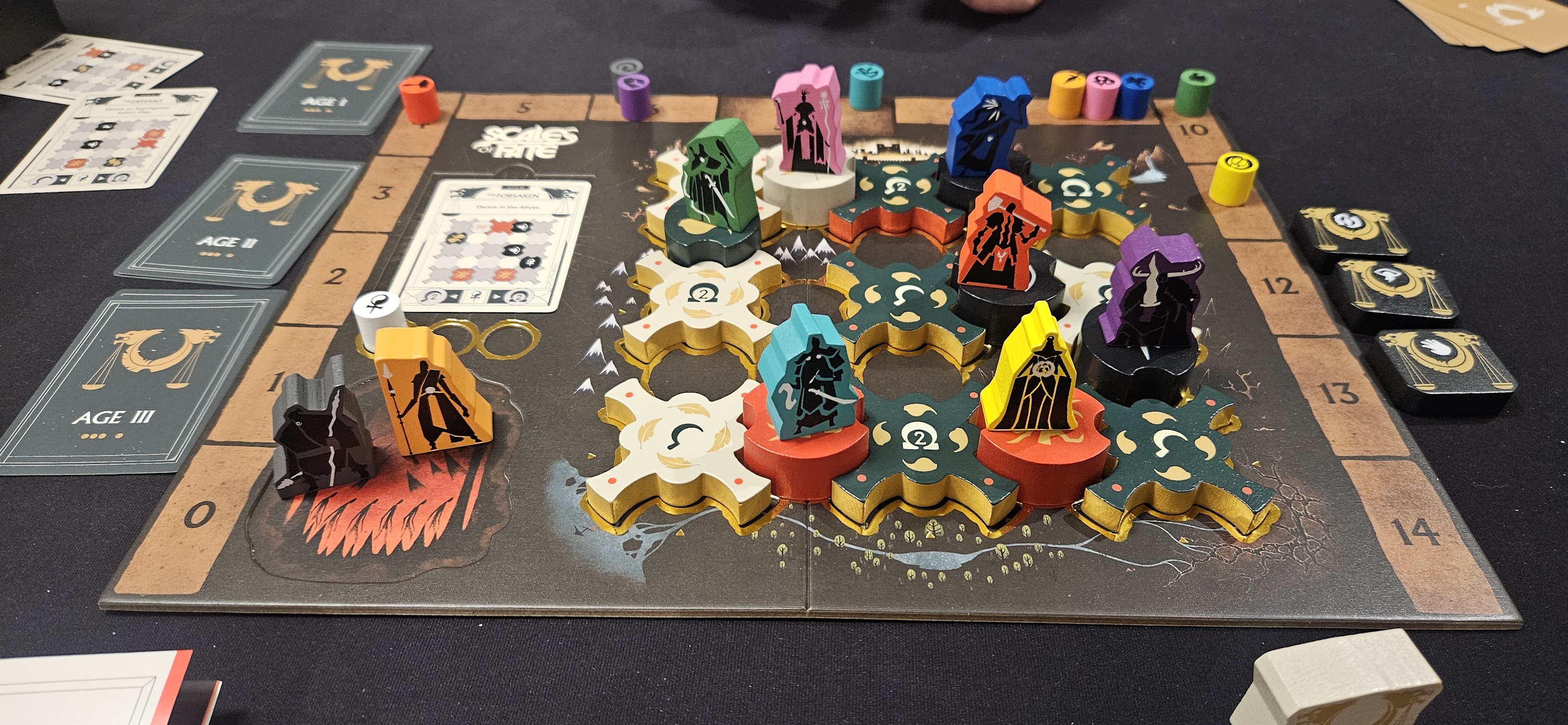
Chillin’ with the cousins.
Honestly, it’s such a breath of fresh air. Not only that Scales of Fate is this good, but that it takes such a novel approach to almost every corner of its design. From the non-literal map to the way it uses relative proportions to signify importance, both on the board and between renown trackers. From the clever approach to shared control to the way players might find themselves accidentally co-parenting a demigod. It’s achingly smart.
More than smart, it feels great to handle, to push around, to study a rival and mark down a clue. When I first saw Scales of Fate, I knew I had to figure out how those pieces fit together. The beautiful thing is, their inner workings proved even better than they seemed from afar.
A complimentary copy of Scales of Fate was provided by the publisher.
(If what I’m doing at Space-Biff! is valuable to you in some way, please consider dropping by my Patreon campaign or Ko-fi. Right now, supporters can read my first-quarter update of 2026: the best board games, movies, books, and more!)



![Wait a minute, how dare you name a place Les Invalides? That should be reserved for hospitals and... [touches earpiece] it's a what? Ahem. Never mind.](https://spacebiff.com/wp-content/uploads/2026/04/4.-flex.jpg "Wait a minute, how dare you name a place Les Invalides? That should be reserved for hospitals and... [touches earpiece] it's a what? Ahem. Never mind.")