Normale Ansicht

Hey! A Place I’ve Actually Been!

16. April 2026 um 21:16

I'm still not sure about this preview thing. I think it's useful, but also, this game is unlikely to change between now and production. But is "preview" a warning that the details are subject to change, or a warning that the game isn't available to purchase yet? I'm still not sure.

At this point, it doesn’t seem far-fetched to crown Josh Wood the king of tableau-builders. Yes, yes, like a trampler of horse glue I’m invoking Santa Monica yet again, but the more relevant touchstone today is Let’s Go! To Japan, a lovely, if flawed, game about planning a vacation to Tokyo and Kyoto.

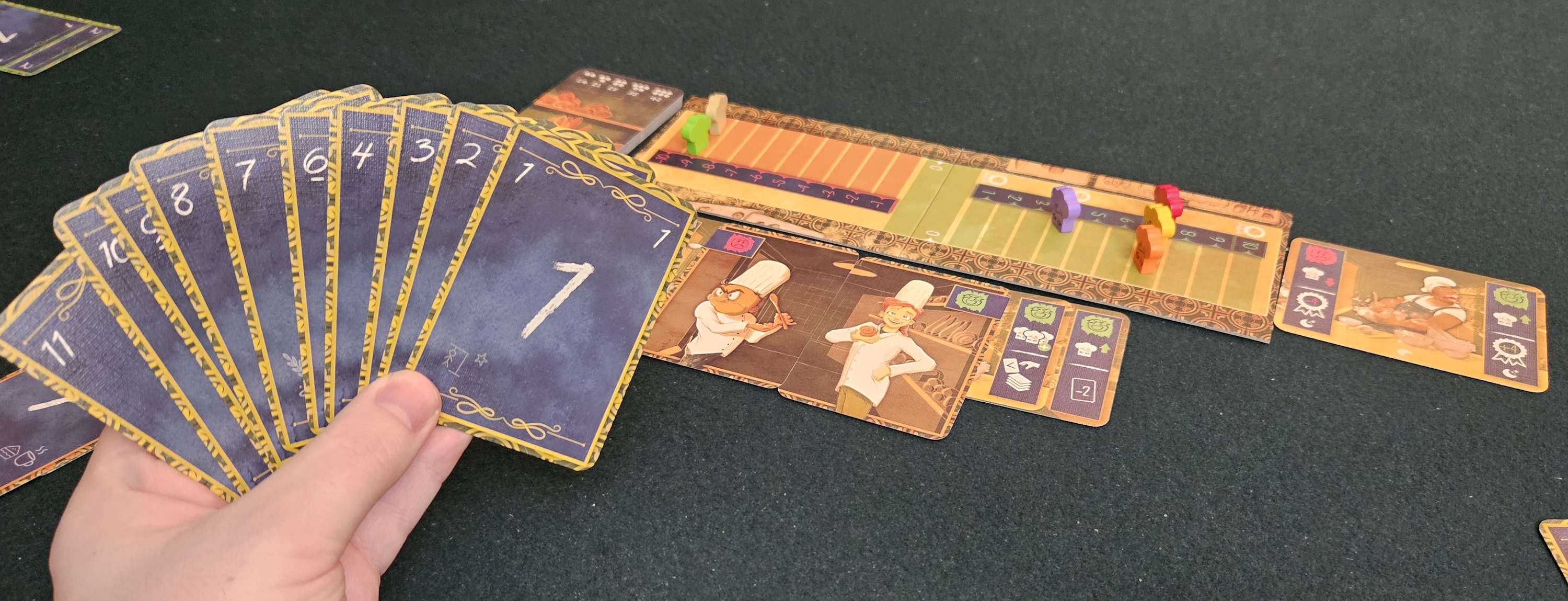
Let’s Go! To France is Wood’s follow-up to that latter title. It tackles every single one of my reservations with that game, and then goes on to produce one of the most delightful, evocative, and grounded tableau-builders I’ve ever played. Maybe it helps that I’ve actually been to France. More likely, it’s that Wood knows precisely what he’s doing with every mechanism, component, and locale.
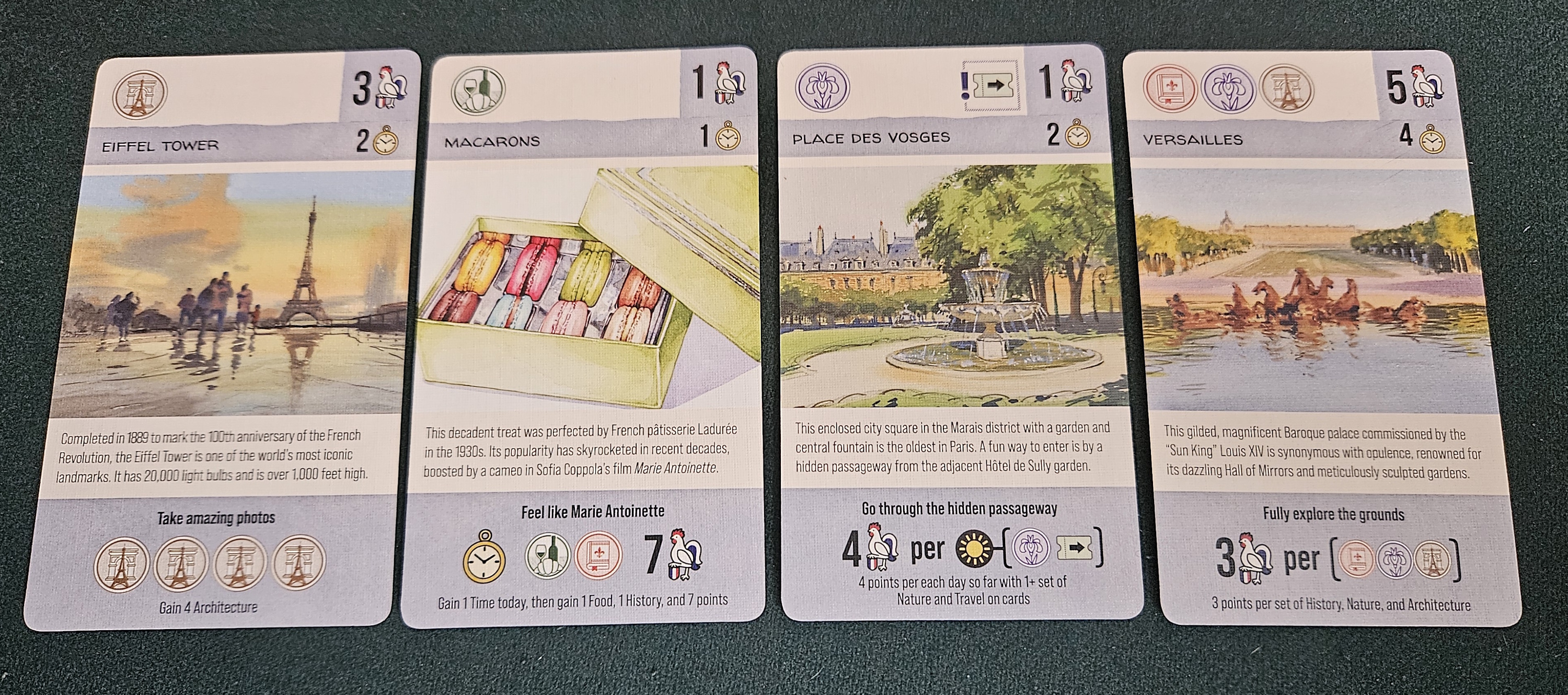
"Tower" is a good example. I know better than to attempt anything else, even if I can say it correctly. I still get guff for having a jokey pronunciation of "Versailles" in a previous review. So many people earnestly believed that I really pronounce it Ver-sah-ay-LEES. I still get messages about that one.

I can even pronounce some of these words.

It’s going to be hard to not turn this into a comparative review with Let’s Go! To Japan, so let’s open with the basics. Let’s Go! To France is a game about planning and executing a trip. Not just any trip. A two-week trip to Paris and some portion of wider France, undertaken day by day and hour by hour.

For all that, there’s an elegance to the whole thing. Turns are presented as simple drafts. You receive some cards. One or two of them will get scheduled into your itinerary. The rest are passed around the table. The cards each present a different activity in Paris: visiting a museum, snacking on delicacies, touring a park, shopping at an open-air market, finding an overlooked nook that you’ll boast about to friends for years to come.

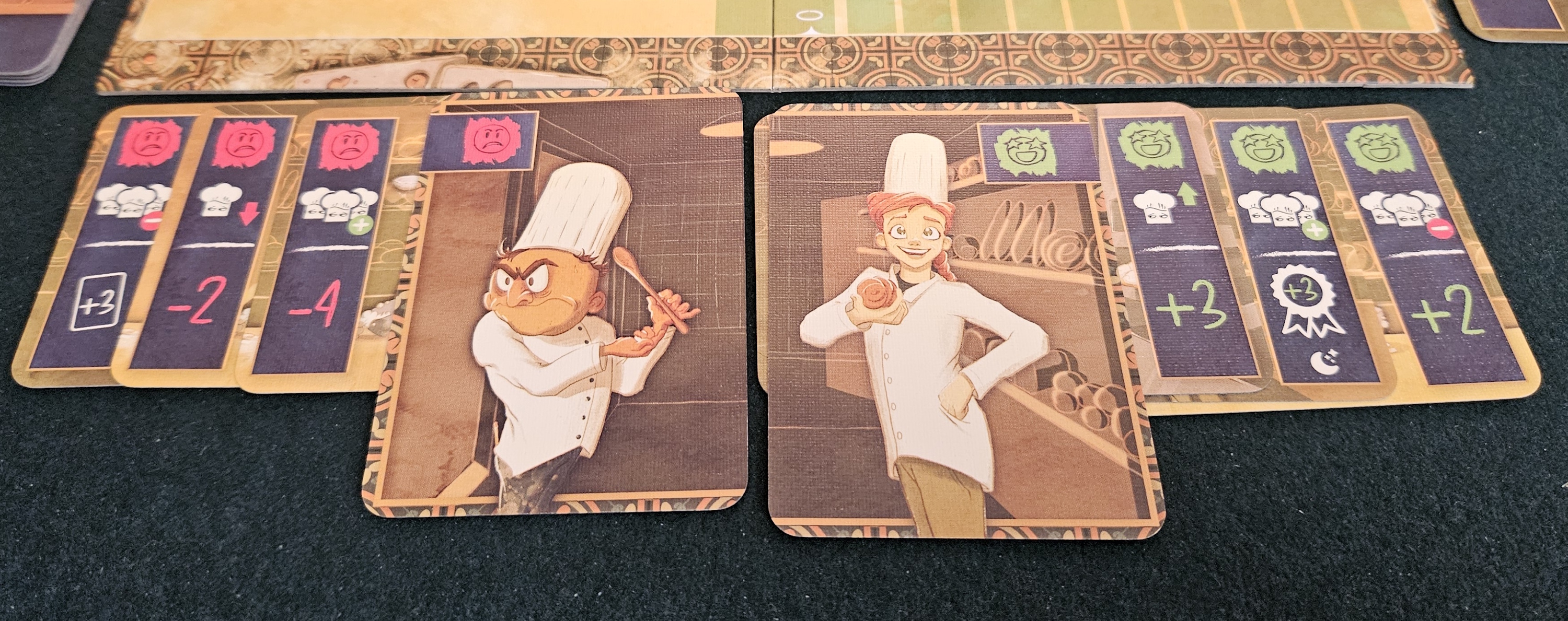
Each card has four main components. Victory points — self-explanatory — some icons that increase the appeal of your trip on a numbered track, the amount of time required to fully visit that card, and lastly a scoring opportunity that will only trigger if this is the final event scheduled on any given day. Your objective is largely about optimizing scoring. To offer but one example, visiting the National Archives earns three points for every history icon you placed on that day. That’s a tremendous opportunity if you’ve arranged a day full of tours, but is easily dismissed if you’re planning on shopping or eating instead.

Those other considerations are no slouches, either. It’s possible to absolutely cram a day with activities, but your energy level will suffer, possibly resulting in subtracted points. There are also ideal conditions for each day, earning little bonuses for visiting the park when it’s clear outside or stuffing yourself with pastries on what I imagine is your cheat day. And if nothing appeals, Wood returns with a trick he deployed to great effect previously, letting any card flip to its reverse side to become a generic “Explore the City” activity.
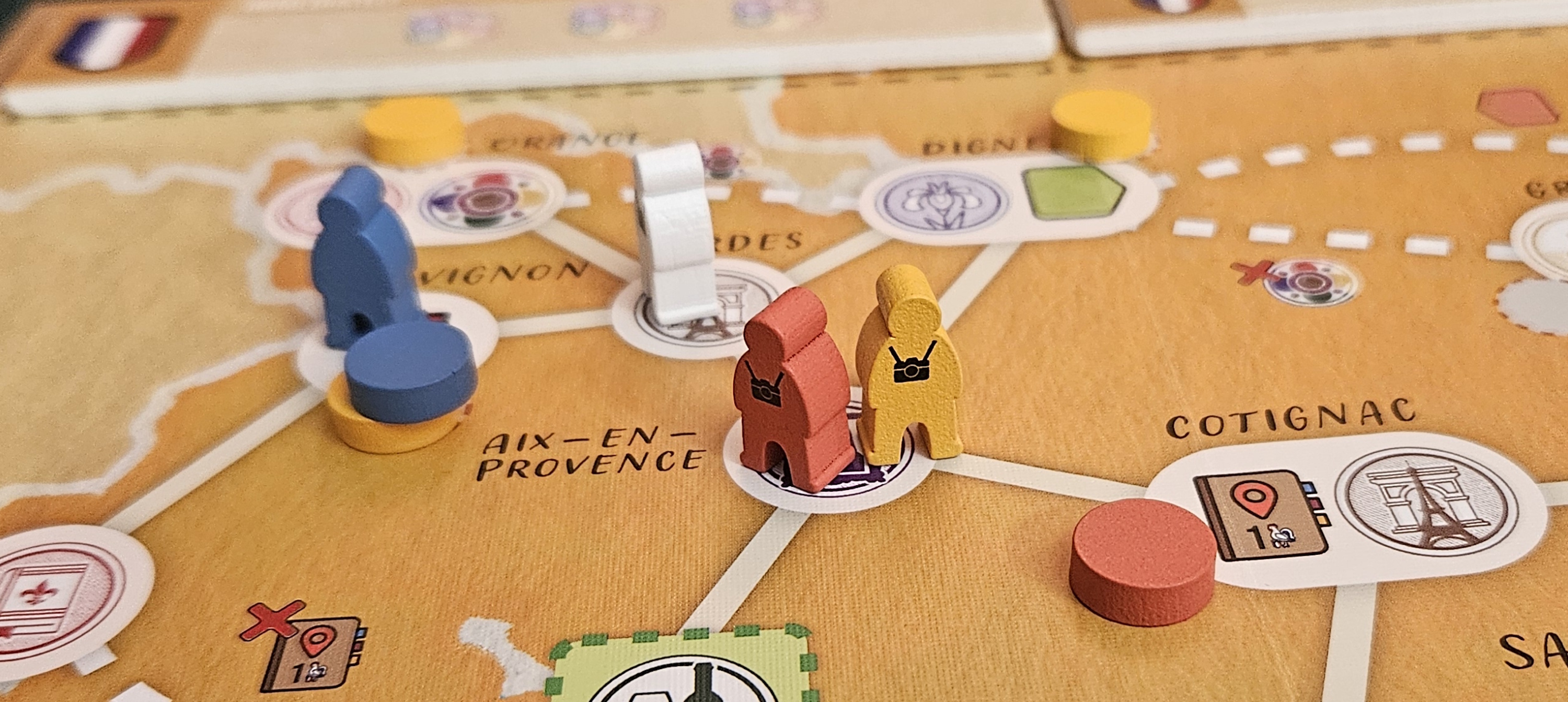
I'm pretty sure some of these are just big cities, but look, if it isn't Paris, it's country, got it?

Spending a week in the country before heading to Paris.

If you’ve played Let’s Go! To Japan, this likely sounds familiar. Indeed, nearly everything here resembles Wood’s previous title, but has become the beneficiary of little tweaks that mark this as the far superior outing.

For instance, there’s the way those Explore the City activities are handled. Previously, exploring Tokyo or Kyoto resulted in your tableau receiving a random card during scoring. This could make or break your day, interjecting some randomness into what was otherwise a carefully structured experience. Here, exploring the city is its own pleasure; one doesn’t need to stumble upon a museum or garden to justify their time spent in Paris. This keeps your tableau in check and feels more appreciative of what makes such a trip worthwhile. Just being here is enough.

Similarly, the ideal conditions for each day are now portrayed as guidelines rather than dictates. It’s worth assigning activities to the corresponding days, but this is only mildly beneficial, and only the first two times you do it. Beyond that, you’re free to schedule your days as you see fit, without worrying that you’re missing out on another drizzle of points. It’s a small thing — basically, you’re earning a benefit just a little earlier than in the previous game — but it goes a long way toward letting you shape your own trip rather than ensuring there’s a history day, a food day, an architecture day, and so forth.

Wait a minute, how dare you name a place Les Invalides? That should be reserved for hospitals and... [touches earpiece] it's a what? Ahem. Never mind.

The tableaux here are much more flexible than those in Let’s Go! To Japan.

The larger change is more structural. Where the previous game saw your vacationer shifting between Tokyo and Kyoto, a system that demanded its own train-hopping minigame, Let’s Go! To France instead divides its trip into two portions. Your main tableau actually represents the second week of your vacation, resolved during scoring. As you place cards into your tableau, however, you might trigger tickets that move a pawn across the countryside. Depending on your destinations — and which region you’ve chosen for the group to explore — it’s possible to begin your week in Paris having already seen some sights, earned some tokens, or maybe even secured a special scoring condition or two.

At times, there’s a sense of vague translocation. You are, in effect, planning Schrödinger’s Vacation, the cards signifying events in both past and future. But it’s a mild discombobulation at worst, one that lasts maybe five minutes before everything snaps into place. The overall process is much smoother than the previous game’s swapping between cities, and provides ancillary benefits to the game’s usual procession of daily scores.

You might, for example, begin your week in Paris already tuckered out from your time in the Loire Valley, prompting you to take it easy for a couple of days or chow down on some crepes for a sugar rush. Or perhaps you’ll arrive already enculturated by old architecture, letting you take advantage of a daily highlight that requires a certain number of icons before awarding big points. Where previously these objectives would only pay out in the later portion of your trip, it’s now possible to assemble a more robust tableau, one that feels rewarding from start to finish.
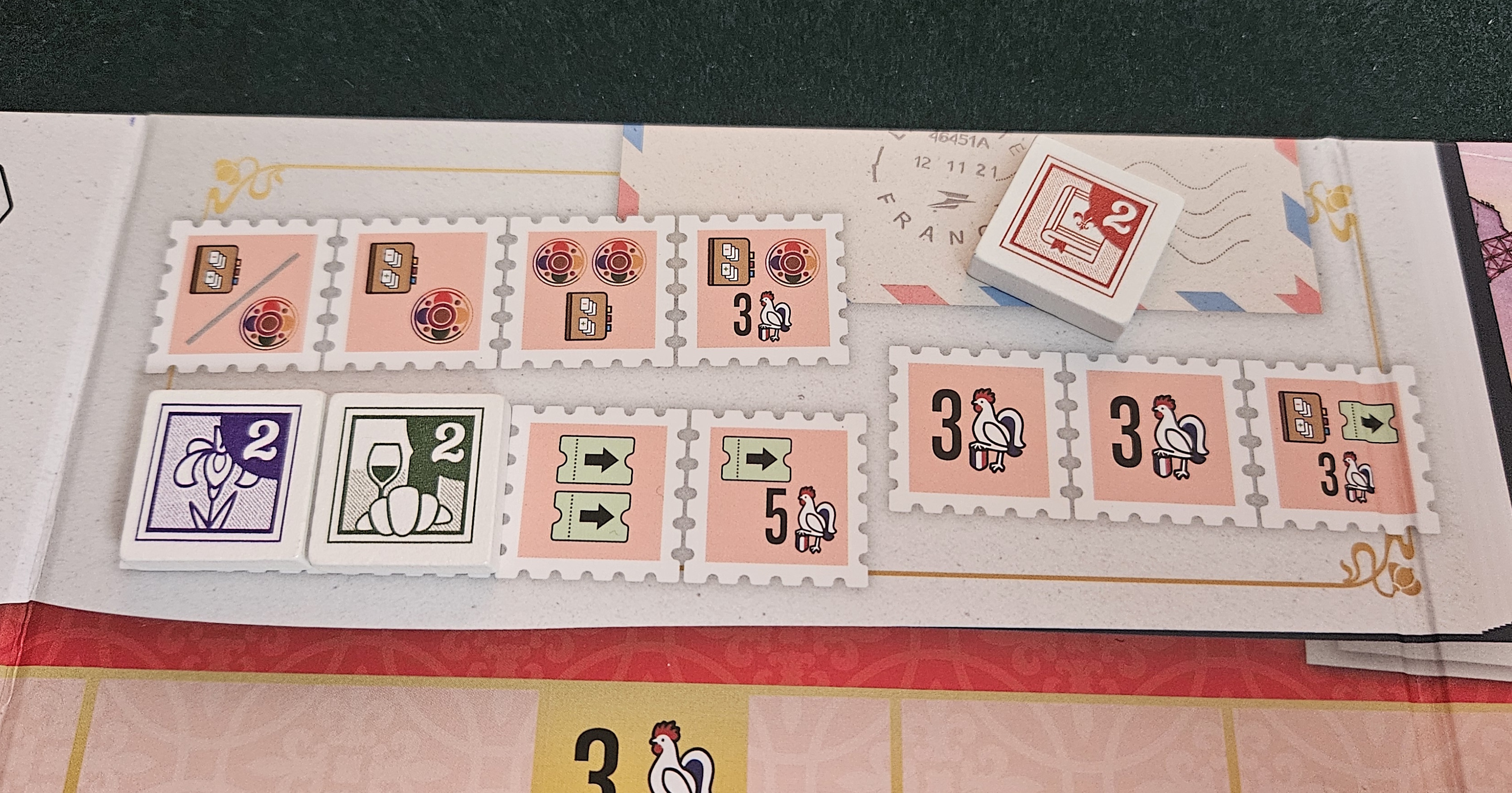
a Belinda's Big Bonus, on the other hand? erm.

I appreciate a bonus.

As before, scoring is an active portion of the game, an event in and of itself where players walk through their trip one day at a time, tallying points and keeping track of their relative energy levels. This helps to digest the game’s point-salad fiber, but it plays an even more important role in contextualizing Paris as a geographic space with its own character and identity.

I’ve often praised Santa Monica as an ideal tableau-builder for the way it asks players to not only create a space, but also to inhabit it, to move around in it, to poke around its nooks and crannies. With Let’s Go! To France, Wood replicates the trick, albeit via an entirely distinct set of mechanisms and representations. This is Paris as a location out of time, the city that is at once a tourist trap and timeless. Around every corner there’s something new to see, some fragment of history that has been improbably preserved across the ages.

And that sense is communicated above the table as well. As one friend put it, you could take the deck to Paris as a reminder sheet of everything there is to see and experience. Playing this game, we found ourselves discussing the spots we’d seen and those we hope to see some day yet to come. The overlooked garden with the hidden entrance, where one friend drank wine and conversed with a farmer. The museum that sparked my imagination more than any other I’d ever walked. The sheer looming size of something. The joy of ducking into a random cafe and having one of the finest meals of your life.
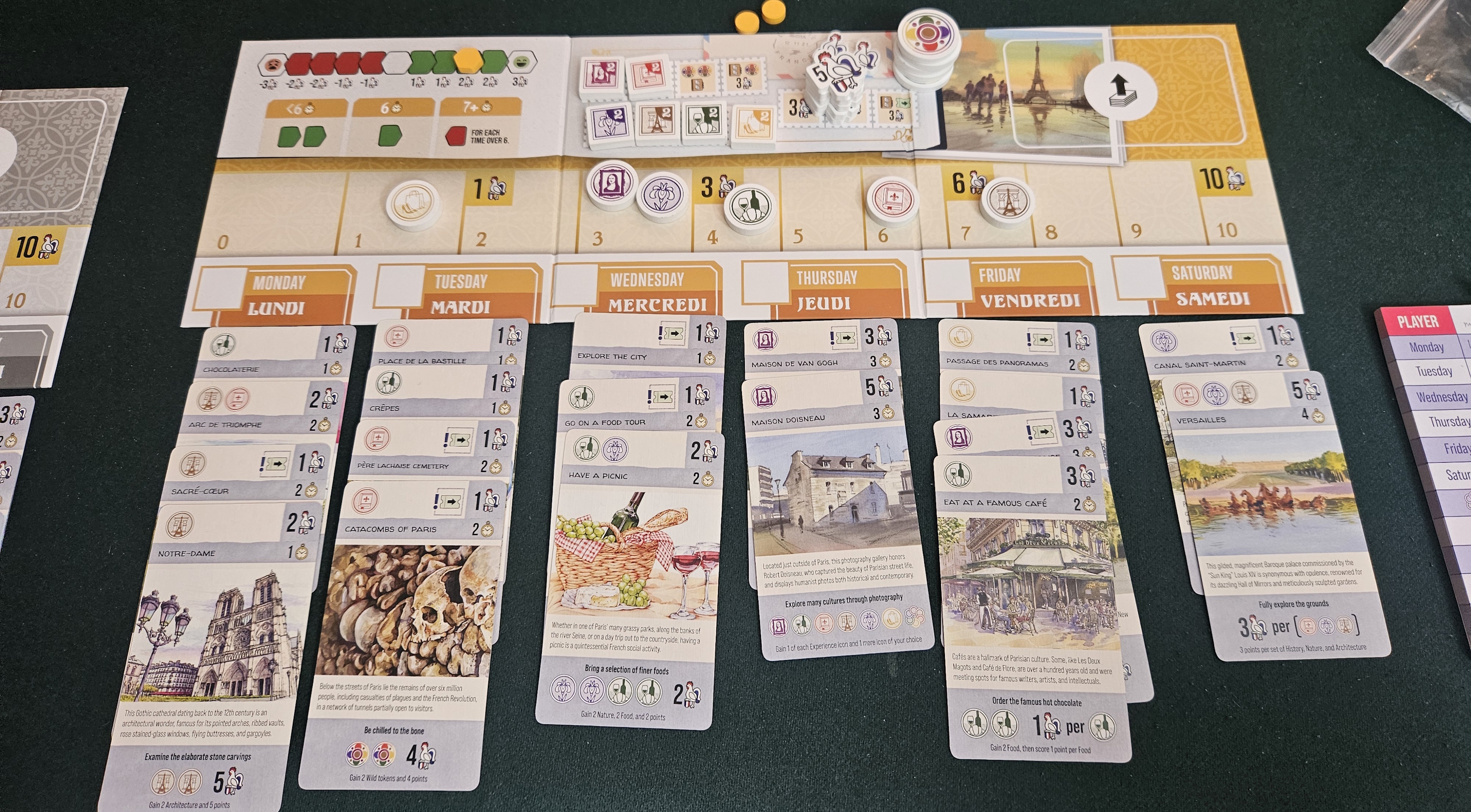
I'd try to squeeze in a meal on Saturday, though.

I’d do that.

The effect is magical. In a sense, Wood has created a transposition of his own, a game at once past and future, both reminiscence and future itinerary.

He’s also crafted a game that’s nearly without parallel. That its best comparisons are Wood’s own past creations is a testament to his skill with this particular medium, but also to the city he’s chosen for us to experience all over again. In improving on its predecessor in nearly every way, Let’s Go! To France deserves its peculiar punctuation. Let’s go, indeed.


A prototype copy of Let’s Go! To France was temporarily provided by the publisher.

(If what I’m doing at Space-Biff! is valuable to you in some way, please consider dropping by my Patreon campaign or Ko-fi. Right now, supporters can read my first-quarter update of 2026: the best board games, movies, books, and more!)

Space-Cast! #55. Burnt Poop

15. April 2026 um 19:24

You might think that Wee Aquinas would object to an episode about poop, but he's spent enough time in privies that he's more or less inured to the concept.

Poop! Spies! What do they have in common? Both are featured in board games designed by Jon Teixeira Moffat, naturally. On today’s Space-Cast!, we’re joined by Jon to discuss the long development of both Night Soil and Burned, the hidden cost of labor, and cinematic hidden movement games.

Listen here or download here. Timestamps can be found after the jump.

TIMESTAMPS

00:36 — introducing Jon Teixeira Moffat
4:06 — Stone Circle Games
7:00 — Night Soil
21:08 — portraying labor
33:15 — Burned


(If what I’m doing at Space-Biff! is valuable to you in some way, please consider dropping by my Patreon campaign or Ko-fi. Right now, supporters can read my first-quarter update of 2026: the best board games, movies, books, and more!)

💾

Flippin’ Mickey

14. April 2026 um 21:30

this is not an ambigram

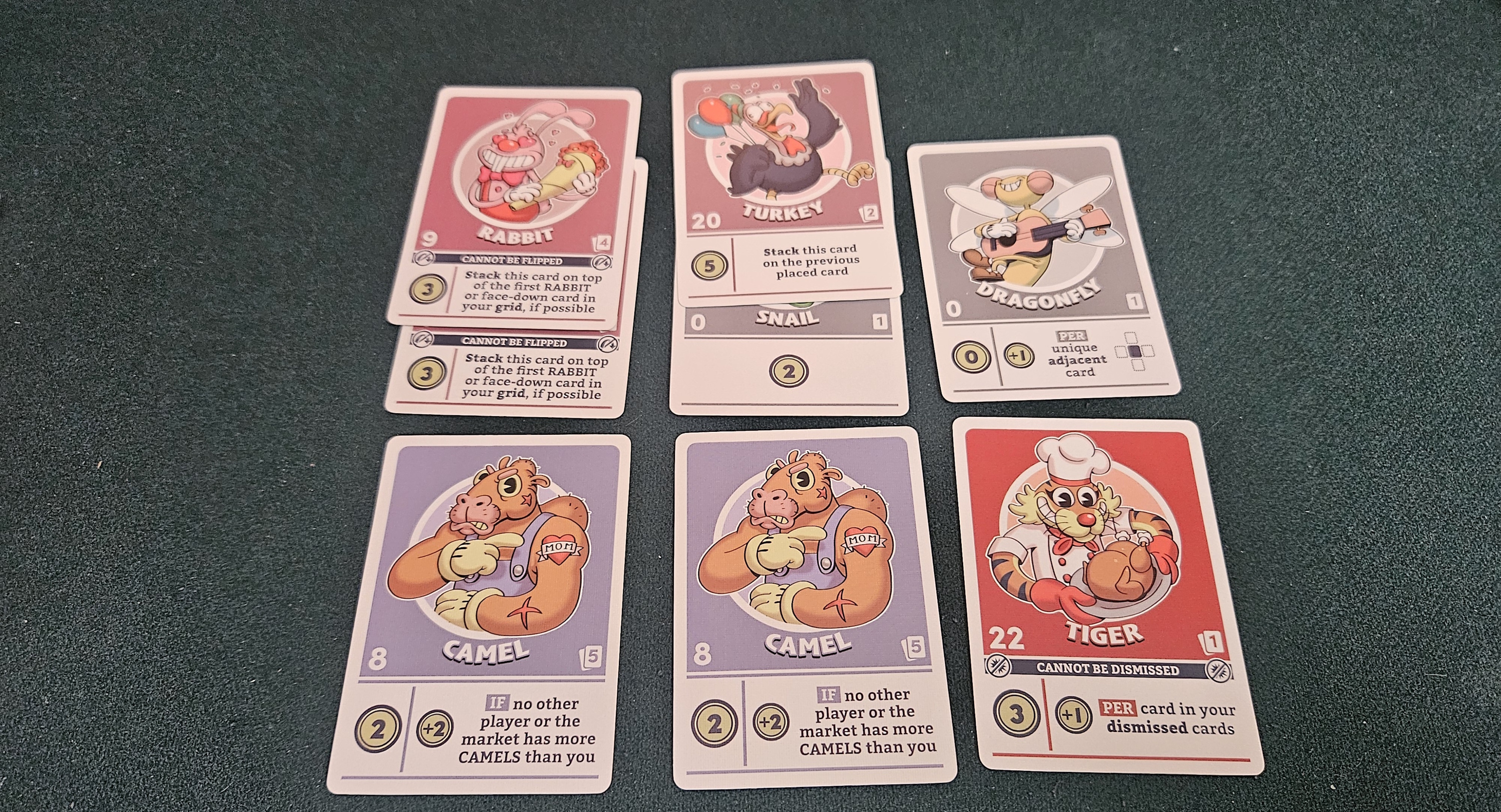
FlipToons was designed by Renato Simões and Jordy Adan, the latter of whom gave us Stonespine Architects and Cartographers, but the real star of the show is Diego Sá, whose animated characters make me want to rate the game significantly higher than I would otherwise. Just look at those little dudes! The camel is two seconds away from winding up a punch. The rabbit wouldn’t feel out of place leaning in for a kiss, only to be rebuffed when the ostrich hides her head in the sand. The sheep is just is out there boppin’ to her tunes.

As a game? Oh, it’s pretty good. Clever at points, nice to play, the usual. My larger reservation is the way it makes me feel during and after a play.

The other day my children were counting a bee's legs and getting mightily confused because it would not stop moving. That's me checking that I have six cards in FlipToons.

Six cards. In theory.

FlipToons is a game of two halves. Two halves which, when hinged like an aquatic bivalve, form into a united whole that conceals an unexpectedly tasty muscle within. Okay, so I skipped breakfast. Point is, FlipToons is hard to discuss holistically without first establishing how its components function apart from one another.

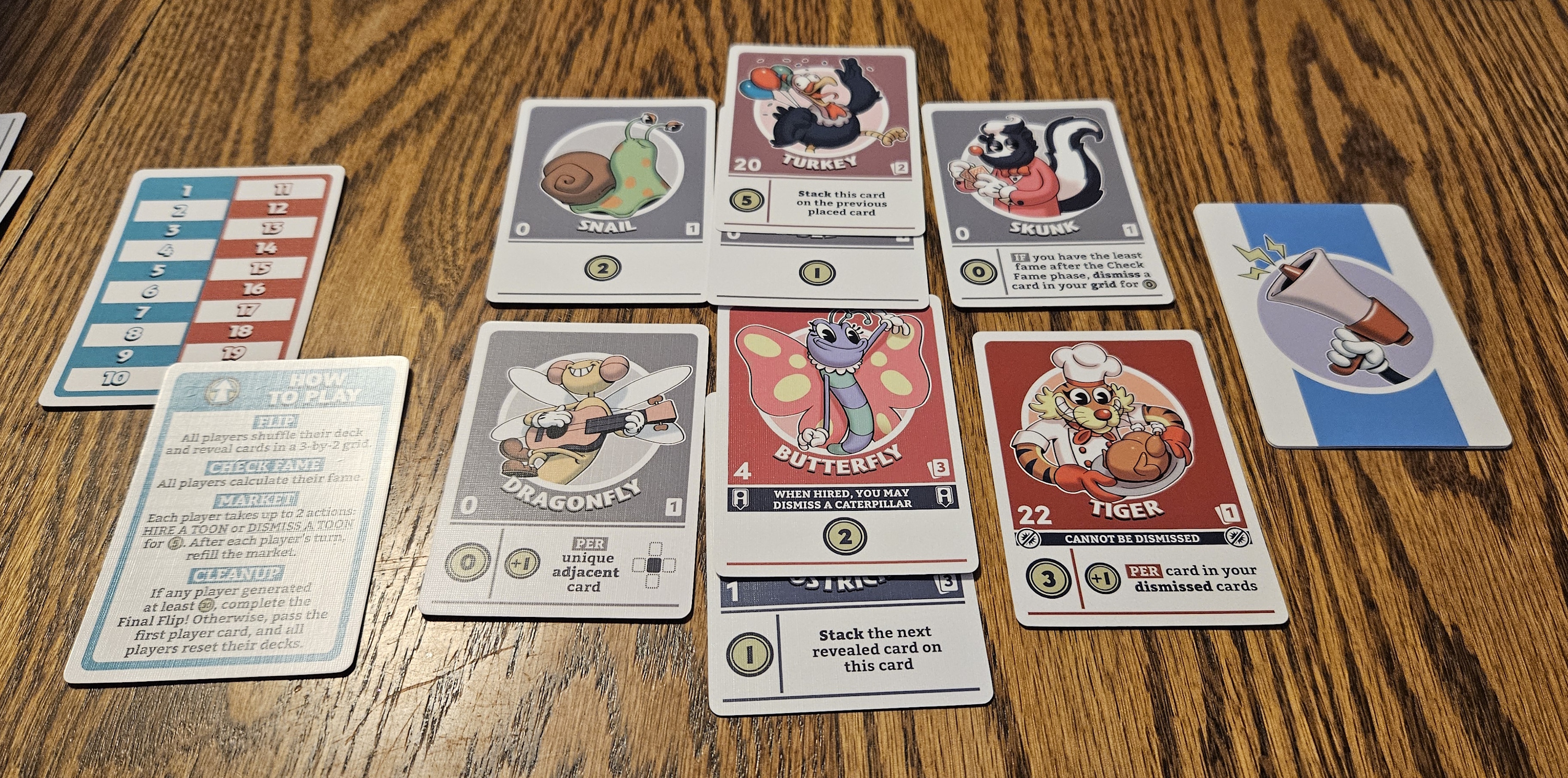
The first part is the deck. When the game begins, you have six cards in total. Two caterpillars, each worth bupkis, but easily dismissed. One skunk, a utility card for winnowing your deck. One bee, worth a single pip of purchasing power. One snail, worth double the bee’s value, making it the single most precious card in your starting lineup. And one dragonfly. Ah, the dragonfly. This guy gives you one point for every unique adjacent card.

What this means requires some explanation. Every round opens with you shuffling your deck and then dealing cards onto the table in front of you to create a three-by-two grid. If you have extra cards, too bad, they remain in your hand. If you have too few cards… well, don’t do that.

Some cards may stack. Rabbits, ostriches, turkeys, these are your chance to get more than six cards into your grid at a time. Others, like sheep or monkeys, trigger benefits if they occupy a particular row or column. Some cards flip, others compare values against other players or the market, and a few, like the pig, are traps that can be gifted to rivals to subtract from their tally.

That tally, then, is taken to the market to shape your deck. Since you’ll only use six-ish cards at a time, keeping your cast trim is a good idea. Fortunately, unlike most deck-builders, the ability to dismiss toons is inbuilt in FlipToons, always available for the low cost of five points.

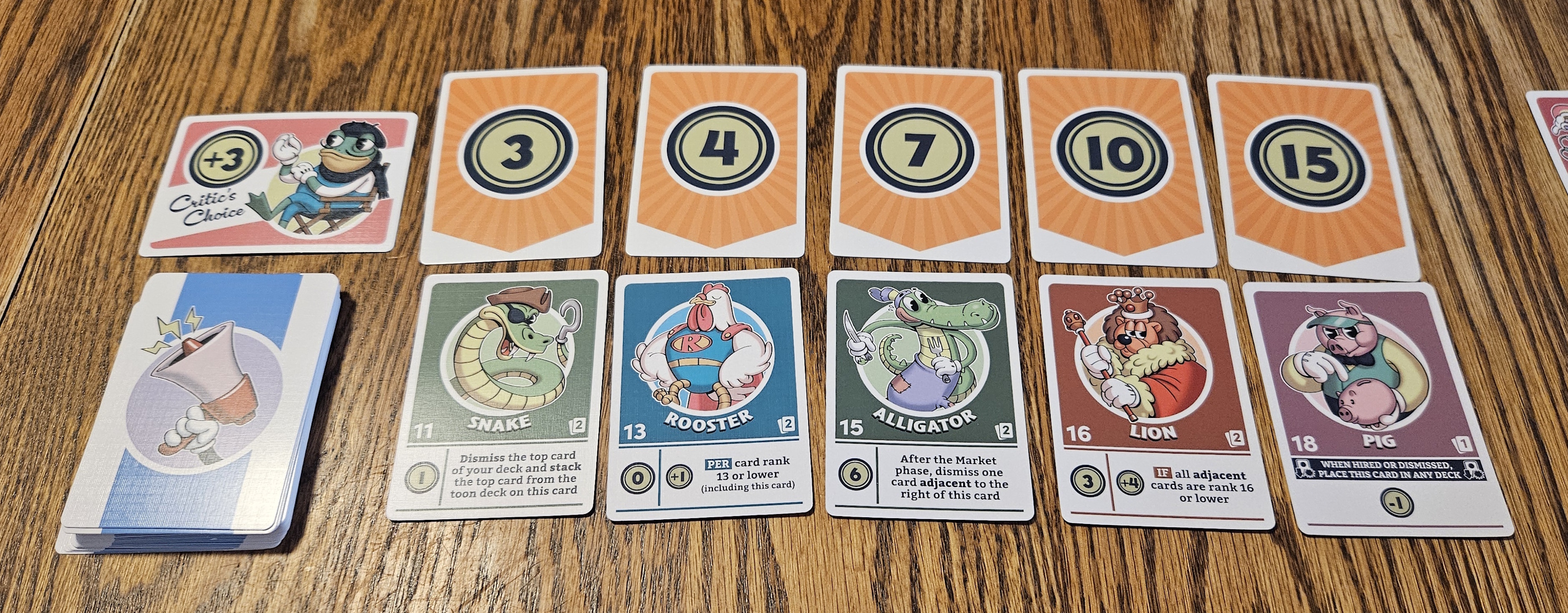
The toons on display, meanwhile, adjust in cost according to their relative ranking. This ensures that something is always available, and if you’re lucky it’s possible for something unusually precious to slip down in cost. Of course, the opposite often also proves true, with low-value cruft sometimes overwhelming the market.

Regardless, you take your purchases and/or dismissals, shuffle your grid back into your hand, and begin all over again. Bit by bit, your cast improves. That measly starting five to six points becomes twelve, then sixteen, then you break twenty and flip your little tally card to its opposite side. The goal is to score thirty.

I'm not sure the snake and the alligator can be played well... then again, they're just gambling outright, which is at least fitting.

Costs are adjusted dynamically, which can result in little surprises.

Okay, not quite. Your actual goal is to score the most on the final round. Hitting a tally of thirty is how you trigger the endgame, and there’s a small plus-three advantage if you’re the one to bring it about, but that’s no guarantee luck will be on your side for the last flip. So, then: hit thirty to lock the game into one final pull of the lever, then hit the jackpot.

The slot-machine analogy is apt here. FlipToons is to deck-building what Balatro was to poker. The titular flip of FlipToons is devoid of decision points. You turn cards in order, left to right and top to bottom, until you’ve produced that three-by-two grid.

There’s more going on in the market portion, but these are minor choices rather than a vast menu. There are five cards available at any given moment, and even when you’re flush with cash in the late-game, you’re limited to two purchases. (And dismissing a card from your deck qualifies, so no double-dipping.) This keeps everyone at the table more or less bungee-corded at the hip, which is probably the right decision for such a light game, but also prevents the table from launching the exponential bottle rockets that were Balatro’s core pleasure.

But about those pleasures…

I have my reservations about these sorts of games. The art and market purchases, while pleasant, aren’t far removed from the lights, illusory choices, and “theming” of a slot machine. I remember as a kid on a trip to Vegas, walking past a slot machine that leaped out of the crowd. I think it was based on Aliens, with those sleek oily monsters I had yet to witness on the screen for myself, but which my friends with the cool parents, the ones who let their kids watch R-rated movies in elementary school, spoke of as the scariest things they’d ever seen. My Dad traced the object of my interest and leaned down to whisper, “That’s how they get you.” It was like somebody had roused me from hypnosis. In that moment, my Dad — who suddenly struck me as cooler than those other dads, or at least cannier — had broken through the social programming of that cigarette-reeking hellhole.

And, look, I don’t think FlipToons is some sort of evil artifact. It isn’t the equivalent of a casino, with its fine-tuned odds to ensure the house always wins and your kid’s college fund becomes another rounding error in a billionaire’s high score. But it produces a similar daze, all submersion and dulled perception. It’s a far cry, too, from some of the sharper auto-battler board games, titles like Tag Team, with its emphasis on attention and preemption, or One-Hit Heroes, which requires constant input from its players. Here, the gameplay comes pre-loaded. All you have to do is pull the lever.

The solo mode is basically a race to hit 30 points while the game discards cards from the market. It's blindingly easy.

It doesn’t always take much effort to reach those 30 points.

I mean, there’s more to it than that. Just not by as much as I would prefer. Certainly not by enough to make me want to play it more.

Because in the end, FlipToons is a pleasant enough diversion. It’s well-crafted, pretty to look at, and feels good to play. When it hits the table, the fugue it offers is dreamy and warm. But when it’s done, I feel like I binged on steakhouse butter in place of an actual filet. It lacks what brought me to the table in the first place. It doesn’t spark my imagination or help me appreciate my friends. It doesn’t teach me anything. It barely even makes a win feel different from a loss. Most of the time, I hardly remember how I spent the past twenty minutes.

But yeah, the art is lovely. Those lovable goofballs. Those scamps. That’s how they get you.


A complimentary copy of FlipToons was provided by the publisher.

(If what I’m doing at Space-Biff! is valuable to you in some way, please consider dropping by my Patreon campaign or Ko-fi. Right now, supporters can read my first-quarter update of 2026: the best board games, movies, books, and more!)
Brine & Origami

14. April 2026 um 00:52

Make an origami of those sticky sea-things that lie on the beach, their sacs bloated and pulsing.

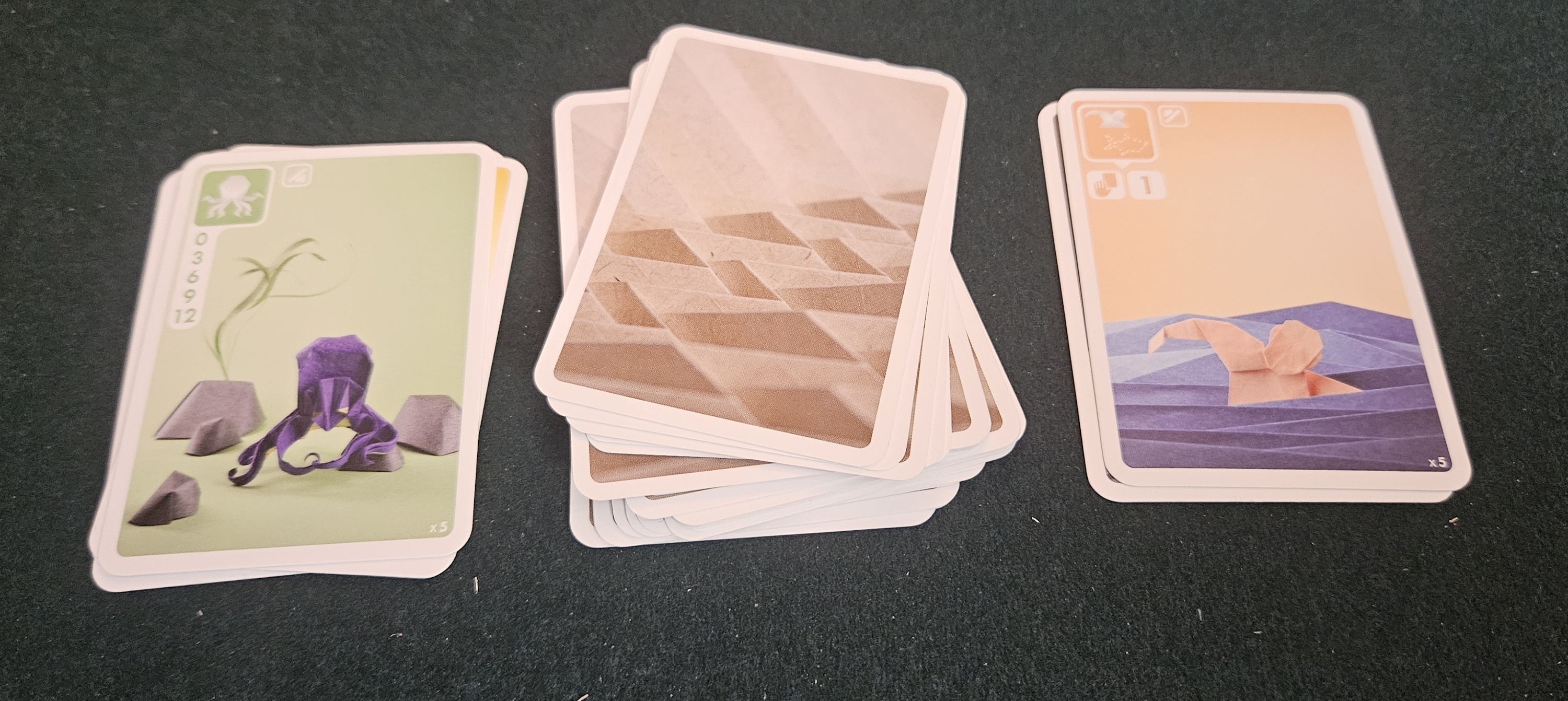
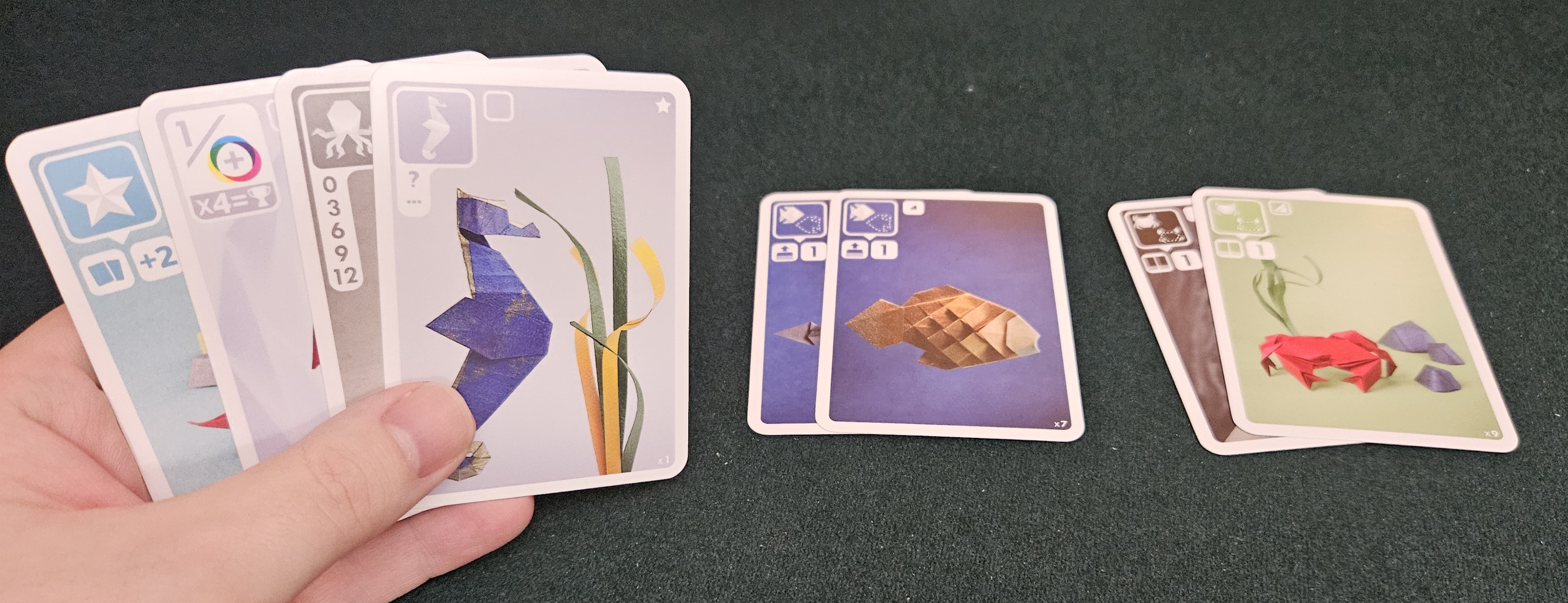
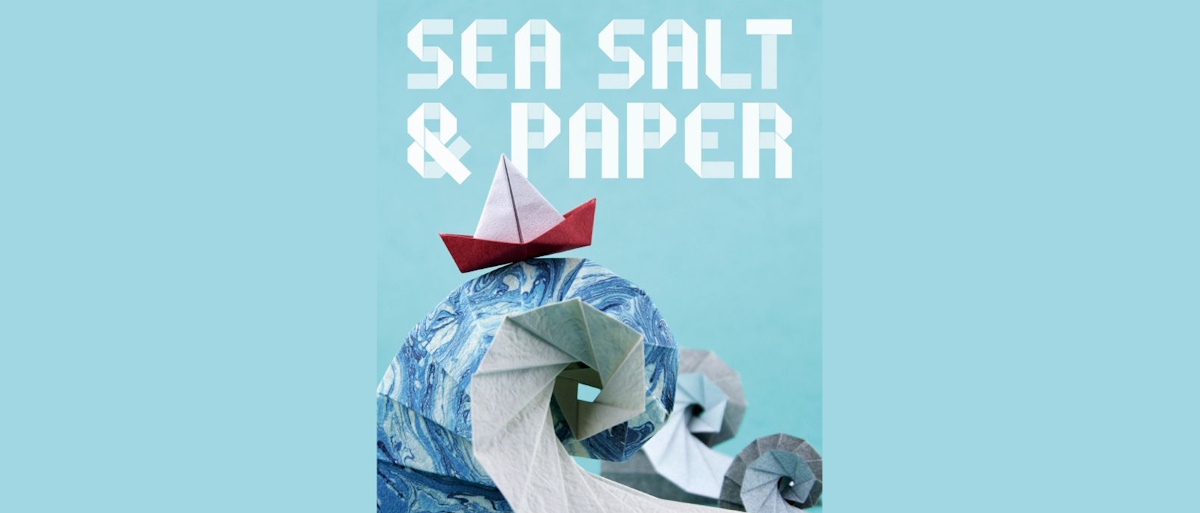
Sea Salt & Paper sure was hot a couple years back, huh? I didn’t think much of this thing the first time I encountered it, perhaps a symptom of having only played it with a single partner; in contrast to some, I find it needs room to stretch out. Perhaps it helps, too, that the expansions, More Salt and More Pepper, both give the game a small kick in its folded shorts.

I could have tidied the piles, but this isn't that sort of game.

The basic choice: from where does one draw?

For those who haven’t played Bruno Cathala and Théo Rivière’s small-box card game, Sea Salt & Paper opens with the gentlest of all possible choices: from where to draw? Your options, in this case, are either the deck proper — in which case you’ll draw a pair, keep one, and toss the reminder into either of two discards — or the top offering from one of those castoff piles. Either way, you gain a single card.

Over the course of multiple turns and multiple sessions, however, this choice begins to take on some depth. First, there’s the possibility of playing a duo. Some cards, when paired with a mate, can be deployed to the table. The pair is worth a point either way, but their coming-out provides some small benefit: crabs that let you dig through a discard pile for something previously buried, boats that start your turn anew, a shark and swimmer that swipe something precious from a rival’s hand.

But while duos are potent, there’s more to your picks than pairing cards. There’s the color of the card, entirely separate from its icon, which can amass points as you gain more of a particular hue. Or there are offerings that pose a risk, like octopuses and penguins, worth nothing at first but gradually accumulating points as you build sets — while, of course, signaling to your opponents that you’re angling for something.

Or there’s the risk of throwing away something worthwhile to the others at the table. More than once, I’ve had to take a worthless shell because Adam, who tends to sit to my left, hoards shells by default. If I throw one out, he’ll nab it for certain. And fortune favoring him, he probably already has three in hand.

This is all to say that Sea Salt & Paper is an unassuming little thing. Its choices are diminutive, but no less crucial for their stature.

Oops, I showed the seahorse twice. You'll see.

Cards in hand are hidden, but vulnerable.

Where the game gets interesting, though, is in its scoring. Played over multiple hands, the objective is to accumulate some number of points. Say, thirty points with four players. But rather than ending any given hand at a certain threshold, here players are allowed to keep playing until somebody elects to go out. And then they’re offered another little choice that bends the proceedings. They can declare the hand is over, at which point everybody scores according to what they’re holding and/or the duos they’ve revealed. Or the goer-outer can announce that they have the high score at the table and nobody can match them.

Aha! The contest is on. And the stakes are high. If the player who went out has the highest score, they earn all their points plus a color bonus, points worth the sum of their highest-held suit. That might be a lot or a little, depending on their priorities that round. Everyone else, meanwhile, earns only a color bonus. Again, that might be a tidy sum, but it will almost certainly be less than their normal score. But if the opposite holds true, the pendulum swings the other way. Everybody else scores their hand points, while the shouty player earns nothing but the color bonus.

Like everything else in Sea Salt & Paper, this decision is understated. But it represents a potentially major swing. I say “potentially” because, well, this is a game of subtle wagers and sudden swings, and it’s entirely possible for somebody to quietly amass a solid bar of colors and come out ahead either way.

This gives it a sleepy atmosphere. I might even call it boring, in a largely pleasant way, the sort of game you play with your grandmother while sharing some light chit-chat. In that regard, it reminds me of something like Mexican Train or countless trick-takers played with a regular deck. It doesn’t exactly knock me out of my socks, but it was never meant for sock-rocking. It’s there for quiet evenings on the seaside, the air heavy with the inrush of atmosphere, a storm coming but still out on the horizon. It’s a bedtime game.

There it is. These pictures weren't even taken on the same night. I guess I just love seahorses. (True.)

Extra Salt adds a few cards.

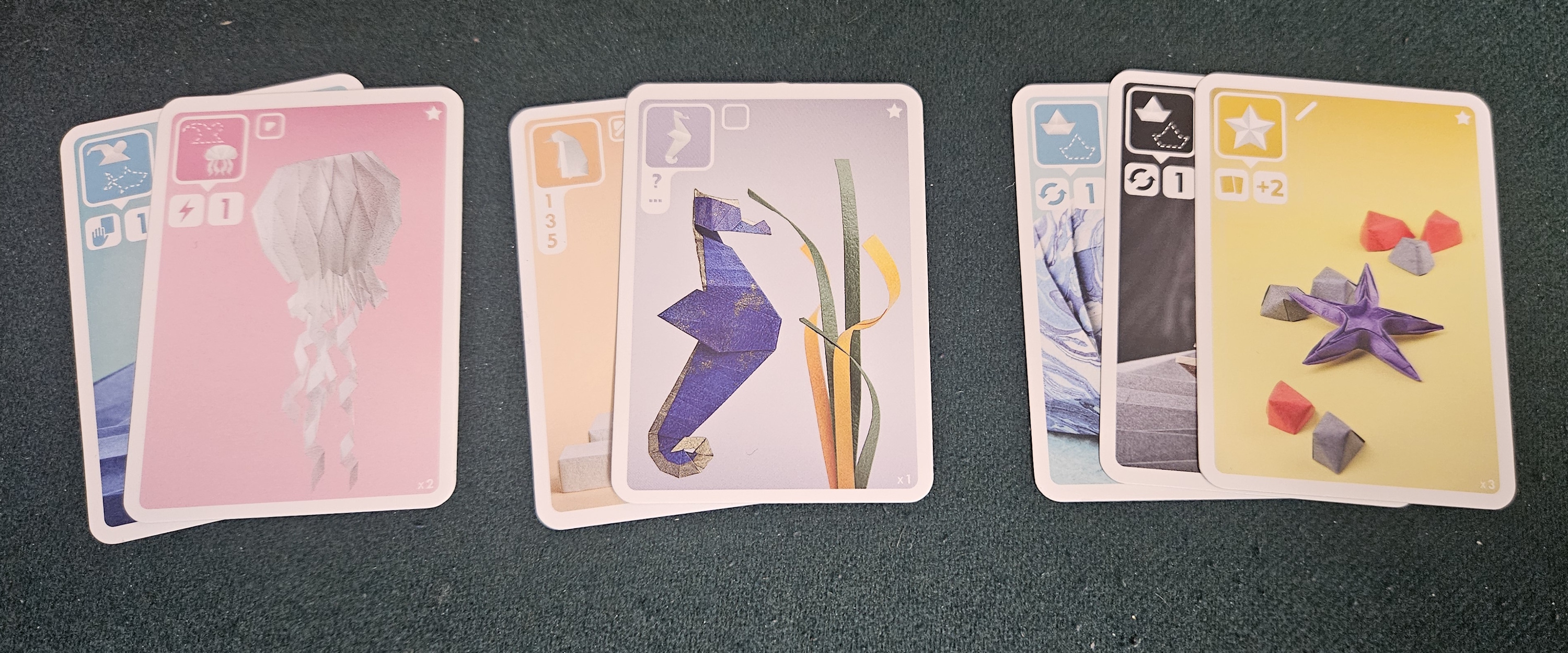
The expansions give it some much-needed kick. The first, Extra Salt, adds only a few cards, not enough to upset the delicate ecosystem of the original game, but sufficient to add at least a few decisions. Extras like a lobster or a jellyfish pair with previously-obvious offerings to produce new effects, while a seahorse makes certain sets more worthwhile and starfish can be added to a duo to drop their ability in exchange for some extra points. The game is still sleepy, but the decision-space is a little denser.

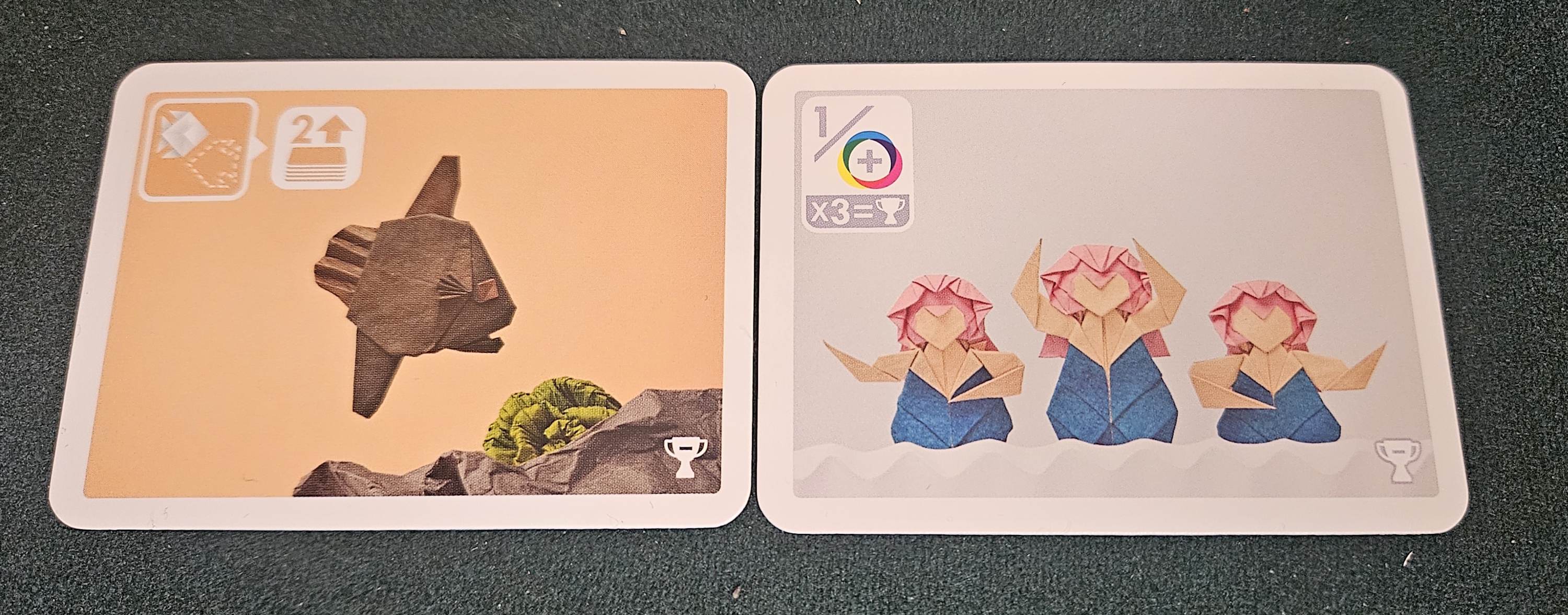
Next is Extra Pepper, the more interesting offering. Every round, an event card is drawn that alters the proceedings. A change to how a certain set is formed, a higher scoring threshold, only needing three mermaids to win outright rather than the usual four… that sort of thing. Everybody plays according to this altered rule, but then — and this is the smart bit — then the winning or losing player receives the event card as a permanent addition to their repertoire. This varies by card, with handicaps going to trailing players and hurdles to winners. Either way, the game receives a nudge that corrects toward the median ever so slightly. Or, better yet, allows somebody to manipulate the rules in their favor by tanking an early session to nab something ultra-potent.

In both cases, the expansions benefit the core game by adding a little more to the turn-by-turn proceedings. If I had to identify an issue with the game — which, again, I’m not sure this is the sort of game that bears a deep critique — it’s that the decision-making process is so muffled. There’s a gap between good and bad play, but good and great play? Eh. I’m not convinced. To their credit, the expansions offer a few more of those small decisions that make it such a pleasant, if still sleepy, game for late nights.

Assignment: Wee Aquinas origami.

Extra Pepper is more interesting.

On the whole, Sea Salt & Paper is a game that’s nice to play with family, as a filler, or when everybody’s too tired for anything heavier. That’s a crowded field, but, well, this just so happens to be one of the games that’s succeeded in that arena. Call it the king of the sleepers. I doubt Sea Salt & Paper would even take it as an insult.


A complimentary copy of Sea Salt & Paper was provided by the publisher.

(If what I’m doing at Space-Biff! is valuable to you in some way, please consider dropping by my Patreon campaign or Ko-fi. Right now, supporters can read my first-quarter update of 2026: the best board games, movies, books, and more!)
Sejm As It Ever Was

09. April 2026 um 23:20

How I feel when I turn in an article draft to my wife.

Here’s a situation for you. It’s the last decade of the 1700s. Far across the sea, a rebellion has ousted the British from thirteen of their prize colonies, leading to the adoption of a new constitution. Revolutionary fervor is sweeping the continent, throwing France into turmoil and the old regimes into paranoia. Your union, the Polish–Lithuanian Commonwealth, has seen its star faded by entrenched nobility and foreign partition.

And now there’s an opportunity to draft a constitution of your own.

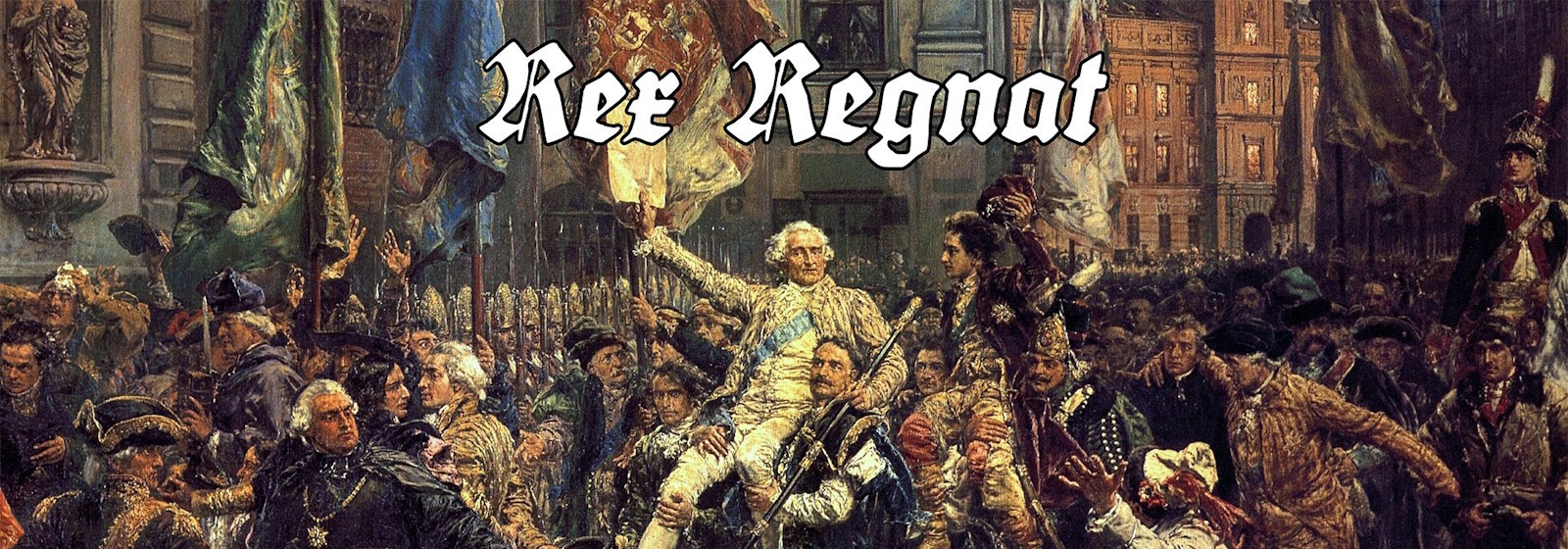
That document — historically the Constitution of 3 May 1791, although you might instead draft any number of parallel constitutions in its place — is the topic of Rex Regnat, Edward Damon’s sharp-as-a-tack title about uncomfortable politics and doomed alliances. Part trick-taker, part parliamentary simulation, and part rumination on a union whose constitution would only last 19 months before it was divided out of existence until the First World War, Rex Regnat is one of the finest political games I’ve played all year.

Hm, where is the WHINING ON 'APOLITICAL' COMEDYBRO PODCASTS issue?

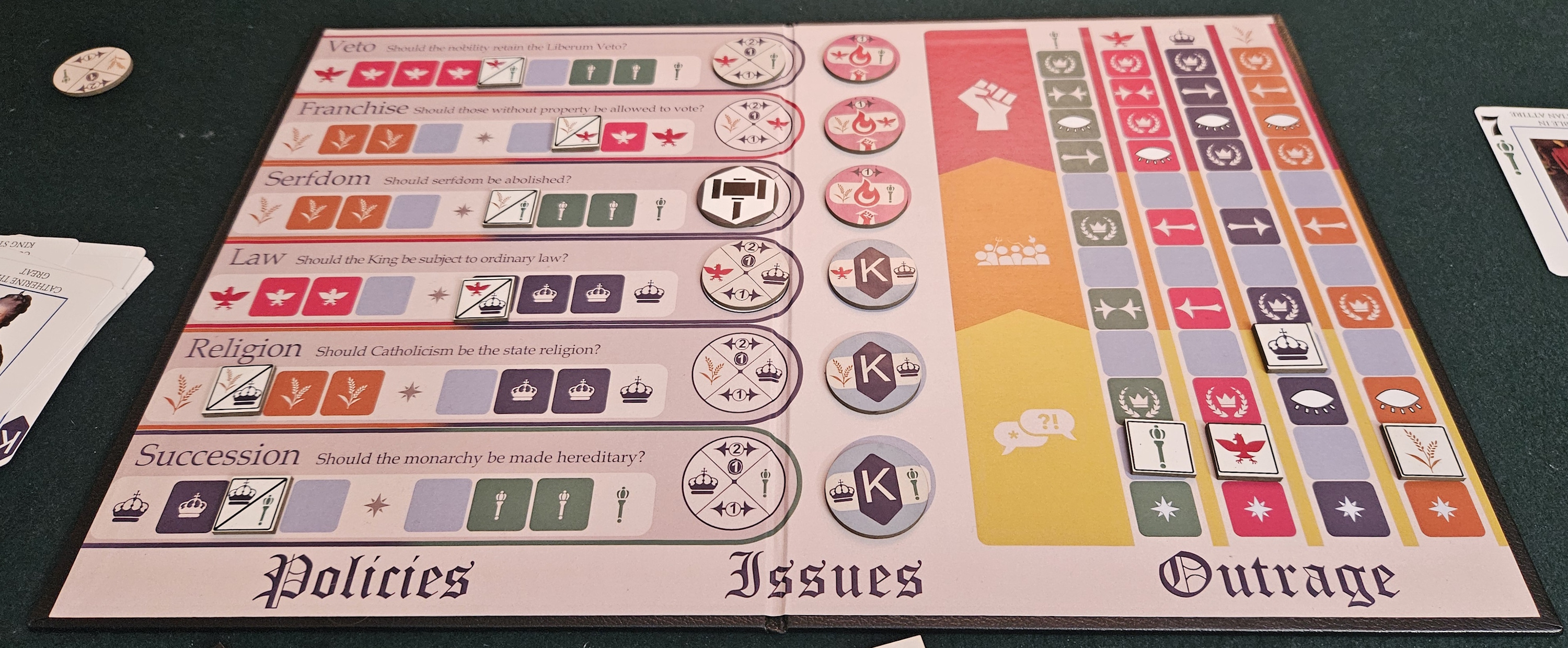
Some of the issues facing the Polish–Lithuanian Commonwealth in the late 1700s.

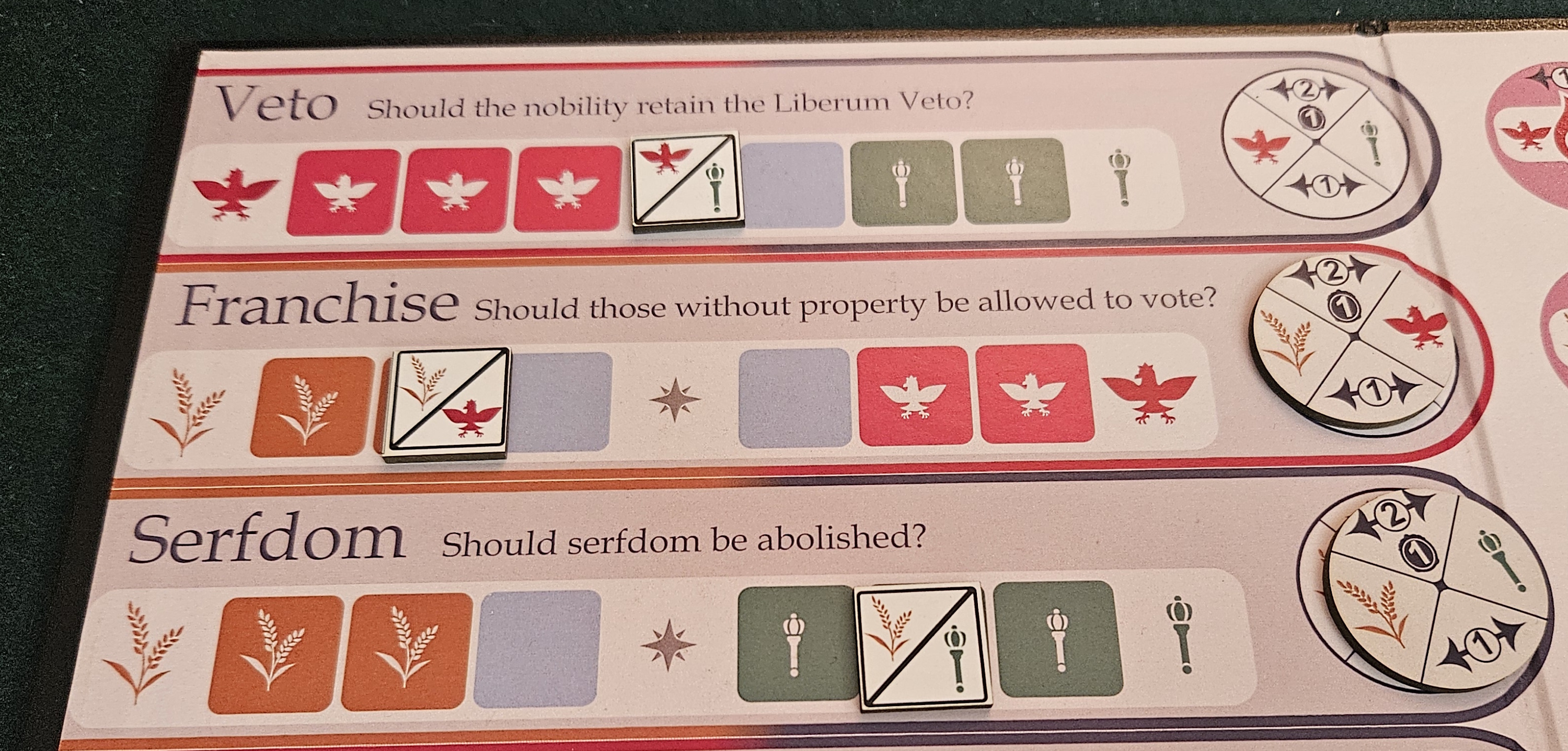
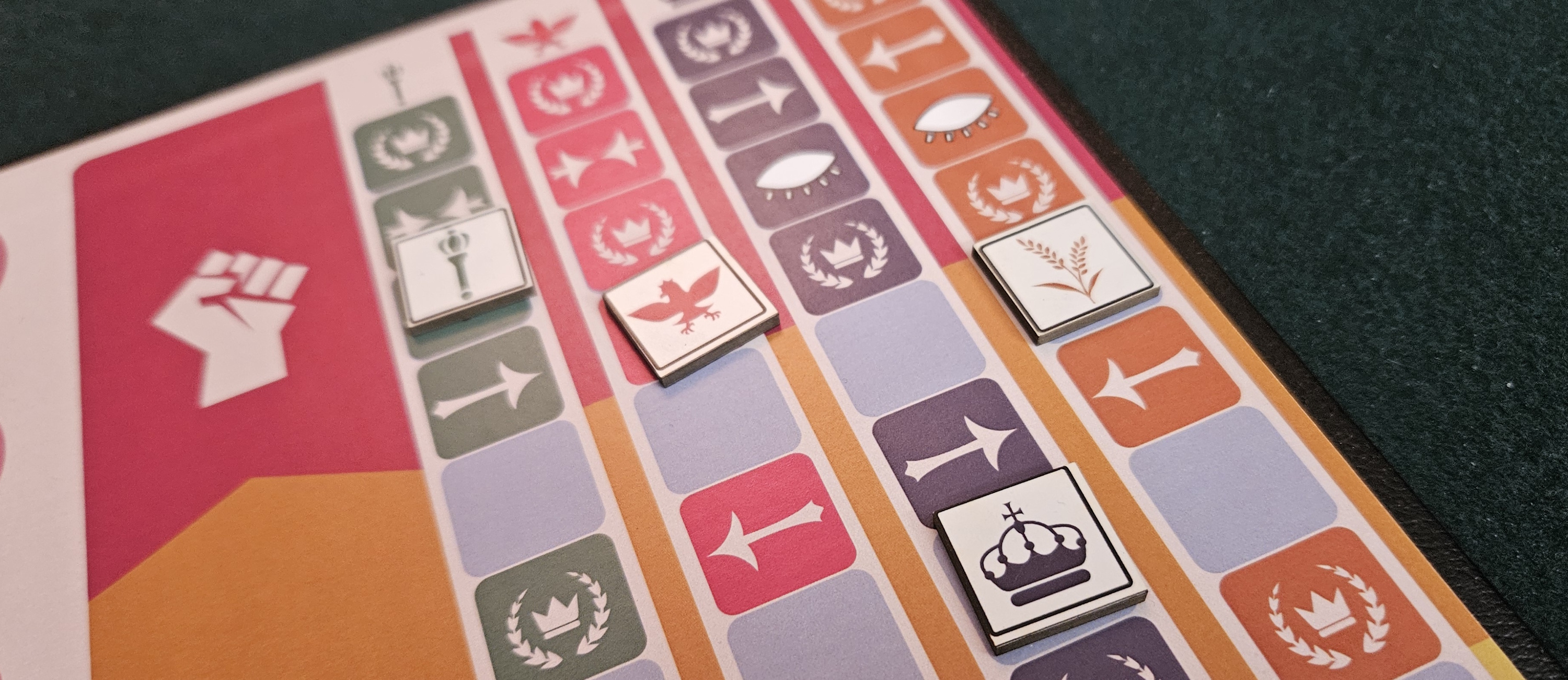
At first glance, Rex Regnat is a game about tracks. The board consists of ten of the things, six for various issues facing the assembled sejm — think “parliament” and you’ll be close enough — and another four for the agitation taking place across Polish–Lithuanian society during the drafting of its constitution.

For the most part, those issues should be familiar to passing students of history. They raise questions about who should be allowed to vote, the status of serfdom, Catholicism as a state religion, and whether the king should be subject to common law. Boilerplate stuff for the Age of Revolution. The two remaining issues are harder to peg without some understanding of this peculiar union’s context. First is the Liberum Veto. This bad boy allowed any deputy of the sejm to nullify the entire legislative proceedings, a terrible idea even in peacetime, but a downright suicidal one when neighboring titans like Russia and Brandenburg could bribe any old noble to veto any reform that might impede their foreign agenda. Next is the hereditary nature of the monarchy. That only makes sense when you realize that kings were elected — and, as a result, tended to function as a stump for their noble electors.

Okay, so the basics are easy enough to understand. You’re one of the factions hoping to mold the constitution to your liking. Handily, the tracks label your intentions. The Regime — which means the nobility and its sway over the monarchy more than the king himself — wants to further entrench their privileges, placing their icons on the right side of the three tracks they care most about. But this can prove slightly deceiving. As those currently hoarding the lion’s share of their country’s power, the Regime would also be content to allow affairs to remain as they already are. Thus they score points for securing their privileges, but also for keeping those tracks — all six of them this time — firmly seated in the middle. This marks them as right-wingers and centrists at the same time. Which is always the case, deep down, but the phenomenon is especially pronounced here.

Opposite the Regime is Reform. This faction wants a constitution that will bring the Commonwealth into the modern world. The Liberum Veto? Out. Serfdom? Out. Total enfranchisement? Hold on a minute. The Reformers aren’t insane. Incremental change, that’s the path forward. Maybe, and this is a maybe here, Reform could grant a few cities free status. Just to prevent the troubles in France from happening here, you understand. But beyond that? Let’s not lose our shirts.

If you’ve ever studied a revolution, you can probably already see the hairline fractures forming at the foundation. Rex Regnat can be played with two players. In such an event, Regime and Reform are the principal actors. But as an experience, Rex Regnat shines with four. That’s because there are two more factions to consider. As ideologies, their role was limited in the historical sejm that oversaw the declining years of the Commonwealth. But they existed, they agitated for their own alterations to Polish–Lithuanian governance, and they played a crucial role, as radicals always do, in popularizing which issues can be discussed in the first place.

I'm outraged that the chits are off-center. But that's my outrage for every game with chits.

Society’s many outraged sectors.

These factions, then, are even further to the right and left than the mainstays. First we have the Radicals, also known as Reform on steroids. Whatever Reform wants, the Radicals want double. Whatever Reform is hesitant to grant, the Radicals are ready to throw a Parisian Moveable Feast to take for themselves. But then there’s their opposite number, Reaction. Think of them as the incel podcasters of the 18th century. They want a stronger monarchy, an empowered military, maybe an alliance with those treaty-breaking Prussians next door. If this should spell annexation… well, reactionary movements have never been especially good at thinking long-term.

Now, you might be thinking that I’m spending a lot of time discussing tracks and factions. True enough. But these dynamics are at the heart of Rex Regnat. Reform and the Radicals, Regime and Reaction; these are the natural alliances, albeit uncomfortable and shoehorned alliances, that dominate the table. They’re Rex Regnat’s version of the Communists, Socialists, and Anarchists from Alex Knight’s Land and Freedom, or the awkward three-way race that defines Mark Herman’s Churchill, or the squabbling powers of Herman and Geoff Engelstein’s Versailles 1919. These comparisons are not ones I invoke lightly. Rex Regnat resembles those games not only because they’re all games with tracks, but also because it intends to put players in the same diplomatic headspace. It’s about trading favors, talking your friends into doing things that benefit you just a little bit more than they benefit them, and maybe, in the end, risking everything on a coup de grace that’s really just a literal coup.

Which is why the tracks are important, but not all-important. Each faction has other aims to consider. The Regime derives most of their points from the tracks, which makes sense, given how badly they want things to remain the same. But they also care about tamping down societal agitation and keeping control of the gavel, the marker that dictates who picks the issue up for debate. Reform, meanwhile, is happy to be included at all, so any issue they win becomes political currency, even those that have nothing to do with them.

The Radicals and Reaction go further, as befits their status as outsiders determined to get a foot in the door. If the Radicals don’t get their way, they can instead foment outrage, possibly leveraging the upset of the people to seize control outright. Reaction, meanwhile, alters its objectives ever so slightly between rounds. In the first half, Reaction wants as many cabinet positions as possible. They’re infiltrating offices. Securing funding. Finding their audience. In the second half, they want to push those outrage tracks up as far as possible. Suddenly, their interests are aligned with Reaction, but only in the sense that they want a riled-up population. They’re here to co-opt everybody’s justified anger for their own purposes.

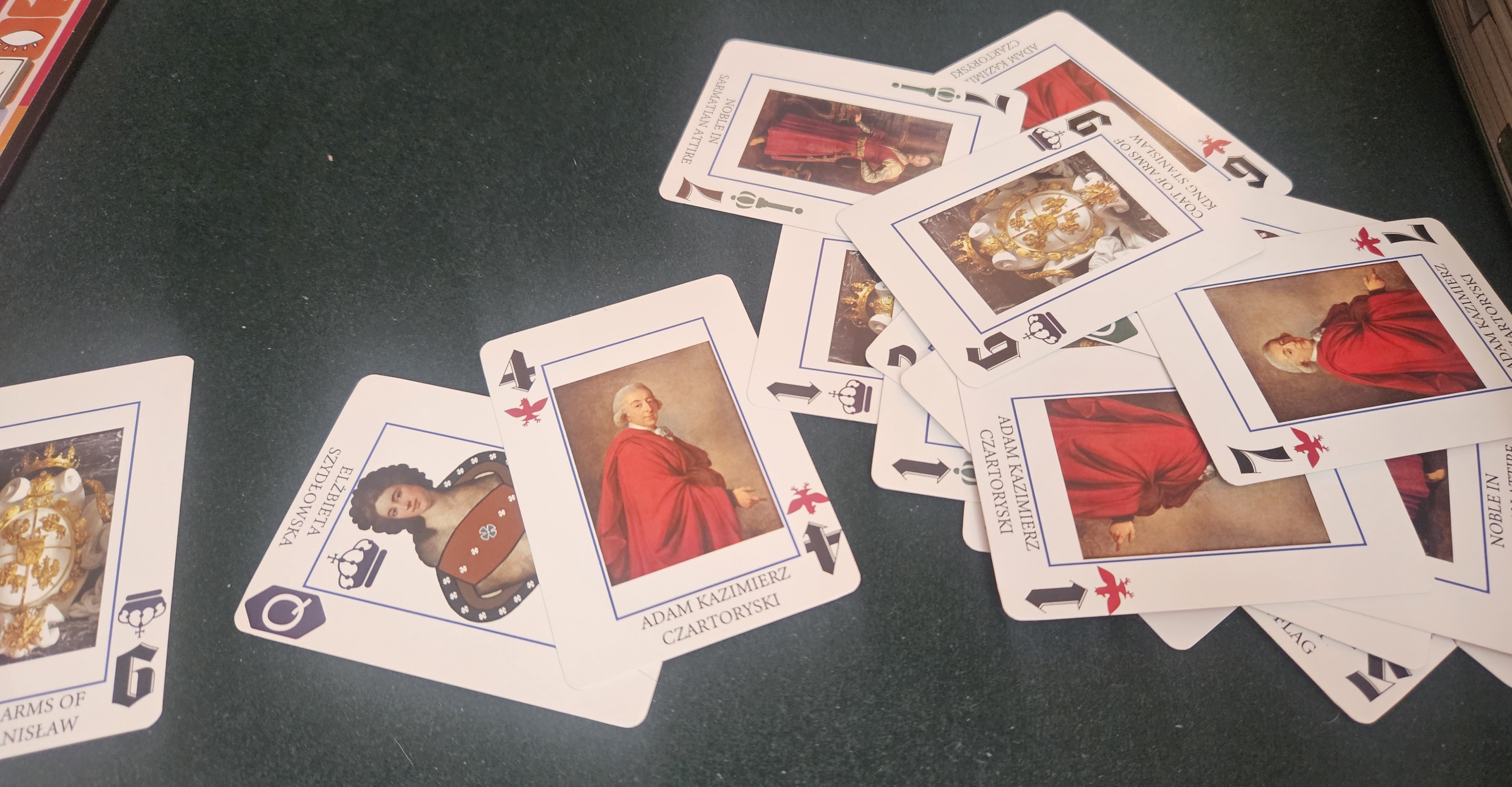
ah yeah, it's red robe guy

Only the cards on your bench can be played into a trick.

Just as those other political titles I mentioned had their own methods for resolving the debates and issues of the day, Rex Regnat finds its footing in the most expected of places… because, yes, this is a trick-taking game. Another trick-taking game. All I play anymore is trick-taking games.

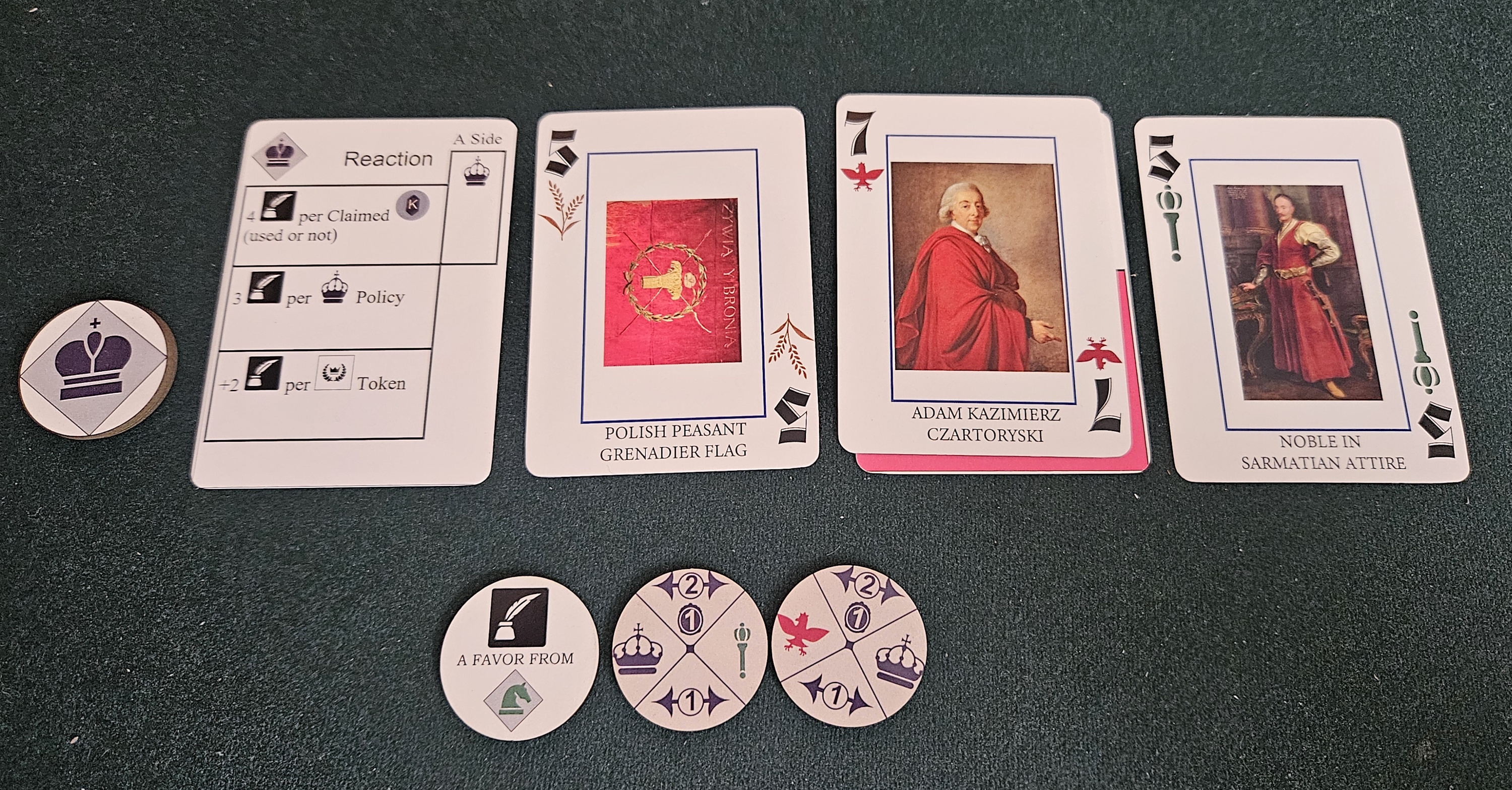
But while Rex Regnat is a trick-taker, it’s quite unlike its peers. The first and most visible difference is that each player always has three face-up cards. This is their “bench,” and these are the only cards they can play into any given trick. Right away, this has a few consequences. The first is that there’s a great deal of manipulation to the proceedings. If I see that you have the highest-ranked card in a particular suit, I’m not likely to initiate a debate over an issue in that suit. Unless, that is, we can come to an agreement.

Or unless I want you to win that issue. First of all, it’s entirely possible to force an opponent to shed a powerful card on an issue that doesn’t really benefit them right now. If you’ve already secured Catholicism as our state religion, letting you expend your strongest card to thump the table about God and Country is a boon that keeps on giving. Go ahead. I don’t mind. Shout about our duty to Christendom. Tell it to the rafters.

But more than that, there are plenty of little overlaps in the scoring conditions, and not only between natural allies. Needling the Regime into stripping the Radicals of an outrage issue is valuable even if it doesn’t benefit me directly. All the better if I can force you to burn a potent card and deprive a leading opponent of their strongest source of points.

But even more than that, precise rankings matter in Rex Regnat. The winner takes and resolves the issue, the natural outcome of any debate. Last place earns the gavel, their backroom politicking letting them dictate the future issue under discussion. But second and third place also get their say, shifting the suit of their played card up on the outrage track. Depending on the sequence — which, again, is often manipulable thanks to the face-up cards on everyone’s bench — it’s possible to ensure that you shift such a track at the precise moment it will confer some advantage. Such as, say, an influence token, worth points to all factions. Or a token that will conceal one of my bench cards, making it all the harder to guess at my next move. Or a shift on an issue track that isn’t directly tied to a debate. No matter the precise debate being undertaken right now, there’s always some way to get ahead.

The result is a form of trick-taking that’s played openly (most of the time) and allows for an unusual degree of control (again, most of the time) and encourages the aforementioned horse-trading and wheedling. While many of the genre’s touchstones are present and accounted for, trump suits and sloughing and tactical tiebreakers, they tend to fade into the backdrop of the game’s politics. Your bench is a set of cards, but it’s also the dignitaries and arguments your faction has ready right now. Your hand becomes blackmail and backrooms deals and side hustles, almost ready for the oven but in need of a bit more leavening. Even smaller incentives, like the royal offices that transform ordinary cards into kings, become opportunities to flex your political clout.

as you can see, red robe guy is a favorite around here

When discards go bad.

I have a great deal of affection for games that use abstraction to speak a deeper truth about the topic they present. I’ve already mentioned a few of them. In Land and Freedom, Alex Knight compressed a complex and drawn-out civil war to a few fronts, some negotiable values, and the squabbles and purges between three factions that couldn’t set aside their differences to save their lives. The result was a game about the shortcomings of revolution and democracy. Churchill’s military fronts were also tracks, linear near-inevitabilities that assume the Axis will collapse, but it’s anybody’s guess who will inherit the world; the outcome was an examination of the war-behind-the-war that produced the remainder of the 20th century. High Treason established its courtroom drama as a series of icons that might or might not be worthwhile, their relative value always slightly out of reach. Justice, Alex Berry argued, was a matter of guesswork and who was seated in the jury box.

With Rex Regnat, Damon pulls a similar trick. Rex Regnat reveals a political system in the throes of reform, but one that might have shambled along for too many decades to carve out a future for itself. Is it possible to pull back from the brink of a monied class that believes its only hope of holding onto its privileges is denying them to anyone else, from electoral power that excludes those it deems too ill-mannered, from foreign interests that incite violence rather than stability? God, I hope so.

That Damon does this without presenting a single map is nothing to sneeze at. Rex Regnat includes design notes, but fewer players will read them than the rules. In place of textual rhetoric, Damon instead has to leverage smaller touches: considered victory conditions, the placement of icons on tracks, an ideological impression rather than a dramatis personae or timeline of events.

I daresay it works, at least in the broad strokes. As a springboard to learning about the Polish–Lithuanian Commonwealth’s final decade, there are none better. Crud, half the people I’ve introduced the game to weren’t even aware that the Polish–Lithuanian Commonwealth existed, let alone that it attempted a series of radical reforms in its final months.

Outrageous! Ahem. Sorry, but I've just written 2000+ words about this game. You'll excuse me for not having another good alt-text.

Taking in the big picture.

But attempt it did, and succeed it did, at least for a time. The 1791 Constitution didn’t last, but it became a model. For the Poland that would recover its independence 123 years later, it became a model of their enduring identity; for the coming constitutions that weren’t throttled in their cradles, it became a model of possibility. In capturing the dynamics of its fraught composition, Rex Regnat offers one of the finest works of abstract ludic history I’ve played in a long while.


I’m adding a note here just in case somebody actually wants to buy this thing, because it’s hard to acquire: you need to go to the Damonic Designs website and email him, at which point he will offer to sell and ship you the game. Yes, this is convoluted.

A complimentary copy of Rex Regnat was provided by the designer.

(If what I’m doing at Space-Biff! is valuable to you in some way, please consider dropping by my Patreon campaign or Ko-fi. Right now, supporters can read my first-quarter update of 2026: the best board games, movies, books, and more!)
Wagering Everything on Bronto

09. April 2026 um 02:36

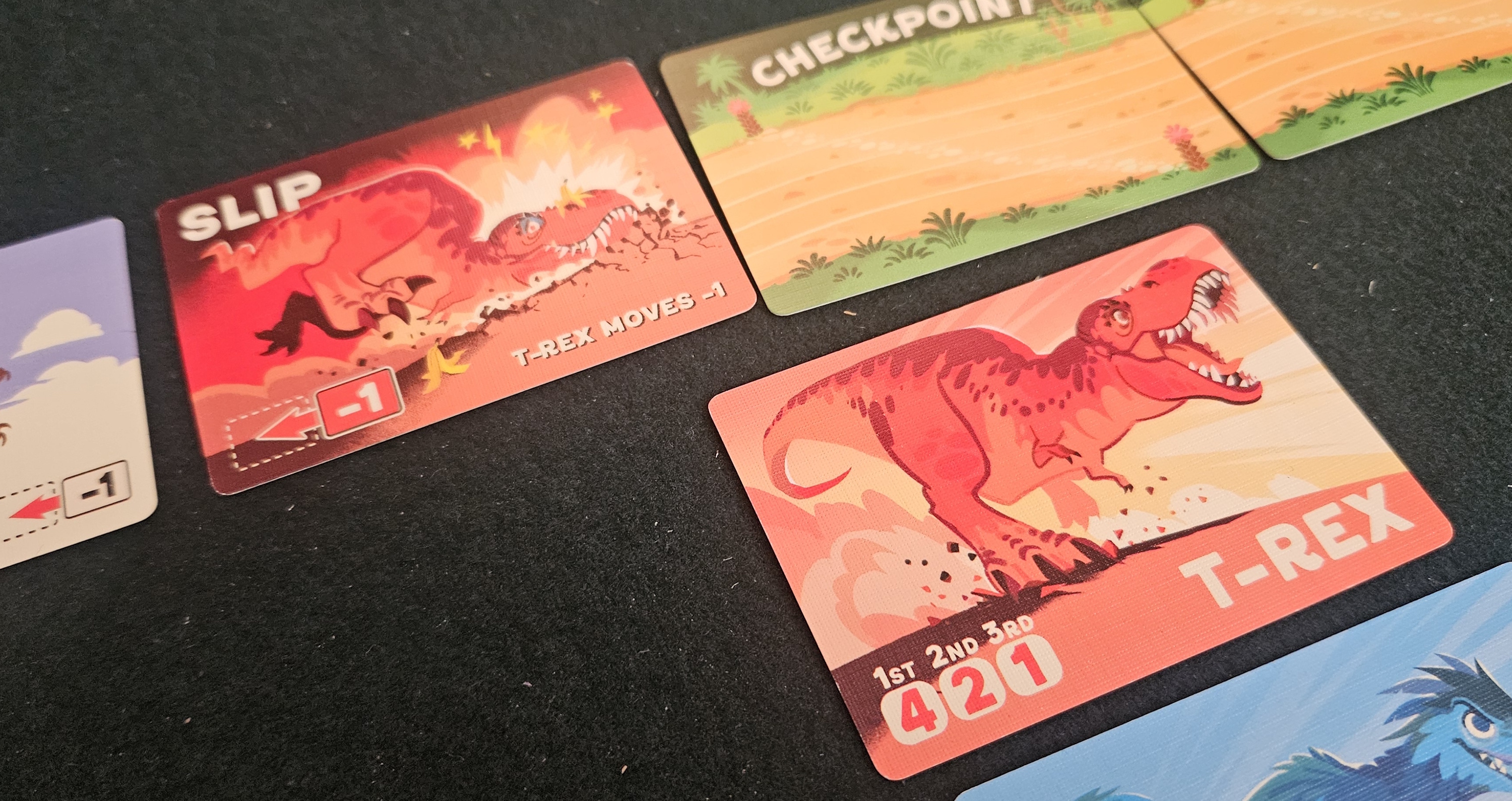
These are civilized thunder lizards, they would never consume one another mid-race. But you can tell they're thinking about it.

Are wacky races the new zombies of board games? Probably not, but it strikes me as wild that I’ve played four distinct wacky race games within the span of a single year, yet nobody within my circle agrees on which one is the forerunner. Dino Racer, the third of those four, was designed by Marceline Leiman, who gave us the lovely High Tide and Nebular Colors (née Heavenly Bodies). This time, the racers aren’t hot dog mascots or magical athletes. I think you can guess what they are.

(They’re dinosaurs.)

STEGGY. STEGGY. STEGGY.

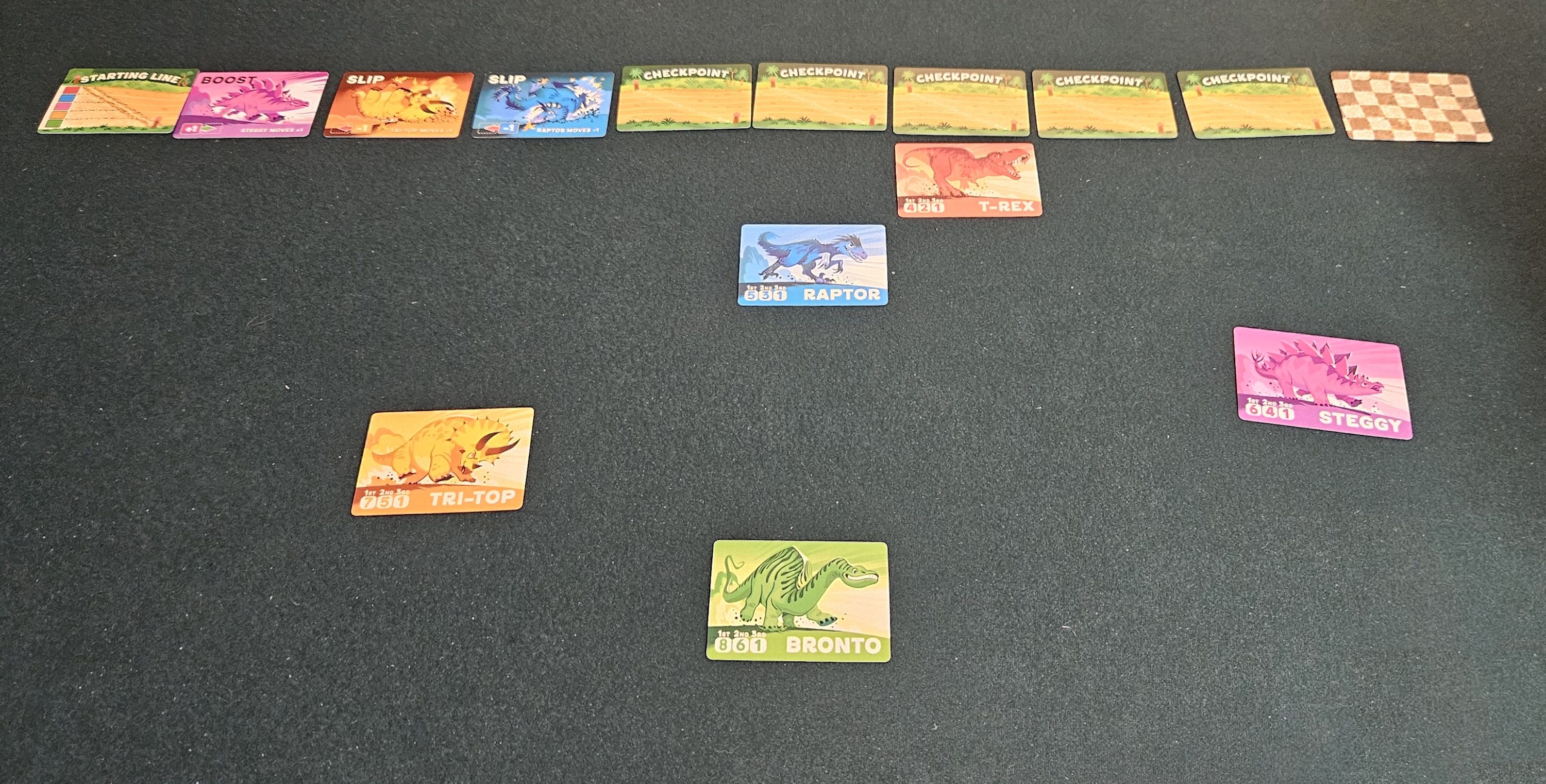
And down the stretch they come!

When we first played Dino Racer, the whole thing seemed broken. Thanks to a small rules error, the outcome of the races was all but foreordained, the wagers were obvious, and not even Eric Hibbeler’s charming dinosaur portraits could do much to make up the gap.

Okay, so maybe it wasn’t such a “small” error on my part. But the point stands. Even something as minute as reshuffling the deck in between matches, rather than letting it run its course and thus tweak the odds from race to race, was enough to scuttle this one. Fortunately, the right rules transform it into a zany good time — albeit one that might prove too light for some enthusiasts.

At the outset, Dino Racer seems like as much a spectator sport as its peers in the wacky race club. When the round begins, five dinosaurs stand hip to hip at the starting line. T-Rex has the best stamina, with diminishing probabilities of success for Raptor, Steggy, Tri-Top and Bronto. These odds are represented by each dino’s quantity of cards in the deck, not to mention their relative tiebreaker positions, but they’re close enough that the outcome isn’t wholly set in stone. T-Rex has one more card than Raptor; Raptor has one more than Steggy; and so on down the line. It’s enough to give some dinosaurs a statistical advantage, but such a slender one that upsets aren’t outside the realm of possibility.

The race itself is resolved in much the same manner as those in Jon Perry’s Hot Streak. Somebody picks up the deck, flips a card, and moves the corresponding dino one space closer to the finish line. Some of that game’s possibilities are left by the wayside; there are no trips or reversals, just a steady forward momentum.

For the most part, anyway. As soon as every dino has reached a column, the checkpoint card at the top of the track gets flipped over. These might produce new opportunities, such as a burst of speed for Steggy, a sudden stumble for Raptor, or a swap between the racers in first and fifth place. What initially seemed like a straightforward foot-race becomes… well, still a straightforward foot race, but one in which the racers’ fortunes are much tightly corded than they previously appeared.

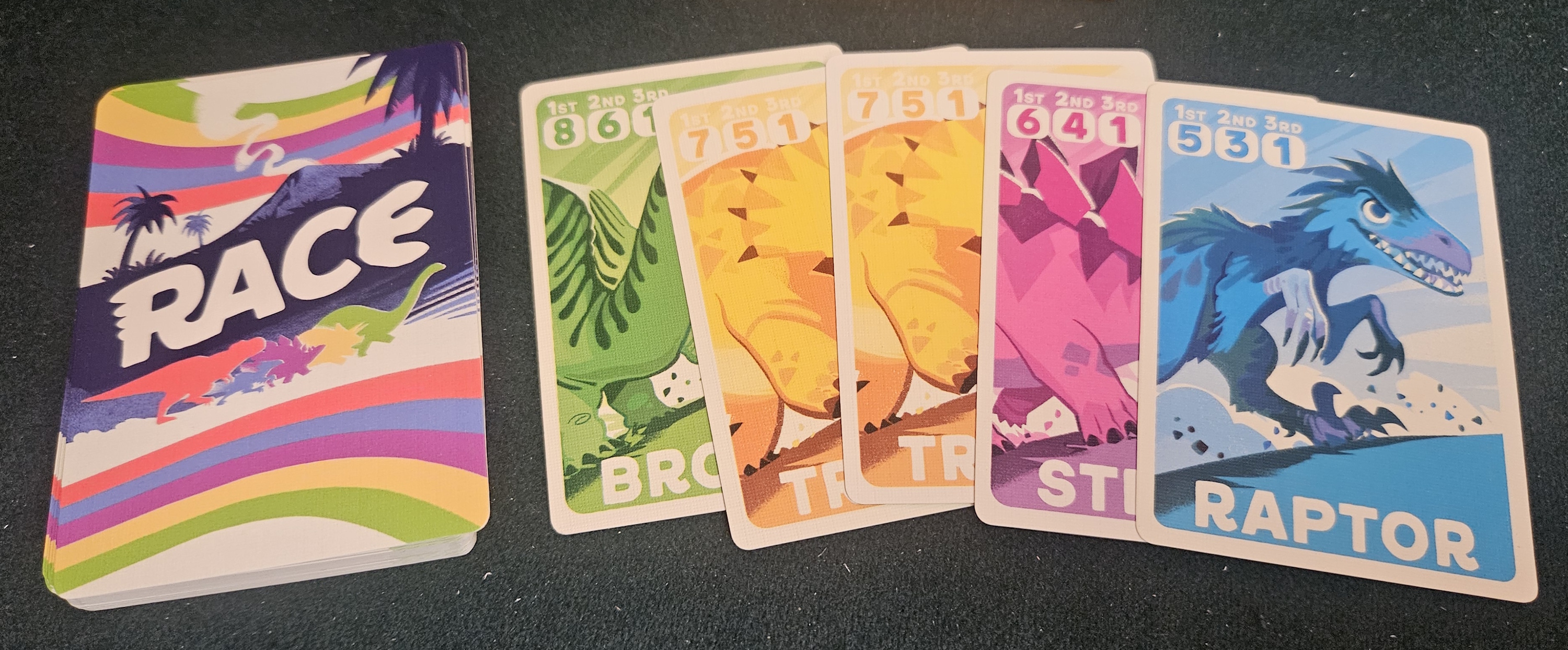
The game’s bigger revelation is that it isn’t a spectator sport at all. Unlike Magical Athlete and Hot Streak, where the bulk of the decision-making occurs before the firing shot, players in Dino Racer are active participants the entire way through. As soon as a certain number of cards have been flipped, the proceedings pause while players take turns selecting from those same cards.

I would call this system Knizian, but I think we've reached the point where that could get me burnt at the stake for blasphemy.

The cards govern both the race and its wagers.

These are the game’s wagers, and they’re informed enough to make smart decisions, but not so settled that you don’t run the risk of losing everything when a loser sprints to the head of the pack. Every detail becomes important. The relative standings between dinos. The cards they’ve burned in previous races. The stronger payouts for less-favored runners. Even the number of remaining checkpoints that are likely to throw the race into disarray. For all that, the way Leiman keeps these decisions constrained to only a few cards — one more than the number of players in the game — prevents anyone from fretting too hard over which dino to pick. It’s possible to play well, but we’re talking about play in aggregate more than turning players into Jurassic match-fixers.

It’s a real holler. Literally. I’ve watched crowds of staid players transform into screamers, bellowing at Steggy to pick up the pace or cheering as another Bronto card flips from the deck. My daughters complained that some of our guests were keeping them up at night; the game under consideration was Dino Racer. A week later, my kiddos gave it a try and screeched like banshees when their favored T-Rex cratered on his snout.

Is it a perfect game? Oh, I have no idea. I’m hesitant to do a compare-and-contrast to its peers. My wife has informed me in no uncertain terms that it’s better than Magical Athlete, which initially struck me as bananas, but I could see preferring it to Hot Streak, which sometimes I favor over Magical Athlete, so at this point it’s all one ouroboros biting precious calories from its own tail.

Because the thing is, these games aren’t actually all that similar. Hot Streak is about obsessive gambling and manipulating the odds. Magical Athlete is about the draft and rolling with the punches. Dino Racer, by contrast, is about placing smart bets, but not especially difficult bets. It’s the lightest of the trio, rules-wise. My kids, aged twelve and six, can play without worrying about special abilities, but there’s still enough for the adults to think about that nobody is getting bored.

It helps, too, that it’s so fast. There’s always something to be said for games that don’t overstay their welcome, and Dino Racer is downright skittish in that regard. Twenty minutes and it’s done. Even if I weren’t in the mood to watch a tableful of people scream at a Triceratops to pick up the pace, it would be over before the headache could form. I don’t even mean that as faint praise. Just, where a session of Magical Athlete means settling in for a while, possibly even a long while if the players settle into a feedback loop, I know what to expect from Dino Racer.

Screaming. That’s what I expect. Provided you get the rules right. Which shouldn’t be a problem, darn it, so I’m not sure why it was that one night. Done right, this game is worth every decibel. It’s cute, it’s fast, and it provides more meat than it might seem from a distance. That’s all good stuff.

UH OH IS THIS GAME POLITICAL (yes)

May it ever be thus to tyrants.

In the end, Dino Racer is about the highest volume one could pack into such a small box, plus a lovely addition to the expanding roster of wacky race games. It displays Leiman in yet another register, all shouts and immediacy, a far cry from the more intimate pleasures of High Tide or Nebular Colors, and even more finely tuned. Just writing about it makes me want to put it on the table all over again. I hope to do so with some regularity.


A complimentary copy of Dino Racer was provided by the designer.

(If what I’m doing at Space-Biff! is valuable to you in some way, please consider dropping by my Patreon campaign or Ko-fi. Right now, supporters can read my first-quarter update of 2026: the best board games, movies, books, and more!)
Business Bazongas

07. April 2026 um 00:56

bring on the Puritans, I say

I like weird games (derogatory) almost as much as I like weird games (complimentary).

Belinda’s Big Bonus is a weird game (weird).

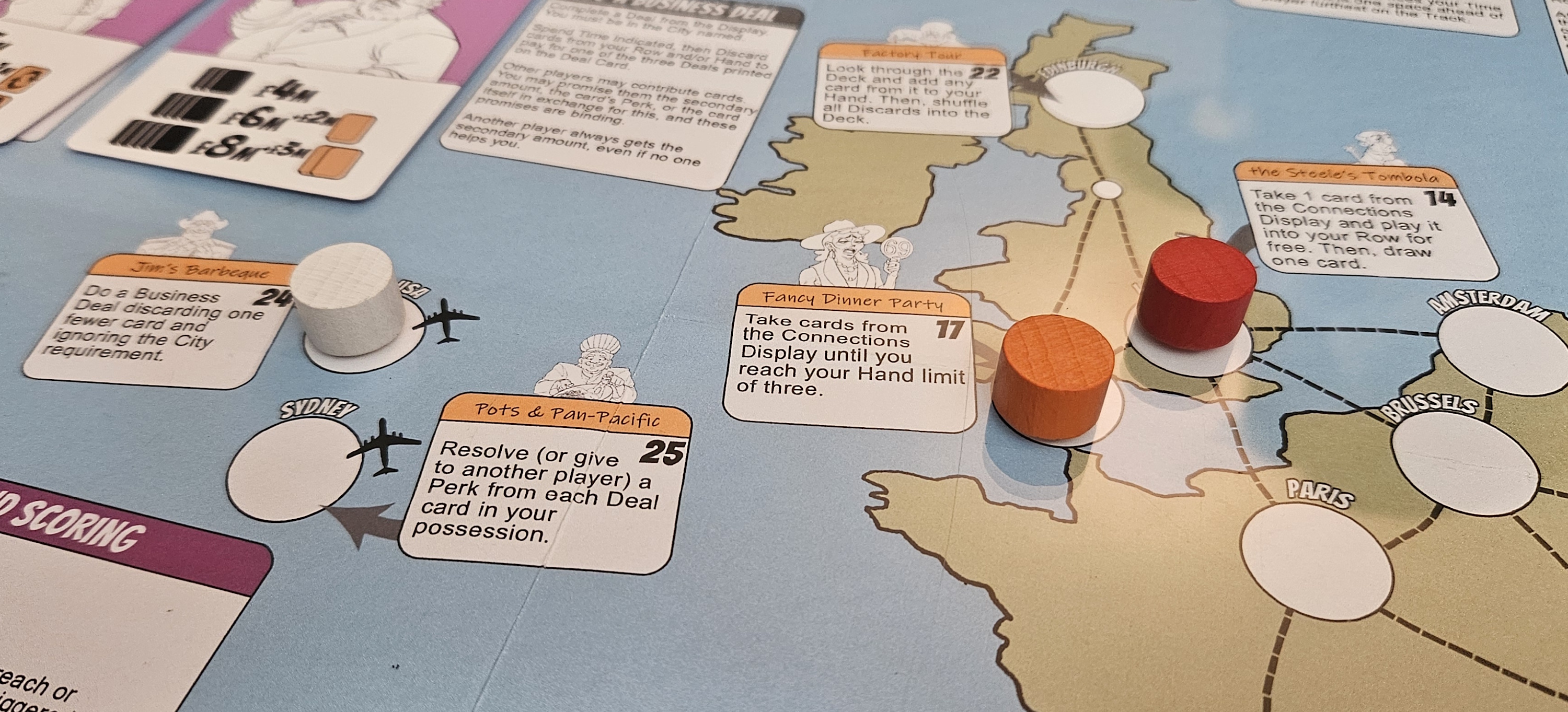
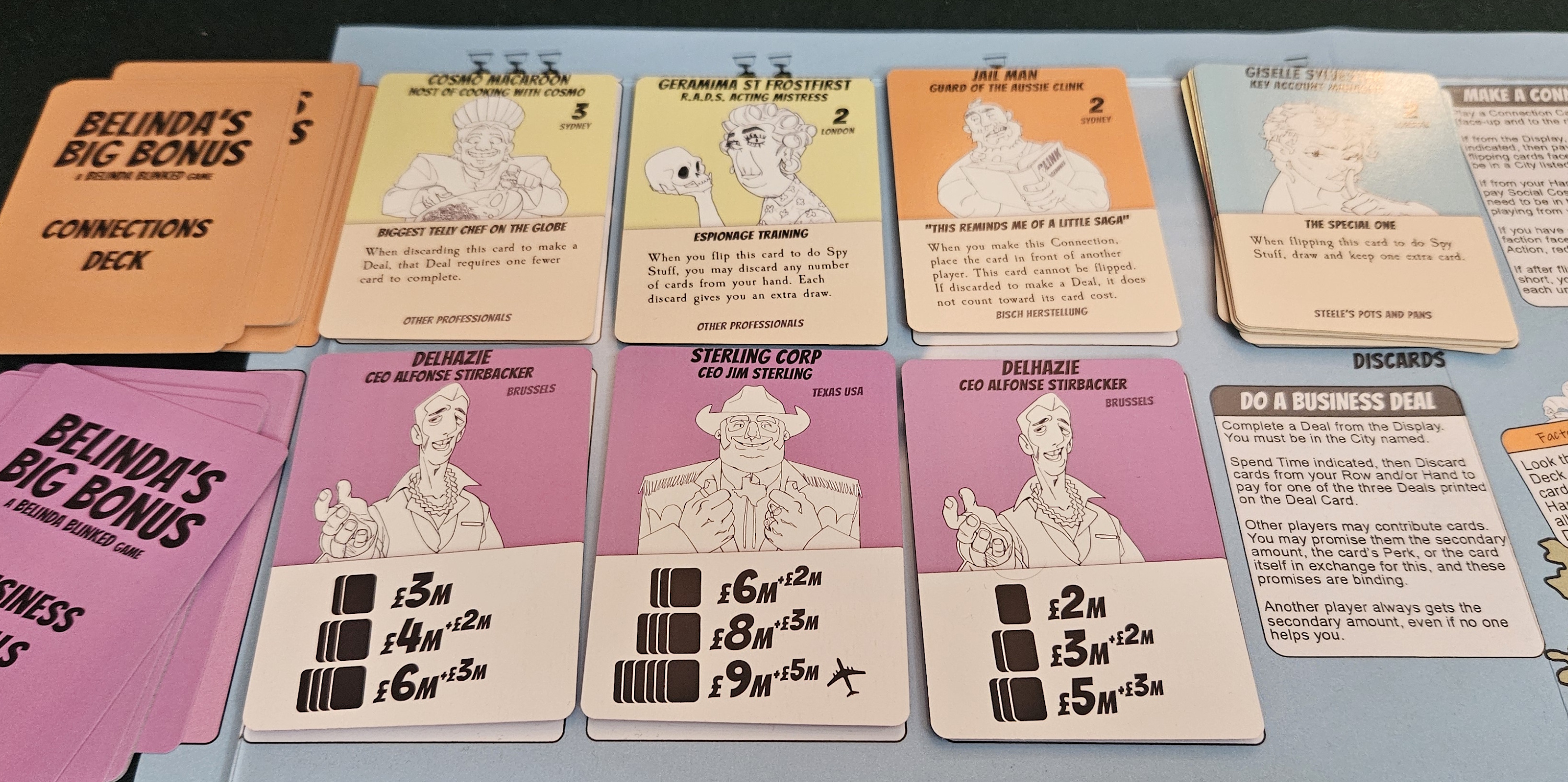
Having your game designed by Amabel Holland sets certain expectations, despite any difficulties in pinning her down to a single genre or register. Similarly, basing a game on an erotic novel series, in this case Belinda Blinked by Rocky Flintstone, also sets certain expectations. Yet Belinda’s Big Bonus isn’t especially erotic. I wouldn’t call it funny, either, although it’s possible I’m just not in on the joke. Neither does it strike me as “so bad it’s good.” Mostly, it’s twice as complicated as one would expect from a licensed game. It reminds me of nothing so much as one of those business guys whose entire life is conducted through Google Calendar invites.

Trekking the World, Third Edition

There is travel, but this is not a travel game.

First of all, we should open with a disclaimer. I know very little about Belinda Blinked. I considered reading the first one as research for this review — “research,” I say — but decided against it. Sometimes knowing less is knowing more. That’s our motto here in the United States. It’s written on our dollars and everything. While scant few people are going to play this thing sans foreknowledge, I happen to be one of them, and if there’s any one quality a critic requires, it’s the resolute belief that one’s experiences are valid no matter how uninformed. Here I stand.

Which is to say, perhaps Belinda Blinked is about managing one’s schedule, suffering from jet-lag, and mixing up which actions cost which payment. Maybe. In which case, may I offer my deepest apologies to Holland, Flintstone, and Belinda herself. Forgive this prude, for he knows not what he do.

At the game’s outset, players step into the not-yet-broken-in business shoes of interns at Steele’s Pots and Pans. Their task is to earn some millions of pounds for the company. They do this by…

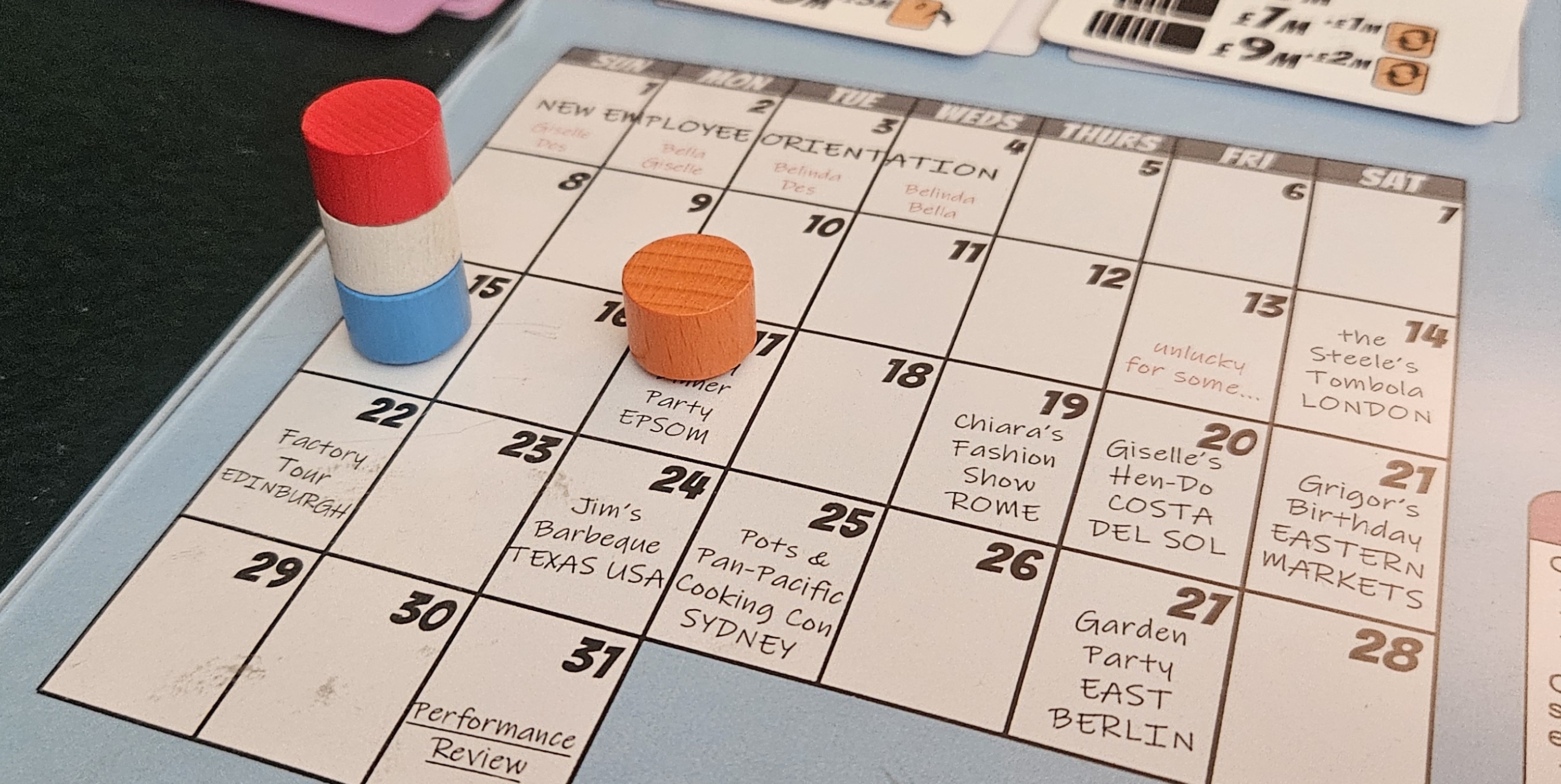
Look, this is the first problem with Belinda’s Big Bonus, and it’s a doozy. As any gaming evangelical knows, it’s hard enough describing a board game to newcomers, and Belinda’s Big Bonus is no board game for newcomers. There are mechanisms aplenty in this trunk, packed together like someone mixed the first-aid kit with the snack bag. There’s a calendar timekeeping system, the kind popularized by Martin Wallace titles, and cards that may exist either in a market, your hand, or a tableau, with interactions dependent on their current source — except sometimes they can be spent from two of those places, and the rulebook is conversational and, although it’s amusing, this doesn’t lend itself to learning the damn thing.

In a dim room somewhere, Martin Wallace nods thoughtfully. He saw this coming. He wanted this to come. Even now, he is thinking about the double entendre of "wanting this to come."

Scheduling, but this is not a scheduling game.

Here’s the short version. Turns are variable, conducted by whomever is farthest back on the calendar. On those turns, you spend some amount of time to make connections — which is to say, put cards into your tableau from either the market or your hand — do spy stuff — gain cards into your hand, from the deck this time — rest to refresh the cards in your tableau, make a business deal by throwing away the cards you painstakingly contacted or spied upon — and, in the process, try to persuade your fellow players to spend some of their cards instead, because these business deals are often collaborative and dole out benefits to multiple players — or perhaps visit a calendar event on the appointed date to gain some advantage.

If that sounds confusing, try teaching it. I’m no stranger to Holland’s more tangled designs, but this one found the most uncomfortable spot on the seesaw between complexity and anticipation: the fulcrum. Belinda’s Big Bonus feels like it should be a light game, looks like a light game, has that licensed light-game air to it, and then, kapow, but a kapow more like a punch to the schnoz than something erotic, it smacks you with a clutter of ideas.

For all that, there is an interesting game in here. The gist is that you need to build out your tableau and hand in order to spend those same cards to make business deals. Along the way, your characters provide something like an engine.

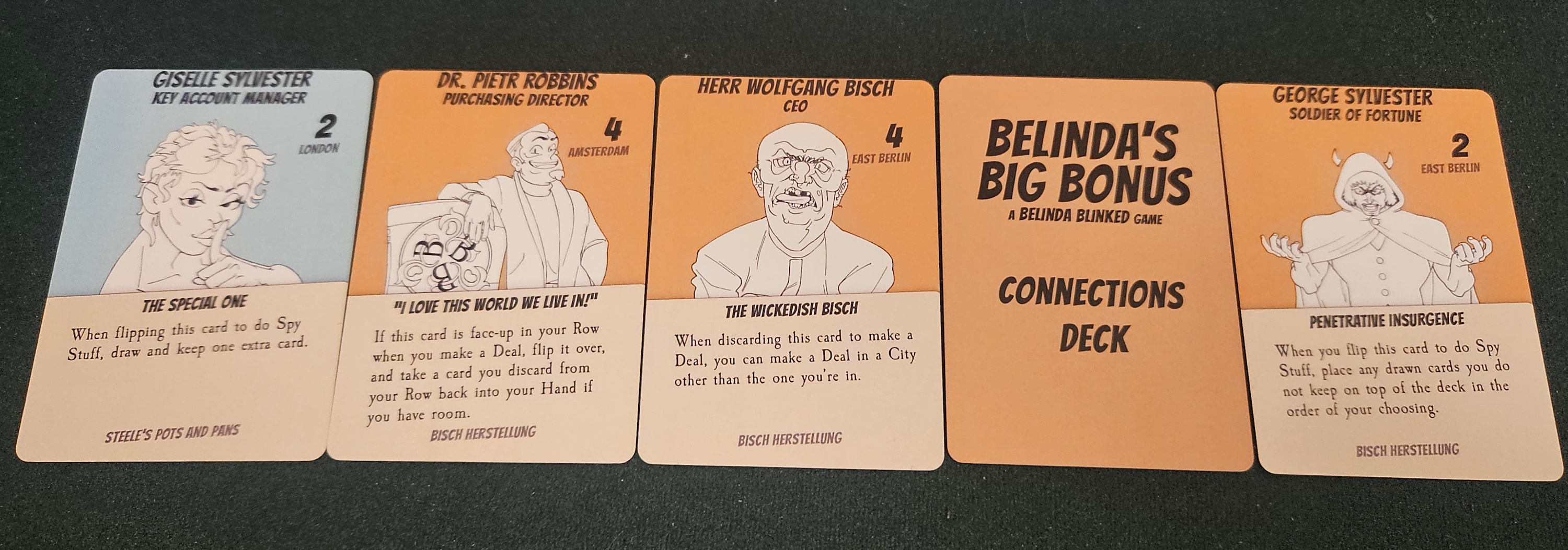
There’s even a narrative to the whole thing. Sir James Godwin makes it easier to attract Bella Ridley to your work group. Meanwhile, James Spooner, the Laird of Gretna Green, brings Cosmo Macaroon into the fold through some act of espionage. Later, your connections to Bella and Cosmo will help you make a deal in Texas, USA for nine million pounds sterling. Unfortunately, that same deal enriches a rival intern by five million pounds, so you try to squeeze some contribution from so-and-so at the table rather than merely handing the commission to whichever competitor is sitting in last place.

I'm friends with ole snarltooth, as you can see

Odd people, but this is not an odd people game… well, scratch that. It’s an odd people game.

Those are genuine dramatic and narrative beats! Along the way, though, Belinda’s Big Bonus is burdened by bloated bits. It’s easy to paint oneself into a corner, for instance, by spending too many cards on an eager deal. This can leave one player sitting around with very little to do but play catch-up. And, hey, that’s their fault, right? If we were playing one of Holland’s cube-rail games, such a possibility would act as evidence of the game’s forthrightness. But here, the possibility comes across less like an honest appraisal of the perils of betting everything on some bad stock tips, and more like an unexpected heel-turn on the game’s part.

Here’s another example. Belinda’s Big Bonus includes the possibility of a traitor moment. When the game concludes, the player in last place might reveal that they now hold the majority of connections to Steele’s rival firm, Bisch Herstellung. This turns them into “the special one” and wins the game in a sudden coup. Cool!

Except, like everything else in Belinda’s Big Bonus, the rules governing the reveal are so text-heavy that it doesn’t feel like an amusing capstone. It’s closer to checking a technical manual to see if you’ve successfully told a joke. It isn’t hard, exactly. Nothing in the game is hard. But it’s less fluid than it ought to be, keeping everybody’s attention on these mismatched processes rather than on the parade of characters and situations strutting across the table.

(derogatory)

Buncha great hangs.

Then again, maybe I’m not in on the joke. Maybe a Belinda Blinked game should be more complicated than most licensed titles. Maybe it should buck common sense by being an erotic game with no eroticism, a business game with no head for business, a whimsy with lots of rules printed on the board. Maybe it should be a big meta-joke at my expense. Maybe this game doesn’t exist for anyone but me, and it was sent to me solely so that everybody could point and laugh and say, ha ha, you took our prank earnestly, you big stupid fool, you moron, you lame-o.

That would be okay. I don’t mind. In the game’s cast of characters, I feel most like the guy anxiously cleaning a stain from his tie. I don’t need to get everything. Sometimes, I even revel in how little I understand. For example, I’ve had a lovely time not understanding Belinda’s Big Bonus. Maybe you’ll have a lovely time not understanding it as well. Just don’t say I didn’t warn you.


A complimentary copy of Belinda’s Big Bonus was provided by the publisher.

(If what I’m doing at Space-Biff! is valuable to you in some way, please consider dropping by my Patreon campaign or Ko-fi. Right now, supporters can read about which films I watched in 2025, including some brief thoughts on each. That’s 44 movies! That’s a lot, unless you see, like, 45 or more movies in a year!)

Silver & Gold & Cinnabar & Verdigris

03. April 2026 um 03:18

I keep thinking those ink spots are diacritics, like Hebrew niqqud or something.

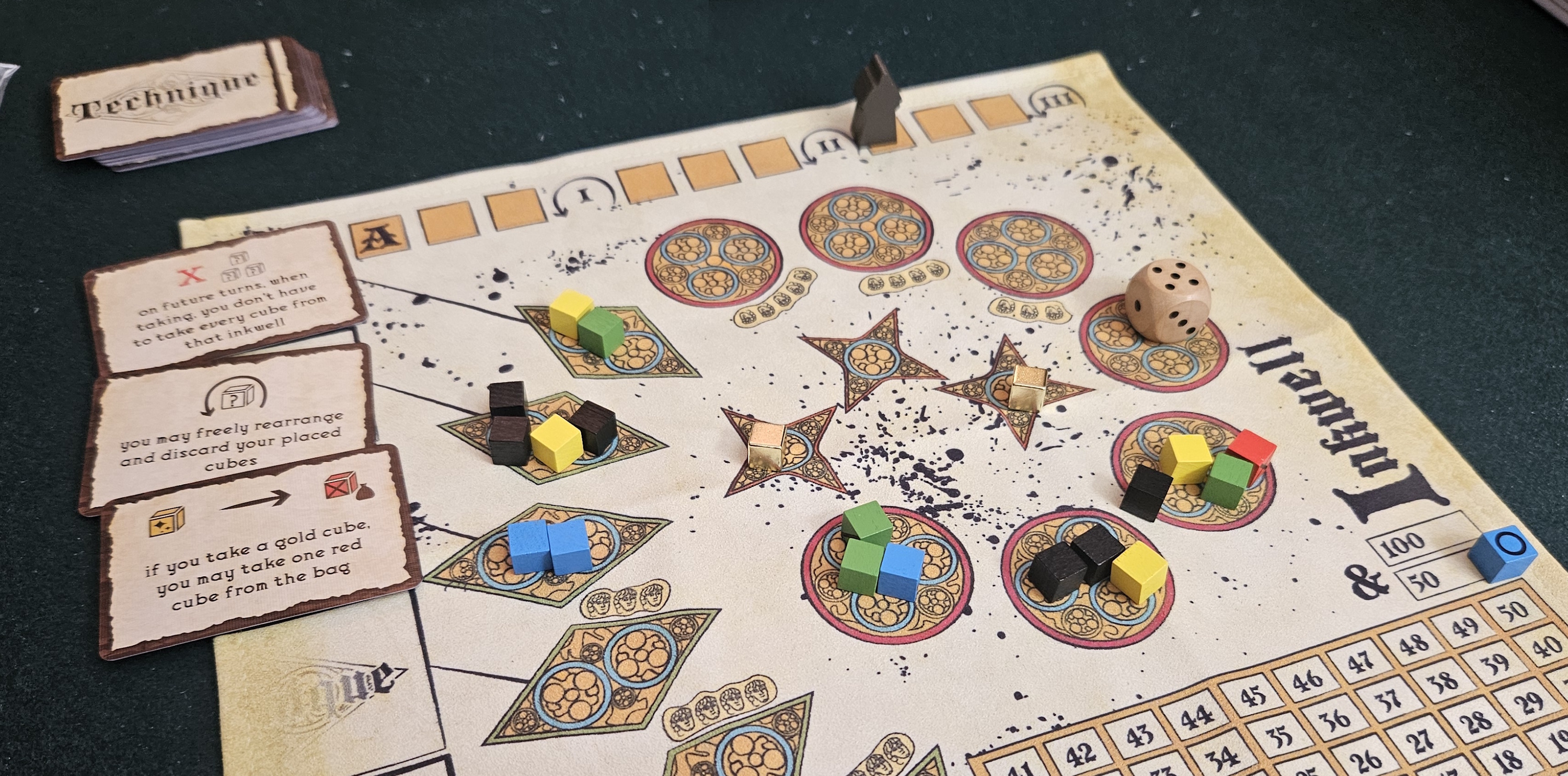
When I play Inkwell, I think about other games. That isn’t a slight on Inkwell’s quality, necessarily, nor a reflection on my fidelity to whichever title happens to be on the table at the moment. It’s just the sort of game that sets the mind to wandering. I have yet to play it without somebody mentioning Azul, for instance, and Sagrada isn’t a distant touchstone either.

The big one, though, is Alf Seegert’s Illumination, an overlooked quip from five years back that also dressed up its players as monks illuminating manuscripts under the stern eye of a passing abbot. And while it might seem like the parallel is entirely in the setting, it’s really the gentleness that does it, the warmth, the do-no-harm-ness of the whole thing. As a game, Inkwell isn’t only about monks; it’s downright monkish.

(Most monks did not dream of pigment-pots.)
Ah, many pots of pigment. A monk’s dream.

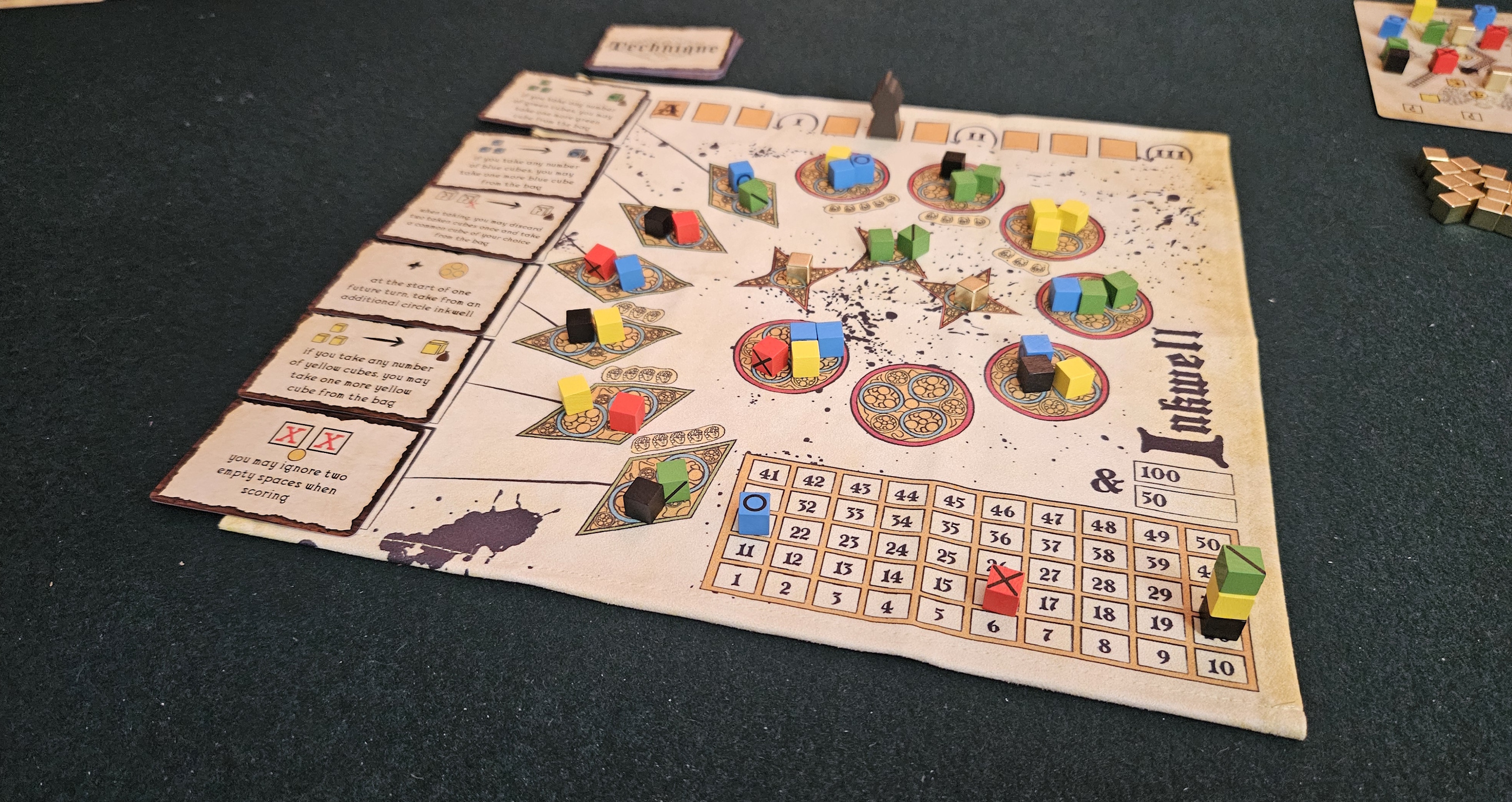
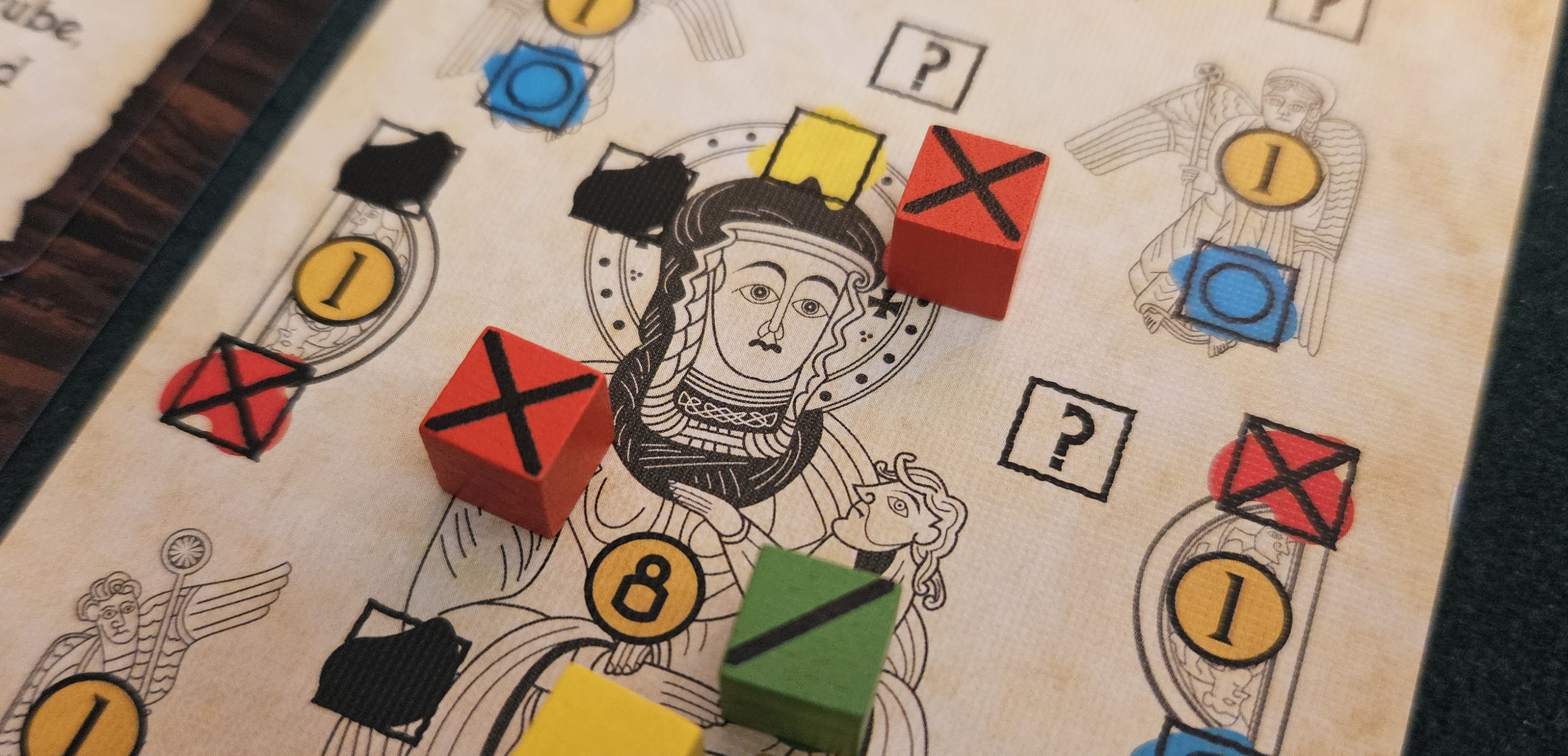
It begins with a page. Not quite a blank page, although one imagines the parchment fresh. For the sake of gameplay, the page is scrawled with the outlines of what will soon become vibrant illustrations: saints and angels, wreaths and knots, lions penned by someone who has clearly never seen a lion, scenes of Eden, holy babes that appear twice of age of the Lord at his crucifixion. Touching these illustrations are squares, each the size of a small wooden cube. Sometimes these squares appear in other spots, too, free of any illustration, but still ready to accept daubs and brush-strokes.

Your goal is to fill that page with color. Reds, blues, yellows, greens, deep charcoal blacks. Maybe some gold leaf. Gold is wild, capable of making up a shortfall elsewhere — because it’s gold, obviously — but it’s also sometimes required in special circumstances. Some spaces are blank, beckoning for leftovers. That or scoring multipliers.

These cubes must be drafted from the central mat, itself represented as a swirl of ink-pots. There are three types to draw from. Circular pots hold the most ink, three cubes at the beginning. Star spaces hold gold, but usually only a single cube’s worth, marking them as a tradeoff between quality and quantity. Diamonds are the most interesting, offering a meager two cubes, but also technique cards, special abilities that gradually hone your monk’s abilities.

ah yes the holy mother and her wonderful baby the prince of AGGHH!

Creepy adult baby Jesus and all.

One turn at a time, players go around and select which inkwells to draw from. There’s some potential for blocking, but it’s a relatively remote concept here, especially in the page’s early moments when any color will serve. The effect is trancelike, meditative, as close to multiplayer solitaire as design collective Jasper Beatrix has gotten thus far. The most burdensome restriction is that you aren’t permitted to draw from an inkwell unless you can actually use every last drop and employ every technique card. This makes blocking even less likely, instead reinforcing the game’s gentle proceedings. It’s possible to grab as many cubes as possible, but that might make the page difficult to fill. Better to proceed steadily, like the proverbial tortoise.

There is some pressure, however light. Whenever one of those varieties of inkwell is depleted — circle, star, or diamond — the abbot marches one step across the mat. He’s here to oversee your work, and at various points he may force the table to turn the page. This scores all those illustrations and color cubes, potentially leaving some work undone. It’s better to turn the page of your own volition, at the time of your choosing, but it’s hard to say exactly when the abbot will peek into the scriptorium to ensure the commissions are being fulfilled.

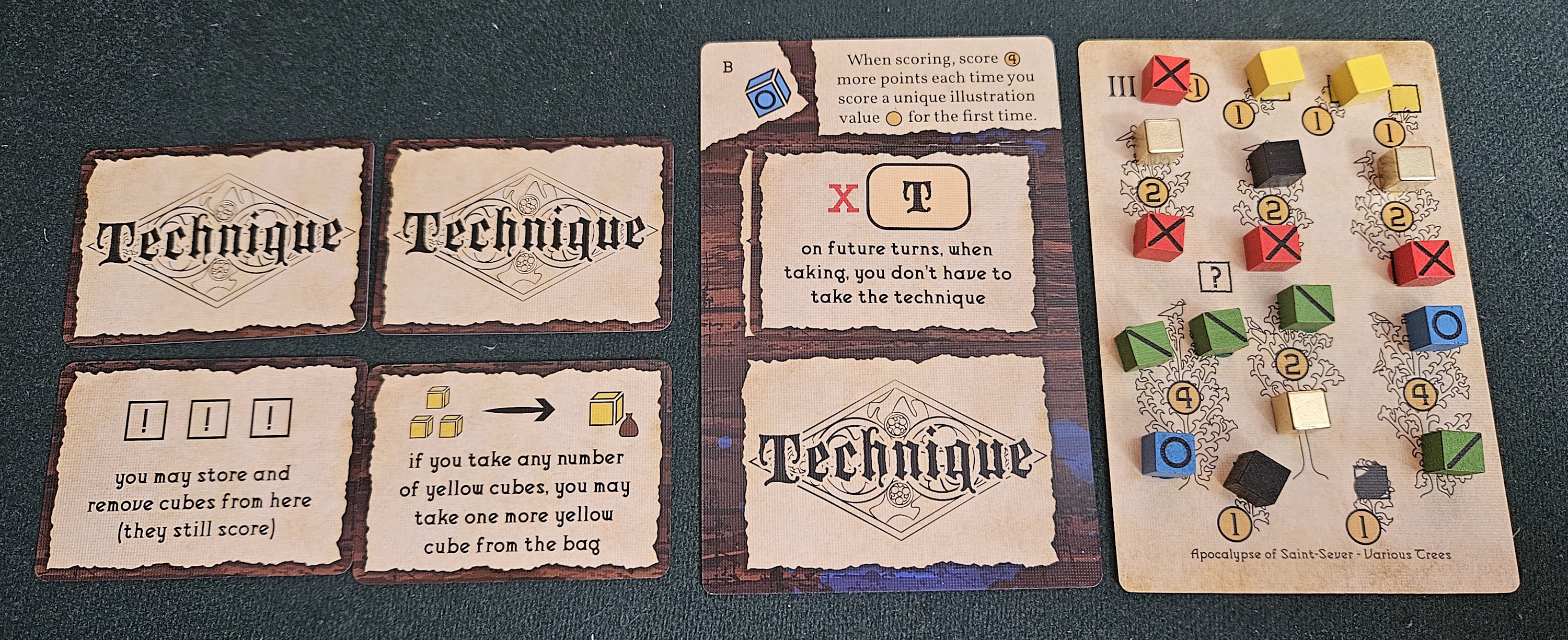
Over time, your accumulated techniques produce little engines, to use a game-word that would have meant something very different to our monks. But there’s some spark of the Latin gignere to these flashes of talent, reflected in the way they speak to an artistry now long displaced. Some techniques bestow extra cubes, perhaps when a specific color is drawn or the abbot marches down the hall, evoking the scribe, bent over his masterwork and taskmaster at once, carefully measuring every drop to its uttermost potential. Others let you claim cubes as a one- or two-time bonus, the medieval equivalent of double-dipping. Others still let you store a few cubes to the side, or rearrange them on the page, saving your palimpsest scrapings for reuse elsewhere.

I like to use as much gold as possible. Not for any game reason. Just because I like how the gold cubes weigh more than the wooden ones.

With the right techniques, the third page can be a breeze.

In some ways, Inkwell is also itself a palimpsest. There are traces of other games here, possibly better or more interesting games. The most pronounced is Azul; it’s impossible to look at the circular inkwells and not see that game’s rounded factories and Starburst-sized ceramics. There are other traces, too, impressions on the parchment that can still be made out despite the game’s clean presentation. Playing Inkwell, it’s hard to escape the feeling that we’ve gone through these motions before.

Of course we have, if only because nothing under the sun is new. None these actions are wholly novel. But Inkwell feels a little closer to its peers than some games. Especially Jasper Beatrix games, with their penchant for novelty and mechanical introspection. Inkwell is no Pacts, with its dissection of I-split-you-choose gameplay, no Here Lies with its decoupling of detective games from rigid logic, no Signal and communication, no Scream Park and tableau-building.

But for all its similarity to other games, there are still reasons to recommend it. For example, I appreciate the open-ended nature of its conundrum, one where each selection feels like another window into a broad decision-space, rather than a binary best or worst pick. It’s rare that a single inkwell feels like the answer to a puzzle so much as one more question. Another brushstroke, perhaps, another inlay of gold. Those other games use artistry as their backdrop; Inkwell, by contrast, feels like artistry. More specifically, it feels like that slender space between commercial reality — deadlines and managers, limited resources, coworkers who sometimes take the pigments you need without meaning any harm — and the aspiration to fashion something that will endure the centuries.

Basically, it's a race to score 100 points before the dumb monk attracts too much attention from the abbot.

The foolish monk Dicelius, also known as SOLOBOT, offers a nice diversion.

Where does that put Inkwell, in the end? It’s hard to say. As a game, it occupies a peculiar middle ground. It lacks the brain-tickling nature of its heavier inspirations, the emphasis on puzzling and position, but ventures a little closer to its source material than those games have ever managed.

More than that, Inkwell is reassuring. It feels like a weighted blanket, the game equivalent of a movie like The Taste of Things, all soft sensation and creamy sunlight and lulled senses. The outcome is neither the strongest nor the weakest of Jasper Beatrix’s collective output, but offers a lovely and gentle visit to a faraway time and place nonetheless.


A complimentary copy of Inkwell was provided by the publisher.

(If what I’m doing at Space-Biff! is valuable to you in some way, please consider dropping by my Patreon campaign or Ko-fi. Right now, supporters can read about which films I watched in 2025, including some brief thoughts on each. That’s 44 movies! That’s a lot, unless you see, like, 45 or more movies in a year!)

How to Hide Your Board Game Purchases

01. April 2026 um 21:21

up next, how to disguise your italian sandwich addiction as board game acquisition disorder (as featured in the DSM-5)

So you want a board game but there just isn’t room in your budget. I hear it all the time. “How can I hide this purchase from my wife?” the refrain goes. “If she finds out that I splurged another $199 on a box of miniatures that we can’t afford right now, she, my life partner, to whom I swore vows of faithfulness, is gonna murder me. That’s a week of groceries! LOL.”

Don’t worry, fam. I got you. Click here to learn how to conceal your illicit board game purchases from your spouse.

Job in Sparta

01. April 2026 um 02:04

Hm. I'm trying to disclose that this game isn't out yet, so the details are subject to change. But Wee Aquinas looks like he's just another one of the boys.

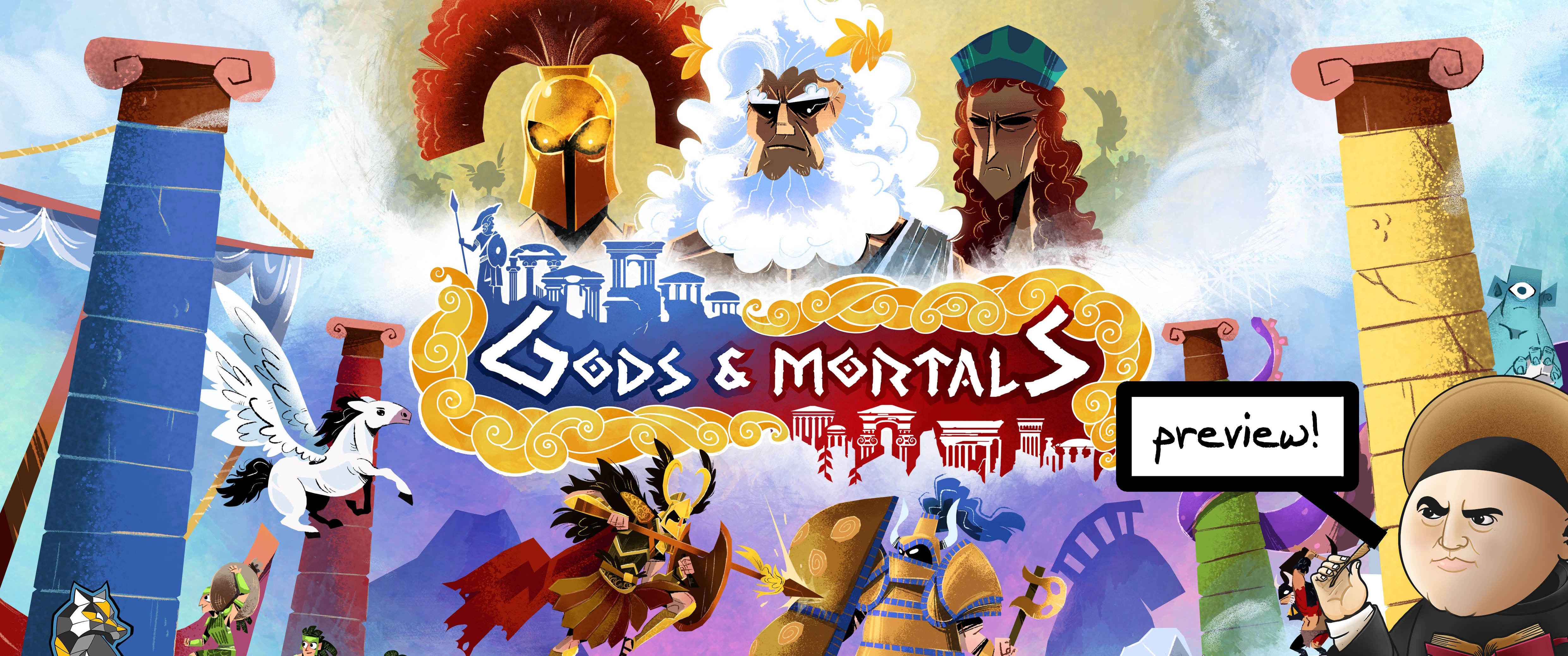
Gods & Mortals, designed by William Borg Barthet and Artyom Nichipurov — the latter of whom brought us the excellent Trick Shot and even excellenter Guards of Atlantis II — happens to be one of my favorite things: a total theological dumpster fire. There’s a purity to Graeco-Roman Polytheism, with its wild gods that are best placated or avoided. It isn’t until Hebrew and Christian religion start bellyaching about God’s goodness that the pantheon’s previous badness became — clap your hands between each letter — P R O B L E M A T I C. What does it mean when the Creator places a wager with his court prosecutor for a man’s soul? It means a problem for how we understand the universe. A big spoiled amphora of a problem.

In other words, Gods & Mortals is Greek myth by way of the Book of Job. As you might expect, it’s incredible.

Sometimes I think my offspring are in the process of murdering some small child, then it turns out they're all just, in their words, "bouncing a dead person," and apparently the abused toddler is having the time of her life because she keeps screaming "Agin! Agin!"

This trampoline game has gotten out of hand.

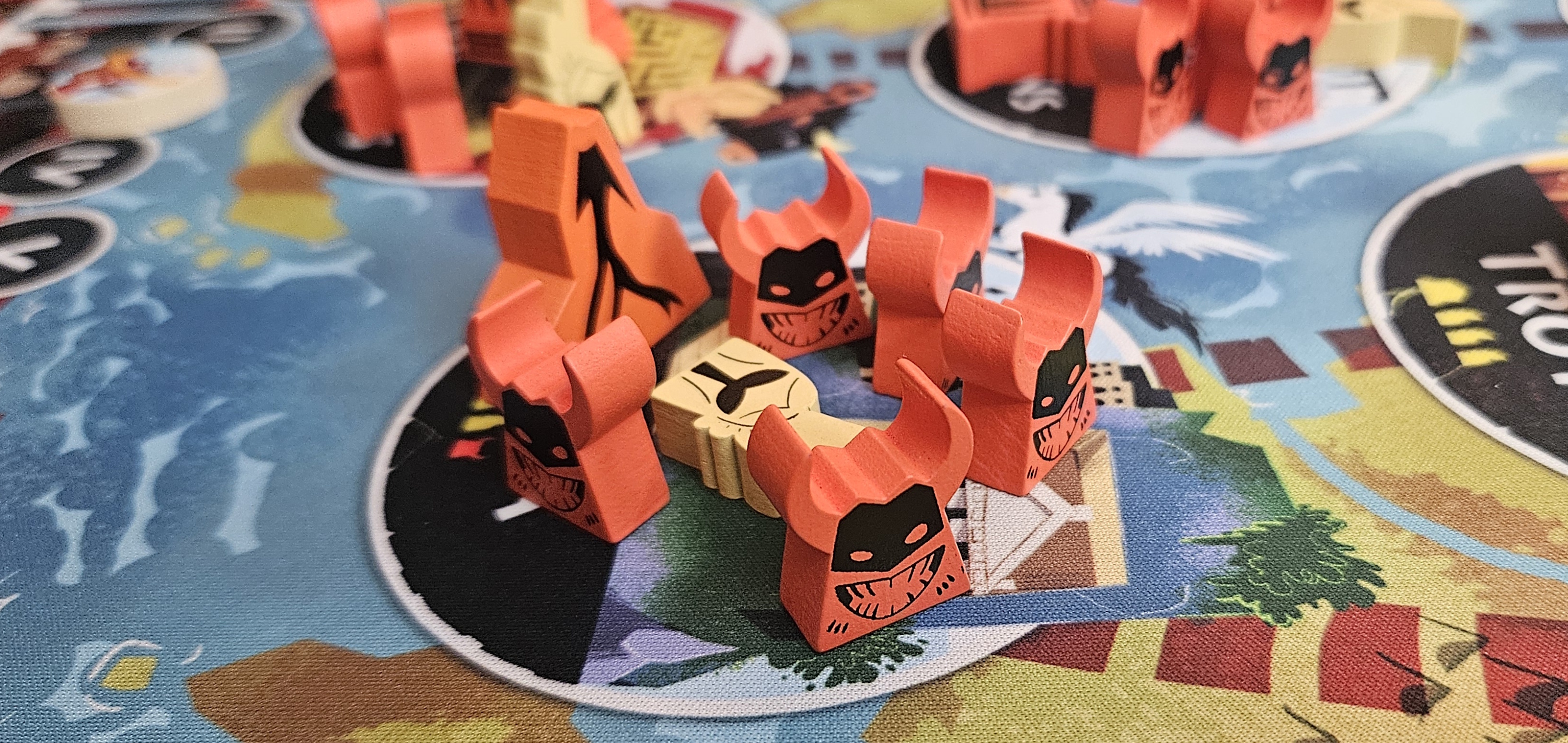
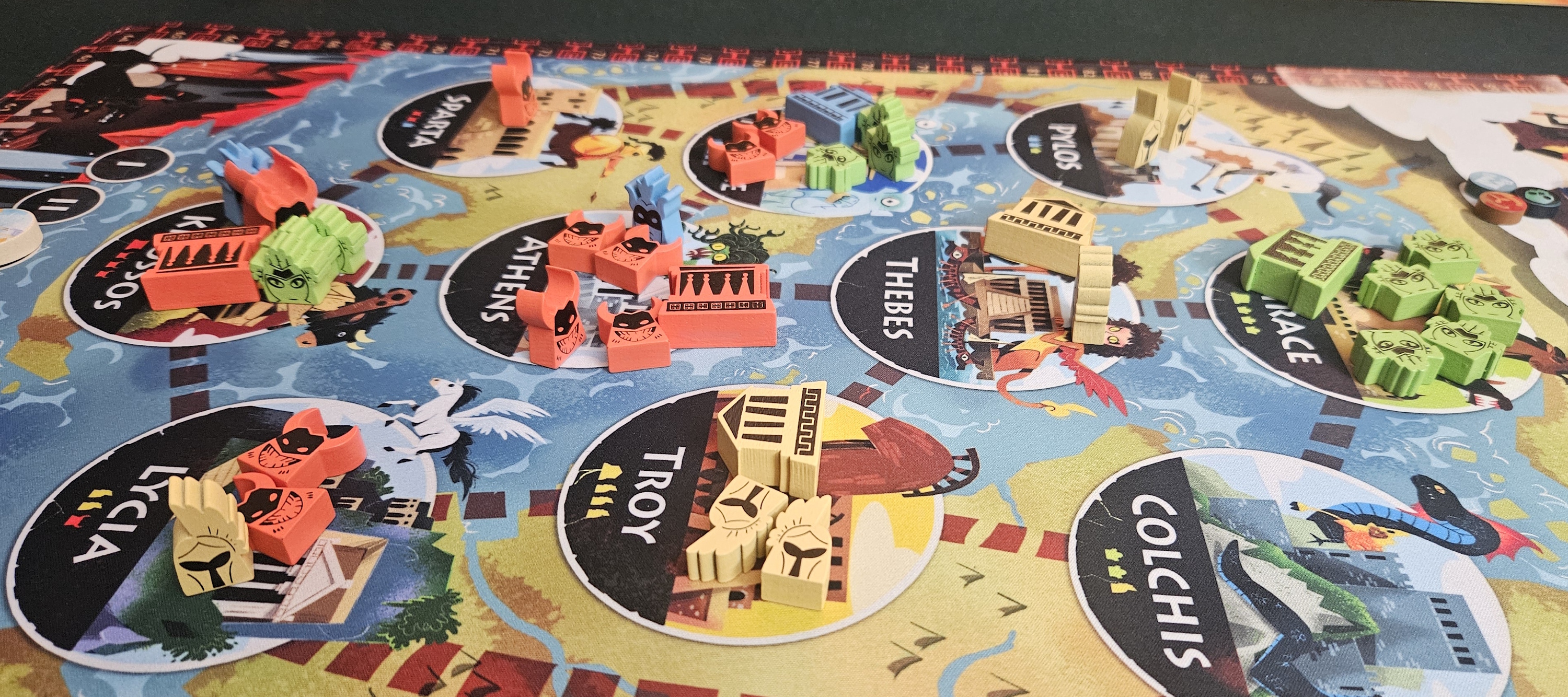
When Gods & Mortals opens, we receive a vision of the Aegean that’s half history and half myth. Humankind has split into four factions, each dominating roughly a quadrant of the known world. Proud Troy rules over one side of the sea, the Achaeans hold the opposite shore, the Minoans are doing the seafaring thing down south, and the northern land are ruled by the Amazons.

Don’t worry about keeping them straight. To you, an immortal, they’re yellow, blue, red, and green. You might as well distinguish between one species of beetle and another. The only reason you care that much is because the entire pantheon has gotten together and decided to wager some of their divine essence on the outcome of mortal affairs. Basically, you’re playing Age of Empires for money.

What follows is a freewheeling contest that plays out in two separate realms. On the table, mortal empires vie for control of territory, erect temples, and sometimes murder each other. Above it, the gods hoot and holler about their preferred sports team, trading wagers and nakedly calling for a rival’s star player to get benched. Betrayal is common. So is cooperation. Often those two go hand-in-hand, swapping places within seconds of the previous state of affairs.

"Hm. I think Dan needs more naps. That'll be four divinity."

I like to believe the gods invest in my soul as well.

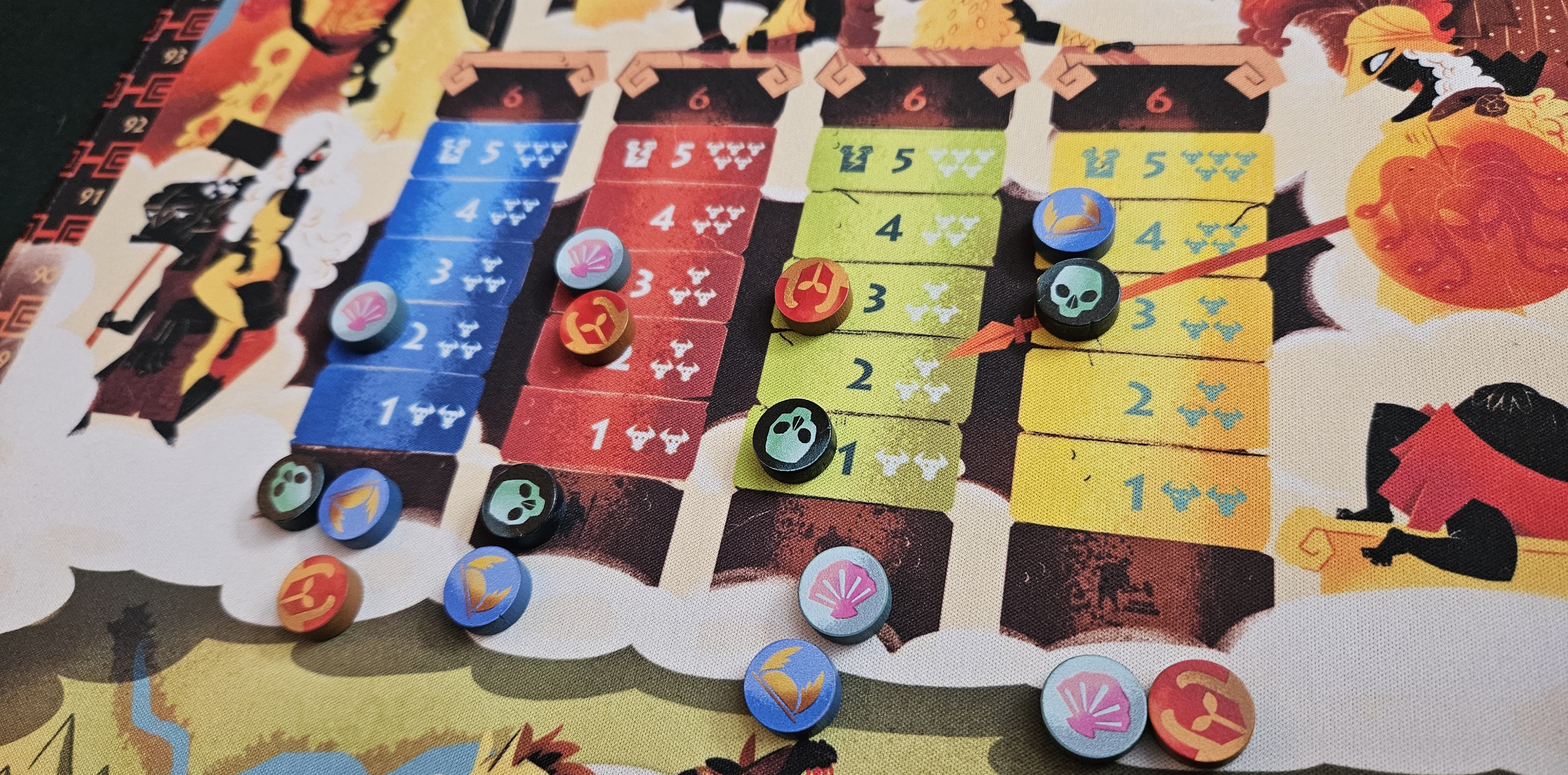
It works like this. When the round begins, every god is allowed to invest a portion of their divinity into the insect human dramas playing out below. The rules are strict. Only two kingdoms can hold your favor at a time. These increments are slow, only permitted one or two ticks at a time. Only one god can hold each level of favor within a kingdom, making it possible to block the interests of their fellows.

Perhaps most crucially, increasing your favor with a kingdom requires a proportionate investment of your divinity. If the Achaeans have been driven back to their city-state while the Amazons control a map-spanning empire, well, you’re presented with a conundrum: either buy Achaean favor at fire-sale prices, or cough up a premium for the Amazons.

Or betray them entirely. The strategy of Gods & Mortals is one of tactical investment and withdrawal. In essence, human factions are the joint-stock companies of your average cube rails title. Buying into a faction requires more divinity as they grow more prosperous. But so does your god’s potential buy-out. It’s tempting to bestow your godly light on a faction in ascent, but that could prove costly; on the flipside, spending too much time on a failed empire might prove catastrophic. We could render this as folksy wisdom. Buy low, sell high. The bigger they are, the harder they fall. Don’t date crazy.

And then, bets placed, the gods shift their attention to the mortal realm. You didn’t expect the gods, of all beings, to place a wager without leaning their thumbs and/or lightning bolts on the scales, did you? Even in the Book of Job, the foremost text on deities with compulsive gambling disorders, the spurned Creator sends a whole whirlwind to browbeat the poor guy into recanting his frustration.

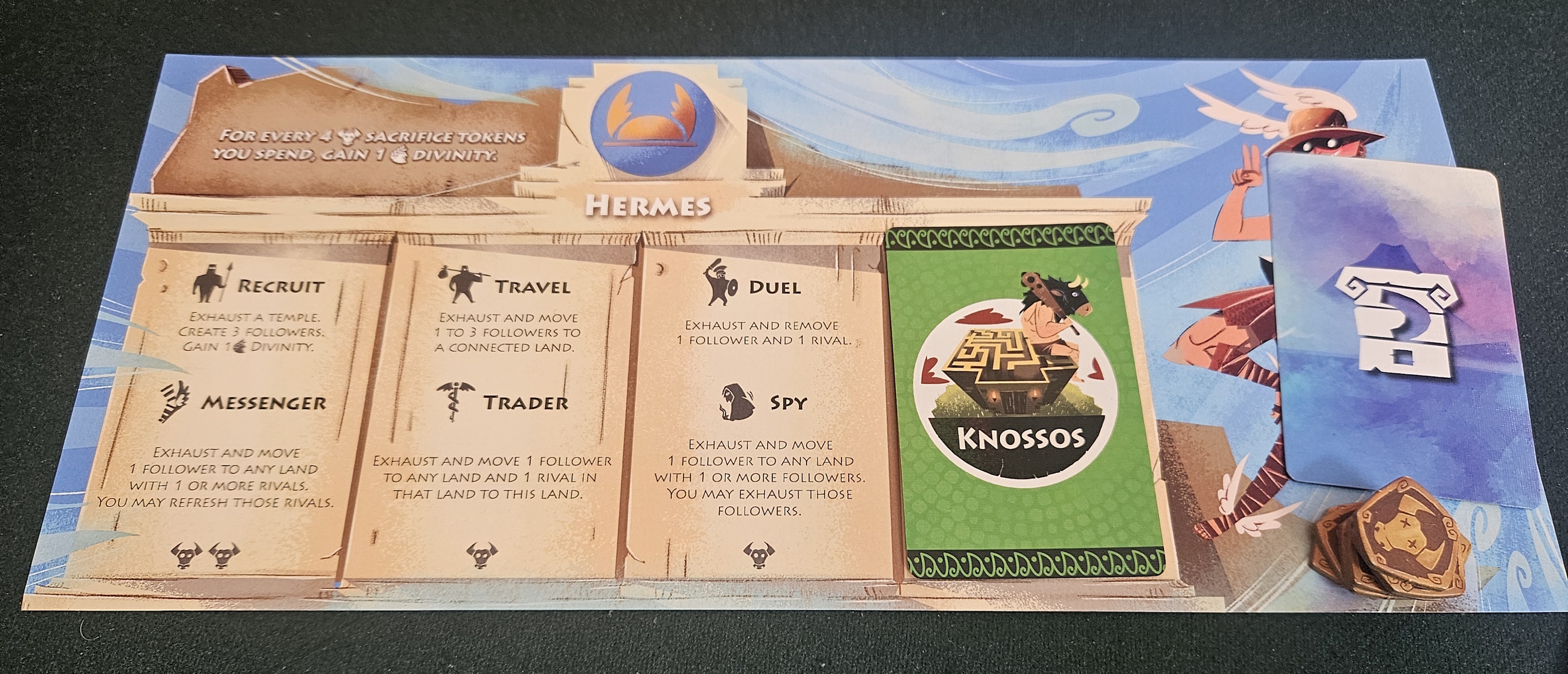
Hermes has the strength of being as vanilla as possible.

Each god brings their own strengths to bear.

This phase occupies the bulk of a round. Going around the table four times, each god takes turns manipulating the mortal wars, expansions, and offerings of the Aegean. As with the previous wagers, there are stark limitations. The short version is that you can manipulate mortal events quite broadly, but only provided you’re holding the right cards, the desired action is still available, and, if you’re going for one of the more powerful options, have enough sacrifices on-hand.

In practice, this strikes a tight balance. On the one hand, it’s exhilarating how transformative your powers can be. Some of this depends on your divine identity. Artemis can guide the bowstring of an anointed hunter to slay rivals in multiple foreign lands. Ares likes to sack rival temples, turning unprotected holy places into recruiting grounds for entire armies. Hades chews up souls and disgorges them as half-rotten Odysseuses. Most actions are smaller — troops marching from one space to another, a temple providing sacrifices to its patrons, a duel that kills both participants — but with the right timing and preparations, human affairs can prove surprisingly malleable.

But the other portion is social. Given the game’s stock-broker core, it shouldn’t come as a surprise that success often requires a deft touch with your immortal relatives. Control over the human factions is entirely shared, making it possible to meddle in surprising ways. I remember the white-hot fury that resulted when a carefully stocked military campaign entered a distant land only to, at the very beginning of the next round, turn around and march home before they could erect their intended temple.

More than that, it’s important to think about the long-term implications of each move. Will building that temple in Thebes lead to a long-term rivalry with Zeus? Is a volcano in Sparta a good way to ensure compliance with your plans, lest the little bondage-geared goofballs scream “This… is… ARGHHHH THE FIRE!!”? Or are there opportunities to trade favors? One session I won on the strength of collaboration, working with another player to reform the Achaeans from a measly two-territory kingdom into a sizeable empire. Theirs wasn’t the biggest faction on the board, in the end. But it had undergone the best growth, which meant the best total increase in our divinity. In my divinity.

as a real historian I can tell you that this is more accurate than most movies

Historical Greece. No embellishment.

All told, Gods & Mortals is a hoot. It’s a stock game, there’s no disguising that, but it’s direct and combative in a way that, say, cube rails is not. It would be tempting to say that this blunts that genre’s subtleties, but the more accurate summary is that it moves the concept in a new direction. The result is flashy but still measured, every god bending the rules in their own manner, but only after careful preparation and in clear sight of everybody else at the table. While it’s distinct from Nichipurov’s previous designs, it carries a few strands of familiar code: the emphasis on human drama, the tightness of a few outlandish actions, the sheer exuberance that comes from discovering each god’s inner workings.

As a bonus, yeah, it’s got that train wreck theology going on. How do we respond when the gods throw our lives into turmoil? Not much, apparently. Maybe, at best, we can place some bets on the outcome.

Gods & Mortals is on Gamefound right now.


A prototype copy of Gods & Mortals was temporarily provided by the publisher.

(If what I’m doing at Space-Biff! is valuable to you in some way, please consider dropping by my Patreon campaign or Ko-fi. Right now, supporters can read about which films I watched in 2025, including some brief thoughts on each. That’s 44 movies! That’s a lot, unless you see, like, 45 or more movies in a year!)

Fry n’ Write

27. März 2026 um 18:45

now I want chicken

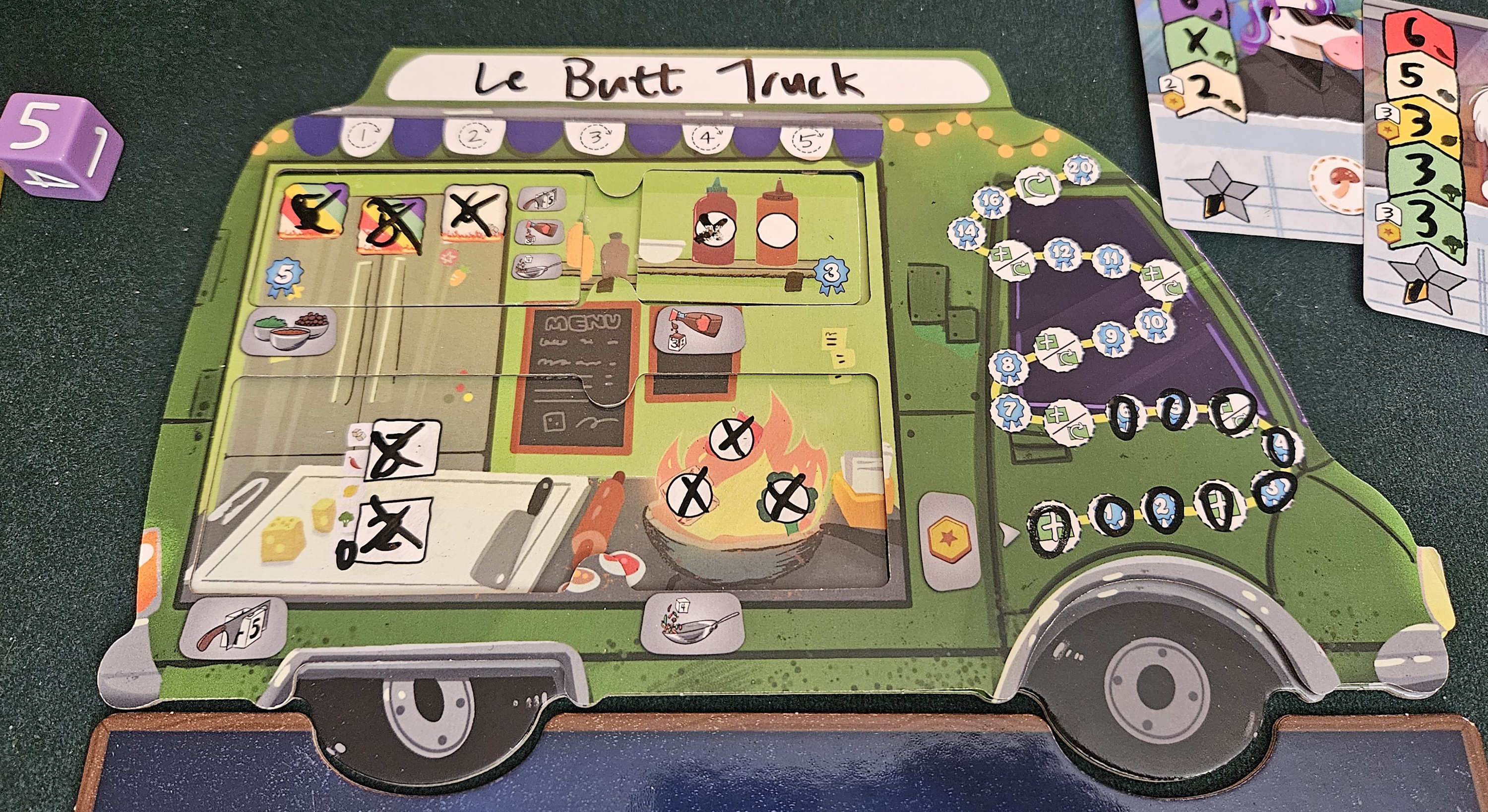
Food trucks, like roll-and-write games, went from unknowns circa 2013 to oversaturated by 2021 to fresh all over again in this the year 2026. At least that’s the hope behind Chicken Fried Dice, a chuck-and-scrawler and food truck simulator from Ashwin Kamath and Rob Newton.

How does it perform? We’ll wait in line together.

I'd eat there.

Ah, my dream job. (This is a lie.)

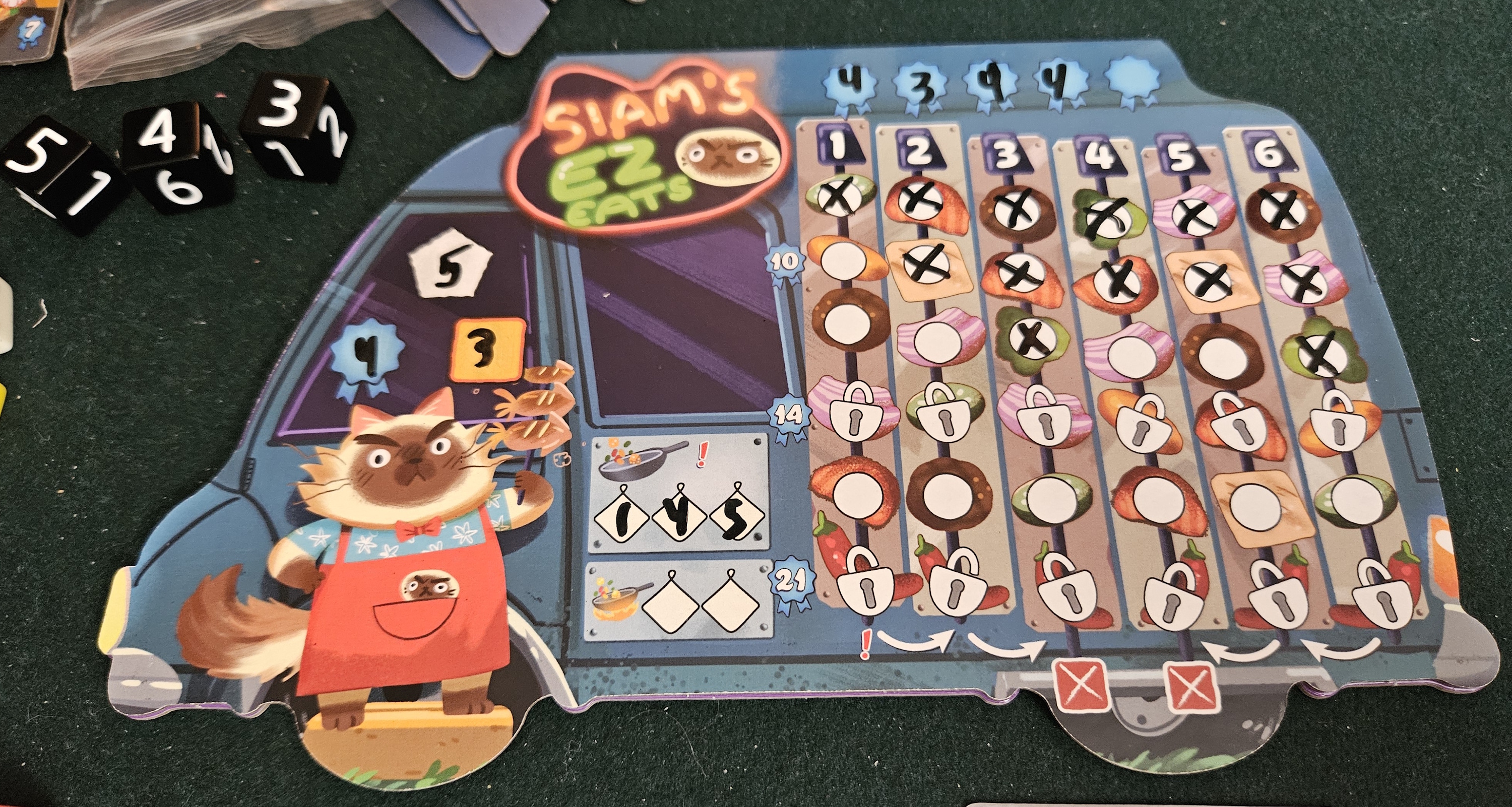
When Chicken Fried Dice opens, you have a food truck not unlike the rolling disaster from Jon Favreau’s Chef. In the language of dice, that means your options are limited, confined to a few rerolls, the ability to “chop” a die to divide a large number into two smaller numbers, and dousing an ingredient in sauce to make it seem like something else entirely. Ah, the secrets of the trade. I always suspected that if I slathered a bread crust in non-gluten barbecue sauce, I could legally label it GF.

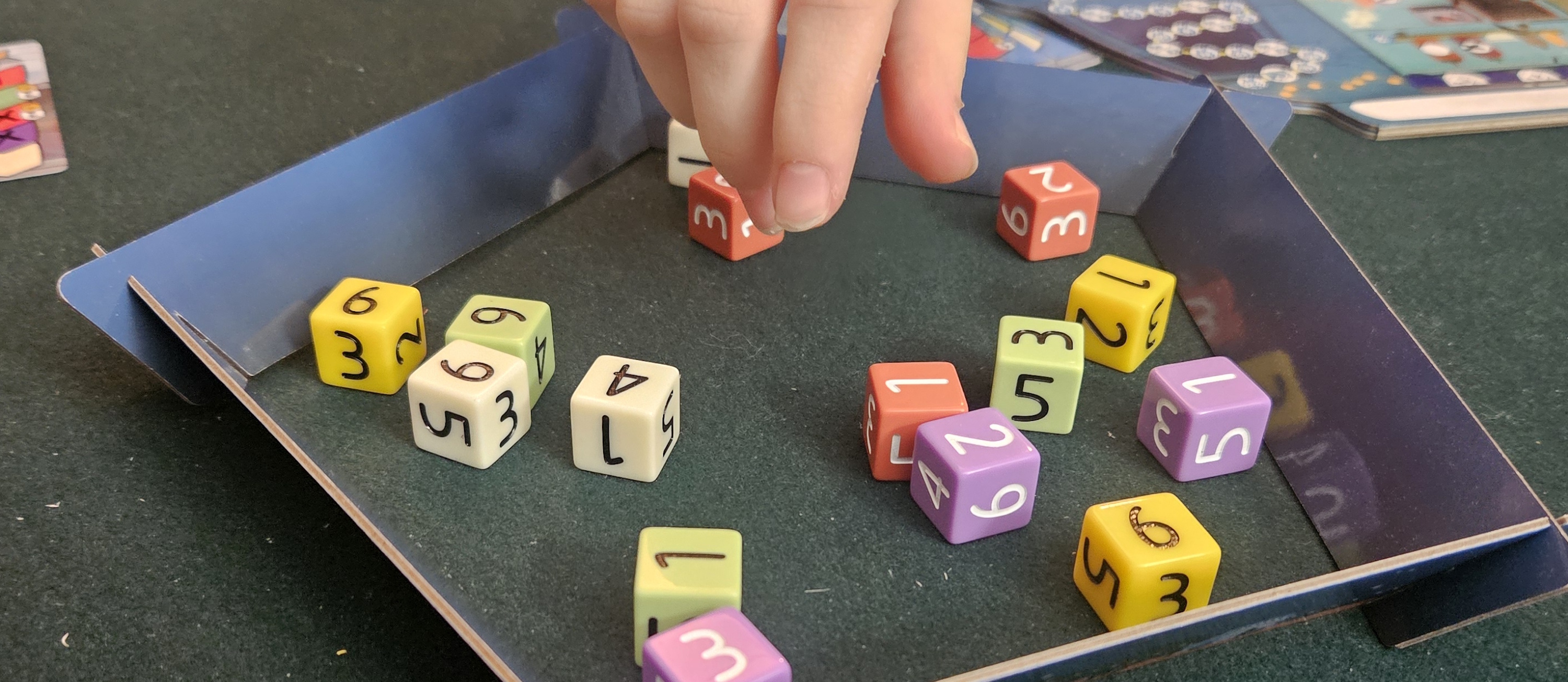
Those tools are essential. On the surface, Chicken Fried Dice is another roll-and-write. You roll some dice, you write down their digits.

But what sets it apart from the competition is how thoroughly you can knead those rolls. For one thing, this is a simultaneous game. Everybody begins by chucking a handful of dice into a shared pot, then fishing them out one at a time. It’s possible to work fast to secure the best ingredients for yourself, but this is rarely easy. See, for instance, the aforementioned methods for altering your rolls. Getting what you want is often possible, but may require some trimming and/or a dash of luck.

Especially that owl. Get outta here, ya jerk. We don't serve your kind. (Owls.)

I have never resented an anthropomorphic animal more.

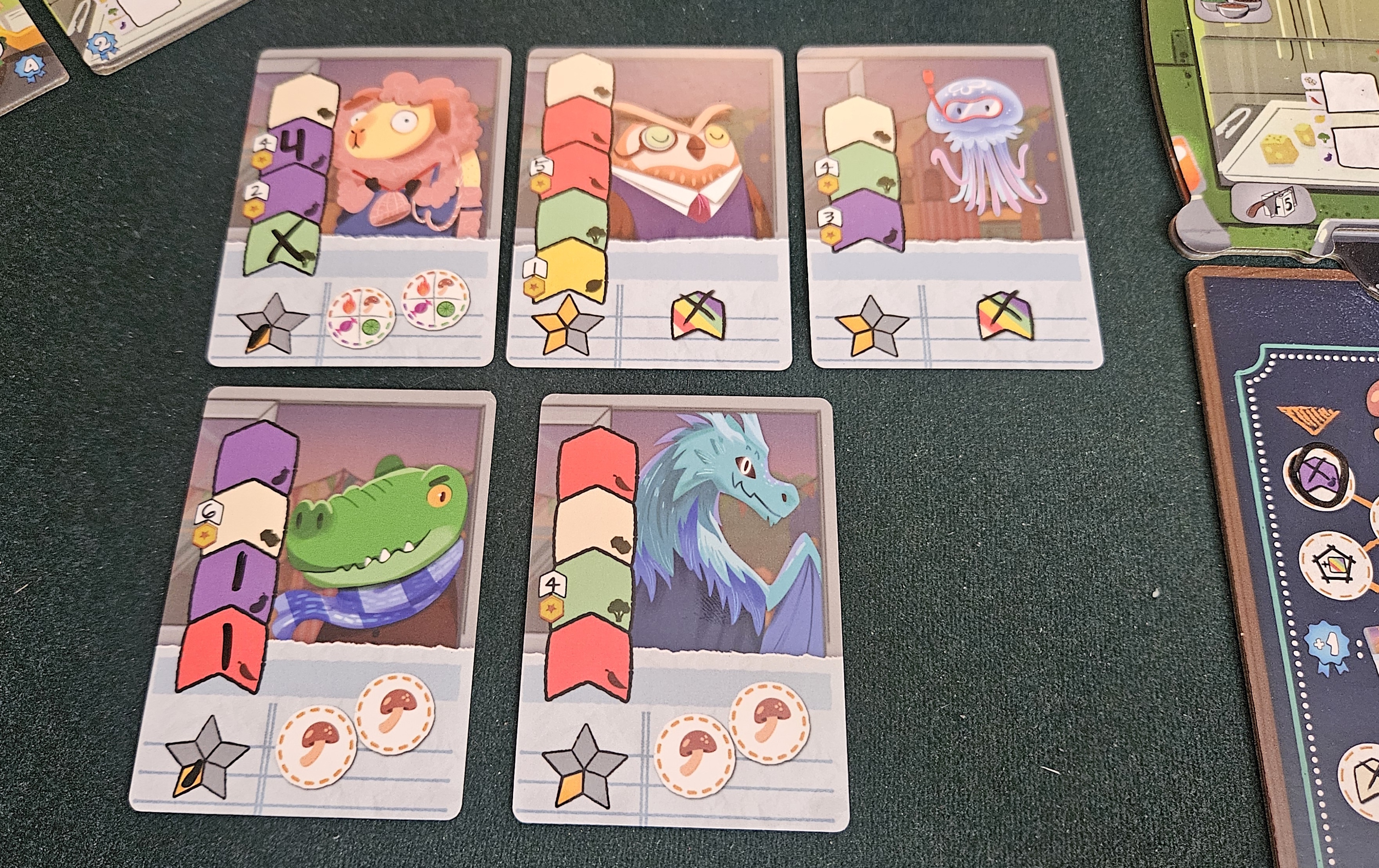
Even more persnickety, though, are the customers lined up outside your truck. I hate them. Everybody hates them. At their most basic, each customer has a list of ingredients they want in their meal. Say, peppers, broccoli, tofu, and more peppers. The first problem is that these represent portions. Each color has to match, of course — bring on the sauce — but each successive digit must also increase, or at the very least match what came before. This turns every order into its own ramen bowl of competing portions, ingredients, and custom instructions.

Naturally, providing customers with their desired meal is how you score points, but there’s so much more to it than that. Customers are willing to stick around between rounds, but the point-earning stars they’ll award your truck diminish over time. Worse, the picky jerks may leave a tip, but only if certain spaces meet their approval. Sometimes this isn’t such a bad thing, like when a number near the bottom requires a low digit. But what about when the bottom-most space demands a 4? And the order is five stonking ingredients long? And the customer doesn’t intend to stick around for more than a few minutes?

As with the best roll-and-writes, Chicken Fried Dice very quickly becomes a game about identifying and enacting one’s priorities. Not every customer will get served, so choosing the best clientele is a must. Those meager tips likely won’t let you improve every station of your food truck, so it becomes necessary to shore up your weak points. Depending on who you feed, little bonuses become available. Free ingredients, various flavors… I’m not sure what’s happening here, because it seems a lot like we’re carving haunches out of satisfied customers to feed the next group, but it does make for some nice combo-building. As your food truck transforms into the renovated sandwich wagon from the latter half of Jon Favreau’s Chef, it becomes possible to serve more and better meals.

It's very hard to not say the f-word during the chuck n' pluck phase.

Chuck and pluck!

The whole thing is a delight. The race to nab dice works in part because it’s harried but not overly punitive. Barring the occasional bonus, players are only allowed to grab four dice, so it’s rare to find yourself under too much pressure. Upgrading your work stations offers tangible improvements, and we have yet to play without someone showing off the name they invented for their truck. The complexity level can be adjusted, with two modes for using the bonus “flavors” provided by customers, whether a simple cluster of four tracks or a more open-ended picnic minigame. The dice-chopping has even provided a nice way to get my twelve-year-old to think about algebra beyond the confines of her math class.

Oh, and the solo mode is nice. Every truck has a reverse side that shows a different puzzle boss to beat, sort of like the uppity food critic from Jon Favreau’s Chef. I haven’t seen them all yet, in part because the prototype wasn’t content-complete, but the ones I’ve tackled have struck a nice balance between putting up a challenge and affording the player a measure of control over the rival trucker’s moves.

Is it a perfect game? Oh, I dunno. It’s a little airier than I prefer, a little more limited, especially when it comes to things like the upgrades. More often than not, it’s possible to upgrade the entire truck in those five rounds, making the game feel more boxed-in than some of my favorite exemplars of the genre. Chicken Fried Dice is a light game, but not so light that there isn’t some crunch mixed into its rice bowl.

This morning I had this image open on the computer while I was getting my six-year-old ready for school. She ran over to it and declared, "Aw, Daddy, I love that angry cat!"

There are five solitaire bots. Or there will be. The prototype only had a few of them.

The short version is that Chicken Fried Dice is something I would play with my sister’s family. They play plenty of games, but require a curated middle ground, neither too light nor as brain-burny as The Anarchy or Fliptown. This is that sort of game: silly but not off-putting, cutely thematic, mathy but not frustratingly so, breezy without zoning me out. To sum it up with a quote by John Leguizamo from Jon Favreau’s Chef: “I’m putting a little corn starch on my huevos, man.”


A prototype copy of Chicken Fried Dice was temporarily provided by the publisher.

(If what I’m doing at Space-Biff! is valuable to you in some way, please consider dropping by my Patreon campaign or Ko-fi. Right now, supporters can read about which films I watched in 2025, including some brief thoughts on each. That’s 44 movies! That’s a lot, unless you see, like, 45 or more movies in a year!)

Burned Notice

25. März 2026 um 20:04

My name is Hot Secret Agent Man In An Improbable Orange Jacket, and I used to be a spy.

There’s a problem with most hidden movement games, and I say that as the mechanism’s greatest devotee. Namely, they’re slow. So slow. Maybe it would be kinder to call them “deliberate,” but even that doesn’t quite transform the ding into a compliment. Stealth, in theory, can be deliberate. Stick insects are deliberate. But it can also be harried, adrenal, instinctual. Like a panther. Like an owl. Like me ducking out of a Super Bowl party before the uncles start complaining about the halftime show.

Burned occupies the untapped middle ground between those two poles. Designed by Jon Moffat, who gave us last year’s top game about poop carts, Burned is neither Mind MGMT nor Captain Sonar. Instead, it’s the closest a board game has ever gotten to making me feel like a highly-trained secret agent picking off mooks in broad daylight. Usually right before they tackle me to the ground and stomp me to death.

"... and not in a Heated Rivalry kind of way. Get out of there, Hot Secret Agent Man In An Improbable Orange Jacket!"

“You have thirty seconds before they’re on top of you…”

Picture with me, if you will, the moment in any spy thriller when the baddies are stomping up the stairs. Go ahead, close your eyes and picture it. Close them. Now open them. This ain’t no radio drama. You, the secret agent, can hear them coming. They’ll be on you in seconds. Not minutes. Certainly not hours. Seconds. They’re at the door. The wood is splintering. They sweep into the room, and you’re

gone.

Burned is about those split seconds. A session takes ten minutes, maybe fifteen at most, and comes across as no longer then five.

Which makes it all the more impressive that it isn’t real-time. Nothing explicitly hurries you along. The Burned Asset takes his turn. Then the Agency pursues him. Back and forth it goes, back and forth, until one side or the other has been planted.

Along the way, Moffat deploys considerable tricks to sell the illusion that the entire encounter is measured in heartbeats. For example, there’s the map. Unlike many other hidden movement games, which deploy geography in the most literal sense, the space in Burned is more impressionistic. Depending on the layout, the entire area might be confined to the square footage of a hotel. And not an especially large hotel. One card will be a courtyard; another, a terrace. One space is just “steps.” Another is a fountain. Stealth, then, is a matter of ducking out of sight, not putting miles between pursued and pursuer.

This sensation of proximity extends well beyond card titles. Both sides move the same way, either walking or running from one card to another. Walking means moving to a card that matches the color of the one you’re standing on; running means moving anywhere — literally anywhere at all — but incurring a penalty, whether announcing the color of the destination if you’re the Burned Asset, or putting your mooks at risk if you’re the Agency. Meanwhile, some cards show multiple colors. These are crossroads, spots one might pass between colors without having to tip their hand.

rawrf

That is one cool pup.

The effect is thrilling. Because every spot on the map is within reach of every other spot, there’s no such thing as outrunning your opponent. You can buy time, sure. You can duck away from a fight that’s getting too hot. But Burned is a chase scene in a confined space, not an entire cat-and-mouse flick. It’s like that moment in A History of Violence where one character outfoxes another by shutting a door in their face, or the single-take fight scene from Atomic Blonde that rolls through a single apartment block, or every other scene in a Bourne movie.

Of course, this wouldn’t work without Burned’s unusually high body count. Most hidden movement games offer a certain asymmetry of vulnerability, where the one being pursued is in danger of losing their life while the greatest risk to the pursuer is the loss of some time. I’m thinking of the Hunters from Specter Ops, who can be stunned but never put down for good, or even the shark from Kelp, for whom failure means missing out on dinner.

Here, nothing could be further from the truth. The Burned Asset is uniquely vulnerable because he’s alone. But the Agency, despite being the better-staffed half of this equation, is almost assured to suffer the greater casualties. When the scene opens, they have seven agents. Most of these will probably be run-of-the-mill operatives. Mooks, in other words, there to chase the Burned Asset and, in all likelihood, give their lives in the attempt. One or two might be spotters, relatively peaceful mooks who are better avoided than assaulted directly, or even canine units that are experts at sniffing out traps.

But the Agency isn’t untouchable. Their principal aim is to kill the Burned Asset, but they’re playing a double game. This entire shebang began as an ambush. So the big guy is here, the Director of the whole rotten apple pie, along with his body double. If the Burned Asset takes down the Director — and possibly the body double as well, depending on the order things shake out — then it’s curtains for the Agency.

The result is a chase in both directions. A highly lopsided chase, to be sure. A chase where one side is doing the bulk of the chasing and the other is usually the chasee. But it’s also a chase where the hunted can very rapidly turn the tables and become the hunter. With the application of a few bullets, a grenade, maybe a bear trap, anything is possible.

The game allows you to choose from a number of kits, and even build your own. Already I have my favorites.

Blammo.

I suppose it bears mentioning that the Burned Asset is the harder role to play. Manpower counts for a lot, and seven to one makes for formidable odds.

In a game this kinetic, this cinematic, and this brief, however, it’s hard to consider that a shortcoming. I have complicated thoughts about balance in the first place — foremost that it’s overrated — and it strikes me as fitting that a contest between one man, no matter how well trained and outfitted, against seven other killers, should be a little tipsy on the scales.

More than that, though, many of my favorite moments in Burned were those that saw me failing to accomplish my objective. One instance in particular stands out. After setting up the map, I positioned myself at an intersection, an obvious hiding place with ready access to two major areas. Right away, the Agency zeroed in on my position. Within a single action, I had been injured. We’re talking twenty seconds into the game here.

But I had planned for this. All according to plan. I popped some tear gas, a single-use tool that stunned every agent at locations of my color. This just so happened to be every single agent in the game. And while two agents had fanned out to secure the area, the rest were clustered atop a single mezzanine.

That gave me a free move, completely unharassed, to do whatever I wanted. That’s an eternity in Burned. So I chose my next move carefully. I took careful aim at the mezzanine. Five agents in my crosshairs. And then I sprayed lead.

Hits in Burned resolve according to a simple deck draw. One by one, we went through the agents. The first one, an operative: DEAD. The next, the body double: DEAD. Third, another operative: MISSED. Who cares, my target is the big bastard. And there he was. The Director. It was entirely plausible that I might win the match within one minute of completing setup. We flipped the next card, and

MISSED.

Dammit. The other agent got away, too. I’ll type it out for consistency’s sake: MISSED. But, hey, that was fine. With so much of its manpower already bleeding out, the Agency was in a bind. I ran. Hid. Tried to regroup.

It didn’t pan out. A little while later, another agent found me and inflicted my second wound. I killed him back, but the exchange left me on death’s door. On the next turn, I shot the wrong guy. He turned out to be a spotter. Which meant whatever sniper was covering his location popped me next. Blammo. Lights out for the Burned Asset.

But the takeaway from this anecdote isn’t that I failed. It’s that Burned produces moments of effortless kino. Every duel feels close. Every shot, every flipped card, every knife duel, every booby trap, every reveal. Sure, the outcome was more The American than John Wick. Sometimes, that’s how the cookie crumbles. When I missed the Director after shooting his body double, I shouted. Yelped, more like. Woke up my friend’s dog. That’s how invested we were in that moment.

As the Burned Asset you can, in theory, double back to where you've been shot. It's always a bad idea. Instead of hiding, you mope around in the open, surely traumatized by the gunshot wound, which inevitably draws too much attention.

Injuries and overwatch both restrict the Burned Asset’s movements.

This isn’t the first time I’ve been excited about a tiny stealth game. I’m thinking about Fugitive, another box that can squeeze into your average jeans pocket. (Or slip comfortably into a cargo pocket, if you happen to be a person of high fashion and leisure.)

But what makes Burned remarkable is not only its size, not only its duration. It’s the way the game conveys cinematic action rather than deductive logic. This is one of those rare hidden movement games that’s about motion instead of movement ranges. At no point does anyone count spaces. There’s no fretting over doubling-back rules. In place of the mechanism’s usual trappings, one finds pure animation, pure punch, pure heft. Which is to say, it evokes feeling more than analysis, a rare strength in such an analytical medium.

In more straightforward terms, it handles like a weapon. It feels heavy and dangerous in my hand. It incites to deeds of make-believe violence. I missed my shot at the Director this time. Next time, and the next, and the time after that, the bastard is going all the way down.


A complimentary copy of Burned was provided by the designer.

(If what I’m doing at Space-Biff! is valuable to you in some way, please consider dropping by my Patreon campaign or Ko-fi. Right now, supporters can read about which films I watched in 2025, including some brief thoughts on each. That’s 44 movies! That’s a lot, unless you see, like, 45 or more movies in a year!)

Imposter Syndrome

23. März 2026 um 23:12

The box art sold me on the game. I never judge a book by its cover. But a box by its lid? Always.

The Imposter Kings reminds me of a game I created as a kid. That probably sounds like a slam. Kids of six and a half aren’t known for making the deepest games.

But it isn’t that. It’s the way the game loops in on itself.

In my game, there were cards numbered one to ten. On your turn, you played a card on top of your dad’s card; on your dad’s turn, he played a card on top of yours. No matter who played, the card had to be higher than the one under it. If ever you couldn’t play a card, you lost and your opponent won. Halfway into our first play, I realized that high cards were infinitely better than low cards. So I made up a new rule on the fly. You could play a one on top of a ten, looping back around to the start of the sequence.

There’s more to The Imposter Kings. Lots more. The game’s designer, Sina Yeganeh, was too sharp to think that numbered cards would be interesting enough on their own. So this is one of those games with plenty of special abilities and triggers and the occasional reaction that plays out of sequence. At core, though, it’s a game about playing the right card so that your opponent can’t follow it up with something better, about knowing when to double down with a high card and when to loop back to the beginning. Exactly like my own game. Just, you know, interesting. I’ve played it more than once, for example.

"KISS!" I shout at the card I play over the other card, consternating my fellow players. They play another card, thinking, "Surely he will not shout 'KISS' this time." I play a card atop their card. "KISS!"

Just a few of the game’s many nasty cards.

On the whole, though, The Imposter Kings always comes back to that one central idea. Either you play a card or you lose. Very quickly, this becomes much harder than it might first seem.

Here’s the obvious conundrum. Let’s say you’re holding a nine. The highest rank. The number of royalty. If you were a six-year-old Dan, that would be the best card in the entire game.

But playing a nine is a fraught proposition. First of all, there are two nines. In The Imposter Kings, you can play any card that’s higher than the one currently seated on the throne. Higher or equal to. So a nine can beat a nine. The Princess comes along and deposes the Queen. The Queen puts that upstart brat Princess in her place. Whoops.

But even if that happens, other cards specialize in deposing royalty. The Elder, for instance, is a lowly three, but loves to swoop in and rap those royals on the knuckles. Or there’s the Oathbound, a bandaged character who can flip an enthroned royal face-down — a trick called “disgracing” — to take the seat and then follow it up with another card of any value. Spending two cards at once decreases the longevity of your hand, especially in a game about being the last person to play a card, but maybe your follow-up will hold the throne for good.

But there’s the question of everybody’s King. When the game begins, everyone is dealt a King. They then choose a card from their hand to place face-down next to the big guy. This is their successor. Once per game, you can flip your King and take your successor into your hand. Oh, and the card currently on the throne? Disgraced. Face-down. Value one. Boop de boop.

But flipping your King is dangerous, too, thanks to the Assassin. This is one of the game’s few reaction cards, and it kills a King the instant they’re flipped. So much for that once-per-game bonus.

But there are ways to out any would-be Assassins. The Judge and the Soldier both excel at revealing whether an opponent is currently holding a card, and both earn a tidy bonus if they’re right. Or there’s the King’s Hand, another reaction card, good for blocking an ability. Or you might make use of the Executioner and Inquisitor, both capable of stripping a card from somebody’s hand outright.

But you might need those abilities for something else. Or perhaps the Assassin is lurking as your rival’s successor, which would mean they could pick them up after you’ve spent the very courtier who could get rid of them.

But… well, there are answers to such a possibility as well, but I think we’ve drawn out this particular strand to its maximum elasticity. The point is that every decision in The Imposter Kings is unusually burdened, unusually dangerous. It isn’t unusual to spend a minute examining your hand. Even when — maybe especially because — there are only a half-dozen cards available at any given moment.

That's a lot of kissing.

A late-game court, full of disgraced or displaced notables.

At best, these decisions feel like little masterstokes. There are elements of deduction, not to mention memory, not to mention yomi, not to mention hoping like hell your rival makes a big dumb mistake. That’s a lot of punch for such a little game. And make no mistake, The Imposter Kings is very little. With two players, you only use eighteen cards at a time. Adding a third or fourth player ups the amount, as well as injects some extra variety, but not by as much as you might expect.

At the same time, the entire process feels algorithmic. Like you’re playing through a flowchart. The Imposter Kings comes across as the sort of game a computer would excel at, its digital spreadsheet mapping the best possible option five, six, a dozen moves out, all those counters and counter-counters charted in advance. Depending on the player count, Yeganeh assuages his game’s near-perfect information sphere, sometimes by keeping a card or three hidden off to the side, sometimes by sheer dint of seating too many players to leave you certain about what anybody is holding.

But like six-year-old Dan deciding that ones can beat tens, these gestures still sometimes come across as patches. Even at the best of times, The Imposer Kings asks a lot of one’s short-term memory. What you’re holding, what you’ve seen played to the court and then disgraced, which cards you threw away when the round began. The player aids are helpful, listing every possible card at the table, but they stumble by not revealing which cards have a duplicate in the deck. Not that it takes a long time to recognize which singles are actually doubles. One benefit of only using eighteen to twenty-something cards is that there isn’t that much to hold in your head.

The bigger mitigating factor is that The Imposter Kings isn’t meant to be played once. Like card games of olde, it’s intended as a many-handed experience, players doing what they can to secure not just one win, but many wins of variable strength. Defeating a foe with cards still in their hand, or while your King is still hidden, or both, is better than eking out a victory through the barest margin. This ablates the luck of the draw, at least to some degree.

It’s also exhausting, requiring one hard-fought win after another to finally scratch out a full victory. In our experience, reaching the necessary seven points takes more time and energy than its slender exterior would indicate. Especially as players grow cannier to one another’s tricks, these sessions can sprawl outward in duration and bitterness — but also in how deviously they permit players to act.

It is me reviewing this game.

Ah, the fool. It is me. It is I.

Here’s the bottom line. Like the game’s cardplay, my feelings on The Imposter Kings are nested and complex, but ultimately they return to a few simple ideas. One, this is a handsome game that’s easy to play but devilishly hard to master. Two, in its efforts to overcome certain inbuilt limitations, it comes across as patchy and overstays its welcome. Three, even slightly different play counts produce radically distinct sensations. Where the two-player game is tight, sometimes even too constricted, and the four-player game devolves into an awkward team-building exercise, the three-player game is utterly perfect, cluttering the game’s headspace just enough to keep everybody guessing, but not robbing it of any of its devious excitement.

Until it falls apart, that is. Because, again, like the cardplay, The Imposter Kings isn’t only one thing. It’s an exercise in high cards trumping everything else, except for the low cards that beat them. Critically speaking, it’s a game where the good outweighs the bad until the bad outweighs the good. Back and forth it goes, never quite settling in one place.

And I’m afraid that’s as definitive as I can be. In the end, The Imposter Kings makes an imposter of me, too. With it on the table, I feel like a kid discovering cards for the first time. The highs. The lows. And everything in between.


A complimentary copy of The Imposter Kings was provided by the designer.

(If what I’m doing at Space-Biff! is valuable to you in some way, please consider dropping by my Patreon campaign or Ko-fi. Right now, supporters can read about which films I watched in 2025, including some brief thoughts on each. That’s 44 movies! That’s a lot, unless you see, like, 45 or more movies in a year!)

A Study in Personal Pickiness

20. März 2026 um 02:03

Nikola Tesla and the Fantastic Displaced Hand

I adore Martin Wallace’s A Study in Emerald. The first edition most of all, although even the second edition, with its overly pruned foliage, will do in a pinch. I’ve talked about these games, and their spiritual sequel, multiple times. In some ways, the original Study was one of my first glimpses into the strength of board gaming as fable, as serious historical examination made easier to stomach thanks to its drapery. Like clothes over a mannequin; like speculative fiction describing theory of mind.

Cthulhu: Dark Providence, co-designed by Wallace and Travis R. Chance, is a remake of Study’s first edition. It’s a very good game. An excellent game. As a design artifact, it improves upon Study in fascinating and crucial ways. I’d be happy to introduce it to anyone who wants a glimpse into what board games can accomplish.

And yet, I can’t help but miss the original. There’s some rosy nostalgia at play. Of course there is. But I’m also longing for that original game’s fangs. And no, I’m not talking about how this edition swaps out the vampires for red-eyed knockoffs.

"I apologize if my bell summoned you."

Greg from Succession and some alcoholic detective vie for the affections of a woman.

Let’s begin with the basics. Cthulhu: Dark Providence is set across the eastern portion of the United States during the Great Depression. People are hungry. Jobs are scarce. Ancient monsters rule the country. Literal monsters, not the nativist politicians who historically used people’s poverty and fear to drum up power. And those monsters are doing their best to pry open portals to otherworldly dimensions.

There’s a certain madness to American politics, always has been, so the idea that overly-tentacled beings that are simultaneously phallic and yonic would prey upon that unique American desperation to bring about an emerald-hued apocalypse is, if not exactly realistic, not the most far-fetched piece of horror fiction out there. This segmented reality informs the design itself. Put another way, Cthulhu: Dark Providence is hard to sum up. It’s a deck-builder. It’s an auction. It’s a social deduction game. It’s about revolution. It’s about trying to go insane on purpose. It’s about concealing yourself from the world. It’s about becoming your fullest self.

In gameplay terms, it’s about taking two actions per turn and clawing desperately at any sense of progress. When Dark Providence opens, everybody receives a role. Broadly speaking, there are two sides: the investigators, who hope to shut the monsters out of our world, and the cultists, who labor to bring humanity into their sticky embrace. These roles are hidden, but not quite as social-deduction-y as newcomers might expect. Concealment is a useful tool, but not a crucial one. There’s a good chance that everybody at the table will understand the broad strokes of everyone else’s objectives within the first half-hour. Still, that uncertainty is helpful. It staves off direct action. If nobody knows which side you support in the “Should we welcome the ancient god who promises to have us sprout penises from our eye sockets?” debate, nobody is likely to have you assassinated.

Much of the time, this produces a multi-act structure. In the game’s early stages, everybody’s motions are tentative, exploratory. Your agent — the avatar of yourself — travels from city to city, spreading influence and gradually picking up cards. Maybe you expand your network of agents. Maybe you tuck St. Louis into your back pocket. Maybe you join the Freemasons or conduct experiments with electricity or come into possession of a book with strange runes stamped into the leather binding. These are added to your deck, albeit slowly.

From there, little vignettes begin to form. Sometimes these are explicit, drawn via the game’s abundant actions. Somebody closes a portal for good, signaling their intention to rid the world of outside influence. Someone else starts appointing fish-people to local school boards, tipping their hand that they listen to dodgy podcasts. At other times, the developments are more subtle, such as when somebody’s network of spies and anarchists includes labor reformers and undead magicians. Other times, the changes are structural, the fabric of our reality coming unstitched as the cult moves up a shared track that will award points to everybody on their team.

We've come a long way from The Man Who Was Thursday, Agent Tuesday. Two days, to be precise.

“Agent CHOOSE-Day, I presume?”

Team. That’s a funny word in Dark Providence. You’re on a team, always, but also not on a team. I mentioned investigators and cultists. It’s true that there are people who share your worldview and objectives, but this is an individualist’s paradise. Only one player will win in the end. That said, nobody can fully ignore the demands of their faction. Mechanically, the concept is simple enough. When the final tally is reached, the lowest-scoring player forces everybody on their team to lose, no matter how high their score. So while you’re always racing against your comrades, you’re also working to ensure they’re better-off than the peons of the opposing team. As in the original game, it’s deviously clever, forcing players to constantly evaluate their social standing in the absence of clear data.

But this rubric is even more tangled than it first seems. There are also dissidents out there, one of the game’s few additions to the original Study’s formula. Dissidents still occupy a team — they’re dissident investigators or dissident cultists, not true independents, sort of like how libertarians are conservatives who like to look at themselves in the mirror — but their scoring is slightly orthogonal to their faction. The main takeaway is that they lose or win on their own, ignoring the usual rah-rah teamwork portion of the game, but are also uniquely vulnerable to exposure.

These complicating factors make Dark Providence a bear to teach and an even grizzlier bear to learn. In that respect, it’s much like the original. Not that Dark Providence hasn’t undergone development. A few nips and tucks make it simpler, on the whole. For example, both games feature quite the cast of potential recruits, but where A Study in Emerald also included an entire pile of duplicates to fuel a double-cross system that was dramatic but also sometimes frustrating to trigger properly, Dark Providence just ditches the whole idea. Once you own an agent, they’re on your side. That is, unless somebody drafts the right card to switch an agent’s allegiance, but that’s a visible threat rather than the lingering face-down tokens of the original game.

On the whole, then, Dark Providence is more akin to a second edition than the actual second edition of A Study in Emerald ever was. Its cardplay is intact, with that trademark Wallace gumminess where cards stick around rather than cycling easily in and out of hand. Its social questions are intact, and indeed are even denser than before, requiring teamwork and competition and backstabbing all at once. The networks of agents and ruffians are back.

Even the original game’s surprising detours with zombies and vampires return, albeit with a fresh coat of paint. Still, the effect is the same. While you’re playing one game, merrily conquering cities and scrounging for points, suddenly the proceedings take on a dark turn as fish-folk begin conquering New York City or your best agents transform into red-eyed phantoms. Just as the original Study was playful and unexpected, so too is Dark Providence. You’re never sure how a session will shape up.

It's the BYU–Utah Holy War.

Their team rivalries are intense.

On its own, these strengths mark Dark Providence as a worthwhile successor to A Study in Emerald, especially given that game’s long absence from print, not to mention the, ah, squickier aspects of its provenance. While Neil Gaiman’s short story was an excellent companion piece to the original game, I doubt anyone is going to miss his name on the cover.

This isn’t to say it’s an entirely perfect production. The standees for holding the agent tokens are duller in color than they should have been, flimsy enough that I had to glue them together, and while their canted angle might be nice for a solitaire game, they’re hard to visualize from any direction but head-on.

As for the more structural changes to the factions… time will tell. The short version is that I’m eager to keep exploring what Dark Providence has to offer. Dissidents may well improve the game’s deduction, encouraging players to unmask one another more often. I have my doubts, as the penalty for being revealed as a dissident feels like a slap on the wrist, but with experienced players Study often featured rather slender scoring margins. Maybe it will prove enough of an incentive to shake up the original game’s dynamics. Either way, this is a (mostly) handsome and (largely) faithful recreation of the original.

Where it steps amiss for me — and maybe only for me, such is the pocket nature of this complaint — is in the game’s handling of its subject matter. A Study in Emerald arose from Wallace’s interest in anti-monarchical bomb-throwers, the anarchists and revolutionaries who took it upon themselves to punctuate the divine right of kings with sticks of dynamite. Smartly for the 2010s, Wallace reasoned that a game about blowing up the continent’s royalty might be considered in poor taste, hence the veneer of emerald paint. The game’s heroes weren’t trying to blow up Queen Victoria; their target was Gloriana, a god from beyond the stars. The pontiff of Rome was not the Pope, but Rhogog. Cairo had no shah, but rather, duh, the resurrected pharaoh Nyarlathotep.

Despite this veneer, A Study in Emerald played like a who’s who of 19th- to 20th-century social theory. One minute you’d recruit Emma Goldman and Élisée Reclus; the next you might watch as Leon Czolgosz assassinated an eldritch spider rather than President William McKinley; eventually, Peter Rachkovsky would lead the Okhrana in a crackdown against a revolutionary cell headed by Prince Kropotkin. That these historical figures rubbed shoulders with Sherlock Holmes and Professor Moriarty only deepened the sense of place, giving the game the hue of allegory.

Not sure this is historical Tesla, though.

Historical figures rub shoulders with fictional characters.

By contrast, the Great Depression of Dark Providence is thinly drawn. What few historical touchstones it levies are mostly limited to gangsters (Arnold Rothstein, a misspelled Stephanie St. Clair), lawmen (J. Edgar Hoover, Eliot Ness, Wyatt Earp), or entertainers (Harry Houdini and Lillian La France, also misspelled), among a few scattered others. Unlike the historical figures of A Study in Emerald, which were united by the dueling social movements of the time, Dark Providence instead leans into the tropes that often accompany Lovecraftian fiction.

There are references, but most of them are confined to the Cthulhu Mythos. Every slouching shoggoth and brain-stealing mi-go is present, of course, but so are figures like Herbert West, Henry Armitage, and the Whateleys. When it comes to the Great Depression in the United States, even as a fictionalized depiction the game is sanitized of, well, everything. There are no labor movements. There are no suffrage movements. There are no Italian immigrants becoming enthusiastic Galleanisti. There is no Harlem Renaissance. There are no veterans’ organizations massing into the Bonus Army. There are no businessmen flirting with fascism by forming the Business Plot. Even the Prohibition stuff is thinly drawn, absent the original game’s clever inversions, putting figures like Eliot Ness on the side of resistance. (Yeah. Sure.)

The effect is to withdraw Dark Providence from the realm of historical fiction and slip it into the same category as most Lovecraftian board games, where figures like Nikola Tesla might wander into the frame, but not with any sense for their lived perspectives or accomplishments. It would feel right at home alongside any number of Fantasy Flight’s Arkham Horror titles or their many derivatives, full of tommy guns and long overcoats and men whose cigarettes dangle precipitously from their lips, but also sharing those same titles’ disinterest in what those characters or symbols stood for. It’s like setting Shakespeare in 1920s gangland Chicago. Fine for community theater, but disappointing as a sequel to a historical drama.

Again, it’s fine. No, really. Dark Providence is still a heck of a game. It’s just that, sans any broader context, the entire thing feels less grounded than its granddaddy. The irony is that, given how the hobby has advanced in the intervening thirteen years, it would be possible to design a game about anarchism without the veil of allegory Wallace draped over A Study in Emerald. Dark Providence flees the other direction, dulling its teeth for the sake of… I couldn’t tell you. To make the game less political, maybe. To lean into the Lovecraft thing. Unfortunately, the main side effect is that the setting feels generic.

Here's another pain point: Why are the cities connected on the card market rather than the city spaces? This is always confusing during play.

At times, it’s a sprawling game.

To be clear, however, even a blunted version of A Study in Emerald is sharper than any number of other Lovecraftian outings, and Cthulhu: Dark Providence is a formidable remake. It’s cleaner around the edges while still retaining the original game’s weirdness. In some ways I even consider it the better-rounded experience, especially where the deduction is concerned. The result is many things: a game out of time, a color out of space, an experience that still has yet to be emulated as widely as it deserves.


(If what I’m doing at Space-Biff! is valuable to you in some way, please consider dropping by my Patreon campaign or Ko-fi. Right now, supporters can read about which films I watched in 2025, including some brief thoughts on each. That’s 44 movies! That’s a lot, unless you see, like, 45 or more movies in a year!)

D’ough

18. März 2026 um 20:12

Cyrano?

L’oaf is that rarest of gifts: a board game that makes me laugh, and not because it includes any actual jokes. Designed by Bart de Jong, it opens with perhaps the most relatable conceit ever put to cardboard, a dead-end job players are working in order to make ends meet, but one they’re not overly interested in completing beyond the bare minimum. Not quite by accident, it’s about many things — the false enthusiasm of managers, the vast gulf between owners and employees, the oppression of tedium. As if by magic, none of those headier topics break the spell.

Little games are the tops.

Pretty much everything.

In the case of L’oaf, this particular dead-end job is a bakery. Tasked with baking a neighborhood’s daily bread, every round begins with an order. Four loaves per player. Six loaves per player. Eight loaves?! What is this? Are we getting paid any extra for baking twice as many loaves as two days ago? No? Then where is the incentive to knead all this dough? I’m about two loaves away from developing a repetitive strain injury!

The incentive, of course, is the damoclean threat of losing one’s income. If you’re American, add your health insurance to the noxious batter. Either way, it’s all stick, no carrot.

To wit, every round becomes a fraught proposition. You need to bake those loaves. But you also don’t want to put in too much effort to a job that doesn’t award any commensurate value. Everybody at the table holds an identical deck of numbered cards, ranging from zero to eleven, from which they deploy a single digit. This is how much effort they’re putting in for the day. Those cards are flipped and tallied.

But this is where de Jong shows his cleverness. If your bakers managed the order, great. The highest contributor ticks up on the reputation track, earning a pat on the head for all their extra effort. If not, somebody is going to take the fall… but only the worst slacker. There’s plenty of wiggle room in the middle.

This is important, because while you earn a few points for moving up on the reputation track, most of your final score comes from the cards you never played. The cards ranked ten and eleven? Crucial components in any slacker’s toolkit.

Actually, the boss is undercover. Raccacoonie is under one of those hats.

I wish these bosses would go undercover.

There are a few wrinkles that prevent players from racing to the bottom.

First, that daily order comes paired with an outcome. Depending on the day — and whether you’re playing with the advanced cards, which I heartily recommend everybody shuffle into the mix right away rather than neutering the game’s range of possibilities — there might be a benefit to putting in that effort. Say, the baker with the highest reputation gets to swap out a card from their hand with one they’ve played before. Or maybe everyone on the negative side of things can improve their standing in the boss’s eyes. That sort of thing.

Second, your boss is tracking all those successes and failures. L’oaf only ends once you’ve tallied five outcomes in the same category. Which is to say, you aren’t quite sure when the game will conclude. More importantly, depending on whether your bakery has a run of good or bad days, the scoring criteria are slightly modified. If the bakery fulfills more orders than it misses, everybody scores the cards in their hands. But if not, everyone with a reputation in the red is fired. No scoring for you.

This transforms L’oaf into quite the mind game. Sure, you want to slack off. But you also need to keep this job. But that means putting in effort tactically, not all the time. But that risks losing face with management if everybody else puts in more effort than you. But if everybody is putting in more effort, that means you probably won’t get fired anyway, so you might as well preserve your strength. But if somebody notices you slacking, they might slack, too.

It’s quite the pickle. In gameplay terms, L’oaf develops a certain tidal motion, players adjusting and compensating for one another, putting in more effort, then pulling back, then failing, then succeeding, and back again. It isn’t uncommon for the game to go the full distance, your boss’s angry-meter and pleased-meter both on the verge of maxing out. Which is to say, it’s surprisingly tight. At least I was surprised. A game about slacking off? Psh. I would never. Until, within a single twenty-minute play, it becomes apparent just how fine-tuned the whole experience is.

Somehow we all got fired. Didn't see that coming.

Check out these utter kings and queens.

And how familiar, too. L’oaf doesn’t only work because it’s tuned to such a precise degree. Nor does it work only because it produces such cautious predictions about how far you can strain your relationships before they snap. No, it works because it captures the long afternoons of a summer job. You know the one. The one you got up early for, the one that took out more than it gave back. Unless you’re one of those aliens who puts maximum effort into everything. In which case, by all means, return to that diet of point salads. Enjoy your fiber. You can poop a car.

For the rest of us, L’oaf is a lovely little thing. Tense, smart, relatable. Funny, too. More than once, the entire table has burst out into laughter when somebody slacked at exactly the wrong moment, their reputation dropping precipitously. Or burst into a smarmy cackle as they barely fulfilled an order and still came away rosy in the boss’s eyes. This is the good stuff. I hope Bart de Jong was sometimes late in getting a revision back to his publisher.


A complimentary copy of L’oaf was provided by the designer.

(If what I’m doing at Space-Biff! is valuable to you in some way, please consider dropping by my Patreon campaign or Ko-fi. Right now, supporters can read about which films I watched in 2025, including some brief thoughts on each. That’s 44 movies! That’s a lot, unless you see, like, 45 or more movies in a year!)

Space-Cast! #54. Shazain!

17. März 2026 um 19:44

Wee Aquinas has seen a flag before, but a chill comes over him when he considers what it might represent here.

Governance and Liberty — in translation, those are the titles of Shasn and Azadi, Zain Memon’s peculiar but timely board games about politics. Today, we’re joined by Memon himself to discuss both titles, plus the function of play as our most ancient form of education, the value of cynicism and evil in games, and what else the auteur has been working on lately.

Listen here or download here. Timestamps can be found after the jump.

TIMESTAMPS

00:50 — introducing Zain Memon, his work in film, and his transition to board games
13:30 — the “party game” of Shasn
21:45 — is there value in portraying cynicism or evil in games?
26:38 — games, one of our most ancient forms of education
31:22 — moving from Shasn to Azadi
42:49 — Macaraccoon
47:30 — representing resistance and revolution in Azadi
52:13 — Zain’s many forthcoming projects


(If what I’m doing at Space-Biff! is valuable to you in some way, please consider dropping by my Patreon campaign or Ko-fi. Right now, supporters can read about which films I watched in 2025, including some brief thoughts on each. That’s 44 movies! That’s a lot, unless you see, like, 45 or more movies in a year!)

💾

“Cozy” Is a Four-Letter Word

16. März 2026 um 23:45

"Cozy Lebensraum," the grumpy voice inside me shouts, like nobody's favorite hang.

I’m deeply suspicious of “cozy.” For much the same reason I’m suspicious of “nostalgia,” come to think of it. In the mouth of business executives, “cozy” becomes something we already own, or at least already have within our grasp, now repackaged and sold back to us as a subscription service. A monthly box of curated snacks. Ten ideas for cozymaxxing your nostalgia shelf. And that’s before we even consider the way institutions and politicians propose that coziness and nostalgia are the way things “used to be,” before someone came along to take away our picnics and crime-absent streets. What if we could go back to the Way It Was? What if all it took was getting rid of a few undesirables?

In other words, I am way too cranky to be Cozy Stickerville’s target audience. “More like Cozy Fascistville,” I probably frumped to myself. Then I learned it was designed by Corey Konieczka. Then I figured it might be a nice thing to play with my twelve- and six-year-old daughters. Then, as the undertow of commercialism swept my legs out from under me, it appeared in my shopping cart, one click away from arriving at my doorstep within three to five business days.

Then, those three to five business days later, it was winning me over.

We never found it.

Looking for a hidden object.

Cozy Stickerville strikes me as a very Corey Konieczka design. Aesthetically, it bears so little in common with The Mandalorian, Star Wars: Rebellion, and Runewars as to make such a statement nonsensical. But I’m not talking about visuals. I’m talking about the maximalism of the thing. The maximalism contrasted with the sheer action economy.

I’ll explain.

Cozy Stickerville opens on a cozy not-yet-village. Gifted a tract of land by a distant and condescending father — hoo boy, does this game have daddy issues — you immediately take it upon yourself to transform this tract of riverland into a home. Or, in game terms, to affix eight stickers onto a grid, creating a pastoral scene right out of a Western. (Back when there was room for everybody, the cranky part of my brain intones. I tell it to shush. My kids are right there, man.)

From there, Cozy Stickerville slips into a comfortable routine. A cozy routine, one might say. Every turn consists of the metronome rhythm of resolving an event card and then resolving an action. These resolutions are steadfast in their simplicity. Events generally present a decision. Build this or build that. Answer A or answer B. Fulfill a need right now or put it off till later. The actions are more diverse primarily in their range. Some appear on the stickers as entries in a little storybook. Others appear on cards. Most of the time, they also present straightforward options. Gather wood from the ground or spend food to possibly gather some extra. Build a house for an eccentric inventor or build a house for some woodcutters. Plant flowers or pave a road.

Despite this simplicity, the actions very quickly display a wonderful range of possibilities. It isn’t only that stickers will be added, first to the board and then atop other stickers. It’s that their addition unfurls new adventures. Sometimes Cozy Stickerville turns into a hidden object search. Other times, it becomes a resource optimization game. There are branching paths to a spelunked cave, uncovered over many in-game weeks. An observatory on the hill becomes a chance to peek at celestial objects; a post office transforms into a test of how well we’ve come to know our neighbors.

That’s what I mean when I say it feels like a Konieczka design. It has that economy of action but maximalism of discovery that have always been the hallmarks of his design. It feels large inside, certainly larger than I expected of a game about putting stickers on a grid.

As loathe as I am at the tendency to turn everything into a property... I wouldn't mind a sequel or two.

Potential actions are easily tracked.

Even the format feels generous.

Over the course of ten sessions, each no longer than half an hour, your village takes shape. Some of that shape is more or less what you would predict from a game called “Cozy Stickerville.” In our town — Happy Riverside Valley, if you care to know the name my girls came up with — we opened a bird-watching tower and animal refuge, a pet shop and a newspaper. We ran for office. We flirted with capitalism, but in a way that wasn’t too destructive. Only two copses of trees were felled, and only one lump of trash came to occupy the area. We dumped it right next to the big golden statue we had erected of ourself, a statement on how it didn’t resemble the way we imagined our unseen avatar.

But at points, Konieczka presents challenges and setbacks. Cozy challenges, to be sure, cozy setbacks. But challenges and setbacks all the same. When we borrowed money from a shady lender, the interest kept coming due at exactly the wrong moment. When we encouraged one character to date another, we were reminded, gently, cozily, that we could instead pursue the romance for ourselves. “Ew!” my girls moaned. When we failed to build a fire station… well, that was the one moment that maybe struck a little too close to my six-year-old’s heart. In real time, we invented the myth of the Farm Upstate, where all ferrets go to live after their house burns down.

These aren’t spoilers, as such. Not really. Mostly, they’re emergent properties, the result of one sticker placed atop another. Or else they’re the common-sense outcome of taking shady loans, engaging in pranks rather than doing your yard chores, or chopping down all of a valley’s trees. Cozy Stickerville sticks to obvious morals, but at least it sticks to them. Is it a spoiler to say that things turn out all right in the end? That you will be vindicated of your father’s disdain? That you will place more stickers on this sticker-grid? The storytelling rarely deposits us in expected places. It’s the trails and switchbacks it travels that are the delight.

BOARD GAME ADDICT is not an option.

Some of the many milestones your village might unlock.

And then, when it’s done, the game permits a second outing. This one is more constrained than the first, flipping the board to its reverse side and using most of the remaining stickers. All those decision cards must be made in the other direction, building the inventor’s house rather than the cabin for the woodcutters, making dialogue choice B instead of choice A, pursuing the agenda you left by the wayside on your inaugural play.

For a legacy game, a format that is often rightly criticized for producing waste, Cozy Stickerville proves only marginally more wasteful than your average children’s stickerbook. I’m not going to pretend it has limitless miles in its soles. There’s no playing the game once it’s finished, unlike some legacies, and the hours contained within are relatively brief.

But those hours and precious ones. I rarely have any trouble getting my kiddos to play board games, but Cozy Stickerville swiftly became such a highlight of our evening routine that it eclipsed all other contenders. My children cooed over their pets, debated where to place every berry bush and flower patch, and quibbled over whether to establish a summer camp or a candy shop. They decoded secret texts with all the reverence of archaeologists and positioned inhabitants with an eye for the view from their bedroom windows. More than once, in between sessions, they discussed which story threads they would pick up next or asked me to open the box so they could study their town. Even before we had finished our first ten-year campaign, upon learning that we could only play the game twice, they asked if they could contribute some of their own money to buying a second copy. Now they insist we should frame the board, spaced halfway between their bedrooms so they can appreciate equal ownership over it.

On the one hand, this doesn’t exactly beat the accusations that Cozy Stickerville is commercialism in a box. But on the other…

Look. I know what our hobby is about for most people. We buy stuff and we sell stuff and hopefully in the middle we enjoy the memories and moments and messages these things create. There’s so much crass commercialism out there, all those boxes of miniatures with barely-developed rules, all the FOMO and churn and Cult of the New.

On the scale of worst offenders, Cozy Stickerville doesn’t even rate. It’s unapologetically cozy, but it also makes good on its word. This is coziness not as a symptom of a culture in decline, or not only that. This is coziness as a shared moment between families. This is coziness as something bespoke and human-crafted, as opposed to slopped from the mouth of the slop monster. This is the coziness of a six-year-old in my lap, eyes glittering as she debates whether to place her kitty near that berry bush or chasing the naughty goose in the lake.

For Konieczka's next effort, might I offer "Not Especially Cozy And In Fact Increasingly Funky Sticker Generation Ship"?

Stickers over stickers! What will they think of next?

I still don’t know whether we’ll buy a second copy. I hope not. Too much of a good thing can spoil its memory. But for those two campaigns, I’m grateful to have bought and played this thing. Because Cozy Stickerville is a reminder that “cozy” is a four-letter word — but so is “love.”


(If what I’m doing at Space-Biff! is valuable to you in some way, please consider dropping by my Patreon campaign or Ko-fi. Right now, supporters can read about which films I watched in 2025, including some brief thoughts on each. That’s 44 movies! That’s a lot, unless you see, like, 45 or more movies in a year!)

Knizia & Kiley

12. März 2026 um 19:20

This is redder than Dan Bullock's last game. Proof that nature is out of balance.

Considering how hard Tigris & Euphrates rocks, it’s a shame the game always seems to be out of print. I’d even go so far as to call it Reiner Knizia’s finest creation, a statement that won’t go uncontested by the Good Doctor’s fans. To a lesser degree, the same goes for Yellow & Yangtze, Knizia’s hex-bound spinoff, although I suppose the remake, HUANG, is still floating around out there somewhere, board-obscuring standees and all.

What I’m trying to say, I suppose, is that I understand the inclination to make one’s own version of the hallowed civilization-builder, even if such an enterprise seems doomed from the start. Not that Rhine & Rhone, designed and self-published by Pax Illuminaten creator Oliver Kiley is doomed, necessarily. Its DNA is far too replicative of Tigris & Euphrates to be anything less than compelling.

But messy? At times inelegant? Awkwardly straddling the line between homage and plagiarism? All of those. More interesting to me, though, are the ways it quietly improves on Knizia’s formula.

Take that, the many hands and hearts that prop up my reign!

Supporters support leaders and shrines. Appropriate.

To begin, it’s useful to zoom out to the bird’s eye view. Like Tigris, like Yellow, Rhine & Rhone is a civilization game in abstract. You can probably guess which rivers are the cradle of this particular culture, but the time period is what makes Kiley’s spinoff exciting. Set during the ascent of Rome, the nearby superpower looms over the proceedings like a schoolyard bully. The other inhabitants of this playground are clans of Celtic Gauls, pitiable in size compared to their neighbor with imperial pretensions, but still scrapping for a fight and eager to make their mark. Which is to say, they’re still looking for their Vercingetorix.

As in Knizia’s masterpiece, civilization in Rhine & Rhone is portrayed as a slow accretion of various bureaucracies. Here that accumulation is represented as “supporters,” four types of cards keyed to corresponding colors of points and leaders. The process is functionally identical to that of Knizia’s games. If I play a green card, it earns a green point for whichever player has their leader of that type situated in that area, whether mine or someone else’s. This was the crux of Tigris & Euphrates, the notion that a single clan might occupy positions of authority in multiple polities, creating an entangled and codependent realm, one where my druid might merrily inhabit a kingdom ruled by your nobles and someone else’s traders and farmers. Every color of governance is important, since only sets of points will score at the game’s conclusion, but they function differently at the table, some more readily gathered or hard-fought than others.

Does this accurately peg the governance of Gallic tribes? No idea. The administrative apparatuses of Ancient Mesopotamia and China were complex enough that modern theorists consider them remarkably state-like. But the rule of thumb is that the past was always more populous and complicated than we would assume from our modern pedestal, and it isn’t uncommon for that same pedestal to disregard tribal systems as more insular and, frankly, inbred than they actually were. For the Gauls, this was a period when foreign encroachment necessitated rapid confederation. Just as the tile-laying and dynastic struggles of Tigris & Euphrates suited the successive Mesopotamian proto-states, here Kiley’s somewhat more hasty approach approximates something true about the need to unify against a neighboring juggernaut.

Anyway, the underlying thematics won’t matter to most players. But it’s still interesting how readily Knizia’s approach can be applied to various periods of political upheaval.

Red and green and purple and yellow are nice. But gold is like peanut butter, filling in the cracks.

As in T&E and Y&Y, sets of points determine your final score.

As in those previous games, Kiley deploys the same touch to great effect. Each of the game’s four colors represents its own sphere of influence. As in Tigris, those colors correspond with slight variations in effect; drawing on Yellow & Yangtze, your clan leaders offer their own powers whether on or off the map. Gray is the color of nobility, producing kings that hoover up points whenever a lower-order leader isn’t present. Blue matches the riverlands, planting farms at a rapid pace. Green stands in for religious leadership, dictating who holds the right to rule. And yellow is the color of trade, offering a marketplace of cards for players to select at will rather than drawing at random from the deck.

So, too, does Kiley replicate Knizia’s conflict system, the same one that has bedeviled players since 1997. The gist is that there are two types of struggles, one mapped to internal conflicts of leadership and another for wars between two neighboring groups. These both require players to tally their support, wager some cards, and then, depending on the outcome, wipe out losing leaders and maybe a swath of one kingdom or the other for a heap of points. Yellow & Yangtze streamlined the process, some would say to the detriment of the original experience, and Kiley opts for the earlier approach from Tigris & Euphrates, with large clashes requiring multiple steps of resolution. There’s a sense of doom whenever somebody bridges the gap between two neighboring kingdoms, not only because there will be blood, but also because the card-based map is about to be thrown into disarray — both ludically and physically.

It’s a mess to handle all those overlapping cards, is what I’m saying, certainly more so than the sturdy tiles of Tigris or Yellow. And the mess doesn’t stop at the need to keep everything lined up just so. Taking a cue from his earlier Pax Illuminaten, itself a messy game, Kiley seeds the opening map of Rhine & Rhone with cards of various types. There are rivers, of course, which must be topped with farms. But there are also cards that are then drawn into your hand as new supporters, and oppida — forts — that bestow bonuses. These bonuses are all single-use, letting players deploy an extra card, move a leader, or perhaps add some oomph to a conflict.

They’re also frustrating as all hell. Simply put, the Tigris formula isn’t improved by letting some players take extra actions. Most turns consist of only two actions, so even a single bump represents a fifty percent increase in efficiency, and the problem only compounds once someone stumbles across a lucky series of oppida and performs four or five full actions at a pop. Meanwhile, somebody else might be stuck with a rinky-dink plus-one to a trade battle. It’s one more element of chance that pushes the system from its original grandstanding and uncertainty into erraticism.

If only grain were blue.

The color palette is pleasant, although I often mix up trade and farming.

At this point, it probably sounds like Rhine & Rhone is at its best when leaning into Knizia’s original design for Tigris & Euphrates and at its weakest when succumbing to Kiley’s impulses. That isn’t quite true.

For one thing, Rhine & Rhone is also weaker for utilizing some of Knizia’s developments from Yellow & Yangtze. Namely, the various abilities for your leaders. The problem isn’t the way they trigger abilities when deployed. I’ve already mentioned that nobles pick up unclaimed points, but the others get in on the fun too, with druids controlling shrines, farmers making it easier to chain card abilities, and traders gathering treasures that bolster your lower point tallies at the game’s end.

Again, this is all fine and dandy. Rather, the problem is the way those same leaders also add some bonus while sitting on your player mat. This acts as a rubber band, affording players who’ve recently lost their entire ruling class some ability to catch up. A noble ruler scheming at court makes it slightly easier to win wars; the same goes for a disgraced druid and clashes of leadership. The benefits for the other two leaders… well, I’d have to check the player mat. They’re just not very useful. Really none of them are all that useful when you get right down to it, becoming one more thing to track in a game that quickly becomes cluttered with information.

Okay, so even Reiner Knizia can over-design a game. But it’s far more interesting to look at the ways Kiley improves on Knizia’s masterpiece. There are two worth speaking about, both of them relatively minor adjustments that alter the trajectory of the system in exciting ways.

This is way more text than a game of this weight and duration should require.

Leaders have bonuses both on-board and off-board.

First, let’s return to those leaders. In both Tigris and Yellow, leaders were tiles like any other. Placed on the board, they occupied the same dimensions as any other tile, whether the squares of Tigris or the hexes of Yellow. This required an open space for any new leaders to slide into, and tended to leave some rulers quite cozy once their support had been shored up.

In Rhine & Rhone, leaders aren’t cards. They’re tokens. And instead of sitting on the table the way a supporter card does, occupying a few miles of river or farmland or village, they’re placed at the convergence of up to three cards. Their seats of power are intersections; one commands the nearby nobility, another holds sway over a court of druids. Maybe a third has decided to lord over a conglomeration of farmers, traders, and petty nobles. For local color, maybe. For variety’s sake.

Joking aside, this changes the tone of Rhine & Rhone compared to its predecessors. Sliding into power is a relatively simple affair. Basically, you show up. This triggers a leadership challenge, potentially booting a long-entrenched ruler from their position. Of course, such a coup still requires preparation. The right cluster of druids to bribe, the right cards in your hand. Or, sure, the right bonuses from oppida. But the possibility of danger puts leadership under constant threat. Even a ruler sitting pretty on a foundation of three druids might be deposed if a challenger catches them with their breeches down.

In terms of gameplay, this alteration is groundbreaking, keeping everyone on their toes well into the game’s final moments. It suits the setting, too. Zeroth-century Gaul is a little more Wild West than ancient Mesopotamia. A little more fluid. A little more prone to a ruler packing up their treasures and retinue and claiming that nice hill-fort in the next valley. The result is a game that’s always in motion, that feels migratory. Holding power is as challenging as taking it. And as for those rulers who’ve fully dug in like a tick, well…

…that’s where the Romans come in.

How many Roman camps can you spot in this image? That it takes any amount of time to figure out is a problem of legibility.

Those darn Romans, up to no good.

When I first heard about Rhine & Rhone, I treated myself to a sensible chuckle. No, not because Oliver Kiley had designed a riff on Tigris & Euphrates. It was the game’s subtitle that did it. I’ll save you the need to scroll up: the game’s full epithet is Rhine & Rhone: Resistance and Collusion in Ancient Gaul. “Who do you think you are,” I thought to myself, “a wargame?”

But as subtitles go, this one is appropriate. The Romans are indeed a clear and present danger — provided you remember to collaborate with them.

In contrast with how we tend to imagine the Gallic tribes today, the La Tène culture was wealthy and settled, if still more fluid than some ancient civilizations. The Gauls sacked Rome in the fourth century BCE, earning the Republic’s respect and fear. Eventually Rome began encroaching into their territory, culminating in Julius Caesar’s invasions in the 50s BCE. The Gallic Wars were unusually vicious even by ancient standards. And, as with many incursions throughout history, they likely would have been unsuccessful without the support of local allies, eager for revenge against dominant neighbors.

Rhine & Rhone captures that vengeful spirit. Every player begins with a few Roman invasion cards. As an action — and for a minor cost in matching supporters — these can be deployed to the map. In effect, your clan acts as scouts and local auxiliaries, producing the ancient equivalent of a carpet bombing. An entire supporter card is destroyed, along with any point-generating shrines and leaders situated atop it. Now the Romans sit there, unbeatable.

For a while, anyway. These Roman incursions simulate the brutality of Caesar’s historical invasions, but also their struggle to achieve long-term control. When the collaborator’s next turn comes around, the Romans break camp. Their card is flipped to the other side. Now that space can be settled again. This costs an extra card, but that’s not a big price to pay.

The problem is that collaboration is a drug. As soon as one clan scouts for the Romans, everybody starts doing it. This can quickly transform the landscape into a patchwork of Roman camps. Rather smartly, Kiley offers a fig leaf in the form of those gray supporters. When a neighboring leader is sent packing by Roman invasion, they can slide over onto a different portion of a noble card. In thematic terms, they’re leveraging their wealthy local connections. It’s a nice touch, making gray cards worthwhile as escape hatches the way green cards are useful for maintaining popular support.

Moreover, these incursions are dynamic in a way that overshadows Tigris’s catastrophe tiles and Yellow’s peasant rebellions. In a sense, they represent a merger of those two concepts, sticking around like a catastrophe, but only for a short duration like a rebellion. This fits the smaller map, not to mention the shorter timescale, fostering an atmosphere that’s always one collaboration away from disaster.

So, of course, for this caption I picked the easiest-to-read picture that I snapped in five whole sessions.

The game state isn’t always easy to read.

Put together, these elements add up to quite the chimera. Rhine & Rhone is not a perfect game. I’m not even sure it’s a good game. It inherits the tremendous authority of its predecessors. Their great expectations, too. To some degree, it comes across like the younger scion of a notable family; it has its father’s eyes and its mother’s stature, but it’s also messier, more cluttered, more idiosyncratic.

To its credit, though, Rhine & Rhone is never not interesting. It demonstrates that Knizia can not only be emulated, but in some ways improved upon. In this case, Kiley pairs those improvements with no small amount of dirty laundry, and the game would have benefited from the same professional development that its proximity to the Doctor’s most renowned titles makes a testy proposition. Still, it’s quite the sight, watching Tigris & Euphrates bear new fruit after all these years. With Rhine & Rhone, Kiley has created something truly strange, a title at once inferior, superior, and sideways to the games that inspired it.


(If what I’m doing at Space-Biff! is valuable to you in some way, please consider dropping by my Patreon campaign or Ko-fi. Right now, supporters can read about which films I watched in 2025, including some brief thoughts on each. That’s 44 movies! That’s a lot, unless you see, like, 45 or more movies in a year!)

Broccoli and Sulfur Pizza

10. März 2026 um 23:28

I really just needed to show off that I've vacuumed my floor recently.

I like small games. No, smaller. Smaller. Small enough that I can fit at least three of them in my hand at once, comfortably, without even stretching. Today we’re looking at three such titles, all of which are, and I’m quoting my offspring now, “Huh! Not bad!” That’s high praise coming from a six-year-old critic.

Oh, and not a one of them is a trick-taker. Take that, tricksters.

Me. I'm the pervert.

What pervert lurks among us?

Pizza Roles

Designed by Thomas Mathews, Pizza Roles is a game about dressing a pizza, debating toppings while your pal is on the phone with the pizza place right now, and trying to conceal that all you’re in the mood for is pepperoni. It’s maybe the most relatable a board game premise has ever been.

It begins with a secret. The titular pizza role, in fact. Everybody has a hidden set of preferences. Maybe you, as Fishy Fin, want to pack your pizza with anchovies, maybe with some sausage and mushrooms, but definitely anchovies. Oh, and absolutely not any pineapple or olives. Or maybe you’re more of a purist: Picky Pete, wanton lover of pepperoni, olives, and onions, but anchovies, ham, and mushrooms belong at the bottom of a composter, not anywhere near your Italian delicacy.

You can see the problem. Everybody wants something different. Sometimes those wants might overlap, but the chances of them aligning entirely are rarer than any syzygy. (Yes, this was all a ruse to use the word “syzygy.”)

What follows is an extended discussion. By which I mean a five-minute discussion, because like the pizza delivery place down the block, Pizza Roles is nothing if not speedy. Everybody has a hand of cards, each representing a different adjustment to the shared pizza you and your flatmates are ordering. Perhaps you’ll propose a topping, moving it on or off the pizza. Maybe you’ll double down on something, flipping it to its extra side. This doubles the points it’s worth, both positive and negative.

Doubling is the first of a few clever touches. The next is that certain cards encourage some minor social deduction even though this isn’t one of those hidden role games where you strictly need to figure out everybody’s stance on who to feed to the village werewolf tonight. For example, your demure pizza lover might instead select somebody else at the table to suggest a topping. If you have their preferences pegged, all the more likely that they’ll select something you also like. Or you might harbor strong feelings for somebody in the room. A crush. A grudge. Either way, these will net you points for fulfilling (or anti-fulfilling) that person’s needs. Or perhaps you just have social anxiety. These cards can’t be played at all, but they net an extra point at the end of the game.

We're cool with hate crimes against fat Italians, right

The cards are cute. Especially when you’re harboring a secret crush.

Okay, anchovies first: sometimes these cards mean you won’t have much to do. It’s entirely possible you’ll begin with a hand that only favors other players, expresses deep apprehensions that really ought to become the topic of your next therapy session, or, sure, dominate the round with powerful moves like throwing a temper tantrum to ensure everybody has to endure limp mushrooms on the dish they’re cost-splitting.

But these cards also inject a tremendous deal of uncertainty into what is otherwise a fairly rote experience. There’s no guarantee anyone will use their entire hand! In fact, it’s pretty common to go around the table a couple times, then experience a certain degree of silence. Is the pizza done? Have we done the impossible by ordering the pizza in less time than it will take to deliver? Then, uh oh, somebody raises their hand. Actually, about those olives…

There’s a cooperative mode as well. Here the goal is to ensure that everybody gets something they want across two pizzas. It’s fine, as these things go, but Pizza Roles is at its sharpest when it’s forcing confrontations. Not open confrontations, mind you. Snitty confrontations. Suggestions and scowls. Little surprises and reversals. It doesn’t always work, to be clear. Sometimes it ends before anybody starts a back-and-forth over some contentious addition.

Most of the time, it works great. It helps that this is one of those multi-victor games that have been slowly gaining momentum around the hobby’s edges. As long as the pizza earns you at least one point, you’re a winner. Maybe not as much a winner as the next fella, but a winner still. Which is to say, yeah, the taste, mouthfeel, and delivery time of Pizza Roles are all in its favor.

honestly, I prefer drone shows

Lights and colors.

Pyrotechnics

I don’t know why the inclusion of tokens makes me feel like Pyrotechnics is cheating. I noted that these were little games, not that they were tokenless games. But there it is. Tokens is cheating. Even if only in my head.

Designed by Michael Byron Sprague, Pyrotechnics is a race between two players to empty their hand of cards. Those cards, it so happens, are fireworks, while the tokens (the little cheaters) are the sparks that fill the rockets. Sparks? I know, I know, the sparks aren’t in the fireworks. That would be potassium nitrate and aluminum powder and other toxic accelerants. But maybe this is fancy fireworks talk. Just go with it.

Anyway, Pyrotechnics blends resource conversion and hand management. On a turn, I pick a card from my hand to use for its research value. Usually this earns a basic spark, one of the primary colors, or maybe lets me blend two basic sparks into an advanced color. Easy enough. But now I pick a firework from the center row. This I either also use for its income — using a different portion of the card this time — or exchange the necessary sparks to set it off. Either way, the card I played from my hand is now shifted into the marketplace, while the card that previously sat in the middle either goes in front of me as a finished product or shifts into my hand.

It’s simpler than it sounds, especially after one quick hand. The main takeaway is that everything is always in motion. Your sparks, which are always being alchemized into different sparks, or even stolen outright by your uppity firework rival, but the cards in your hand and/or market as well. Anything in the middle can be used by your opponent, but it’s inevitable that something you’re holding will eventually become more valuable in the middle than taking up space in your hand. Thus your cards move in and out of public circulation, in and out of safety.

There’s probably a chemistry lesson in there. Something about change.

this weight loss program has been great at reducing the plumpness of my thenar eminence

My hand is getting thin. That’s a good thing.

Pyrotechnics is a tidy little game, especially once you realize it’s about managing your opponent as much as it is about swapping colors. Successfully becoming a Feuerwerksmeister means keeping an eye on your opponent: which sparks they’re holding, which fireworks they’re intent on launching, even the cards that circulate into their hand. This isn’t strictly necessary; it’s possible to play as poorly as you like. But since this is a race, every detail is valuable information.

Especially since there’s room for low-key sabotage. Extremely low-key, but still. There’s nothing stopping you from hoarding certain colors, picking up a card one turn before your opponent launches it, or leaning into the “steal a spark” powers. These become sharper as both players empty their hands, leaving more of the card-share on the table. These ever-tightening constraints turn the back half into a frantic dash for the last few essential powers.

If there’s any one problem for Pyrotechnics, it’s that the entire thing is too tidy, with exchanges that are a little too bankable to permit truly cunning plays. Sprague avoids the common newbie pitfall of making the game too balanced; here there are plenty of card effects that are twice as powerful as others. But the action economy is tight enough, and the actions similar enough, that most moves struggle to distinguish themselves from those sitting to their right and left. For a game filled with sparks and fireworks, it wouldn’t have been a bad thing to permit the occasional chemical reaction.

On the whole, though, Pyrotechnics is a successful two-player race. It’s colorful, pleasant, and encourages constant trade-offs. Also, the tokens are fine. (Shudder.)

why is the broccoli on the left trying to have sex with me

Happy broccolis.

Don’t Botch the Broccoli

Unlike the previous two titles in today’s steamer, Don’t Botch the Broccoli isn’t a freshman outing. I covered Mark McGee’s previous title, the perspective-altering Tether, just a couple years back. The unfortunate side-effect is that this particular batch of broccoli left me colder (and limper, and more sulfurous) than expected. Perhaps that isn’t fair. At a certain level, Don’t Botch the Broccoli is hyper-competent at what it sets out to do.

The idea is simple enough. This is one of those games where everybody plays a card hoping nobody will play its duplicate. The problem is that cards have a range of values, from a score-erasing negative one all the way up to positive four. Obviously, you’re going to play the four. Obviously. But then somebody else will also play the four, and that’s the batch botched.

Or, well, that’s how it would normally go. McGee is too clever for that. Instead, matching numbers are all added to your “steamer,” a face-up stack of cards in front of you. Then, and only then, the lowest remaining number finishes cooking, moving both that card and every single card in its owner’s steamer to their scoring pile. All other cards botch, moving them and their steamer’s contents back into their owner’s hand.

In other words, you want to get high numbers into your scoring pile, but you also want to play low cards in order to finish cooking everything. This encourages some interesting behaviors. For once, high cards are somewhat poisonous, at least when it comes to steaming. But the more you add to your steamer, the more information you’ve sputtered onto the table. Now everyone else can try to sabotage your cookery.

DON'T BOTCH should be a metal band

Don’t Botch is easy to play with kids. Take that as you will.

Does this have anything to do with broccoli? I don’t think so, and I’ve charred my share of the cruciferous bastards. But as a psychological game, Don’t Botch the Broccoli comes across as the Platonic Ideal of the form, stripped of every extemporaneous flourish.

Turns out, I like those flourishes. At least I like some of them. There’s a certain emptiness to Don’t Botch the Broccoli that prevents me from wanting to spend more time in its presence. Too often, I feel like the strongest play might as well be to select randomly from my hand. And, look, I know that isn’t the case. There are considerations to be made, inferences to draw, guesses that are better informed than ignorant. But it doesn’t always feel that way.

Or maybe that’s because my six-year-old keeps winning. To the game’s credit, everyone in my household can play with equal adroitness. To its diminishment, even the kiddos don’t think much of it. When I last dragged it out, both girls asked if we could instead play anything else. Those were their exact words: “Anything else.” Ouch. (Also, they’re lying. There are games they despise with white-hot rage. It’s just that I know better than to produce those games during family time.)

Anyway, that’s the final title in this particular steamer. Sadly, it’s a bitter irony that Don’t Botch the Broccoli was the one that got botched.


Complimentary copies of Pizza Roles, Pyrotechnics, and Don’t Botch the Broccoli were provided by their respective designers.

(If what I’m doing at Space-Biff! is valuable to you in some way, please consider dropping by my Patreon campaign or Ko-fi. Right now, supporters can read about which films I watched in 2025, including some brief thoughts on each. That’s 44 movies! That’s a lot, unless you see, like, 45 or more movies in a year!)

Monopoly Ruins a Great Train Robbery

10. März 2026 um 06:34

Argh. Again, I would look so cool in back-lit glasses.

Early in the rulebook for The Glasgow Train Robbery, designers Eloi Pujadas and Ferran Renalias — whose names you might recognize from fashion dueler The Battle of Versailles — clearly spell out their stance on the 1963 train robbery that is the topic of their game. “The Glasgow Train Robbery is a board game inspired by historical events,” the disclaimer reads. “It does not intend to glorify crime or violence.”

Look, I’ll just come out and say what we’re all thinking: Unlike Pujadas and Renalias, I absolutely intend to glorify robbing a train full of cash. That’s the coolest and most morally correct action a human being can take. Yes, people were hurt. Yes, property was stolen. But the only villain here is Monopoly. That’s right, the board game. Without it, the heist would have been successful.

Cover the green train light with a glove, you say? Power the red stop light with a battery, you say? Very well. I am powerless in the face of this newfound knowledge. See you on the evening news.

How to rob a train, a step-by-step primer.

When The Glasgow Train Robbery opens, we find ourselves in the shoes of those plucky gangsters during the early hours of 8 August 1963. It’s dark out. The nearby town is asleep. The tracks are beginning to hum.

The gang consists of roughly fifteen individuals, although Pujadas and Renalias limit their players to two roles. First up is the Coordinator. This player is tasked with running things from the safe house: tallying inventory, passing out equipment, minding how much evidence the crew leaves in their wake, keeping everybody on the same page. Next is the Operative. They’re out in the field, moving down the paths that run parallel to the tracks, ferrying tools and manpower from one place to another, handling problems on the fly.

Right away, the beauty of this particular cooperative system is that it doesn’t quite resemble anything that’s come before it. There are antecedents, of course, but they’re pleasantly muted. Unlike the world’s thousand Pandemic imitators, this isn’t one of those games that sees players responding to three fresh crises per turn; unlike our hobby’s countless adventure games, there are no encounters to resolve.

Instead, the core experience could be described as one of fragmentary communication. There are plenty of board games about that, too, but here the few garbled words spoken through commercial walkie-talkies are especially precious. Both players have their jobs to do, and they’re different enough that they only intersect at certain junctures. But those junctures are crucial enough that even the slightest misstep can result in mission failure.

but an unlimited quantity of cigarettes

Each character can carry a limited number of tools.

Here’s what this setup looks like. At any given moment, both players are neck-deep in their own concerns. The Coordinator is running a safe house that’s been transformed into a temporary loading dock, crammed full of coiled rope and guns and masks and gloves. They have plenty of helpers — nine people in that little farmhouse when the game begins — but it’s still all they can do to pass out enough tools.

Outside, the Operative is playing their own game. They take those tools and head down to the tracks. There they use their limited manpower to access caches of equipment, quiet any passing patrols, and, above all, prepare for the train’s arrival.

In other words, while one person plays warehouse manager, the other is playing a movement game with a sprinkling of whack-a-mole.

But as the train grows closer, the game counting down its passage one sleeper at a time, those roles converge. There are five steps to the plan: stop the train, tie up the crew, unhitch the back cars, roll the mail car into position, unload the loot onto the waiting truck. Each step requires the players to get the right people into the right locations, not to mention bring along the proper tools. The details of those steps, however, are unknown when the game begins. Worse, once known, they can’t be communicated openly.

The real heist didn't use guns, but they did smack an engineer pretty bad with a cosh.

As the Operative, you need to tackle problems as they crop up.

Instead of talking like mature adults, the Coordinator and Operative prefer to communicate solely through signals and occasional bursts of static. Toxic masculinity, am I right? This presents some unique conundrums. Perhaps the upcoming step will require the train to stop alongside the open field with the tractor, require an individual with technical aptitude to be nearby, and ideally provide some walkie-talkies and batteries for rejiggering the whatsit.

But as the Coordinator, how do you tell your partner what you need? As the Operative, how do you hint that you need an extra gun and some gloves to solve the problem over at the water tower? The easiest option is to call them up on the radio, but these opportunities are few and far between. Limited, too, with players only capable of speaking two or three words per card. So other possibilities appear. Maybe you can divide the tools in such a way that your partner realizes you need extra rope. Maybe you boot another smooth-talker out of the safe house for them to walk down to the tracks. Maybe, eventually, you thump the table or something. That’s probably cheating. But you know what they say. Ninety percent of all communication is cheating.

What begins somewhat sedately, that train seeming distant enough that there’s no need to rush, very quickly becomes a race to tackle the last few steps and get away free and clear. It’s a brilliant little system, capturing both the drawn-out tension of planning and the scurry of tackling a half-dozen problems at once. As new witnesses wander into the scene, as the evidence accumulates, as the train gets closer to passing in the night, the game starts to feel suitably close to any number of heists we’ve only watched on the screen or read about in thrillers.

That's how our AI God will reconstruct me in the far future. Fortunately, my idiot gene-clone won't know anything except board games.

Leaving as many fingerprints on this Monopoly board as possible.

After a few tries, the game’s limited communication becomes second nature. You and your partner in crime learn to divvy up tools like two hands of the same body, deploy gangsters to their proper posts at exactly the right moment, and handle your own troubles without making them the other guy’s problem. This is when Pujadas and Renalias suggest to begin mixing in additional modules. Now there are patrols on the tracks, or your insider on the train needs help overpowering the conductor, or there’s an all-new way to distribute tools that’s more powerful but also more dangerous. There isn’t unlimited variety here, but the game contains more to explore than I first assumed.

Along the way, perhaps the game’s one misstep is that the roles aren’t equally interesting to play. The Operative is the more challenging and dynamic job, always shifting between issues as they arise, while the Coordinator mostly feels like a glorified warehouse manager who’s sorting guns and balaclavas instead of crates of cereal and T.P. The distinction isn’t that great — both tasks are still challenging — but the Coordinator is given the lion’s share of the game’s intel while their partner gropes around in the darkness.

And then there’s Monopoly. The historical Great Train Robbery of 1963 very nearly got away with the crime. But while waiting in their safe house, they passed the time by playing the Parker Brothers ripoff that would compel multiple generations to associate board games with tedium. Even after the gang wiped the place down for fingerprints, and paid some bum to burn it to the ground (he ran off), Monopoly preserved everyone’s fingerprints. Most of them, anyway. Some members of the gang were never caught, and the money was never recovered. We can take some consolation from that.

(Yes, the game does include the Monopoly board! It’s the main component in what is basically a miniature rondel game for the Coordinator. Evidence piles up whenever anybody is left in the room with the game. It’s very silly. But like many silly things that seem too goofy for fiction, it’s also what happened in real life, so I’m happy to see it included.)

Shown here, some patrols that add even more evidence to the bag. Ugh. And I intended to pin our downfall solely on Monopoly.

A handful of modules make the heist even harder to pull off.

I’ve written before that Salt & Pepper is publishing some of historical board gaming’s most interesting titles right now. Whether they’re examining war criminals, papal conclaves, naval huntsanarchist guerrillas, or Pujadas and Renalias’s own game of high fashion, I can always count on them to deliver a colorful, evocative, and capable portrayal of history. The Glasgow Train Robbery is no exception. It draws on familiar tropes while still feeling fresh, covers some surprisingly dense subject matter with a few clever turns of abstraction, and above all produces a kettle-tight heist unlike any other I’ve tabled to date.


A prototype copy of The Glasgow Train Robbery was temporarily provided by the publisher, but unlike some prototypes it was 99% finished, so I’m calling this a review.

(If what I’m doing at Space-Biff! is valuable to you in some way, please consider dropping by my Patreon campaign or Ko-fi. Right now, supporters can read about which films I watched in 2025, including some brief thoughts on each. That’s 44 movies! That’s a lot, unless you see, like, 45 or more movies in a year!)

❌