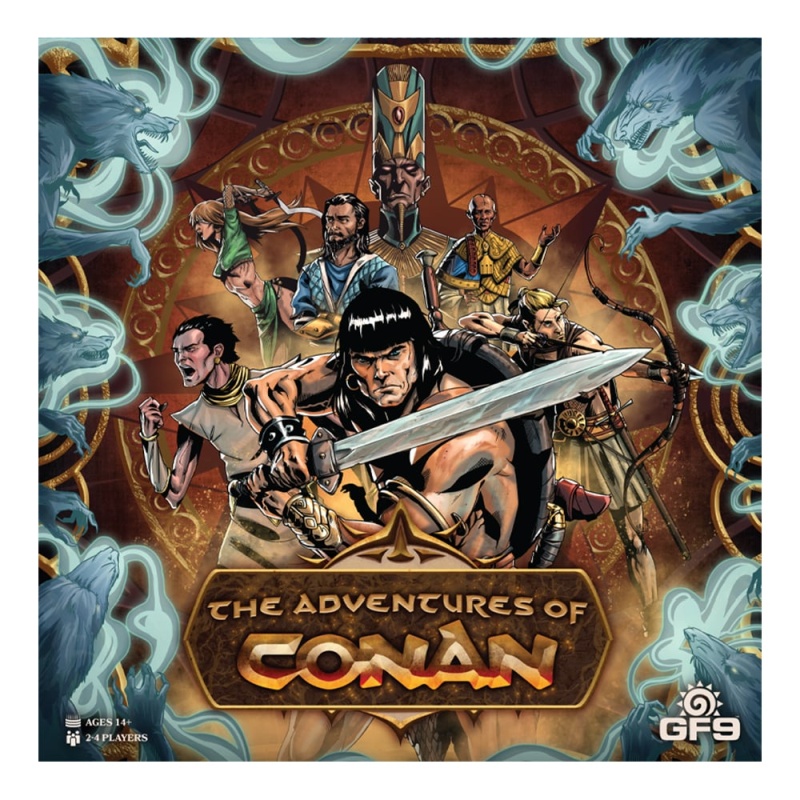
This is a game where each player has a sheet which says how they can win. The first player play as Conan. The next player chooses a foe to play, the next player chooses an ally to play and if you have a fourth player they choose another Foe to play. Each player has their own aims and objectives for the game which makes for an interesting time. Each round plays with small combats and other exciting parts of the exploring then we see if there is a bigger fight to happen between Conan and the board and maybe a second fight as well. If Conan does not loses one or both of his fights then the third player has a chance to save the day, depending on the results bonus points go out to the players and you go on to round two.
As you go through each of the rounds the game opens up and you get more and more fun from the playing of it. On your sheet for your player it tells you what you need to achieve to win the game for your character, so good luck and enjoy yourselves! This is a complex yet fun game that is not going to be every-ones cup of tea, (I recommend giving it a go) yet it if you like this sort of game then you will love the complexities that come with exploring this realm adds to your life. I would highly recommend this great game! Espeically if you enjoyed the Dark Horse Comics line of Conan titles where the characters, adventures and art are taken from.
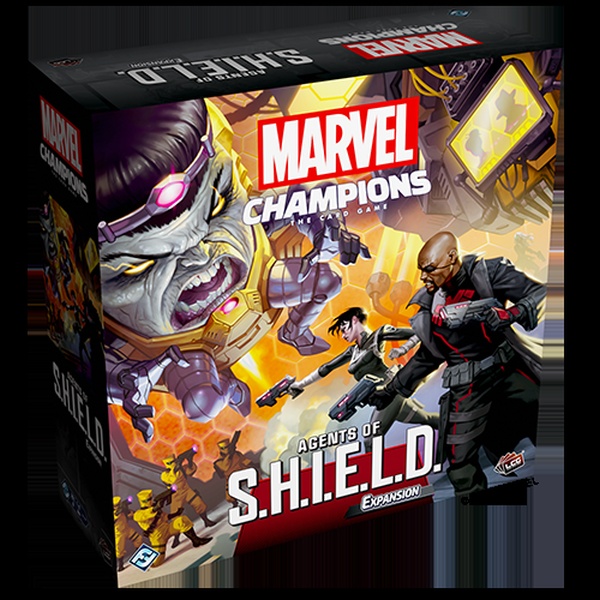
Before we look at this expansion, the first question is what does S.H.I.E.L.D. stand for? Well S.H.I.E.L.D. orginally stood for Supreme Headquarters, International Espionage and Law enforcement Division but after 1991 It stood for Strategic Hazard Intervention Espionage Logistics Directorate but in the MCU, some cartoons and the TV series it stands for Strategic Homeland Intervention, Enforcement and Logistics Division.
This Expansion comes with the super spy who is Nick Fury as well as Maria Hill who is the Director of S.H.I.E.L.D both are very powerful Allies and leaders. Nick Fury Alone is so sneaky it is worth trying out more crafty ways and see if you can undermine the enemy and win without them realising your antics.
In this multi-part scenario you are trying to rescue some Scientists who have been abducted and find the mole within S.H.I.E.L.D. The baddies begin with Black Widow and Belova but lead onto M.O.D.O.K. when you can rescue the scientists Then just as you think you are through and can return home for a rest you have to contend with the Thunderbolts, a team of Anti-Heroes led by Citizen V, whose abililties have a lot of interesting outcomes and are not just your regular minions but hard hitting villians in their own right.
The great thing is this box comes with six different modular sets featuign Thunderbolts you can use in this scenario giving this set excellent replayability. This also has the opening that future products may come with Elite Thunderbolt minions that can also qualify fdor this scenario giving more options. As for the final villian, the mole within the board, well you are just going to have to play the game to find out who that is.
This expansion will stretch your mind and make you think about how you will choose your heroes and how you will use them.Happy Gaming!
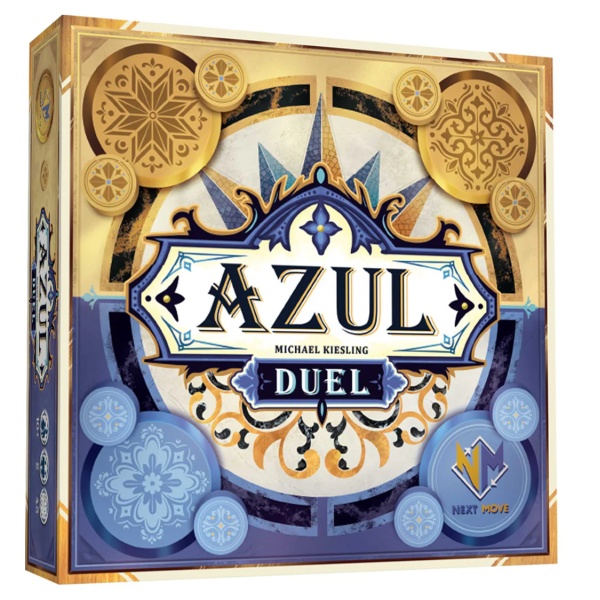
Usually when games bring out there two player version it is a more simplistic shorter version of the game. However, in this case it is a more complex version which while still being beautiful has more compexity and is a very clever game.
As well as the single tiles that you use in Azul there are packs of cards with four different tiles on each of them and when you draw one you place it on the board and then choose one from the four placed tiles, you take the choosen one and place it on the correct side of your player board and it is placed by you to gain the most points you can from the tile.
There are 75 acrlylic tiles, 2 player boards, 4 scoring markers, 4 player tokens, 20 bonus chips, 1 score board, 5 factories, 18 dome plates, 1 tower (easy to assemble) and 1 beautiful draw string bag for the acrylic tiles.
This is a great game and the complexity added just makes it that much greater and oh so much more playable as a game. I highly recomend this game if you enjoy a little more umph to your gameing experience.
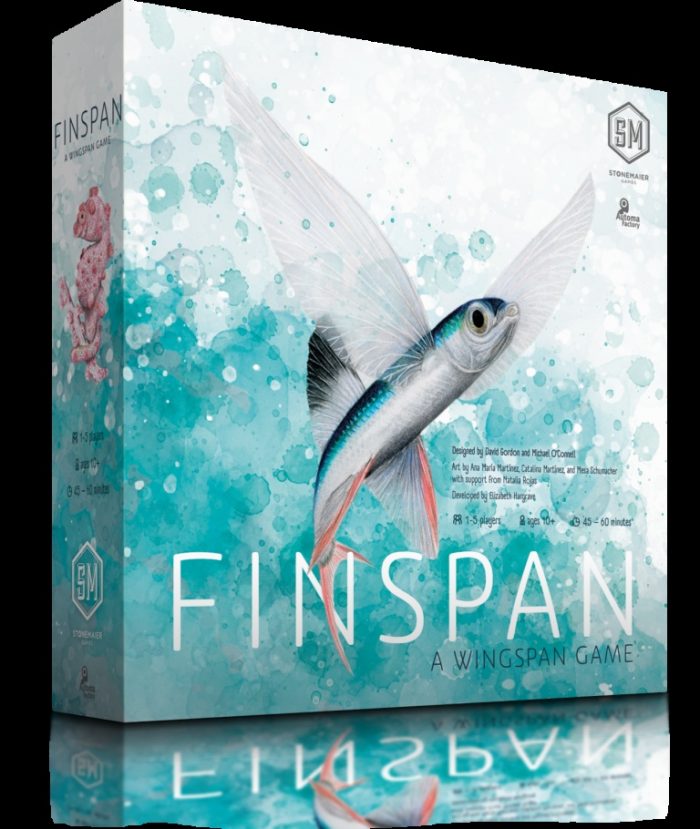
When I heard that this game was coming out I worried that it was goimg to be too similar to Wingspan and Wyrmspan, However, I needn’t have worried. as it is enough like Wingspan to learn fast how to play it, yet the game is so different once you start to play it that It feels like it is it’s own game.
I felt that the game play was more straight forward and easier than Wingspan to play. yet with the complexity of the bonuses it has a complex intricacy and beauty all of it’s own. All who played the game there with me and there was five of us in total, we all thoroughly enjoyed our game and the feel of the of it was superb.
You have to put the fish at the correct depth (there are symbols on the cards) and as you place it it has a cost of either fish, eggs or young fish on it. Also your card gives a benefit which might be as you place the card, when it gets activated, (on a dive) or at the end of the game. You can choose to dive one of three columns and gain the benefits of them with any bonuses from any of the bonus fish placed in that column.
This is a really nice game that plays well. There are exquisite pictures of the fish and it comes with cardboard discs of eggs, young fish and of schools of fish, there is a pack of wooden tokens which can be gotten to upgrade your game components, this makes a wonderful improvement.
Because we hit this stretch goal during the crowdfunding campaign, the BGDL will be sponsoring a board game design competition that will run from late April to mid July.
The goal of the contest is to give designers the opportunity to grow and improve at the process that the gaming industry follows. (And to give you a chance to be recognized and win, of course.)
When you approach a publisher about your game, the order of events is typically: pitch, sell sheet, rulebook, prototype.
So, the contest will consist of 4 rounds:
Round 1) Create and submit an elevator pitch for the best game you’re designing. The best pitches will move on to the next round.
Round 2) Create and submit a sell sheet for your game. The best sell sheets will move on to the next round.
Round 3) Create and submit a polished rulebook for your game. The best rulebooks will move on to the next round.
Round 4) Create and submit a prototype of your game. The games will be played, and winners will be decided.
1st Place–$100*
2nd Place–$75*
3rd Place–$50*
(*these numbers are subject to change)
Participants in each round will receive feedback from board game professionals on what they did well and what needs to improve.
And assuming a later stretch goal gets unlocked, all finalists will receive an automatic berth in a second BGDL sponsored design challenge we’re currently calling “BGDL Design Star” that will happen in late 2018.
Epistemic status : high confidence in the meta level slightly lower in the toy level and low in the object level
Secret information in this context means information known to one player (or party) that is NOT known by the other player (or party).
Large amount of economic behavior such as signaling can be thought of as secret information. In this context the secret information can be thought of as a skill such as ability to do math. The owner of the secret information (often known as the agent) uses this information and try’s to show the principle that they posses the quality, through costly signals. (if the signal were not costly everybody would do it therefore it would cease to be a good signal).
Secret information in board games
Board games use secret information all the time,it’s a great way for the game designer to introduce randomness while not sacrificing agency of the players. Take for example the game poker. Texas hold’em gives players 2 hole cards, these hole cards are hidden from the other players. The fact that you know that they DON’t know what your hole cards are has profound impact on gameplay. a player can see themselves as the guy who 3bet rather than as the guy with pocket aces. The secret information in this case is what I refer to as randomly assigned information. With this sort of information, the player can inform their decision to maximise the information asymetry present, and also try to deduce the information that the other players have. This deduction as one may notice from that video is about narrowing the possibility space to determine what isn’t possible. in a game like chess the possibility space of what has happened in the past is already determined. So such deduction about what previously happened is unecessary. The difference is that in a game like poker, the web of gameplay has impact on what the current game state actually is. For example, there is a big difference between starting 100BB deep, and 3 betting for 6 BB (making a total of 12BB in pot) and then betting half pot on a J46 rainbow and getting called, compared to calling a 4x raise and then potting on a J46 Rainbow and getting called, even though at the end there is the same amount of money in the pot and the same cards have shown up. The web of previous actions is connected to the web of actions after.
Utilizing Secret information (in board games)
When a player is dealt secret information that secret information should dictate their play. When playing magic a common play is to bluff attack with a 2/2 into a 4/4 with the assumption that you have Giant Growth in hand, if you do have giant growth then your opponent suffers greatly, but if you get your bluff attack called they will eat your 2/2 with no compensation. So how can a player get their 2/2’s blocked when they have giant growth but not get them blocked when they don’t? Well they can’t, but a player can employ universe assesment (blogpost to be made later) you attack in the situation where if your attack get’s blocked you were going to lose the game anyway, or you had little chance. And you non-bluff attack in the situation where you have giant growth. Notably one does NOT bluff attack in the situation where the game is slightly favorable but they will fall behind if their bluff get’s called, because in that situation the bluff value is low. Notably they aren’t “soul reading” their opponent, you are looking at the current gamestate and determining “does the value in bluffing outweigh the downsides of when bluffs get called? The answer can often be “no” but is also frequently “yes”.
It is also of note that if you are on the reciving end of a bluff attack, one should consider the state of their hand. examples of such reasoning follow
“my hand sucks, I won’t beat him if he has giant growth anyway, but if he doesn’t have giant growth then the edge I gain from blocking the bluff attack is large especially if his hand is garbage as well, then I actually may steal a win from a game that actually is even”
“my hand and deck are awesome in this spot, I can’t lose unless I make a bad block in this spot if I don’t block I lose nothing, but if I do block I could lose the game”
“My hand is ok, if his hand is the type of hand that would bluff attack, then either his hand is attrocious (and wouldn’t win anyway, he’s just making this attack to cover the spots when he has giant growth) or his hand is medium but he has a bad lategame and needs to push through a good amount of extra damage. his hand could be a giant growth hand with a useless land and a 2 drop, which I do beat if I cast my next spell but I don’t beat if I block, if he has a good hand and a giant growth I lose no matter what, so may as well ignore that possibility…”
The last example while complicated should illustrate how complex the decision making can get when you introduce uncertainty and secret information. Players use their own secret information to make the decision and base their decisions on the information they have rather as well as elimination of possible universes from the opponents possibility space.
Using secret information in real life.
In real life we can use secret information in a number of ways, we can take the same principle from board games that our actions reveal information about the information we have. Signaling in economics is when a person makes a decision that reveals information about the type of person they are. You can use signaling to show for example if you are a person with high IQ, by going to App academy or college straight out of high school.
We can also do the reverse, take signals given to us from other’s sets of information about them and use those signals to guide our behavior. The secret information of somebody’s skill as an engineer is important information to obtain. One could hunt for engineers by offering high compensation to those who are willing to take a 1 month trial run where an employer determines the employee’s productivity. Those productive engineers would be delighted to take such an opportunity, but lower quality ones would certainly consider such trial runs to not turn out well. As such only engineers above a certain caliber would even bother showing up.
In situations where competition is zero sum (or nearly so) one can use the lines of reasoning in the magic the gathering examples, go over what the other side Doesn’t have given their previous actions, and go over what you don’t have given your previous actions. Iteration over this process may help leading to understanding what is and isn’t going to happen.
Thank’s for reading my first blog post, I hope this post was useful to you, comment on my blog about what I could do better. Seriously just comment any comment at all no matter what it talks about would be extremely useful to me for future posting.
Epistemic status : high confidence in the meta level slightly lower in the toy level and low in the object level
Secret information in this context means information known to one player (or party) that is NOT known by the other player (or party).
Large amount of economic behavior such as signaling can be thought of as secret information. In this context the secret information can be thought of as a skill such as ability to do math. The owner of the secret information (often known as the agent) uses this information and try’s to show the principle that they posses the quality, through costly signals. (if the signal were not costly everybody would do it therefore it would cease to be a good signal).
Secret information in board games
Board games use secret information all the time,it’s a great way for the game designer to introduce randomness while not sacrificing agency of the players. Take for example the game poker. Texas hold’em gives players 2 hole cards, these hole cards are hidden from the other players. The fact that you know that they DON’t know what your hole cards are has profound impact on gameplay. a player can see themselves as the guy who 3bet rather than as the guy with pocket aces. The secret information in this case is what I refer to as randomly assigned information. With this sort of information, the player can inform their decision to maximise the information asymetry present, and also try to deduce the information that the other players have. This deduction as one may notice from that video is about narrowing the possibility space to determine what isn’t possible. in a game like chess the possibility space of what has happened in the past is already determined. So such deduction about what previously happened is unecessary. The difference is that in a game like poker, the web of gameplay has impact on what the current game state actually is. For example, there is a big difference between starting 100BB deep, and 3 betting for 6 BB (making a total of 12BB in pot) and then betting half pot on a J46 rainbow and getting called, compared to calling a 4x raise and then potting on a J46 Rainbow and getting called, even though at the end there is the same amount of money in the pot and the same cards have shown up. The web of previous actions is connected to the web of actions after.
Utilizing Secret information (in board games)
When a player is dealt secret information that secret information should dictate their play. When playing magic a common play is to bluff attack with a 2/2 into a 4/4 with the assumption that you have Giant Growth in hand, if you do have giant growth then your opponent suffers greatly, but if you get your bluff attack called they will eat your 2/2 with no compensation. So how can a player get their 2/2’s blocked when they have giant growth but not get them blocked when they don’t? Well they can’t, but a player can employ universe assesment (blogpost to be made later) you attack in the situation where if your attack get’s blocked you were going to lose the game anyway, or you had little chance. And you non-bluff attack in the situation where you have giant growth. Notably one does NOT bluff attack in the situation where the game is slightly favorable but they will fall behind if their bluff get’s called, because in that situation the bluff value is low. Notably they aren’t “soul reading” their opponent, you are looking at the current gamestate and determining “does the value in bluffing outweigh the downsides of when bluffs get called? The answer can often be “no” but is also frequently “yes”.
It is also of note that if you are on the reciving end of a bluff attack, one should consider the state of their hand. examples of such reasoning follow
“my hand sucks, I won’t beat him if he has giant growth anyway, but if he doesn’t have giant growth then the edge I gain from blocking the bluff attack is large especially if his hand is garbage as well, then I actually may steal a win from a game that actually is even”
“my hand and deck are awesome in this spot, I can’t lose unless I make a bad block in this spot if I don’t block I lose nothing, but if I do block I could lose the game”
“My hand is ok, if his hand is the type of hand that would bluff attack, then either his hand is attrocious (and wouldn’t win anyway, he’s just making this attack to cover the spots when he has giant growth) or his hand is medium but he has a bad lategame and needs to push through a good amount of extra damage. his hand could be a giant growth hand with a useless land and a 2 drop, which I do beat if I cast my next spell but I don’t beat if I block, if he has a good hand and a giant growth I lose no matter what, so may as well ignore that possibility…”
The last example while complicated should illustrate how complex the decision making can get when you introduce uncertainty and secret information. Players use their own secret information to make the decision and base their decisions on the information they have rather as well as elimination of possible universes from the opponents possibility space.
Using secret information in real life.
In real life we can use secret information in a number of ways, we can take the same principle from board games that our actions reveal information about the information we have. Signaling in economics is when a person makes a decision that reveals information about the type of person they are. You can use signaling to show for example if you are a person with high IQ, by going to App academy or college straight out of high school.
We can also do the reverse, take signals given to us from other’s sets of information about them and use those signals to guide our behavior. The secret information of somebody’s skill as an engineer is important information to obtain. One could hunt for engineers by offering high compensation to those who are willing to take a 1 month trial run where an employer determines the employee’s productivity. Those productive engineers would be delighted to take such an opportunity, but lower quality ones would certainly consider such trial runs to not turn out well. As such only engineers above a certain caliber would even bother showing up.
In situations where competition is zero sum (or nearly so) one can use the lines of reasoning in the magic the gathering examples, go over what the other side Doesn’t have given their previous actions, and go over what you don’t have given your previous actions. Iteration over this process may help leading to understanding what is and isn’t going to happen.
Thank’s for reading my first blog post, I hope this post was useful to you, comment on my blog about what I could do better. Seriously just comment any comment at all no matter what it talks about would be extremely useful to me for future posting.

 Anmelden